
Although the programme tells me I have just seen Wagner’s The Flying Dutchman, I’m not entirely convinced that I have. Well, the orchestra was playing Wagner, yes, and the singers were singing too, but most of the time, the music seemed to serve as little more than background noise.
Swiss director Milo Rau has taken Wagner’s The Flying Dutchman and steered him straight into some rather troubled political waters. He certainly hasn’t shied away from the elephant in the room: Wagner was an antisemite. He died long before the Nazis came along. That didn’t stop Hitler from making his music part of the Nazi cultural machinery. Today, Wagner’s is still a touchy subject in Israel, where his music has long been met with an unofficial boycott.
Rau takes Wagner’s baggage, throws it overboard and sails straight into the political minefield of Germany, Israel and Palestine. The Flying Dutchman is no longer just cursed to sail the seas for eternity – he now has an entire nation’s past weighing him down. And there’s no smooth sailing ahead.
All that’s missing is the “previously on…”
But before the opera even gets going, we have to meet the cast. During the overture, each character gets their own little introduction sequence: a video portrait, their name displayed alongside it, and a short biography explaining who they are and where they fit into Rau’s political puzzle. It feels less like the opening of a Wagner opera and more like the opening credits of a TV series, where everyone gets their moment on screen before the plot kicks in.
The Dutchman is Germany, still haunted by the ghosts of the Holocaust. Senta is Israel, while Erik represents Palestin. Daland, meanwhile, embodies the generation that founded the Israeli state.
And So the Story Begins
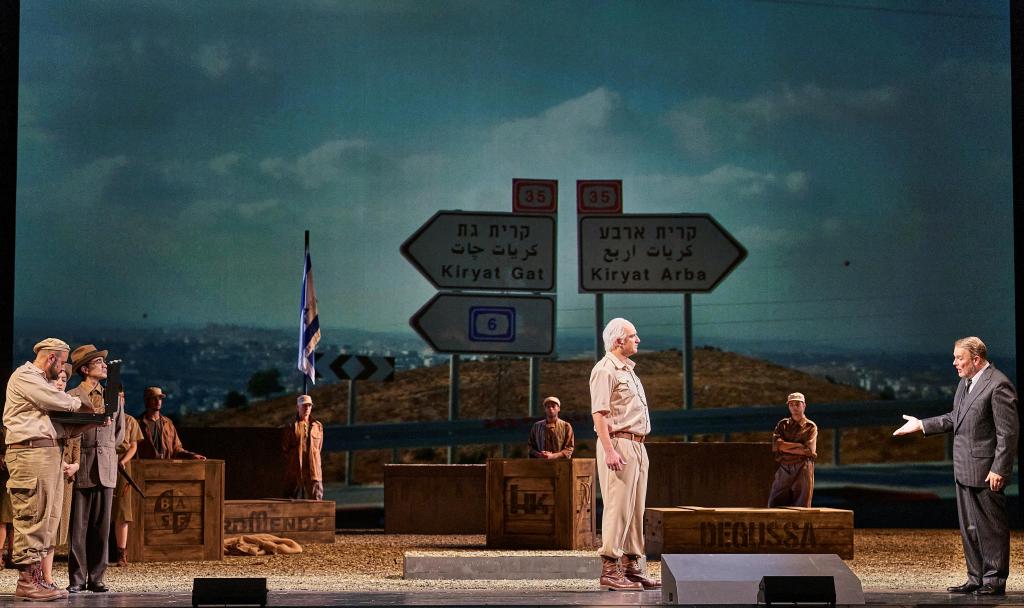
First stop: the founding of Israel. The Dutchman arrives with his fortune packed into boxes bearing the names of German industrial companies. Daland is more than happy to strike a deal, offering up his daughter Senta in return. Wagner’s good old marriage bargain has turned into a rather uncomfortable bit of political horse-trading.
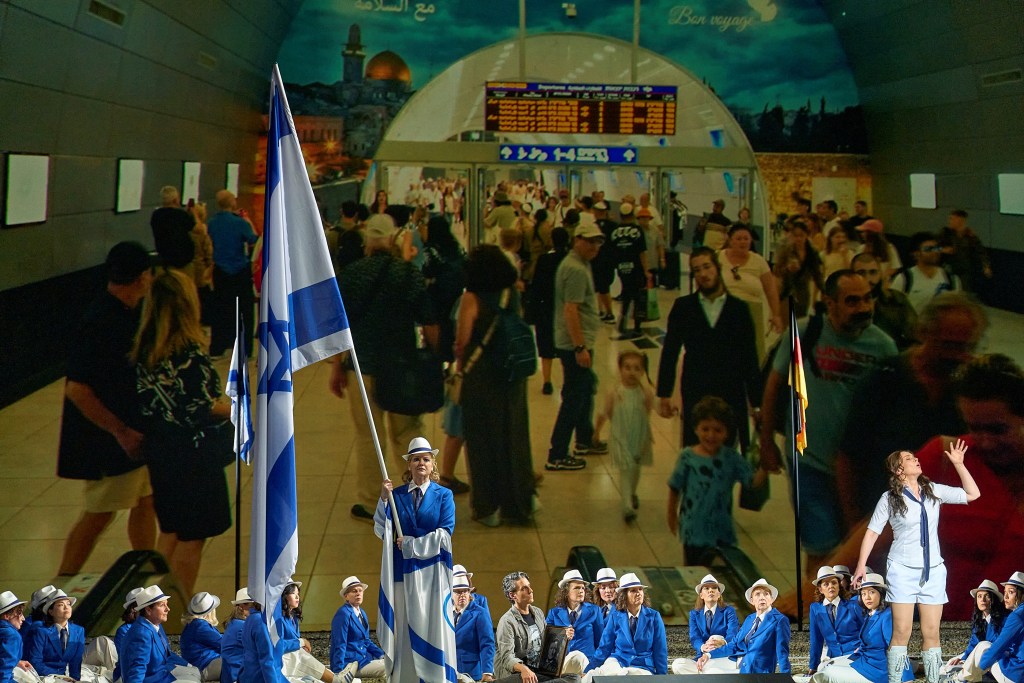
Then comes Munich, 1972. The Olympic Games, where the Israeli athletes’ story is set against the backdrop of the terrorist attack that claimed the lives of eleven members of the Israeli team. Mary takes charge, waving the Israeli flag.
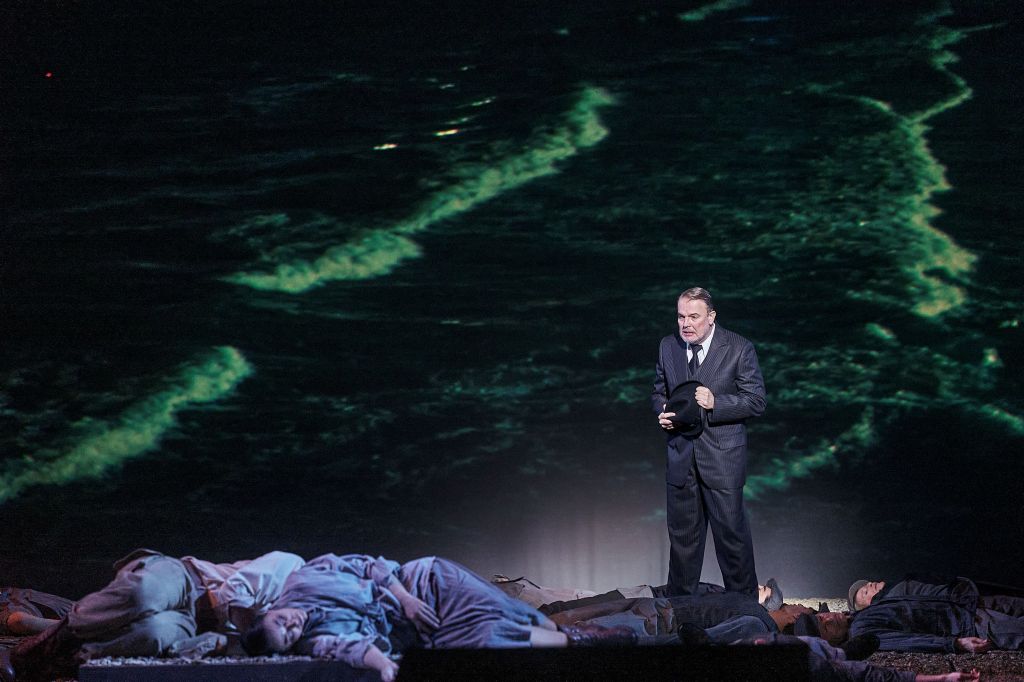
Act III takes us to the opening of Berlin’s Holocaust Memorial in 2005. The towering concrete slabs leave little room for anything else – and neither does the past. The Dutchman is condemned to wander the seas for eternity. Germany is condemned to carry its past just as long.
And as if all this wasn’t enough, there’s yet another story playing out on a giant screen at the back of the stage. Real people, real-life stories and a steady stream of text and historical facts. So we end up with three narratives competing for our attention: Wagner’s story in the music, Rau’s version on stage, and a documentary on screen.
Wagner, Where Are You?
Keeping up with all three is quite the challenge. The text on screen flashes by at such speed that you need to concentrate just to read it. Meanwhile, you’re also supposed to follow the singers’ words and, somewhere in between, remember that there’s an orchestra playing down in the pit.
The biggest problem, however, is that Wagner’s music seems to have been given remarkably little consideration. It is there, of course, but what it actually contributes to the production is anyone’s guess. At times, it feels less like an opera with a documentary running alongside it and more like a documentary that happens to have a Wagner score.
Every now and then, though, Rau gets it right. When the sailors shout “Wach doch auf!” (Wake up!) at the Dutchman’s ghostly crew, the words take on a whole new meaning against the backdrop of Berlin’s Holocaust Memorial. Perhaps it is not the dead who need waking up, but the living.
Down in the Pit
Whenever I managed to tear myself away from the stage, Lithuanian conductor Giedrė Šlekytė had my attention – though it took a while for the orchestra to warm up. The opening felt rather flat, with little of the tension and dramatic spark one might hope for in Wagner. Šlekytė generally keeps the orchestra on a tight leash, ensuring that the singers are always clearly audible, but sometimes at the expense of the music’s own dramatic force.
In the sailors’ chorus the tempo becomes almost too eager, leaving the chorus struggling to articulate the text clearly.
The Voices on Deck
I’ve heard Tomasz Konieczny sing Wagner quite a few times by now, particularly Wotan, but this was my first encounter with his Dutchman. And I must say, Rau’s rather sorrowful take on the character suits him remarkably well. There is something about his dark, richly resonant voice that lends itself beautifully to the Dutchman’s endless suffering. It reminded me of his Wotan in the final act of Die Walküre, saying goodbye to Brünnhilde: deeply intimate and full of feeling.
Tareq Nazmi makes a perfectly decent Daland, with a wide bass voice, though I found his portrayal somewhat lacking in personality. Aušrinė Stundytė’s Senta is a more complicated affair. She seems to push her voice rather hard in the upper register, while the lower notes come across with considerably more ease and warmth. At times, I almost found myself wondering whether I was listening to a mezzo-soprano.
Attilio Glaser is a pleasure as Erik. His clear, lyrical tenor, excellent diction and natural stage presence suits the performance very well.
So, technically, I saw The Flying Dutchman. The music was there, and the characters were there. But somewhere along the way, Wagner’s opera seemed to get lost at sea.
Fun Fact!
Wagner originally conceived The Flying Dutchman as a one-act opera to be performed before a ballet!
Trailer:
Cast:
- Conductоr: Giedrė Šlekytė
- Directоr: Milo Rau
- Stаge Designer: Anton Lukas
- Сostume Designer: Silvie Naunheim
- Video Designer: Moritz von Dungern
- Lightning Designer: Jürgen Kolb
- Dramaturg: Nathalie Rozanes and Johanna Danhauser
- Сhoir: Marco Medved
- Daland: Tareq Nazmi
- Senta: Aušrinė Stundytė
- Erik: Attilio Glaser
- Mary: Kai Rüütel-Pajula
- Der Steuermann: Omar Mancini
- Der Holländer: Tomasz Konieczny
- Erzähler*innen: Sarah von Schwarze and Shlomi Moto Wagner
Chor der Deutschen Oper Berlin, Orchester der Deutschen Oper Berlin
A World of Voices: Aleksi Barrière on the Making of Innocence, Interview
»But everyone’s smiling in the pictures.« says librettist Aleksi Barrière. Weddings are funny things. You spend a fortune on flowers, food and fancy outfits, only to have your tipsy aunt explain why you’re still single. In Kaija Saariaho’s opera Innocence, though, the problem is a liiittle bigger than drunk uncles and questionable speeches: a school…

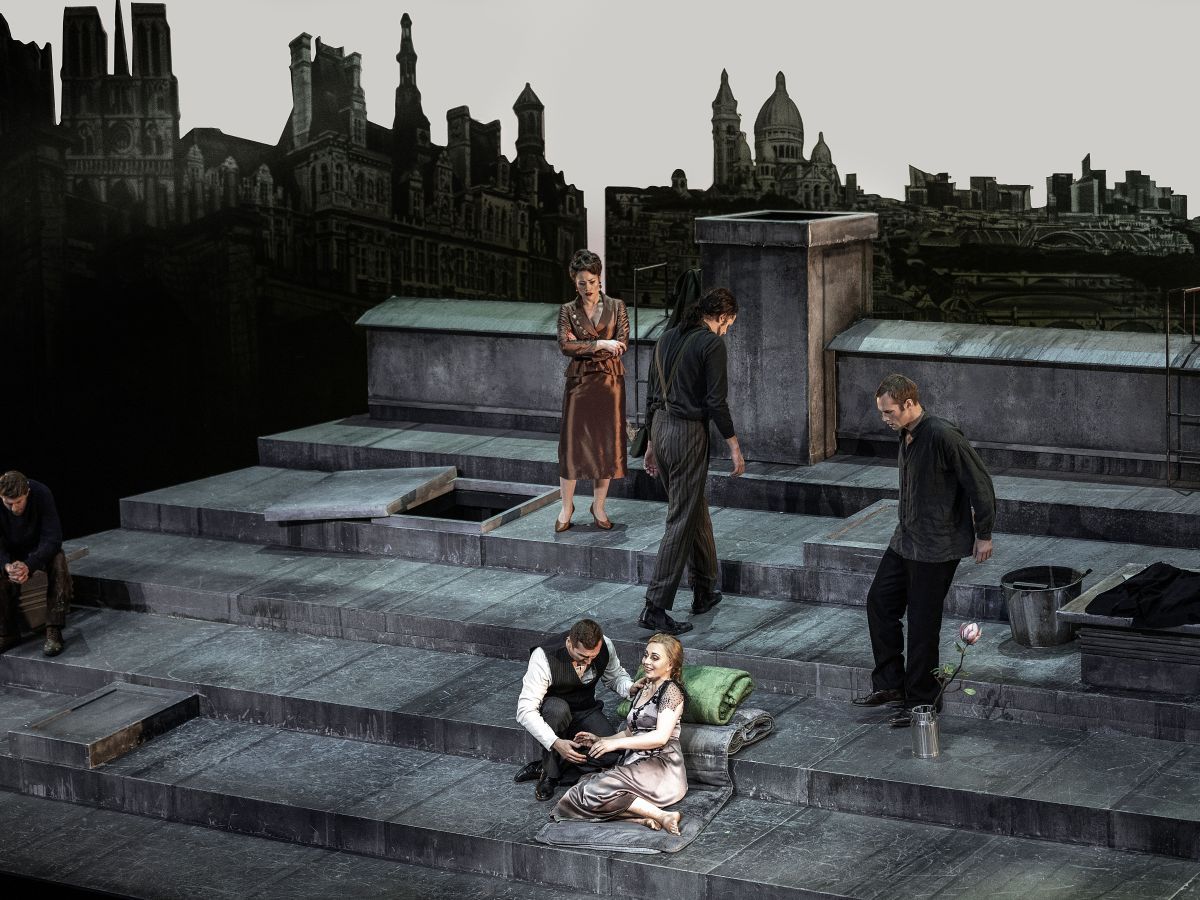
La Bohème, the Royal Danish Opera 2026
It’s freezing in Paris, the rent is due, and Rodolfo has run out of firewood. His solution? Burn his own manuscript. Act by act, his literary masterpiece (perhaps?) goes up in flames. So much for a promising literary career. It’s a tough world for a struggling artist, where even your best work might be worth…
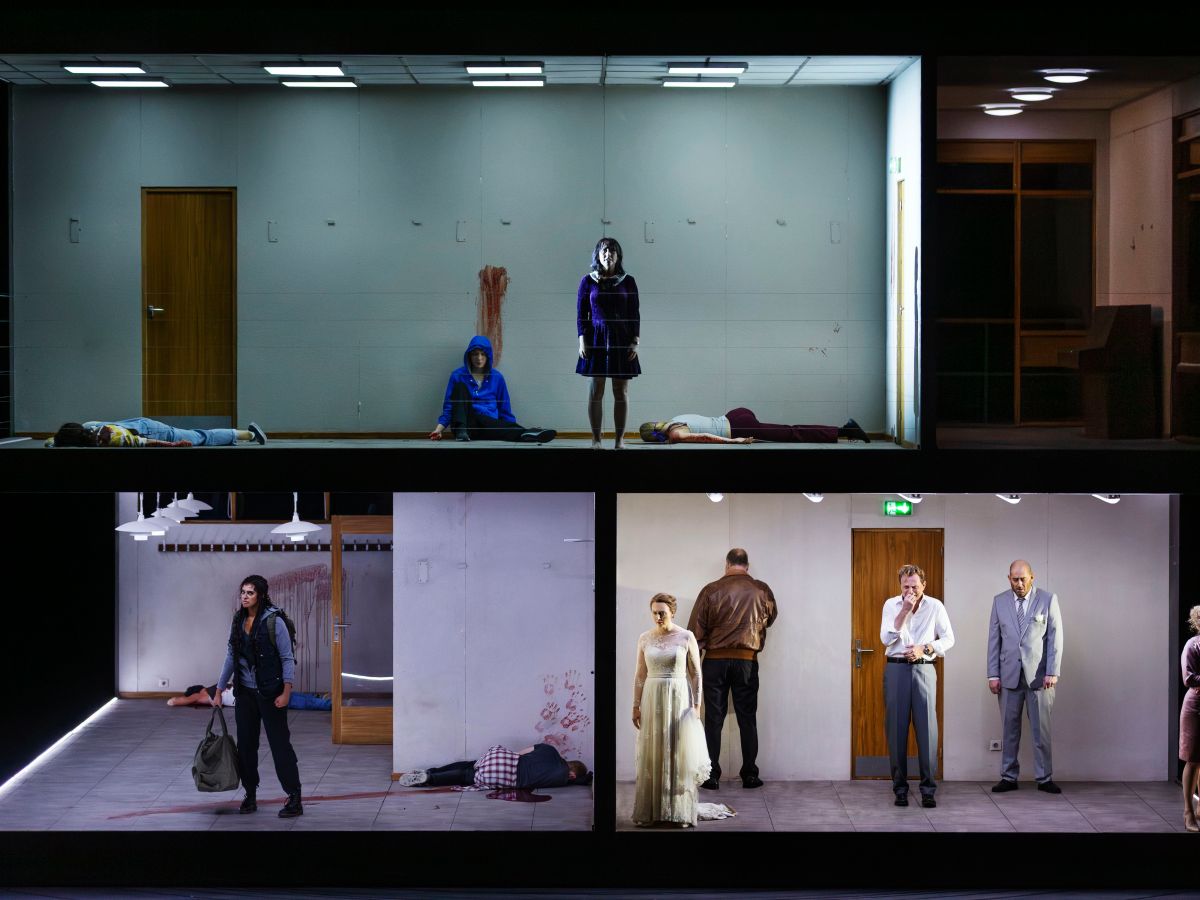
Innocence, The Royal Danish Opera 2026
Guilt is a funny thing. You don’t have to pull the trigger to be caught in the aftermath. Sometimes, simply being there – or being related to the person who did it – is enough. We like to think we’re innocent. But scratch the surface, and who knows what you might find? In Kaija Saariaho’s…

