
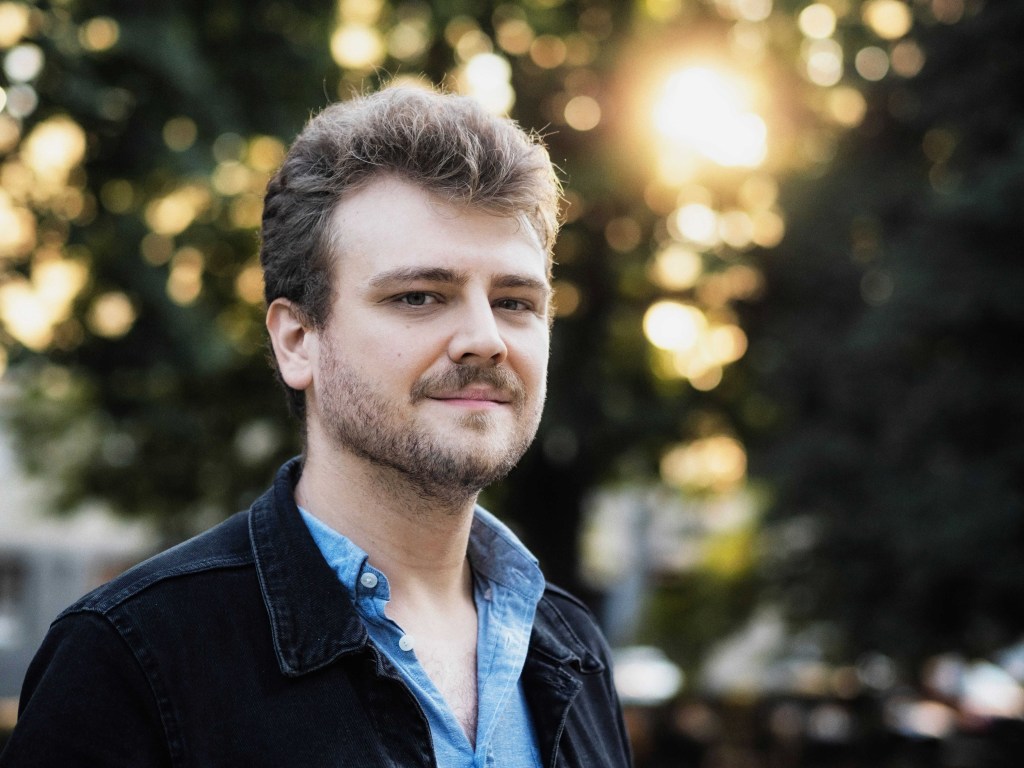
»But everyone’s smiling in the pictures.« says librettist Aleksi Barrière.
Weddings are funny things. You spend a fortune on flowers, food and fancy outfits, only to have your tipsy aunt explain why you’re still single. In Kaija Saariaho’s opera Innocence, though, the problem is a liiittle bigger than drunk uncles and questionable speeches: a school shooting ten years earlier.
Fast Facts:
- Composer: Kaija Saariaho
- Librettists: Sofi Oksanen and Aleksi Barrière
- World premiere: Festival d’Aix-en-Provence, 2021
- The cast: Thirteen people speaking (sometimes singing) nine different languages
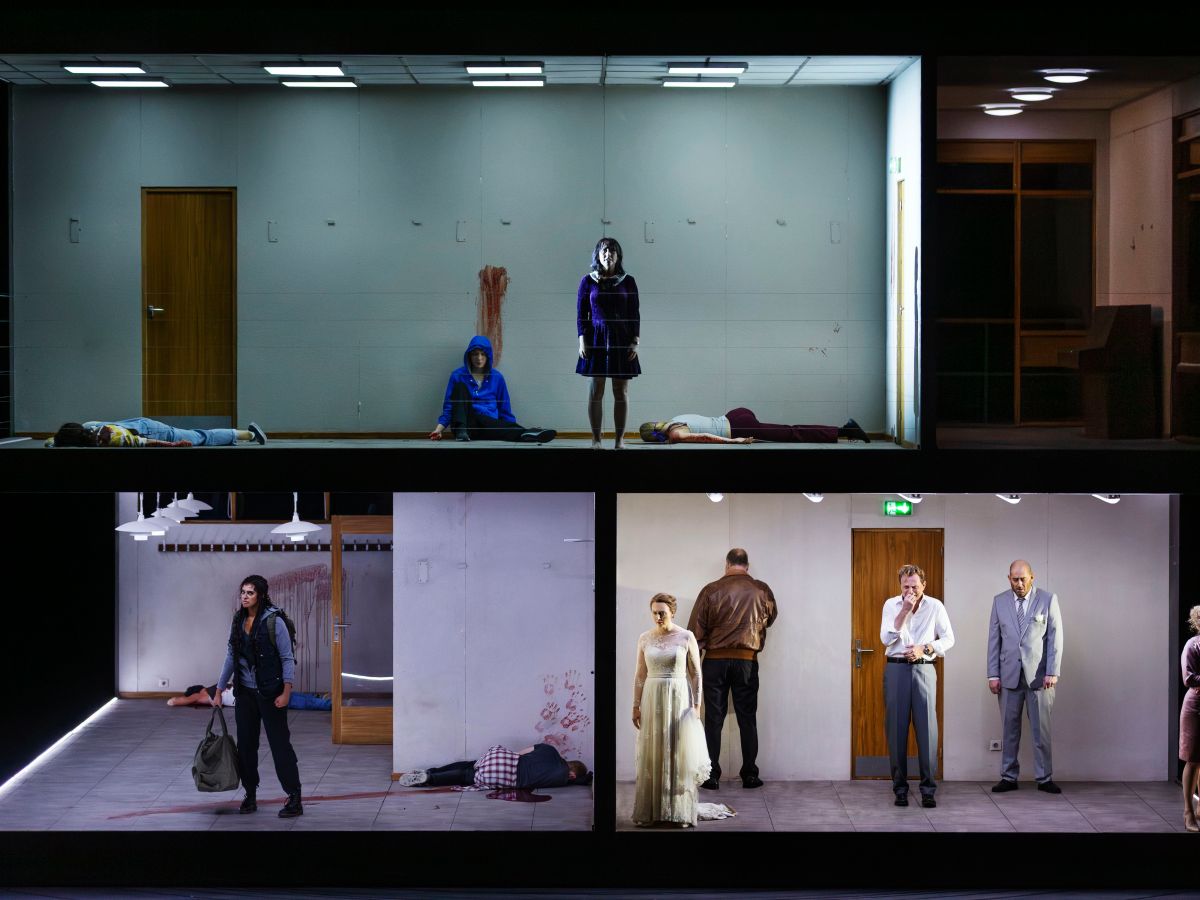
- The starting point: A wedding haunted by a school shooting that happened ten years earlier
With the premiere of Simon Stone’s production of Innocence at the Royal Danish Opera, I had the opportunity to speak with Aleksi Barrière, who developed the opera’s libretto alongside Finnish novelist Sofi Oksanen and his mother, composer Kaija Saariaho.
But before there were characters, scenes or dialogue, there was something else entirely.
»We didn’t start with the story,« he explains. »In this case, it was more like starting with an idea and an atmosphere. Kaija wanted to tell a story about a community that is dealing with one event from different points of view.«
Saariaho had an idea: a choral opera where a whole community gets to speak, but everyone has their own voice. That’s also where the nine languages come in. But figuring out what would bring all these people together took months of discussions. Eventually, the trio landed on a school shooting.
Barrière had already explored the grief of parents after such a tragedy in his 2013 staging of Mahler’s Kindertotenlieder. This helped shape the approach to Innocence: rather than showing us the violence itself, the focus would be on what comes after – the grief, the trauma and the long process of trying to heal. One thing was clear from the start: the shooting itself would never appear on stage.
»You cannot show violence on stage in an artistic context without glamorising it or playing with some kind of thrill that is a little perverse,« Barrière says.
Rather than putting the shooter at the centre of the story, Innocence turns its attention to those left in his wake: the people who must somehow piece their lives back together, make sense of the senseless, and learn to live with what cannot be undone. Because when the shooting stops, the suffering is far from over.
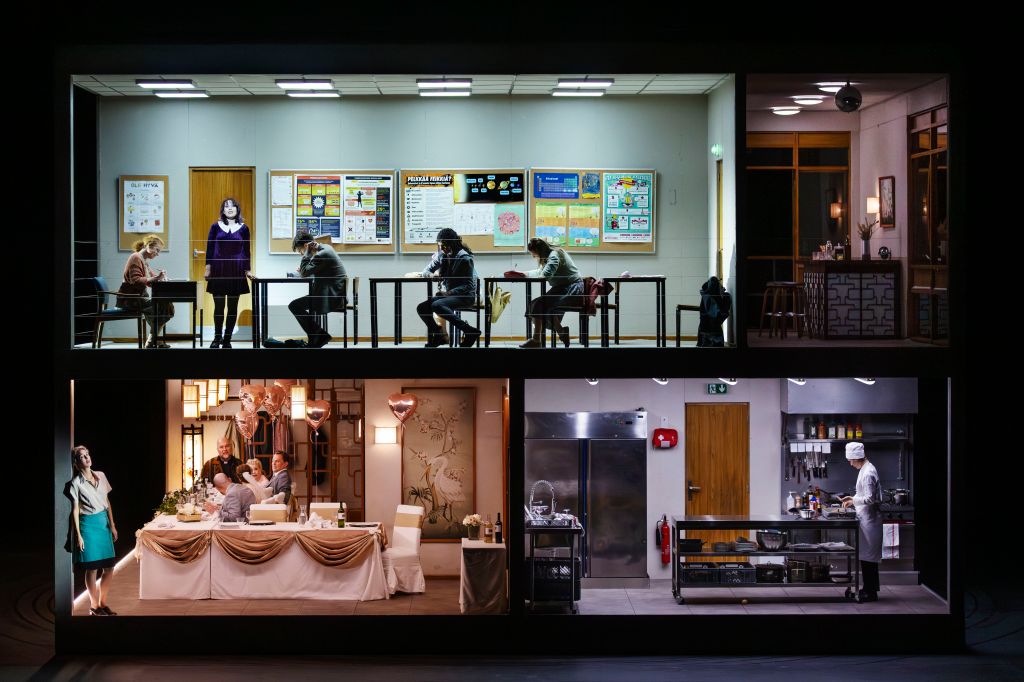
There was another important distinction: Innocence was never meant to be a thriller. As Barrière explains, Oksanen wanted to go beyond the immediate thrill of violence, while Saariaho approached the same idea through music. Rather than pumping up the audience’s adrenaline, she wanted the music to work more like a way of calming a panic attack: slowing down, breathing in and out, and making room for emotions. After all, adrenaline can put us in a kind of tunnel vision, making it harder to take in information and process what we feel. The aim was to create space for something deeper than the shock itself.
Why a Wedding?
Introducing thirteen characters can be a bit of a headache. In some operas, you barely have time to figure out who’s who before someone dies, gets married or reveals a long-lost relative. But in Innocence, Sofi Oksanen found a neat shortcut.
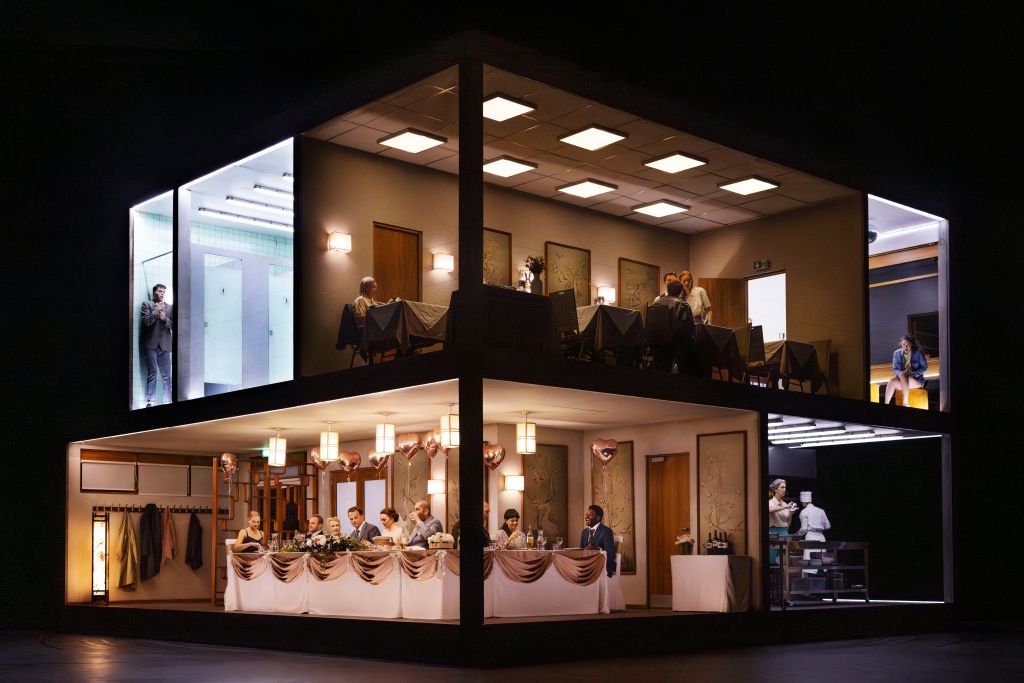
»If you have a courtroom or if you have a wedding, then you look at the image and you know immediately who is whom,« Barrière explains. »You know who’s the judge, who’s the accused, who’s the family of the accused, who’s the family of the victim.«
That leaves room for the interesting part: the story.
No Names, No Problem?
In the early stages, most of the characters were little more than sketches. Of course, there was a bride, a bridegroom and a waiter, but they had no names or clearly defined identities. Finnish made it possible to keep things open for longer. As Barrière says:
»What’s interesting about the Finnish language is that there are no genders […] there’s no he or she. So she [Oksanen] could write the first versions of the characters not knowing […] what their native language is, or even if they were men or women.«
As the characters took shape, Barrière and Oksanen initially had their doubts about how much the names would actually matter. With thirteen characters to keep track of, would the audience even remember them?
Saariaho, however, saw things differently. After all, she would spend years (three of them to be exact) composing the music, not to mention the time developing the work. For her, the characters had to be more than names on a page – they had to feel like real individuals, not, as just as, “student number four”.
Nine Languages, Thirteen voices
Barrière is critical of reducing multilingual theatre to a story about people failing to understand one another.
»I’m very annoyed when I see a multilingual piece that is only about Babel,« he says. »We didn’t want language to be just one thing because that’s not what it is.«
In Innocence, language has a more complicated role. »We wanted language to be all these things,« Barrière explains. »It’s about exclusion, it is about inclusion, it’s about communication, it’s about intimacy.« Some characters share a language that allows them to communicate privately; others remain outsiders. The waitress, for instance, never speaks Finnish and is never fully integrated into the wedding party.
The languages also became a starting point for Saariaho’s musical world. In 2016, once the multilingual text had taken shape, Barrière arranged for native speakers to record it, giving Saariaho a sound palette from which to build the orchestration. As Barrière explains: »She listened, she made transcriptions of the speech patterns. She worked with […] the sound colours of how the different languages sound. And she imagined the orchestration based on that. That’s why the Spanish is very percussive and the French is very airy because it’s a language that happens a lot in the front of the mouth. So she orchestrated it like that.«
Different instrumental colours are associated with different characters, and the orchestra shifts as the relationships between them change. Rather than presenting one unified sound, the music offers a series of perspectives – just as the story does.
»You only look at the story from one or two points of view at the same time,« Barrière says. »You never get the whole picture.« That is also why orchestra never play in tutti. »Usually there are families of instruments that are used for specific characters. And so in Kaija’s formal thinking, it’s very important that all characters meet in different combinations, because then you create different types of orchestrations based on who is interacting with whom.«
It really allows each character to stand on their own. »What you don’t want is just a chorus of victims,« Barrière says. »You want everyone to have their own identity and be there as individual persons who have their own story and their own process of healing.«
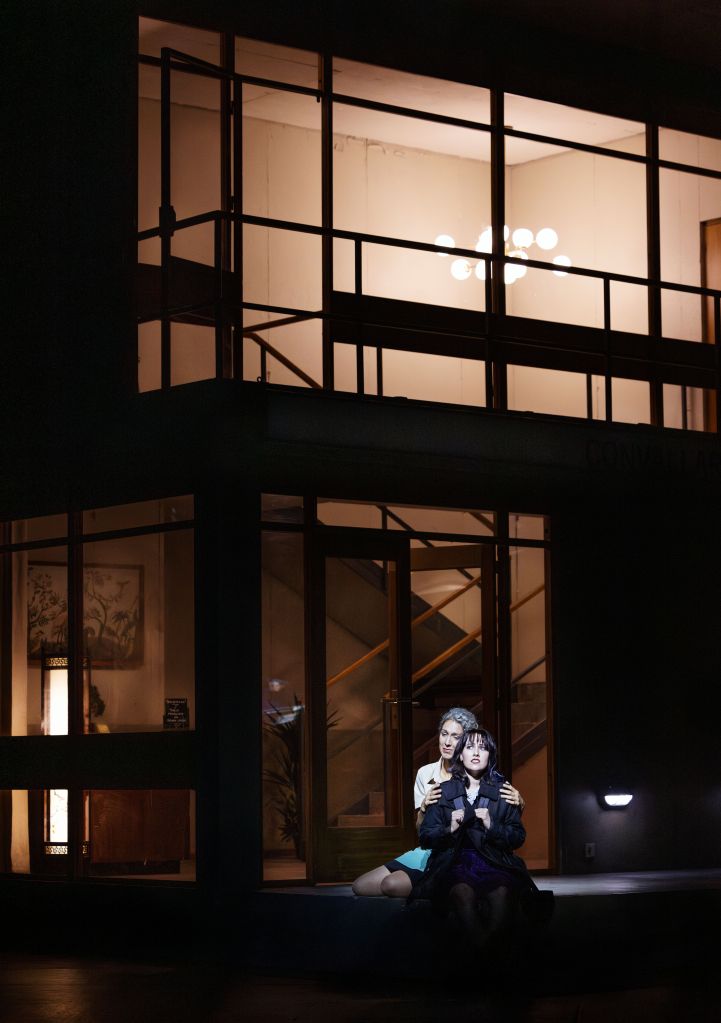
The student, Markéta, is a special case in Innocence: as Barrière points out, »she doesn’t exist anymore«. He initially imagined her singing in a natural, amplified style, somewhere between pop and jazz. Saariaho, however, associated the character with traditional folk-singing techniques from Karelia, the region her family came from, near the Russian border. The region also carried a painful history for Saariaho’s family: her father’s village, which was in Finland when he was born, is now in Russia.
The traditional singing techniques also carried personal associations for Saariaho, bringing back memories of her childhood and her grandmother’s cottage in Finland. »There is this nostalgic aspect of looking back, and thinking of a time where things were different«. Markéta is also the past. Barrière also mentions the “Mockery song”, characterised by teasing and cruelty. He saw a connection between these contrasting associations and Markéta herself: »You cannot stay with the vision of the mother that she is this perfect angel,« Barrière says. »You have to show both sides within one vocal technique. I think this was Kaija’s masterstroke.«
Beyond the Next Big Opera
Although Innocence was an exhausting undertaking, it was far from the end of Saariaho and Barrière’s collaboration. He continued directing her stage works, including the opera Only the Sound Remains. In 2022, they also created Between, a production combining Saariaho’s first music-theatre work, Study for Life (1981), with her violin concerto Graal Théâtre (1994). Barrière added an actor performing a text he had written, turning the work into a kind of double concerto for violin and actor.
Would he ever consider directing Innocence himself? »At some point, maybe it could be interesting,« he says. Having already spent so much time with the opera, it is not at the top of his priority list. But if the opportunity arose to present it as he imagines it, »I would love to do that someday.«
Their collaboration also extended to Reconnaissance, a 25-minute science-fiction madrigal for choir, percussion and double bass about the conquest of Mars. For Barrière, projects like these reveal something essential about Saariaho’s artistic legacy: even after writing six operas, she remained interested in exploring new forms rather than simply moving on to the next major work.
»Not everything has to be a big opera,« he explains. »You can combine the same elements in different ways.«
For Barrière, that willingness to keep experimenting was one of Saariaho’s greatest strengths. Even towards the end of her life, she continued searching for new artistic possibilities.
La Bohème, the Royal Danish Opera 2026
It’s freezing in Paris, the rent is due, and Rodolfo has run out of firewood. His solution? Burn his own manuscript. Act by act, his literary masterpiece (perhaps?) goes up in flames. So much for a promising literary career. It’s a tough world for a struggling artist, where even your best work might be worth…

Innocence, The Royal Danish Opera 2026
Guilt is a funny thing. You don’t have to pull the trigger to be caught in the aftermath. Sometimes, simply being there – or being related to the person who did it – is enough. We like to think we’re innocent. But scratch the surface, and who knows what you might find? In Kaija Saariaho’s…
Die Walküre, Hamburgische Staatsoper 2026
How much control do we really have over our own lives? We make decisions, change our minds, take wrong turns and tell ourselves that, ultimately, we are the ones behind the wheel. But what if the steering wheel isn’t really ours to begin with? In Claus Guth’s now 18-year-old production of Die Walküre, control is…

