
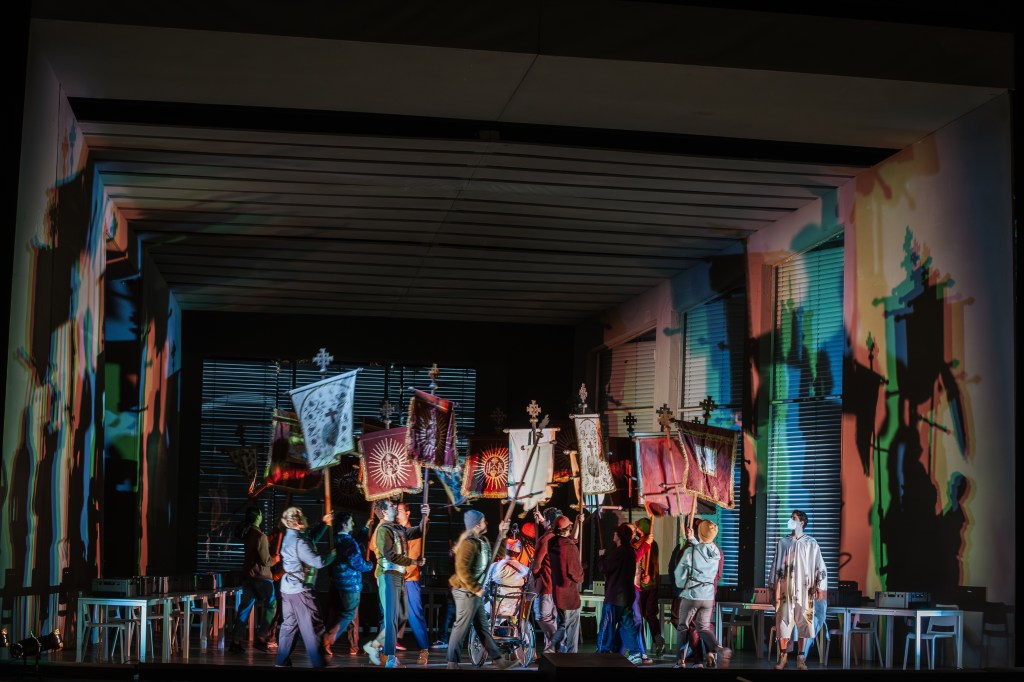
A red hookah, a guitar, water sloshing in jerry cans, Elvis hair – and Gurnemanz and his gang in puffer jackets, pairing polished shirts and ties with metal breastplates. Not exactly your standard Parsifal picture. But that’s the unholy cocktail the Hungarian director András Almási-Tóth poured into the Grail Knights’ world in his 2022 production.
A Concept with Captions
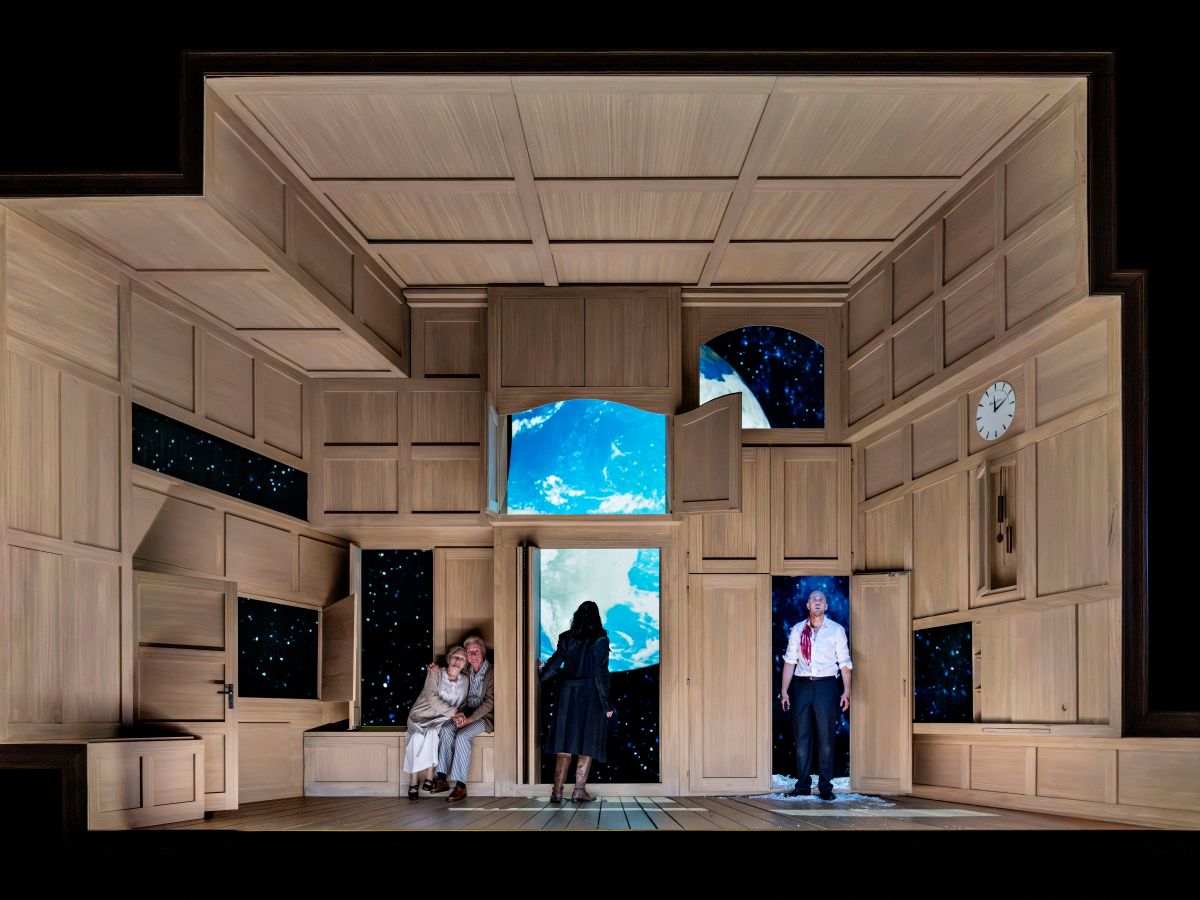
We open 30 years into the future: a homeless Gurnemanz and (his wife?) Kundry waking up side by side. Yes – apparently, in this version, they’re a couple. Parsifal is there too. Lines of text get thrown onto the back wall to spell out the concept… though later it feels like they create more chaos than clarity. Personally, I’m more of a “show it, don’t tell it” kind of person.
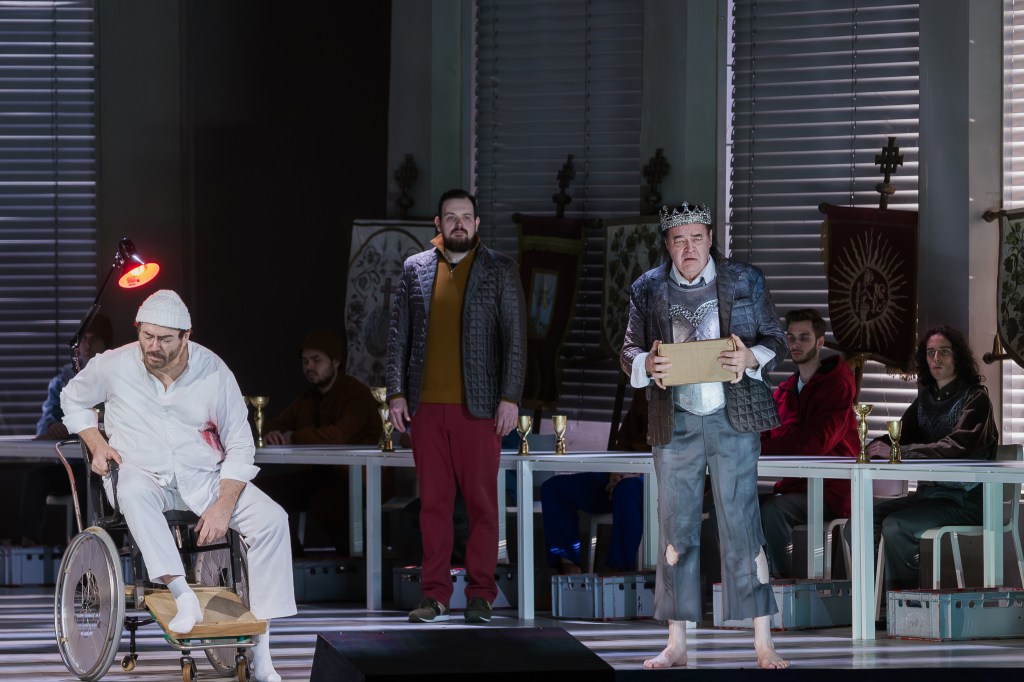
The idea is that Parsifal has failed his quest and is now stuck living with the two of them. But before you can quite settle into that, we’re flung 30 years back in time. Enter a younger Parsifal (played by an actor), while the older one hovers nearby, watching (and singing) – and trying, somewhat desperately, to rewrite what’s already happened.
Less Leitmotif, More Lost Motif
A decent idea, perhaps, but in practice, it doesn’t quite land – or rather, it lands all over the place. Things start to feel a bit strange, and by the final act you’re left wondering what’s actually going on. During the transformation music in the first act, the white walls suggest some kind of time machine, and in the Good Friday music (Act III), words come rushing past: “Mitleid,” “die Wunde,” “der Speer” – all relevant to the story, yes, but what are they doing on the wall?
We’re also jumping back and forth between different time zones. Flags that hint at the Middle Ages, costumes that feel almost futuristic, breastplates and business shirts, a spear appearing out of nowhere, Grails everywhere – and… is that Adam and Eve casually walking past? What exactly is András Almási-Tóth trying to tell us with all of this?
A Grail Of A Tenor, A Trial Of A Bass
Parsifal (spoiler) ends up rewriting his story, steering himself away from the fate we saw at the beginning. He quite literally breaks into Act II, into the scene with Kundry – which, musically, might have been the evening’s finest moment. The orchestra played with both cohesion and colour, matched by Andrea Szántó’s warm mezzo and, not least, István Kovácsházi’s take on Parsifal.
Had I not known better, I might have guessed it was Andreas Schager (Austrian tenor) on stage – at least on one of his more restrained days, with a slightly calmer vibrato and less of his “all or nothing” approach… Kovácsházi’s sound and timbre really does echo Schager’s – and that’s meant as a compliment. After all, Schager is one of the most in-demand tenors in this repertoire today.
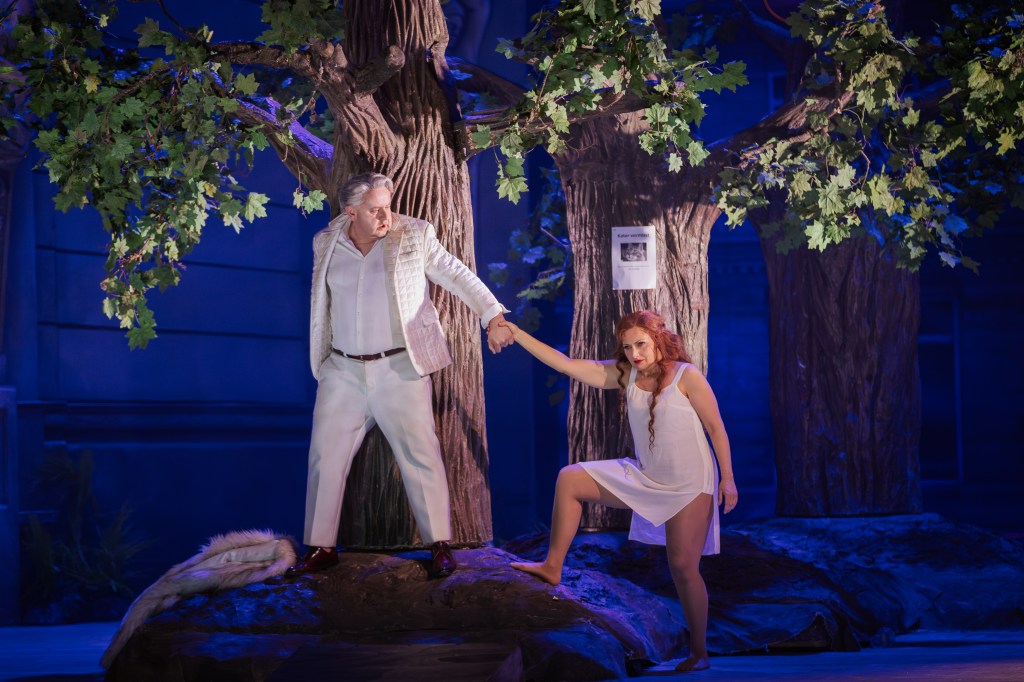
Kovácsházi’s take on Act III was particularly interesting, bringing out something new – something I hadn’t quite seen or heard before.
The evening’s biggest disappointment was the character who arguably has the most to say: Gurnemanz. It’s a massive role, demanding a bass with authority, a big voice and stamina – someone who can truly carry and command the line. Unfortunately, those are not quite the words I would use about András Palerdi.
Several times, he had to be steered back on track by the conductor – coming in too early, too late, stretching phrases or rushing ahead. At the beginning, he lingered heavily on almost every word, which drained the music of its direction and momentum.
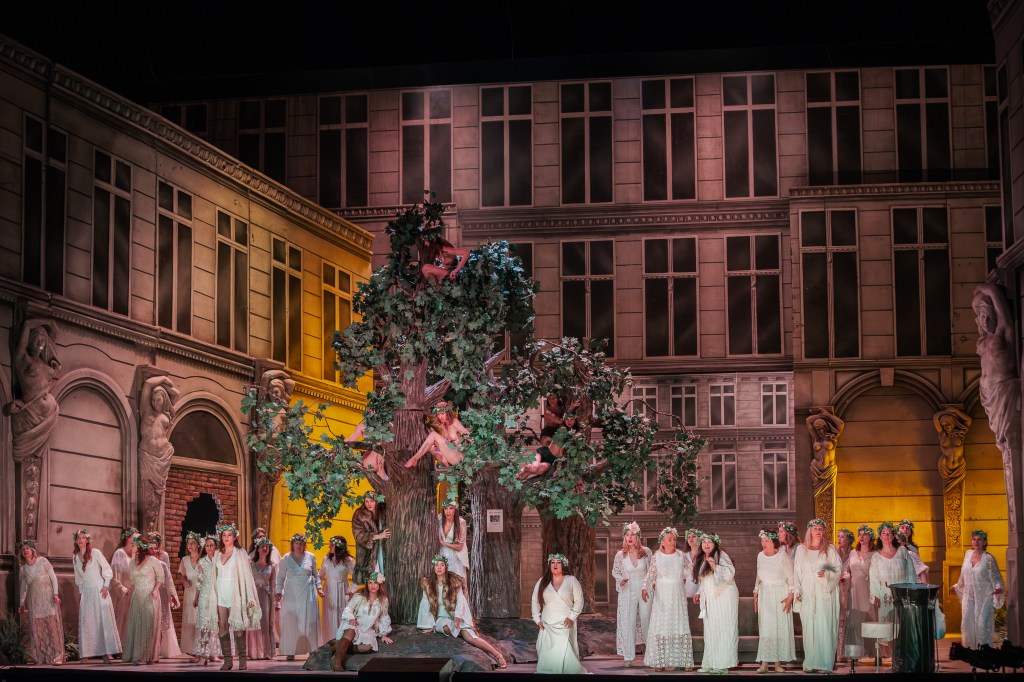
German conductor Constantin Trinks did his best to keep the troops in line – but not everything fell neatly into time. There were moments when the chorus lost its thread, drifting apart instead.
Speaking of the chorus: in Act I, the men don’t stay on stage at all, but spread through the stalls and fill the hall. It’s surround sound in full display – Grail knights coming at you every which way.
Otherwise, it’s really the orchestra that saves the evening. Parsifal is no easy score, which only makes it clearer what a fine ensemble this is. It was especially the interludes that stood out – those moments where the music could actually breathe and bloom.
And Constantin Trinks’ shaping of the Good Friday Music had a real sense of sweep and surge – gently growing, steadily glowing, and leaving you wanting more.
From Holy To Wholly Confusing
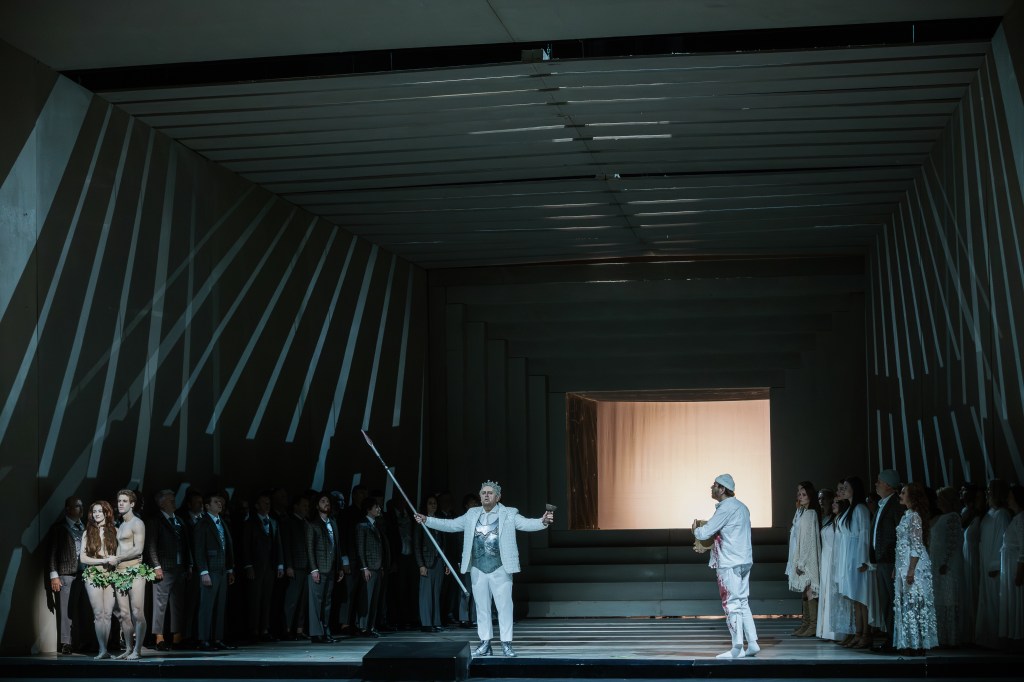
Alright – here comes the ending. Parsifal stands there like a king reborn: dressed in white (apart from the grey breastplate strapped across his chest), a crown on his head, a spear in one hand and a Grail in the other. In front of him, the knights have joined forces with Klingsor’s Flower Maidens.
So what does it all mean? That the truly sacred thing we’re left with is love?
Maybe. Or maybe András Almási-Tóth is trying to blur the line between the “pure” and the “corrupted” – suggesting that redemption doesn’t come from keeping things separate, but from letting them collide. Knights and flower maidens, Grail and temptation, past and future – all folded into one slightly chaotic, but strangely human, final image.
Fun Fact:
In Parsifal, the magical transformation scene actually took longer on stage than the music Wagner had written for it. So instead of extending it himself, Richard Wagner handed it over to Engelbert Humperdinck, who added a few extra bars.
Trailer:
Cast:
- Conductоr: Constantin Trinks
- Directоr: András Almási-Tóth
- Stаge Designer: Sebastian Hannak
- Сostume Designer: Lili Izsák
- Lighting Designer: Tamás Pillinger
- Video Designer: András Juhász
- Dramaturg: Enikő Perczel
- Choreography: Dóra Barta
- Сhoir: Gábor Csiki
- Amfortas: Kálmándy Mihály
- Titurel: Fried Péter
- Gurnemanz: Palerdi András
- Parsifal: Kovácsházi István
- Klingsor: Szemerédy Károly
- Kundry: Szántó Andrea
- 1. Gralsritter: Pál Botond
- 2. Gralsritter: Pataki Bence
- 1. Knappe: Topolánszky Laura
- 2. Knappe: Fürjes Anna Csenge
- 3. Knappe: Ujvári Gergely
- 4. Knappe: Szeleczki Artúr
- Blumenmädchen 1/1: Horti Lilla
- Blumenmädchen 1/2: Megyimórecz Ildikó
- Blumenmädchen 1/3: Sahakyan Lusine
- Blumenmädchen 2/1: Rácz Rita
- Blumenmädchen 2/2: Anija Lombard
- Blumenmädchen 2/3: Kálnay Zsófia
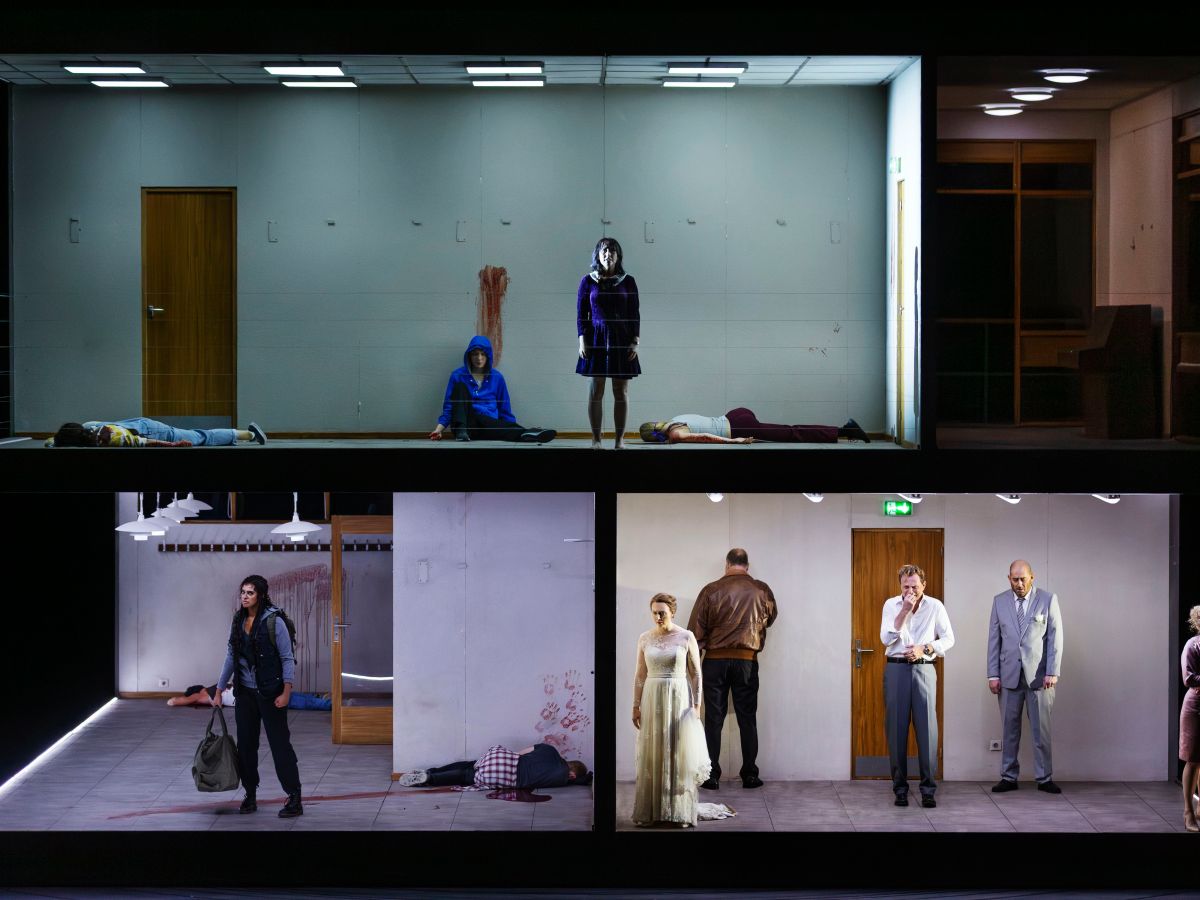
Innocence, The Royal Danish Opera 2026
Guilt is a funny thing. You don’t have to pull the trigger to be caught in the aftermath. Sometimes, simply being there – or being related to the person who did it – is enough. We like to think we’re innocent. But scratch the surface, and who knows what you might find? In Kaija Saariaho’s…

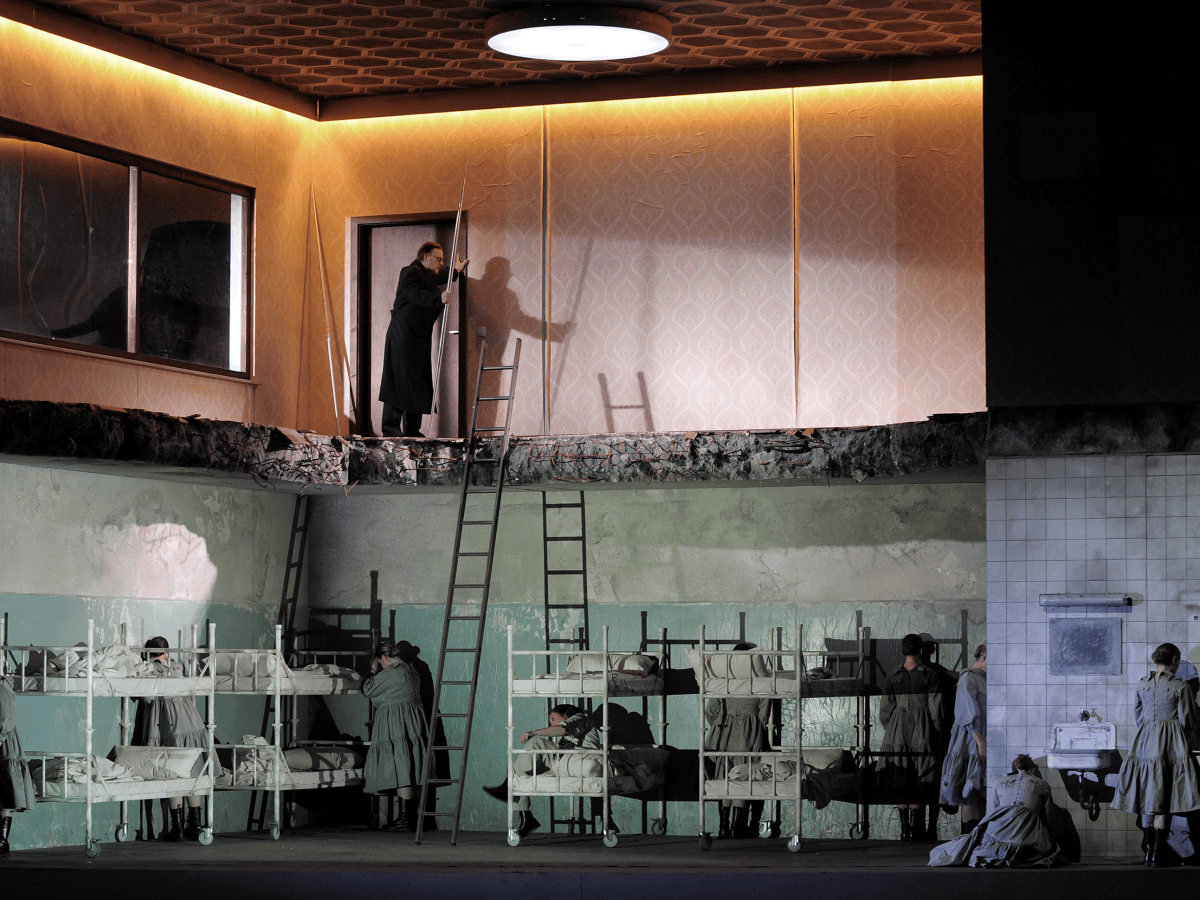
Die Walküre, Hamburgische Staatsoper 2026
How much control do we really have over our own lives? We make decisions, change our minds, take wrong turns and tell ourselves that, ultimately, we are the ones behind the wheel. But what if the steering wheel isn’t really ours to begin with? In Claus Guth’s now 18-year-old production of Die Walküre, control is…
Werther, The Royal Danish Opera 2026
Werther you like it or not, doomed love is back on the menu. Think Tristan and Isolde, but with the drama dialled down a notch. The music is a little Wagner, a little Puccini – just without the same oomph. Chief conductor Marie Jacquot keeps the orchestra on its toes, steering the whole thing with…

