
New year, new m…opera… 2026 comes in cold – on the streets and on the sheets (of music, ofc). Only 12 days ago, a brand-new opera had its worldpremiere, drawing on an old German fairy tale. This, however, sounds anything but old.
Dark woodwind murmurs. Soft strings shimmer. Brass bubbles and boils – with and without mutes. Transitions that seem to tip their hat to an older master.
We find ourselves in a forest. Dense with secret sounds and an almost excessive amount of percussion: branches creaking underfoot, something snapping somewhere in the dark, wind whispering through the trees, and all those noises you’re never quite sure what they are. This is the soundscape Peter has to find his way through.
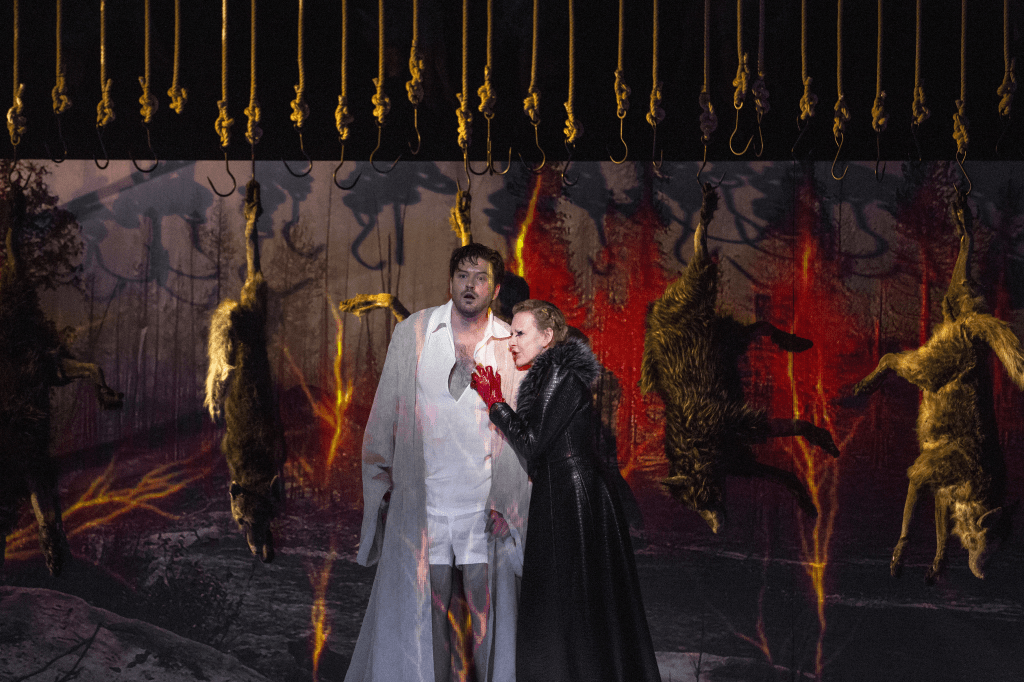
Photo: Bernd Uhlig.
Peter barely leaves the stage. Whether the drama unfolds in his mind or in reality remains unclear, but his struggle refuses to disappear. Azaël wants his heart. Ah, yes, opera and love: Passion. Desire. Big feelings… well, no. Not this time. This is meant quite literally. She wants his flesh. His beating muscle inside his chest. A sacrifice demanded by the gods, no less.
Peter was born on a Sunday and carries a special mark. He’s the chosen one. It has to be his heart. Once it’s taken, though, he’s not completely hollow inside. Or… well, he is, but the heart gets swapped for a stone and placed in a transparent glass (slightly reminiscent of Frédéric Chopin’s heart, preserved in cognac, sealed in a crystal urn, and shipped off to Poland. A completely random association. Probably no connection. You’re welcome!).
When Peter’s heart is taken, his feelings go with it. He lives, but is dead – his words, not mine. Then the orchestra goes quiet. Completely. Just Peter, his voice, and his thoughts for a few minutes. Peter, alone in the world. Proof that music isn’t the only thing that knows how to talk – silence does too.
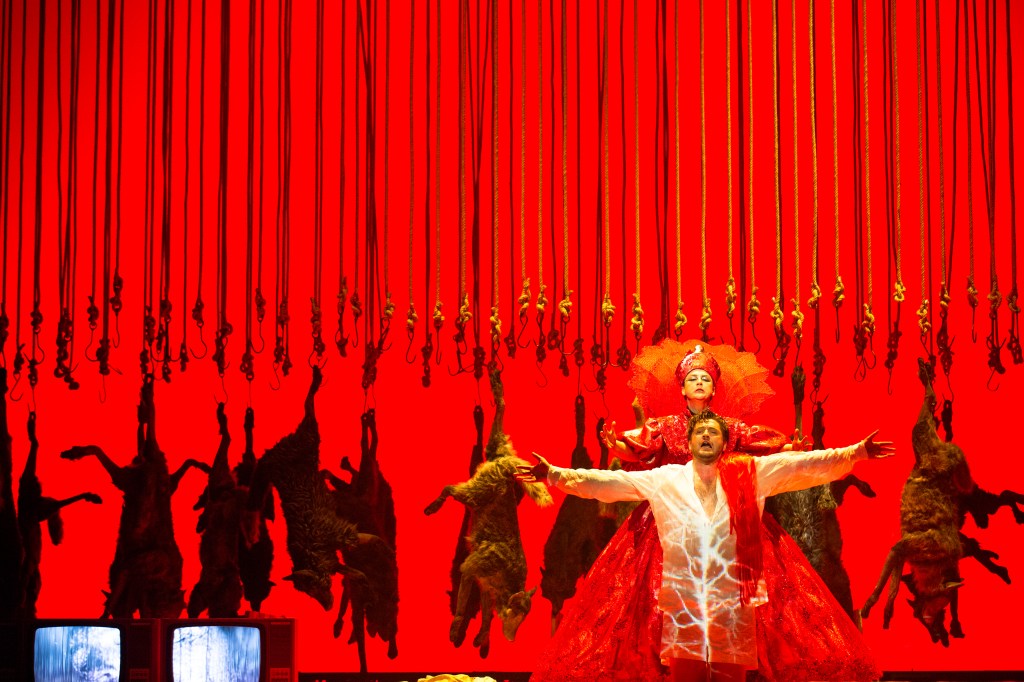
Photo: Bernd Uhlig.
Azaël is evil. But not in the usual operatic way. How does an evil person sound? They speak. Boo! Normally, the villain comes with a dark, booming voice. Matthias Pintscher, however, takes a different (though interesting) route.
Oh, right – the composer! Matthias Pintscher. German conductor and composer, currently living his best life somewhere in his fifties. On stage, he’s the one waving his arms; on paper, the one behind every charm. Das kalte Herz is his fourth opera. It’s sung in German (which feels like the only reasonable choice once you decide to call it Das kalte Herz (The Cold Heart)).
Knock, knock…
The drama lasts one hour and fifty minutes – no interval. By now, this is starting to feel like the new standard (Innocence, Written on Skin, Orest…). Maybe we can thank Richard Strauss for this – Salome and Elektra certainly showed us the way. Or… perhaps it’s the electronic devices glued to our hands and brains, quietly shortening our attention spans one swipe at a time. Possibly both. Either way, it’s still shorter than Wagner.
But Wagner still finds a way in – if not knocking on the door, then stepping on a branch. With the very first sound from the strings, Die Walküre is already hovering nearby. And that way of stitching scenes together? For example, letting a bass clarinet linger on its own before sliding into something else feels unmistakably like the sorcerer of Bayreuth.
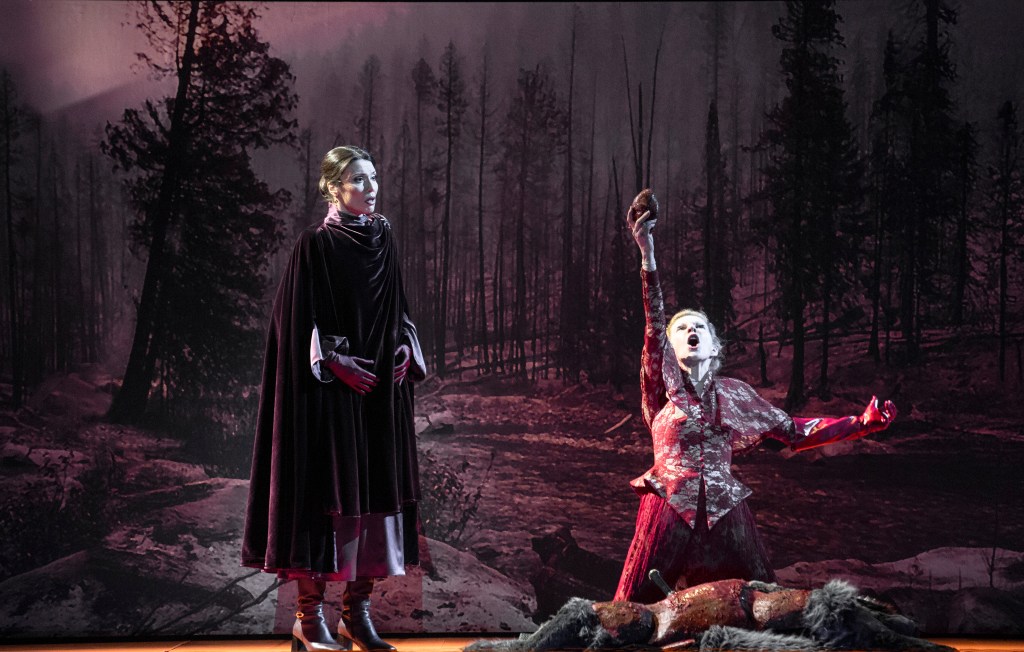
Photo: Bernd Uhlig.
There aren’t melodies to grab onto
This is all about sound. Timbre. Texture, colour and atmosphere. It can feel a little long – unless you give in, let it go (as Elsa would say), and just breathe inside the forest Pintscher projects around us.
If we look at the orchestra, we could go a little deeper. Or maybe not – because it’s already down there. Right at the bottom. Deep inside the forest’s deepest deep. Deep as both verb and noun. Same word, different job.
Lichtes Licht. Zeichnen meine Zeichen. This kind of wordplay keeps popping up. A trick clearly enjoyed by librettist Daniel Arkadij Gerzenberg. He also seems to know his Wagner. Otherwise, Peter just casually turns into a Grail knight, quoting “Nie sollst du mich befragen, noch Wissens Sorge tragen.” No warning, no explanation, just Lohengrin passing through.
Unfortunately, these literary winks are among the few moments where the text really comes alive. The language leans old-fashioned, but often stops short of actually saying much. The action isn’t always clear, and even knowing Wilhelm Hauff’s fairy tale by heart doesn’t help all that much. The opera borrows motifs from the story, then quietly wanders off and becomes something else entirely.
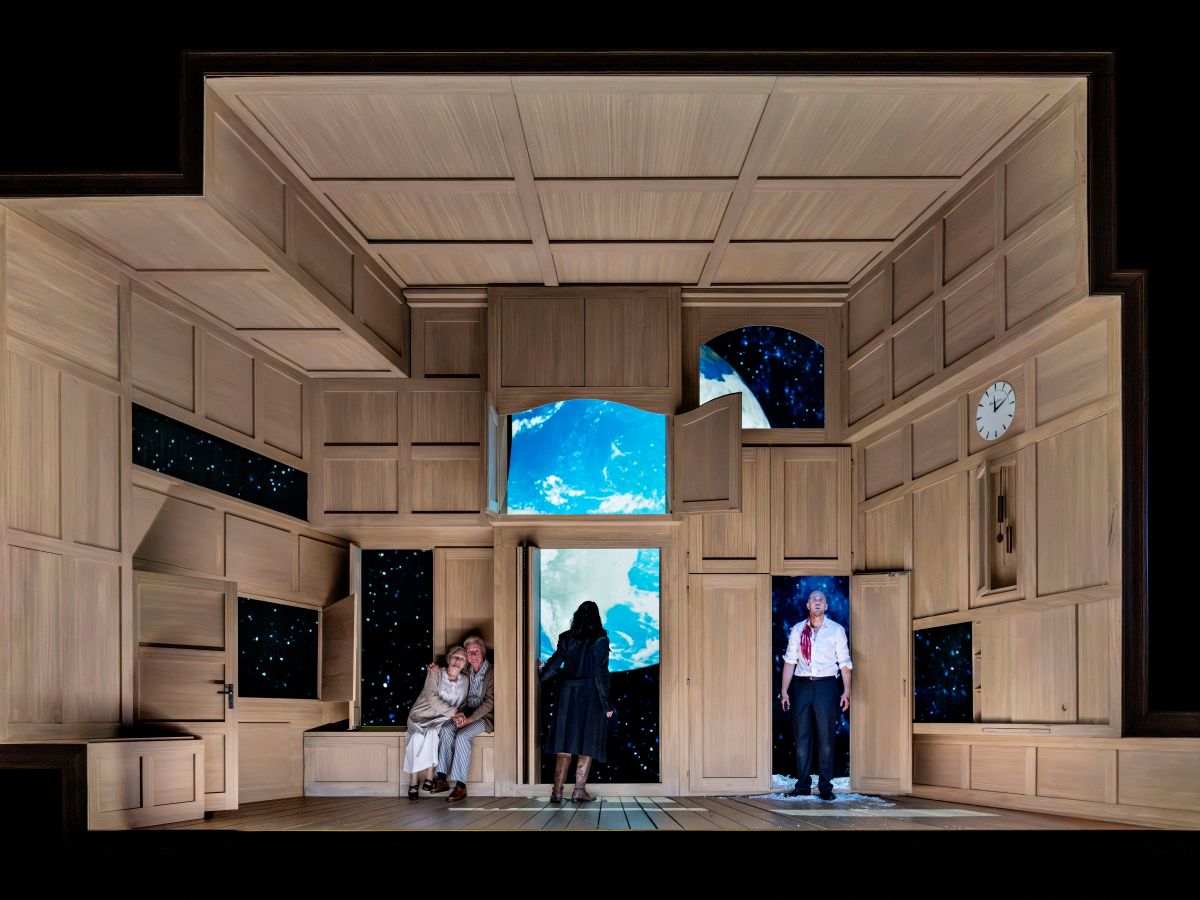
The stage isn’t exactly more entertaining to look at
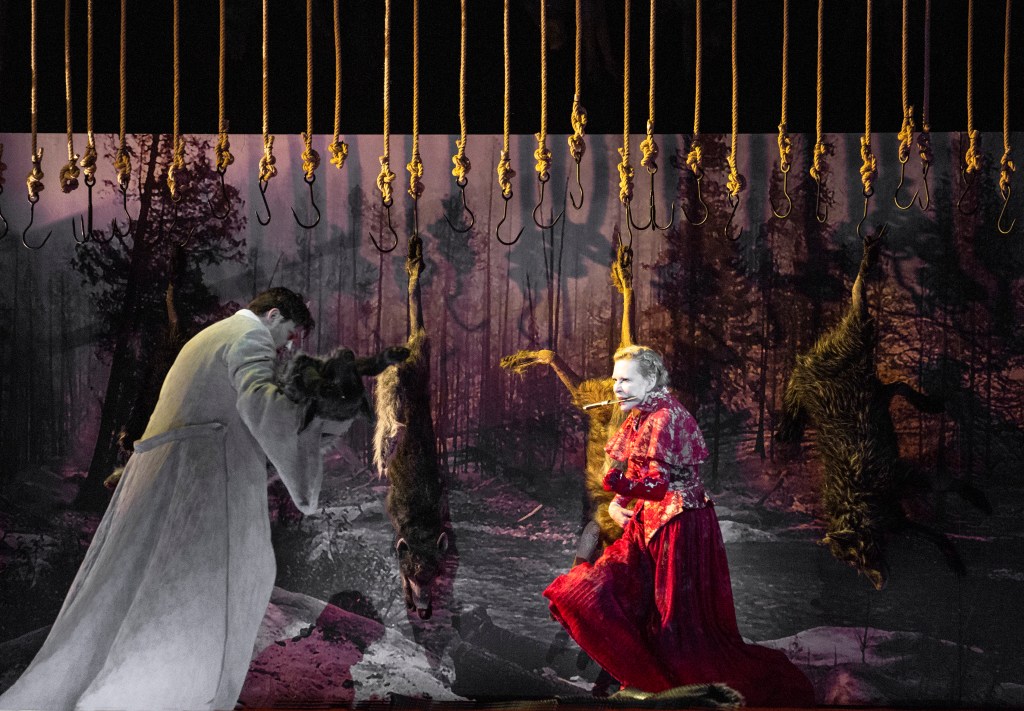
At first, there’s a low wall showing a forest – its temperature entirely dictated by the lighting.
Above the wall, there’s a whole forest of ropes. After a while, they start moving upwards. Suddenly, dead wolves are hanging, heavy and still, like a cow at the butcher’s.
The forest backdrop slowly retreats, further and further away, until it finally collapses – sending a blast of wind and cold air straight into the auditorium.
It could almost have been a concert performance for all I got from the staging. I didn’t exactly leave with a lot of visual souvenirs.
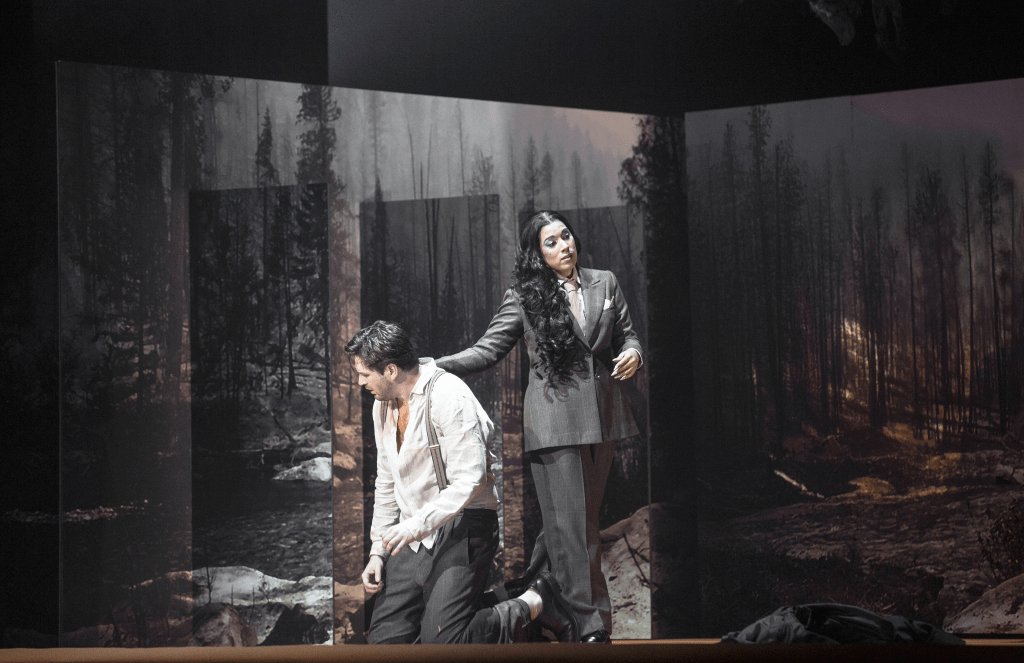
Photo: Bernd Uhlig.
Cold, Cold Heart
Thankfully, there was plenty to grab onto in Peter. Or rather, Samuel Hasselhorn, as he’s called once he steps offstage. A relatively young baritone from Göttingen (Germany) who more or less took charge of the evening.
And no. Not just because he is the main character and therefore carries the drama around with him, but because of that voice. Precise. Clear. Warm (even with a cold heart). A richly coloured sound that may or may not have melted a few hearts in the audience… Okay, that might be laying it on a bit thick. But he really did sing incredibly well (I’m already looking forward to hearing him in Brahms’ Requiem in less than 12 hours!).
Now What?
As the final note runs out, there’s a moment of collective hesitation. Hands hover somewhere between laps and applause. In the score, something like morendo is written, and the sound really does fade – but the curtain descends so slowly that the silence stretches and thickens.
It’s actually quite pleasant. A pause long enough to taste what’s just been served, to let it sit for a second. People stay still. No one wants to be the first to break it.
Except… Peter is still standing there, in front of the curtain. The lights don’t go out. Nothing clearly signals: this is the end. Leaving the question hanging in the air: so… is this it? Are we done? Or is there more coming?
Dramatically speaking, it doesn’t quite go: snip snap snout, this tale is out. It just… stops. A few seconds of awkward silence later, someone starts clapping, the rest follow, and we all go home.
Fun Fact!
Matthias Pintscher studied composition with Giselher Klebe and Manfred Trojahn, and at one point had Hans Werner Henze as a mentor. He also studied conducting with Pierre Boulez and Peter Eötvös.
Did Someone Say Brezel?
It suddenly dawned on me that I’ve never talked about the brezels at Staatsoper Unter den Linden. A huge mistake!

If you’ve read my previous posts, you’ll know that I like to keep an eye on whether opera houses can produce anything other than what’s happening on stage (important, yes…).
There is, after all, nothing quite like a brezel between the acts. Today’s brezel experience happened before the performance, since there was no interval – but the principle remains.
Big. Fluffy. Smooth as a baby’s bottom. The dough itself? Actually quite nice. Buuuut it does get a little sad when nothing is happening on the surface. By which I mean: salt. Where is it? Hellooo?
So yes, if you feel like dedicating a chunk of your evening to standing in the several-metre-long queue in the Apollosaal, go for it. Personally, I think I’ll save my focus – and patience – for whatever’s happening inside the auditorium next door;)
Trailer:
Cast:
- Conductor and composer: Matthias Pintscher
- Director: James Darrah Black
- Assistant director: José Darío Innella, Leander Teßmer
- Set Design: Adam Rigg
- Costumes: Molly Irelan
- Light: Yi Zhao
- Video: Hana S. Kim
- Co-Regie: Anderson Nunnelley
- Dramaturgy: Olaf A. Schmitt
- Peter: Samuel Hasselhorn
- Mutter: Katarina Bradić
- Anubis: Rosie Aldridge
- Clara: Sophia Burgos
- Azaël: Sunnyi Melles
- Alte Frau: Adriane Queiroz
- Kind: Solist des Kinderchors der Staatsoper
Staatskapelle Berlin
- Innocence, The Royal Danish Opera 2026
- Die Walküre, Hamburgische Staatsoper 2026
- Werther, The Royal Danish Opera 2026
- Macbeth, Royal Danish Opera 2026
- Tosca, Opera Hedeland 2026
Innocence, The Royal Danish Opera 2026
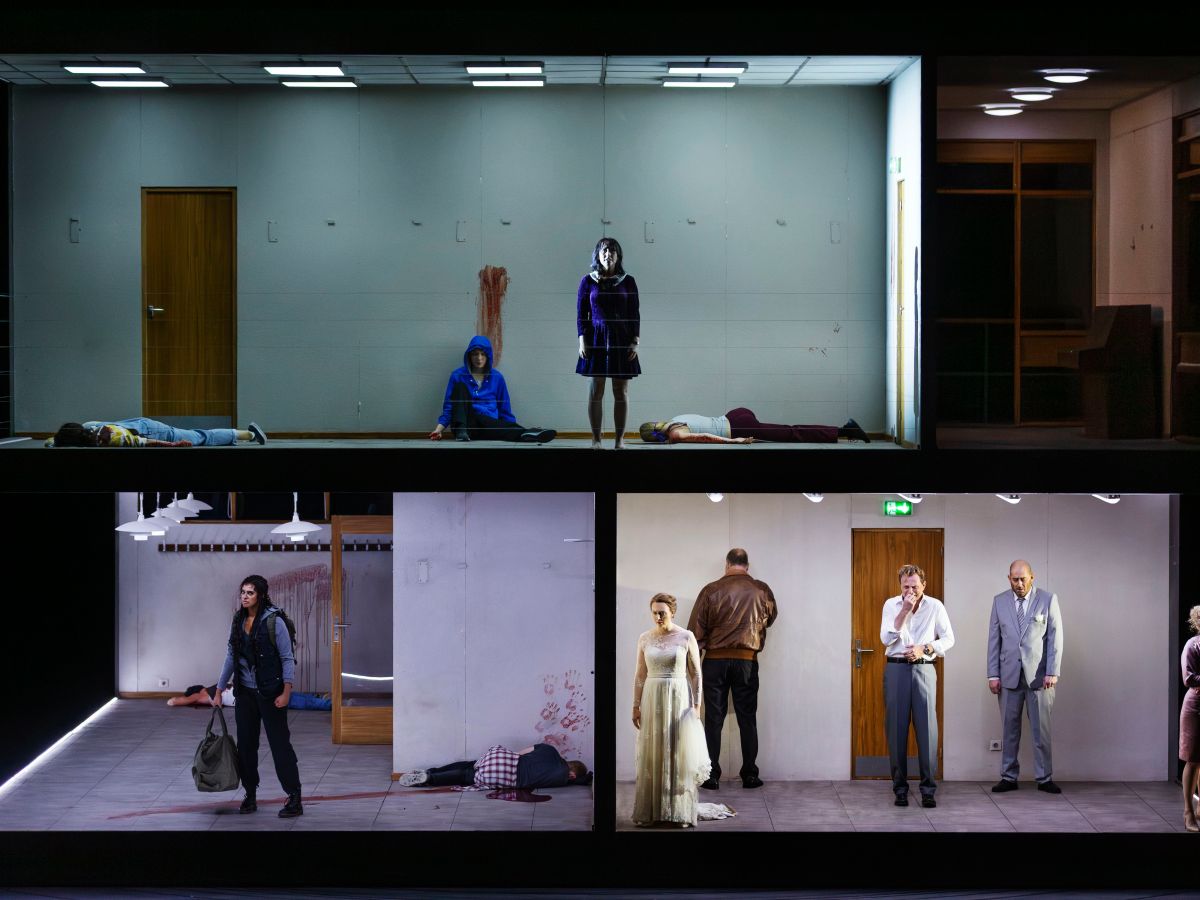
Guilt is a funny thing. You don’t have to pull the trigger to be caught in the aftermath. Sometimes, simply being there – or being related to the person who did it – is enough. We like to think we’re innocent. But scratch the surface, and who knows what you might find? In Kaija Saariaho’s…

Die Walküre, Hamburgische Staatsoper 2026
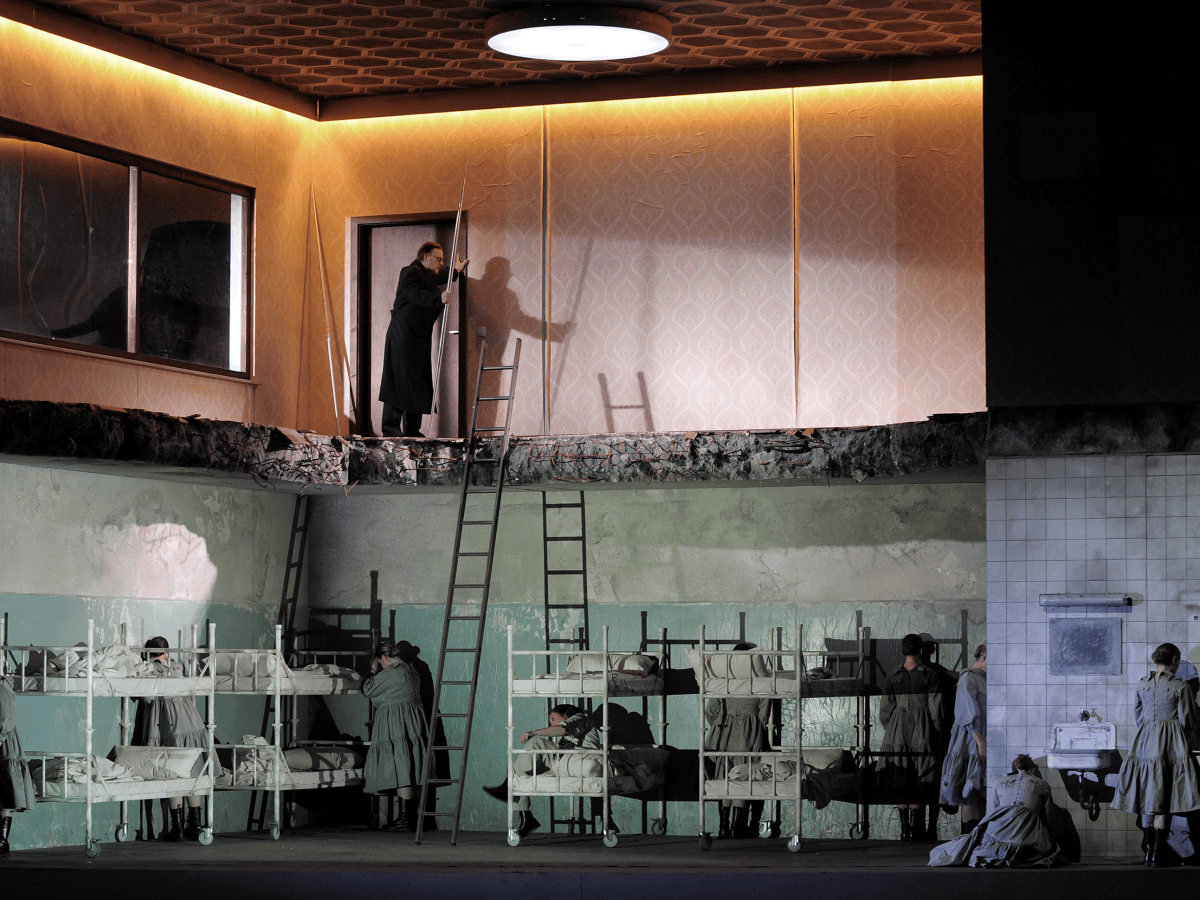
How much control do we really have over our own lives? We make decisions, change our minds, take wrong turns and tell ourselves that, ultimately, we are the ones behind the wheel. But what if the steering wheel isn’t really ours to begin with? In Claus Guth’s now 18-year-old production of Die Walküre, control is…
Werther, The Royal Danish Opera 2026
Werther you like it or not, doomed love is back on the menu. Think Tristan and Isolde, but with the drama dialled down a notch. The music is a little Wagner, a little Puccini – just without the same oomph. Chief conductor Marie Jacquot keeps the orchestra on its toes, steering the whole thing with…

