
Dear Diary, Siegfried is finally here.
Step one: melt down some sword scraps. Step two: stab a dragon. Step three: chat with a forest bird. Step four: wake up a sleeping woman surrounded by flames. That’s usually the to-do list. Then Tcherniakov takes the tale, tosses it, and tries again.
Btw, if you forgot what happened on day one (Rheingold), you can peek here. And if day two with Walküre is already a blur, this link might make it reoccur.
The Concept
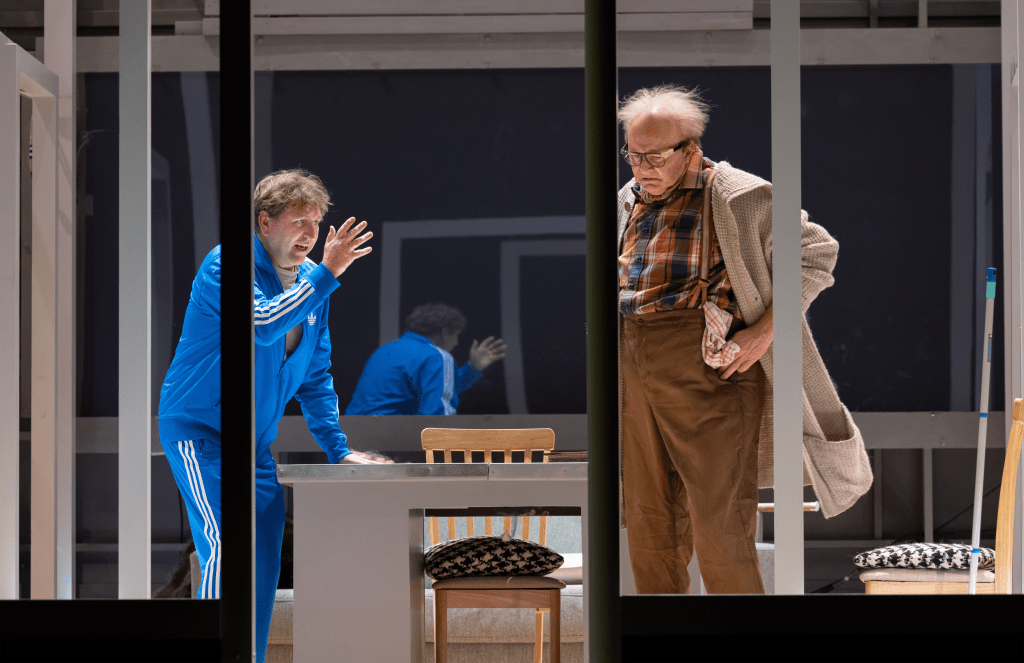
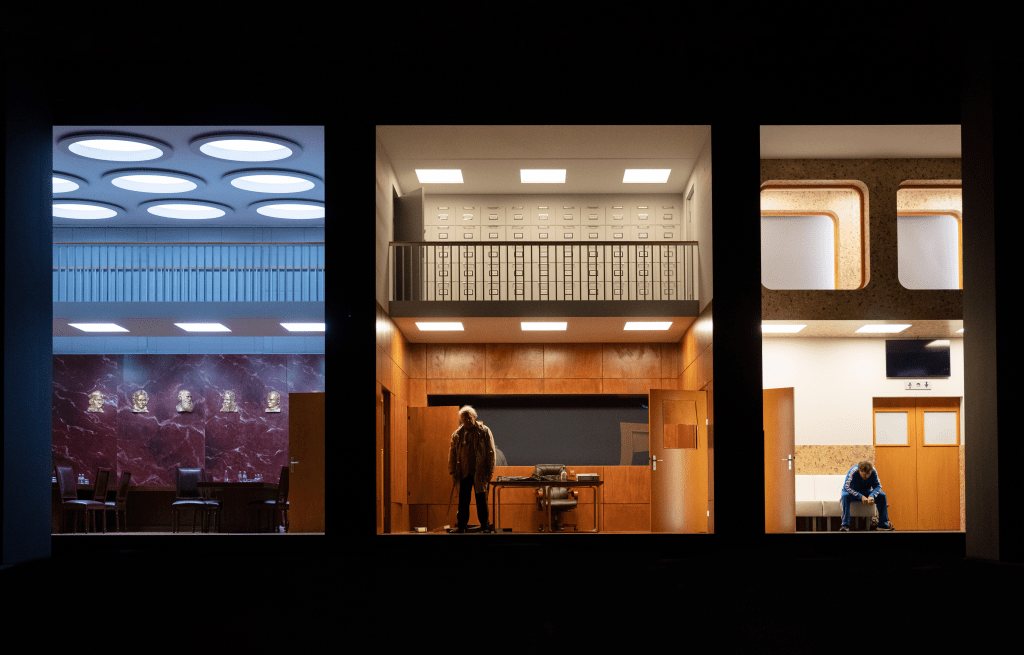
Siegmund and Sieglinde are…. well, dead – so now Mime and Siegfried have moved into their old apartment at the research institute. The bedroom? Renovated into a Lego playroom. Behind a glass wall, Wotan (aka der Wanderer) lurks, keeping watch like he once did with S & S. Twice he even makes sure Siegfried sees him. Why? Well, it makes sense when the boy starts asking about his father (after all, grandpa duties don’t stop in Valhalla… or do they?). And to seal the deal, the orchestra also slips in the Valhalla motif, just in case we missed the family connection.
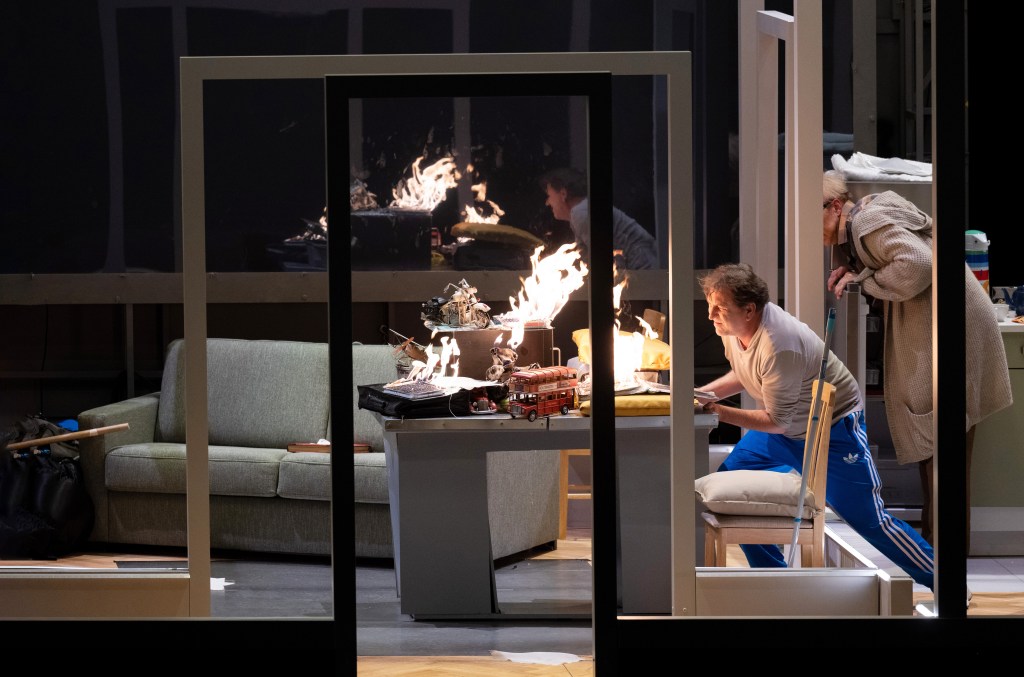
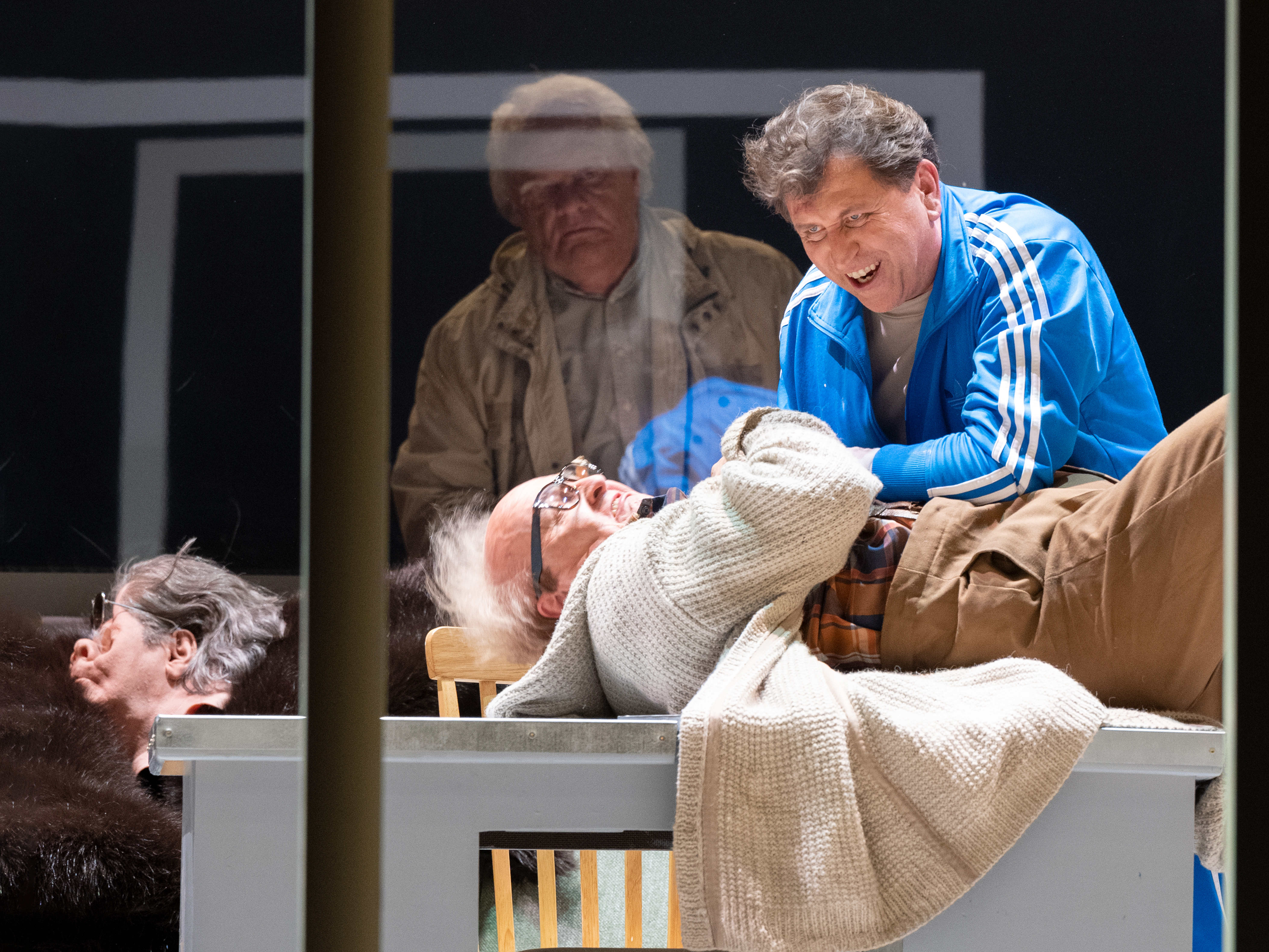
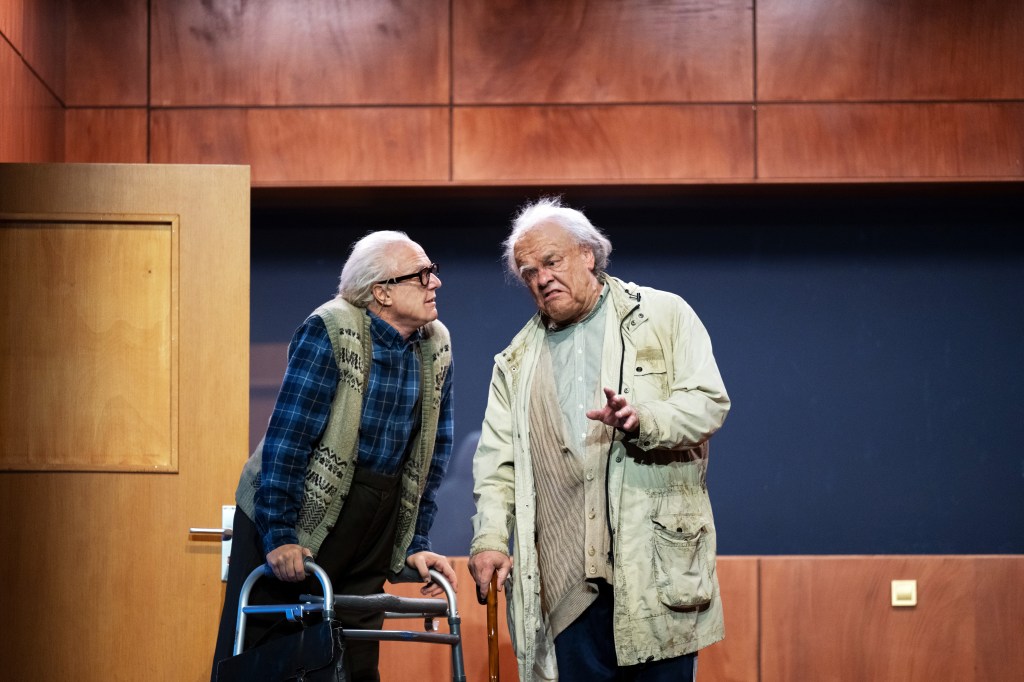
Siegfried shows up in blue jogging gear, chewing gum, playing with toy cars, pranking Mime, and setting random things on fire. And Mime? Well, a lot has happened since Rheingold. Now he’s busy competing with Alberich and Wotan over who can push the hairline furthest back. His look: trousers pulled way above his belly botton and held up by suspenders, a long grey cardigan over a lumberjack shirt, glasses taped together, and a walk made of tiny, nervous steps. He scratches behind his ear like a cat with fleas and occasionally sticks his tongue out at random moments – little ticks that make him seem forever unsettled.
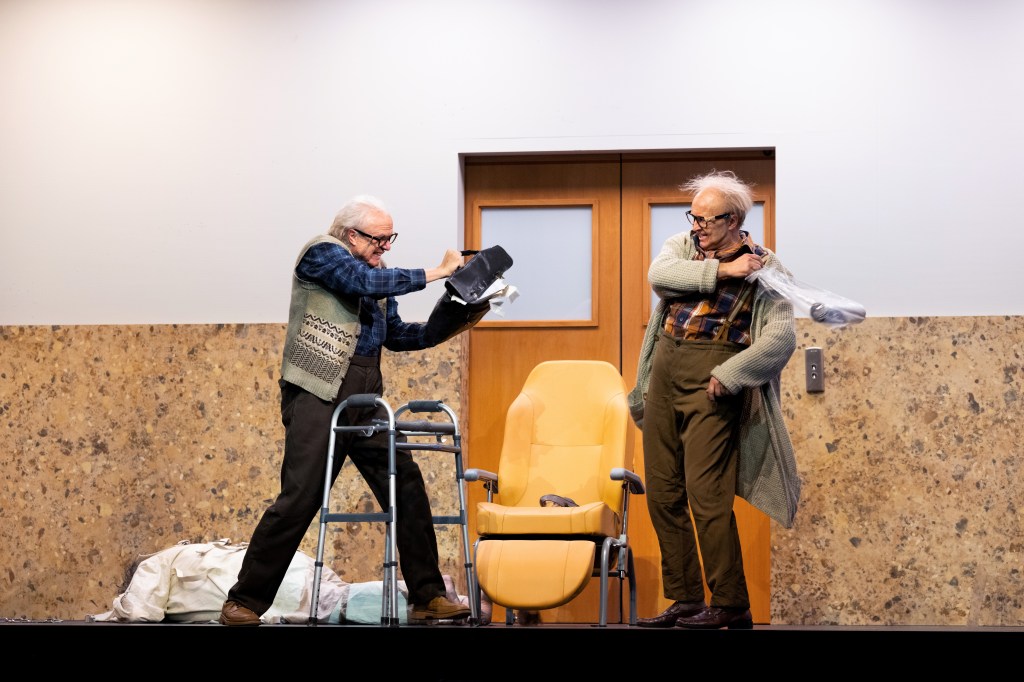
His brother Alberich isn’t much better off. When the two of them start bickering, it turns into a kind of elderly slapstick. Honestly, I could totally picture myself and my little brother doing the same thing in sixty years: holding the door like “after you,” only to slam it right in his face at the last second. Or blocking the handle so he can’t even open it himself. Or whacking each other with a worn-out leather bag – or maybe a tote with a thermos inside. You know, all the oldest tricks in book.
Right, so the first act is basically about Siegfried having to make that sword – Notung, as it’s called. But he’s a teenager, and what are teenagers absolute experts at? Nothing. I mean doing nothing. World-class procrastination. So instead of getting the job done, he literally sets half the place on fire and still manages to end up with nothing but a couple of sad sword scraps.

After the first intermission we’re (surprise, surprise) right at the start of yet another experiment. We’re told it’ll begin in 30 minutes – giving Siegfried just enough time to wander off to Neidhöhle, where Fafner hangs out. The experiment is split into five chapters, each with its own grand title like: “Entspannung. Waldweben” (Relaxation. English: “Forest Murmurs.” Wagner: “Let me just make up a word real quick.”), “Kontaktaufnahme mit dem innern Helfer” (Contact with the Inner Helper), and “Realisierung eines unbewussten Wunsch” (basically meaning discovering a wish you didn’t know you had), just to name a few. Breaking it up like this? Works. Fits what’s happening on stage.
Another prop I missed in Rheingold was Wotan’s spear – which, spoiler, we finally get in act three. But ungrateful me? I don’t even want it now. He drags it out of his closet at the very last second, and honestly, it looks completely out of place. Can someone please explain what Tcherniakov was thinking with this scene?

Brünnhilde also walks in with Wotan in act three, and promptly lies down to nap in a room labeled “Sleep Lab.” Another experiment?
The Music
Honestly, I don’t think we could find a better Erda today. And when I say “today,” I mean of all the singers performing around the world right now. Hungarian Anna Kissjudit made her debut in this role for the premiere of this production in 2022, right after joining the ensemble. She must have been… what, 26? I still can’t figure out how someone that young can sing these roles at such a level! I was literally jaw-dropped this evening – and so was she, I think, because the mask she was wearing didn’t quite stay in place…

At the other end of the spectrum, we have Michael Volle, who at 65 can still hold an amazing vocal form. Even today, he keeps the standard high! For example, when he says to Erda: “dein Wissen verweht vor meinem Willen. Weisst du, was Wotan will?” – (notice the love he puts into the V and W), which, in English means “Your knowledge blows away before my will. Do you know what Wotan wants?” On the very last word, “will,” Volle really emphasizes it, and because the music follows a pause—even the libretto says “Langes Schweigen”—the word resonates dramatically through the hall.
Stephan Rügamer was a funny and entertaining Mime, and his voice actually fits the role pretty well too.
Tonight I also got to discover a singer I hadn’t heard before: Kathrin Zukowski as the whimsical Waldvogel. And believe it or not, it was her debut in the role! Her diction was so razor-sharp that I could catch every single word – no surtitles needed, thank you very much. Her bright, clear voice was an absolute joy. A bit broader than some of the other Waldvögeln I’ve heard, but definitely not a bad thing! I could totally see her taking on one of the Rhine Maidens in the future. I’ll definitely be keeping an eye on what she gets up to next!
Andreas Schager – one of the “hot shots” around here at the moment. If there’s a role he can sing, it’s probably Siegfried. And yes, he can sing, but his acting? Not exactly readable in his face. His arms were okay, but still, it wasn’t quite enough. Sometimes, it was even hard to tell what he meant with what he was singing. But, well, it sounded great.
The same goes for his potential other half (?) Brünnhilde, sung by Anja Kampe. Oh, she can sing. One thing I thought about a lot when I first heard her in this Ring about a year and a half ago: back then, I was sitting in the second row of the parquet and could literally look straight into her mouth. Her tongue… wow. The biggest vibrato I’ve ever seen – not that her voice swings in huge vibrato waves, but you could absolutely tell her tongue working. I kind of thought it might have been because I was sitting so close, but now I’m in the fifth row (okay, not that much further), and it’s still just as obvious.
Do I wanna say something with this? Nah, it’s just an interesting observation. Also because she sings with such a wide-open mouth, which reminds me a bit of coloratura soprano Edita Gruberova, who almost never closed her mouth while singing.
In a Danish Wagner biography, Siegfried is called the Ring’s Scherzo – but in this Ring, I’d argue the second and third movements got swapped, because the third felt more like an Adagio kinda. Christian Thielemann starts quietly, almost static, but I think he still begins faster than, say, Solti does in his legendary recording. His interpretation also shines through tonight in his choice of tempi – nothing extreme, but here and there he stretches a passage and trims another.
There were more slip-ups from the orchestra today than there were in Walküre (which also seemed like a work that suited Thielemann a bit better).
Again, a recurring theme was that the singers kept looking down at the pit. Maybe they’re trying to spare their colleagues’ ears by singing slightly forward instead of right in their faces? My guess is they’re just trying to follow the conductor as closely as possible, but sometimes it feels a bit extreme. As a listener, I personally find it way more fun when the singers actually sing to each other – you get a real sense that they’re interacting, not just performing for the audience.
That said, it was still a towering, thoroughly satisfying musical evening. Several of the roles were almost impossibly well cast.
Now, only the grand finale remains. See you at Götterdämmerung – or as we like to call it in Bayreuth: Gödä!
Fun Fact!
Wagner finished Acts I and II of Siegfried in 1857, then ditched the dragon to chase after Tristan and Meistersinger. He didn’t pick it back up until 1869, finally hammering out Act III – with the last polish coming in 1871.
Trailer:
Cast:
- Musical Director: Christian Thielemann
- Director, Set Design: Dmitri Tcherniakov
- Revival director: Thorsten Cölle
- Assistant director: Caroline Staunton
- Costumes: Elena Zaytseva
- Light: Gleb Filshtinsky
- Video: Alexey Poluboyarinov
- Siegfried: Andreas Schager
- Mime: Stephan Rügamer
- Der Wanderer: Michael Volle
- Alberich: Jochen Schmeckenbecher
- Fafner: Peter Rose
- Erda: Anna Kissjudit
- Brünnhilde:Anja Kampe
- Die Waldvogel: Kathrin Zukowski
Staatskapelle Berlin
- Parsifal, Bayerische Staatsoper
- Parsifal, Hungarian State Opera 2026
- Turandot, Landestheater Linz 2026
- Parsifal, Semperoper 2026
- Der Rosenkavalier, The Royal Danish Opera 2026
Parsifal, Bayerische Staatsoper
That’s it – Easter is over, and so is my five-Parsifal passion parade: five Grail quests, five solemn sagas, and enough sacred suffering to last me until Pentecost. New sets, new styles, new singers stepping solemnly onstage. Down in the pit, the orchestra at the Bayerische Staatsoper was the real holy hit: while everyone else…

Parsifal, Hungarian State Opera 2026
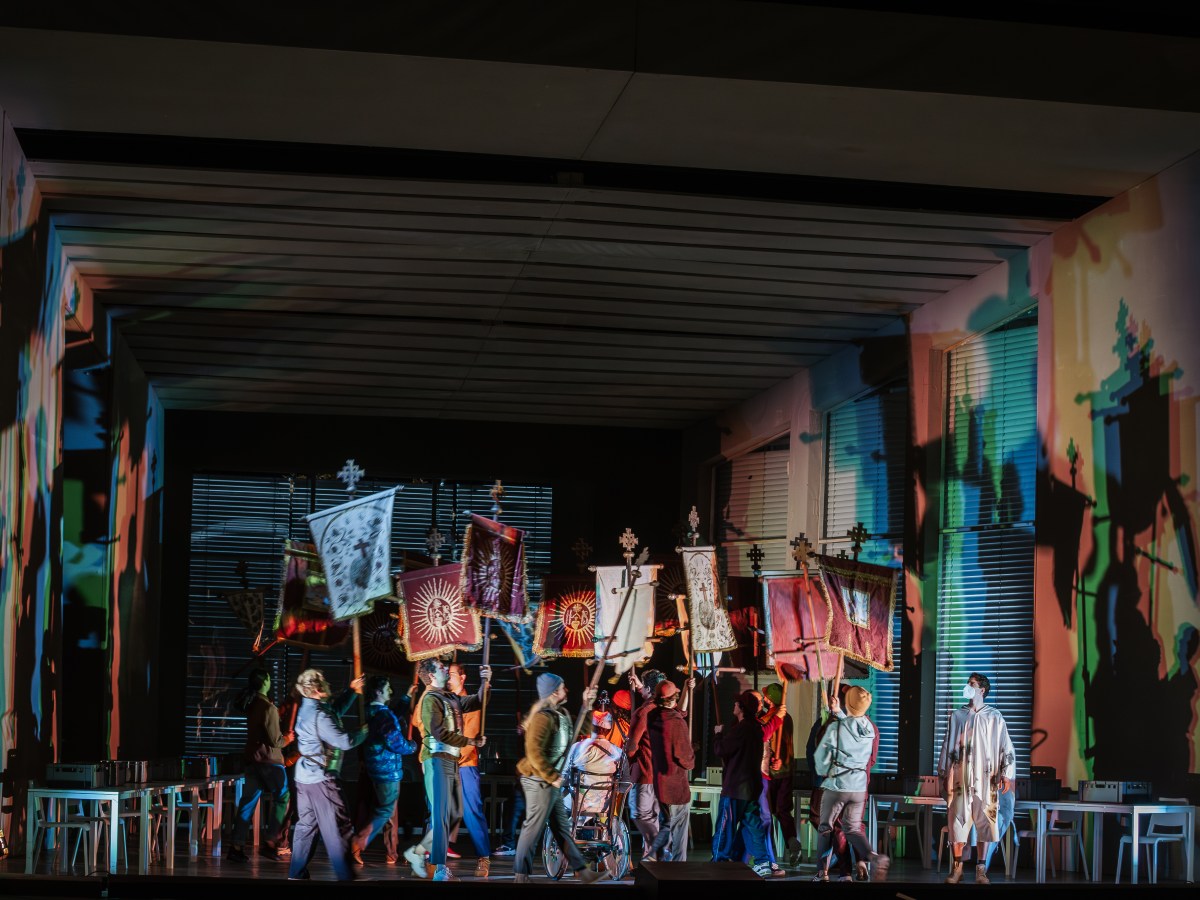
A red hookah, a guitar, water sloshing in jerry cans, Elvis hair – and Gurnemanz and his gang in puffer jackets, pairing polished shirts and ties with metal breastplates. Not exactly your standard Parsifal picture. But that’s the unholy cocktail the Hungarian director András Almási-Tóth poured into the Grail Knights’ world in his 2022 production.…
Turandot, Landestheater Linz 2026
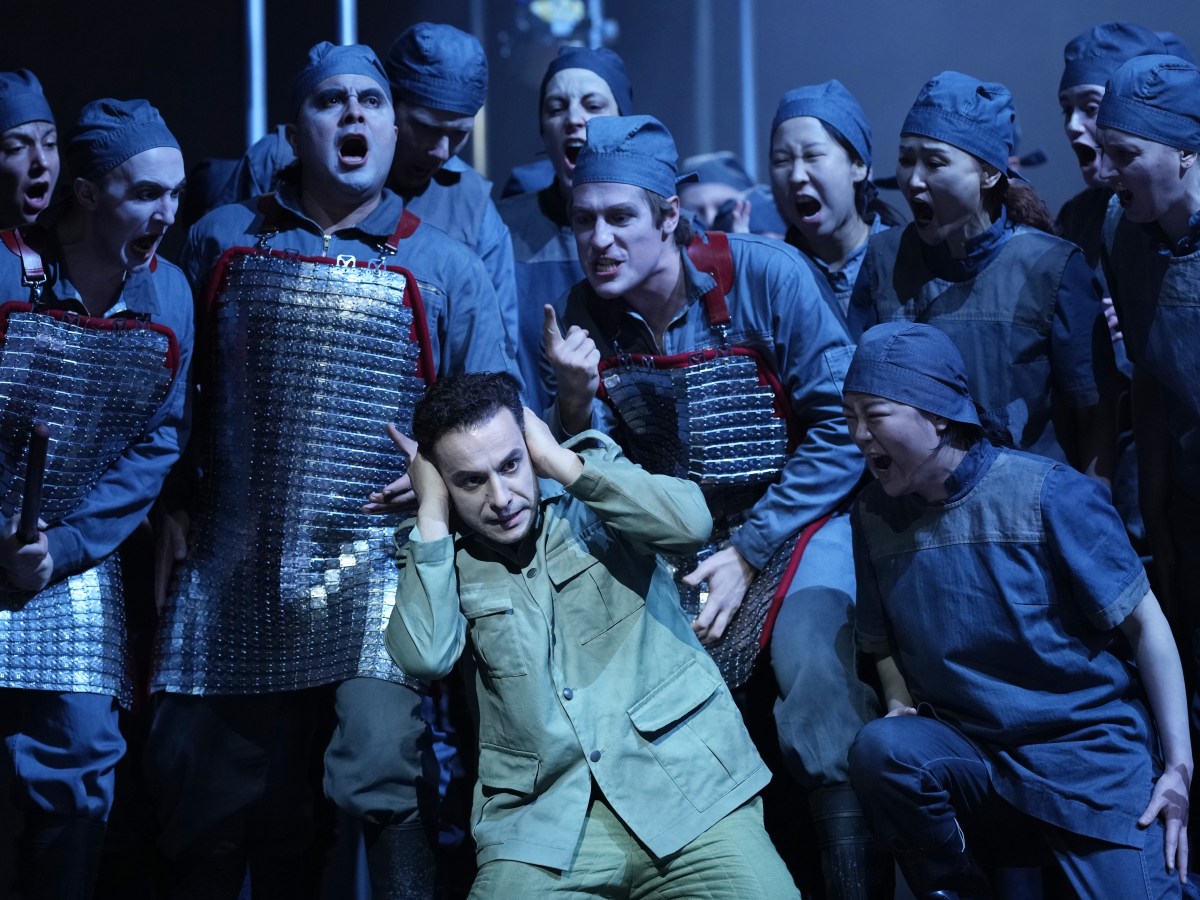
Four notes followed by a chord, like a door being flung open. No warning, no warm-up – just bam. At the Landestheater Linz – about an hour from Vienna – they didn’t hold back. Especially the percussion, which seemed determined to make those opening bars really land. At first, it felt like opening-night energy – everyone…


 Blogfløjten