
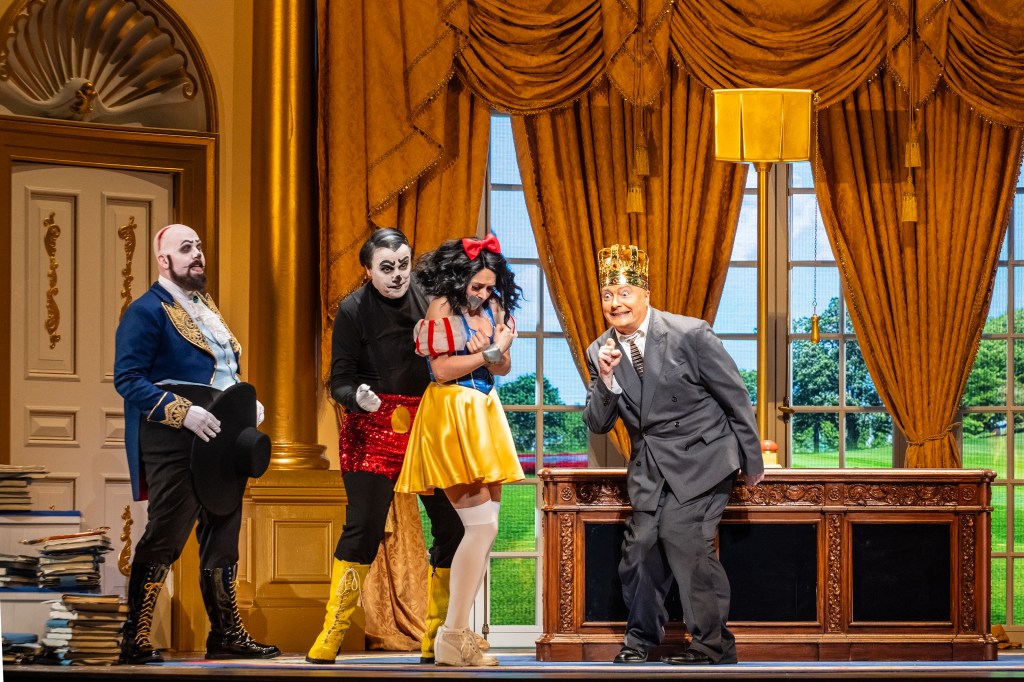
World premiere! A brand-new opera by Austrian composer Olga Neuwirth. Which basically means: no one knows what we’re about to listen to or experience. No map, no manual, no “how it’s usually done.”
What is an opera, anyway? At what point do we decide that something is one? If this hadn’t taken place inside the opera house, I’m not sure which box I would’ve put Monster’s Paradise in.
Some Magic Whistling
The opening briefly recalls The Magic Flute. You know the scene: the snake, the fight, the sense that something is about to go very wrong. In Monster’s Paradise, a tail slips out from behind the curtain. Just a tease, not a threat. We’re not there yet.
The Magic Flute is a Singspiel. So, singing and speaking share the stage. Olga Neuwirth flirts with the same idea. The opening stretches on without a single sung note. Instead, we are greeted by two talking figures, Vampi and Bampi – names that already sound more cartoon than character. Distant cousins of Tamino and Pamina? Or perhaps Papageno and Papagena? When they finally do start singing, it’s clear these voices aren’t trained for opera. Suddenly, the whole thing slides into something almost musical-like. They even start talking straight to the audience. Breaking the frame and pulling us into the game.
A Flood of Familiar Faces
The president’s servants – henchmen, lackeys, call them what you like – go by the names Mickey and Tuckey, both sung by countertenors. Mickey? As in Mickey Mouse? Ding ding diiing. And they are far from the only recognisable faces. Disney princesses greet the audience in the foyer, dressed in short skirts and waving pom-poms: Sleeping Beauty, Cinderella, Belle, Snow White. Elvis drops by. So do characters from The Muppet Show, Maria from The Sound of Music, and two walking hotdogs. And that’s really just the beginning…
Oh, and then there’s another figure we all know. The one usually found in a very big white house…
Vampi and Bampi aren’t human at all. They don’t live on Earth, they just watch it fall. Calm from above, they keep chaos in view, until curiosity kicks in: let’s go down there too. So down they descend to see madness firsthand, landing where the fences tightly stand. That very white house, locked down and sealed. Right in Washington, D.C., fully revealed.
Okay, But Who Are Vampi and Bampi?
That part is actually quite simple. They are Olga Neuwirth and her librettist, Elfriede Jelinek. This is, at least, how director Tobias Kratzer chooses to put them on stage. As observers. Commentators. Figures hovering somewhere between creator and creation.
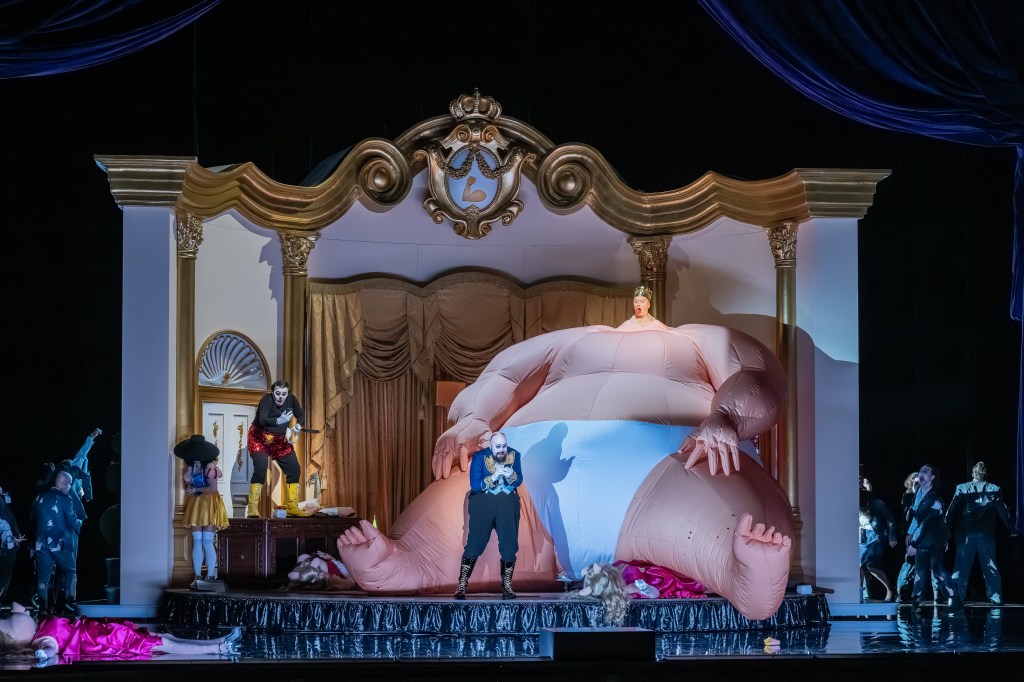
Inside the White House, behind the desk, sits Donald Trump. His wife, Melania, stands silently in the corner, wearing a hat so oversized it makes her look like an expensive floor lamp.
Trump – or Der König-Präsident, as he is called – is presented as a grotesque, goofy caricature who never quite seems to grasp what’s happening around him. Everything is about him. Always. Almost completely bald, except for a tiny tuft carefully gathered on top of his head. He looks both ridiculous and strangely exposed. What kind of role is this, exactly? In some ways, he recalls King Herod in Salome (R. Strauss): part tyrant, part clown, dangerous and absurd all at once.
The role is carried by Austrian baritone Georg Nigl, who is thrown into a wide range of vocal techniques. He begins down in the depths and then slowly drags the sound upwards in a long glissando, stretching it higher and higher until it suddenly finds itself stranded in falsetto. It looks dangerous. It sounds risky. And yet, it never tips over. This is not a role for just anyone. Nigl makes it look easy.
What on Earth Is Going On? A Big Critique?
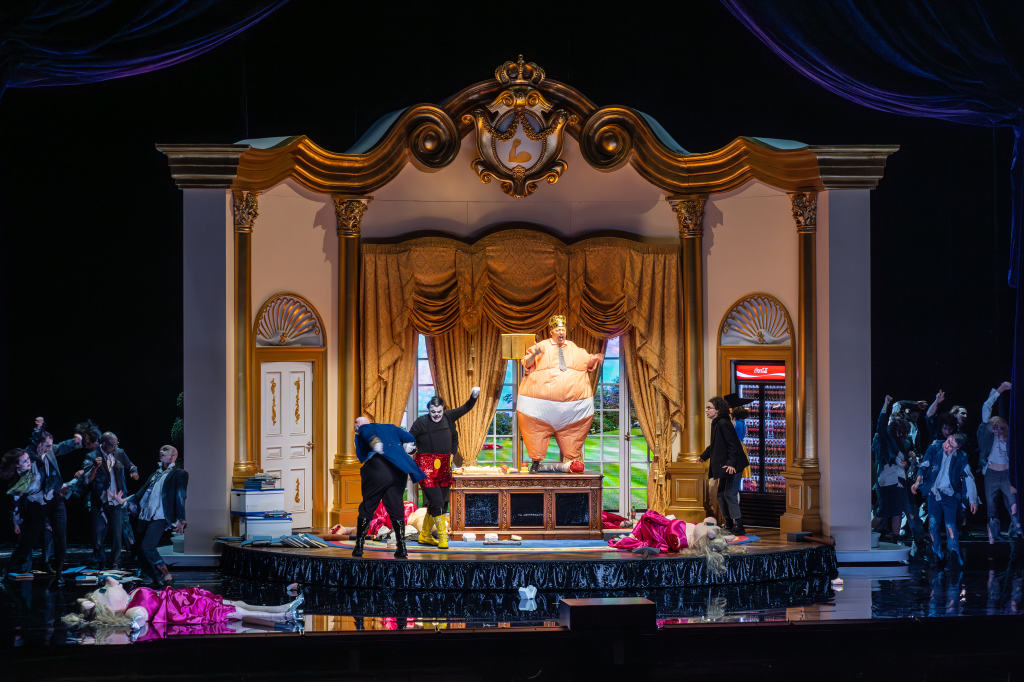
Outside the King-President’s house, zombies circle in their dance, chanting praise, caught in a trance. They don’t think for themselves, don’t question or resist. They follow commands, repeat the script.
It’s hard not to hear this as criticism at play, which leads to a larger question that won’t go away: Is Monster’s Paradise a critique of the world we are living in?
Small jabs keep popping up along the way. At one point, there’s a remark about women not having time to destroy the world because they’re far too busy destroying themselves – while cooking goulash, no less. Nothing is spelled out, of course. But then again, some of us might recognise a country that sounds suspiciously like “Trussia.”
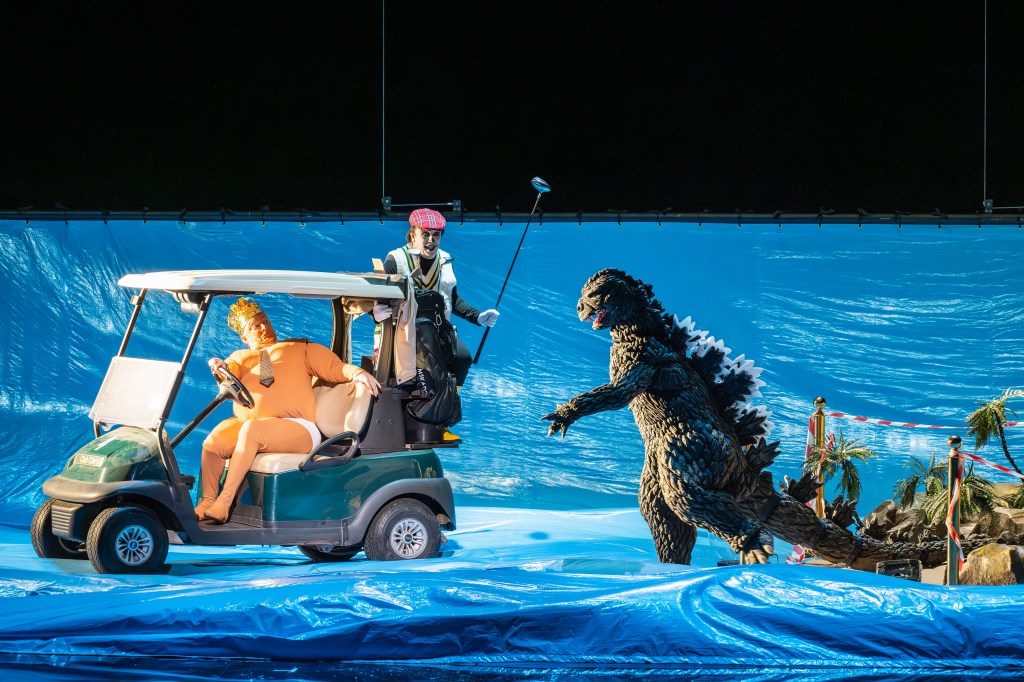
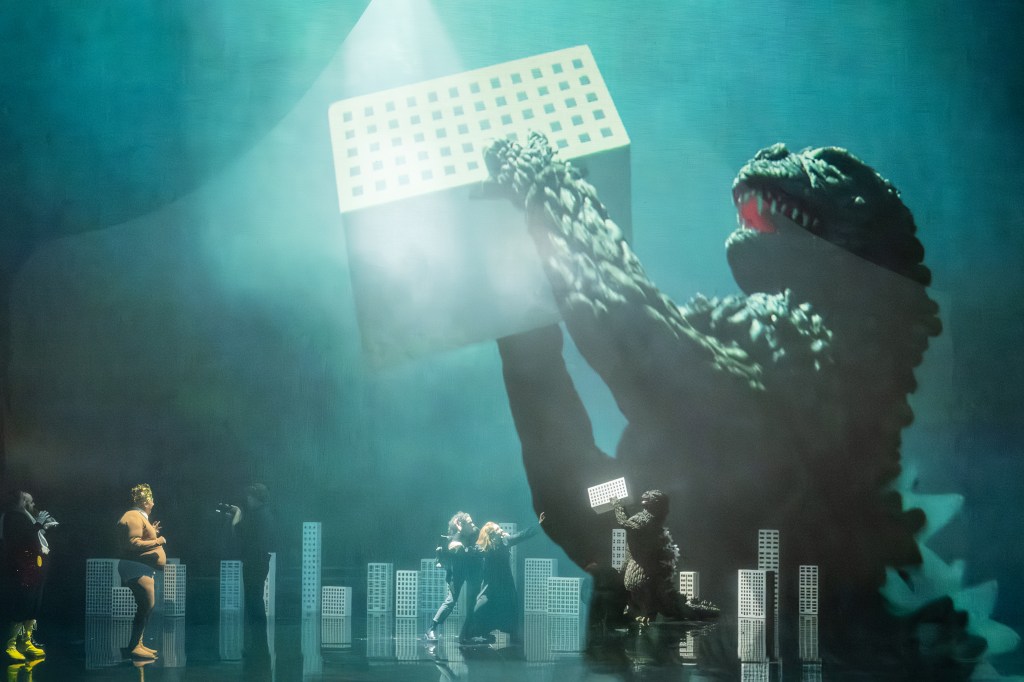
The King-President himself seems to want just one thing: to be king and to control everything. In one scene, he literally plants a golf club into an island, like a flag of conquest. I can’t help but wonder which island that might be. Greenland, perhaps? That ambition does not sit well with Gorgonzilla. In a striking shadow-play scene, the President fights against the monster…
In that moment, the President hasn’t actually done anything – at least not yet. He hasn’t acted, decided, or ordered anything at all (except for a generous amount of fast food). Which leaves an uncomfortable question hanging in the air: who is really the monster here??
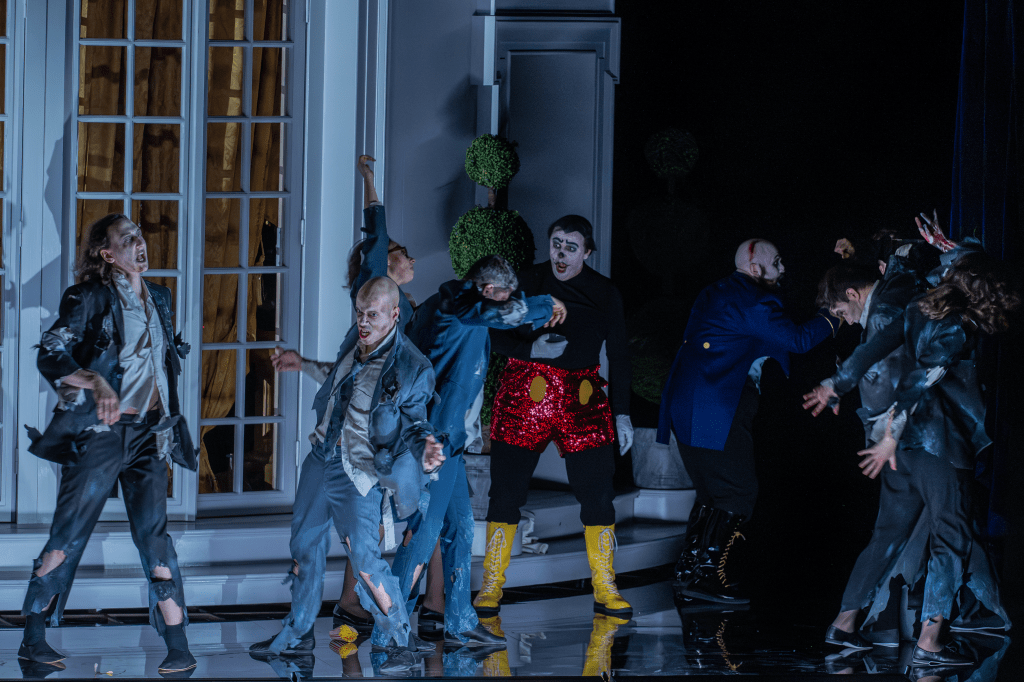
The destruction of the world, after all, is not caused by humans alone. Or rather: not everything is within human control. Extreme weather – earthquakes, volcanic eruptions, tornadoes, storms, floods, you name it – can wipe out entire populations. Director Tobias Kratzer finds room for all of this in his staging, folding human arrogance and natural catastrophe into the same unsettling picture.
At one point, a woman is projected onto the wall, announcing: “Living for others is a rule of nature. We are all born to help each other.” She is called God and looks a bit like the Teletubbies’ sun – slightly silly, strangely reassuring. She returns throughout the evening with her words of wisdom, some wiser than others… Curiously, she is the only one who speaks English in an otherwise German opera. Why might that be?
The Sound of Music
The music? When we visit the white house, it’s grand. At first. Almost like something Mozart could have written for a noble entrance – ceremonial, upright, maybe a bit full of itself. And then, almost straight away, it isn’t. The pose slips, the seriousness cracks, and the music starts smiling at itself. There’s a constant sense of irony in it.
Much of the piece works with timbre and moods rather than melody. Unison strings appear, pale and exposed, played without vibrato, fragile to the point of discomfort. Glissandi keep pulling the music out from under our feet, bending and sliding until any sense of stability disappears. When a storm breaks out on stage, the orchestra becomes wind, rushing and swirling through the hall.
And when the music threatens to become tonal, it never quite commits. In much the same way that György Ligeti does in Le Grand Macabre. Anything that might turn into a simple melody or accompaniment is twisted just enough to sound absurd. Familiar, but wrong. Recognisable, but unreliable.
Now and then, a trumpet cuts through the sound, muted and distinct as it moves around. The colour leans jazz, the melody too. In the trills, the phrasing, the way it comes through.
At times, the music even turns a little pop. A drum kit appears. An electric guitar joins in and – just like in a pop song – gets its very own solo. A tiny one. When I say tiny, I mean teeny tiny. I think it had seven notes. Now I’m thinking: pop music simply means popular music. Verdi’s operas were sung in the streets. So was Verdi pop? And if Neuwirth’s opera becomes a hit, does that make this pop too?
You can hear Neuwirth’s background in film straight away, and her time at IRCAM is all over the place, too. Electronics buzz, blur, and bend the sound. One of the main characters doesn’t sing at all. Gorgonzilla – or Gonzilla, or Gott Zilla; Jelinek clearly enjoying the wordplay (and honestly, gorgonzola wouldn’t have been that out of place either). She talks through a microphone. Her voice is twisted into something that sounds like it was borrowed straight from a cartoon villain.
And that’s exactly it: cartoons. Many of the musical effects feel borrowed straight from the world of animation. The entire percussion section joins in on the joke, including the sound of timpani being “re-tuned” mid-note. The music is full of classic cartoon effects. The kind you hear when someone slips on a banana peel, crashes into a wall, or does something spectacularly silly. At one point, I was fairly sure I heard some kazoos. And a car-horn?
A Few Final Thoughts
I could easily write an entire book about the staging alone. The same goes for how Olga Neuwirth shapes music in space, or how Elfriede Jelinek twists and toys with language. Images and ideas keep accumulating. Was it snow or ash falling onto the stage? Musical quotations surface again and again: Bruckner, Holst, a Strauss waltz, and Schubert’s Fantasia in F minor for four hands – played on a stubbornly out-of-tune Bösendorfer grand piano.
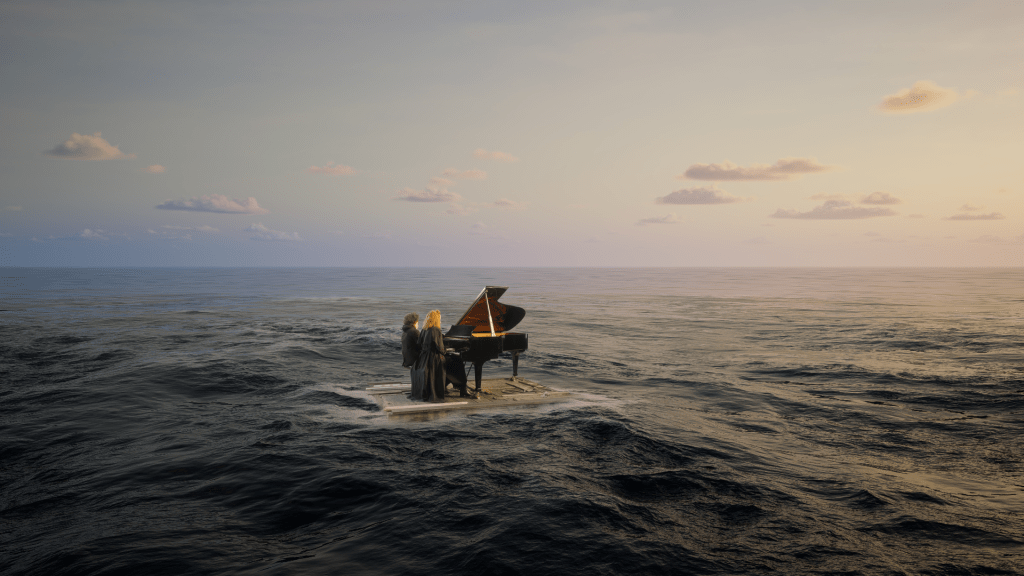
That is the last scene: the piano grows increasingly unruly. The keys start moving on their own, constantly getting in the way of what the pianists are trying to play. And yet, they don’t stop. They keep going. Somewhere inside all that resistance, disruption, and noise, they manage to find a fragile, almost tender melody. It is hard not to hear this as something larger: the world is out of tune, the system works against you, things keep interrupting. Still, you try to continue, to navigate, to make sense of the chaos.
The images pile up. The King-President suddenly grows to monstrous proportions – perhaps a very literal image of power? We also see the White House being stormed, a figure with a machine gun on the first balcony, bombings and ruined buildings. Even the Elbphilharmonie appears, taken perhaps a little too literally… Politics, parody, catastrophe. Maybe we all live in a fairy tale?
At this point, the only sensible thing left to do might simply be to go and experience it for yourself.
Fun Fact!
Bach in the Mozart Year 2006, Neuwirth and Jelinek were set to premiere the opera Der Fall Hans W. in Salzburg. Expectations were high. Ambitions aimed for the sky. Then came the crash: the libretto was told goodbye!
The opera took a sharp, satirical cut at the real case of Franz Wurst – a paediatrician convicted of child abuse and incitement to murder. Too dark? Too direct? Or just too much to Handel?
Jelinek was furious. Swore she’d never touch opera again. Say the word “opera”, and you might get a slap.
Time heals all wounds… apparently. Somehow, here we are, more than two decades later.
Neu wird es bei Neuwirth.
Trailer:
Cast:
- Conductor: Titus Engel
- Director: Tobias Kratzer
- Co-Regie: Matthias Piro
- Stage Designer: Rainer Sellmaier
- Costume Designer: Rainer Sellmaier
- Video: Jonas Dahl, Janic Bebi
- Live-Elektronik: Markus Noisternig
- Sounddesign und Samples: Oliver Brunbauer, Olga Neuwirth
- Klangregie: Julien Aléonard
- Lightning Designer: Michael Bauer
- Choir: Christian Günther
- Kinder- und Jugendchor: Priscilla Prueter
- Dramaturgy: Christopher Warmuth
- Vampi: Sarah Defrise
- Vampi (Actor): Sylvie Rohrer
- Bampi: Kristina Stanek
- Bampi (Actor): Ruth Rosenfeld
- Der König-Präsident: Georg Nigl
- Gorgonzilla: Anna Clementi
- Mickey, des Königs höriger Adlatus I / Doppelgänger des Königs / Todesengel II: Andrew Watts
- Tuckey, des Königs höriger Adlatus II / Todesengel I: Eric Jurenas
- Ein Bär: Ruben Drole
- The Goddess (Video): Charlotte Rampling
- Drumkit: Lucas Niggli
- Electric guitar: Seth Josel
- Pianistinnen „Verstimmte Klaviere“: Elisabeth Leonskaja, Alexandra Stychkina
- Chor der Hamburgischen Staatsoper
- Kinderchor Alsterspatzen – Kinder- und Jugendchor der Hamburgischen Staatsoper
- Philharmonisches Staatsorchester Hamburg
- Komparserie der Hamburgischen Staatsoper
- Innocence, The Royal Danish Opera 2026
- Die Walküre, Hamburgische Staatsoper 2026
- Werther, The Royal Danish Opera 2026
- Macbeth, Royal Danish Opera 2026
- Tosca, Opera Hedeland 2026
Innocence, The Royal Danish Opera 2026
Guilt is a funny thing. You don’t have to pull the trigger to be caught in the aftermath. Sometimes, simply being there – or being related to the person who did it – is enough. We like to think we’re innocent. But scratch the surface, and who knows what you might find? In Kaija Saariaho’s…

Die Walküre, Hamburgische Staatsoper 2026
How much control do we really have over our own lives? We make decisions, change our minds, take wrong turns and tell ourselves that, ultimately, we are the ones behind the wheel. But what if the steering wheel isn’t really ours to begin with? In Claus Guth’s now 18-year-old production of Die Walküre, control is…
Werther, The Royal Danish Opera 2026
Werther you like it or not, doomed love is back on the menu. Think Tristan and Isolde, but with the drama dialled down a notch. The music is a little Wagner, a little Puccini – just without the same oomph. Chief conductor Marie Jacquot keeps the orchestra on its toes, steering the whole thing with…

