
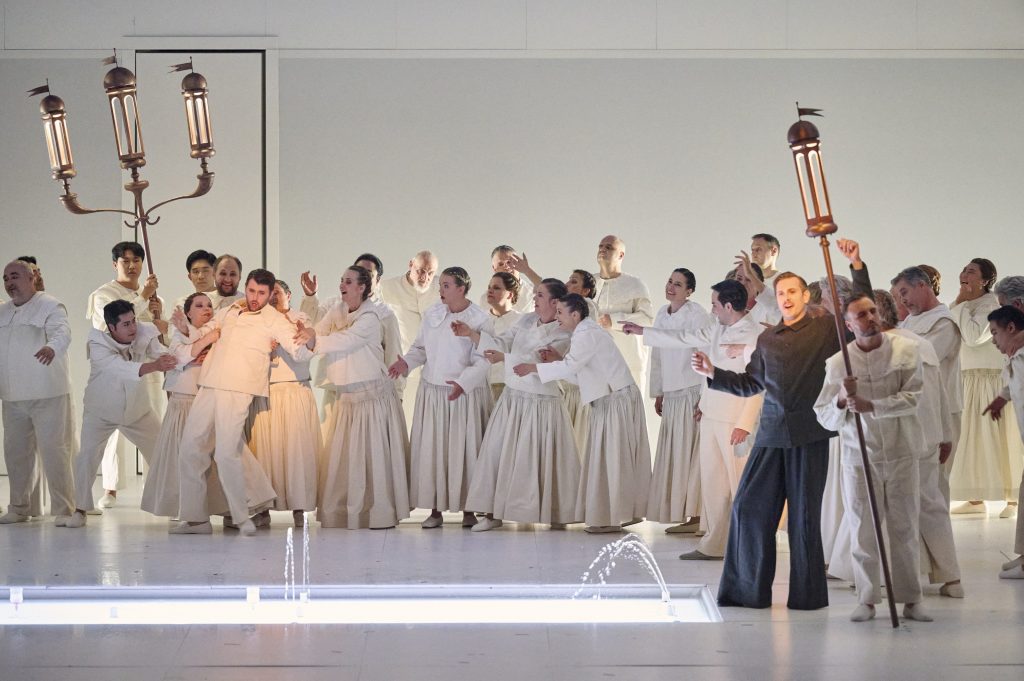
Are you allergic to colour or colourblind? Then Stuttgart’s Otello might be your kind of wild night out. The whole stage is dipped in black and white (they don’t technically count as colours, or?). Apart from a bit of red (and green) here and there, obviously (opera, duh). Gotta have some blood in the mix.
Hold on to your hats and glasses — or better yet, grab a life jacket! This storm full-on hits you right in the face. No slow build here — we’re thrown headfirst into the chaos, full speed, no time to chill. The backdrop heaves like a furious sea, the chorus crashes like thunder, and the choreography lashes and swells. We’re smack dab in the eye of the storm — no umbrella gonna save you now!
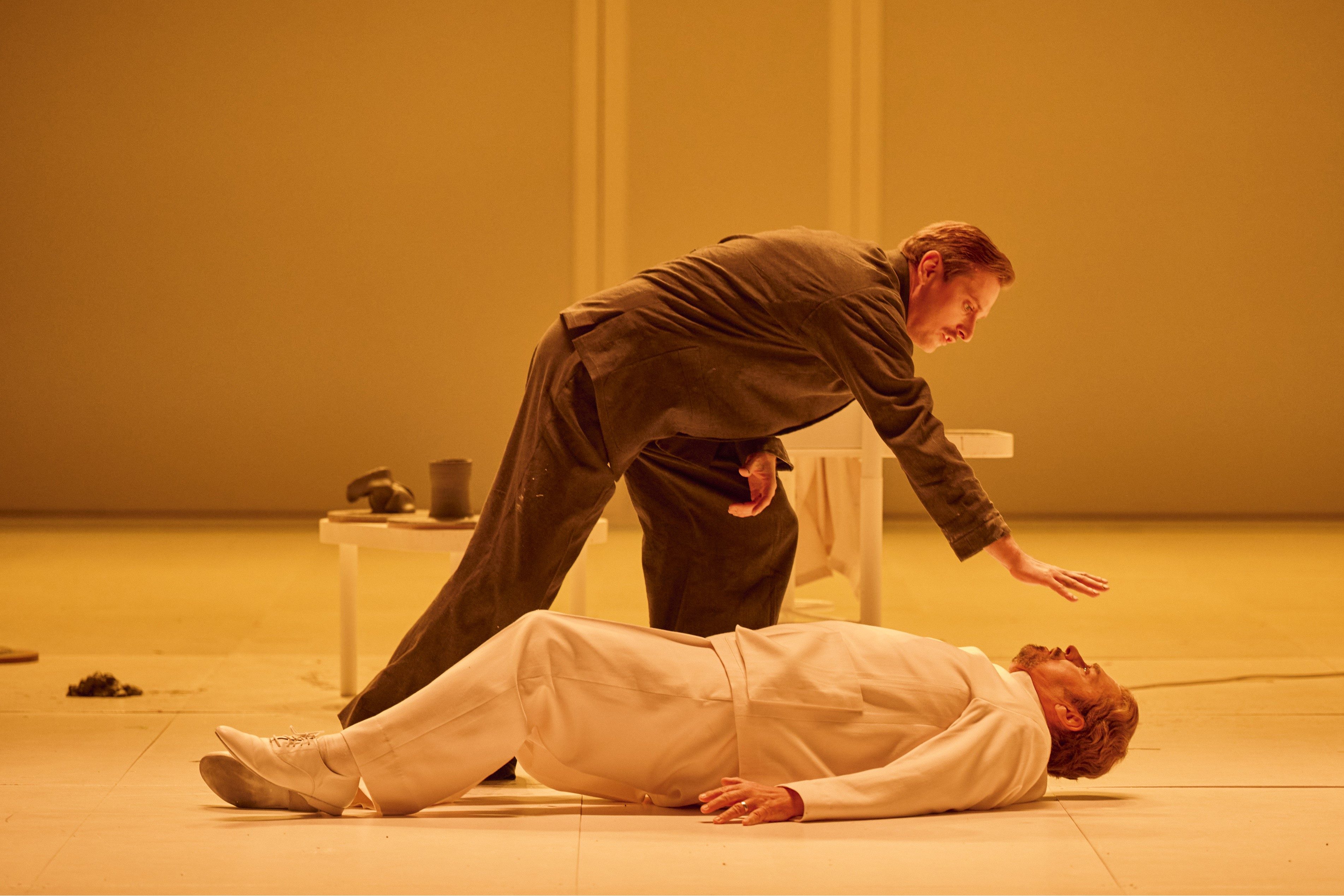
The stage is packed with white people — I’m talking clothes here. The clinical whiteness practically blinds you, like someone spilled an entire bottle of bleach. Then there’s the black sheep: Iago. Dude doesn’t even have to open his mouth — one look and you just know he’s trouble.
The higher the heel, the darker the scheme
So, what’s the deal with Otello anyway? Well — love, lies, and loads of jealousy. Otello, the celebrated general, comes home to his darling Desdemona. But peace is short-lived. Lurking in the shadows is Iago. The bitter underdog, burning with jealousy and ready to stir the pot. He spins his web of lies, fans the flames of doubt, and watches Otello slowly fall apart.
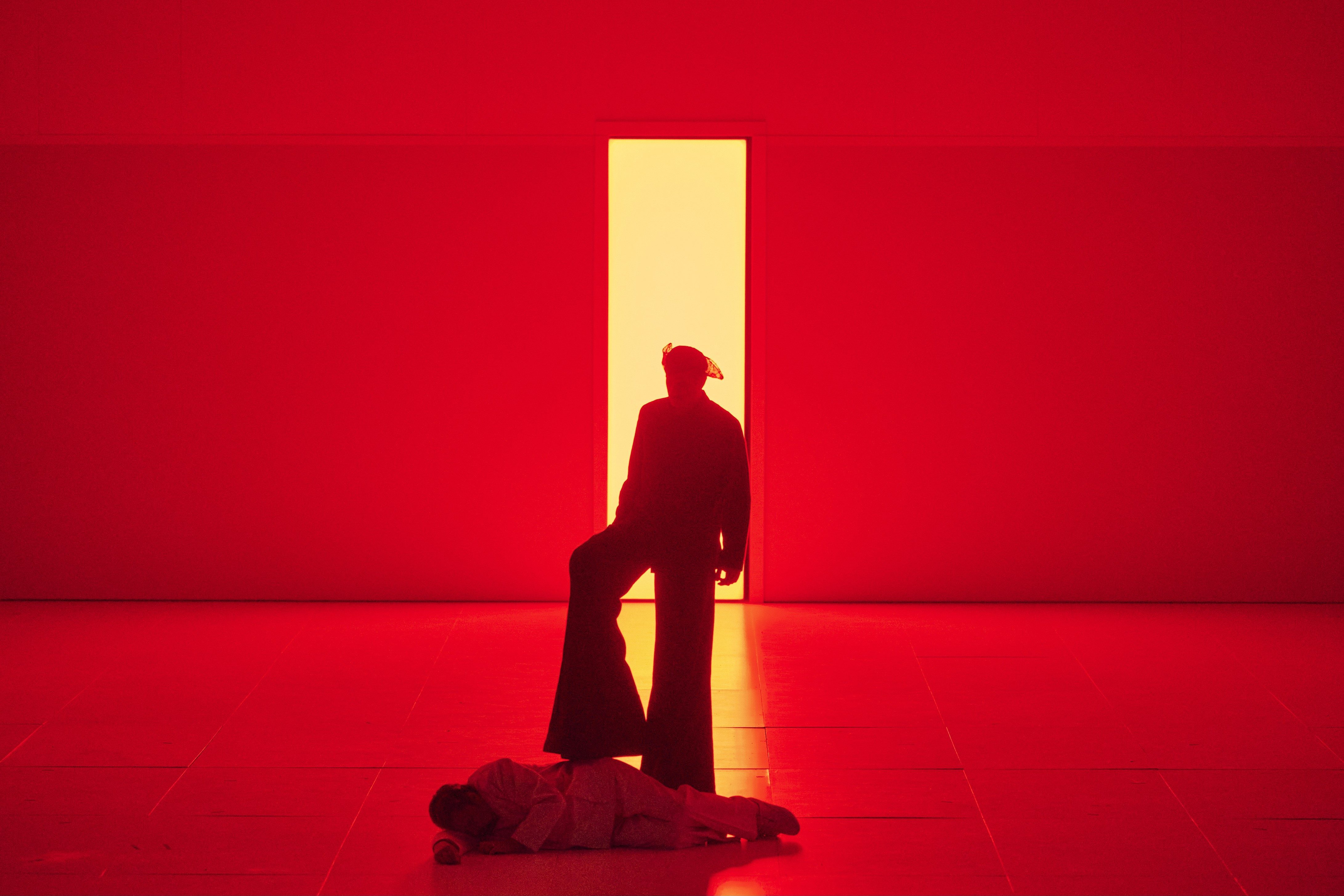
As the plot thickens, so do Iago’s schemes — and apparently, his shoes… In this production, he doesn’t just climb the social ladder, he literally levels up. Every act adds a few extra centimetres. By Act III, he’s basically a shady stork in stilettos, strutting around like, “Yeah, I’m in charge now.” Power moves with killer shoes. While everyone else is freaking out and shrinking away, Iago’s rising — in height, in confidence, in pure evil mastermind vibes.

Queen To d5
And then we have our doomed duo: Otello and Desdemona. He stays dressed in white from start to finish — the picture of purity, or at least he think so…
Desdemona, meanwhile, runs a small costume department of her own. She flips between black and white like a human chess piece. One moment she’s angelic in ivory, the next cloaked in darkness — as if reflecting the way Otello sees her: pure one minute, guilty the next. It’s not her who changes — it’s the lens she’s viewed through.
At the end of Act I, Otello declares his love for Desdemona (yeah yeah, we already knew that) — but there’s something very real keeping them apart. Literally: a long rectangular pool with a fountain, stretching between them like a cold, watery moat. The drama hasn’t gone kaboom yet — it’s just simmering, like a pasta pot right before the lid blows off.
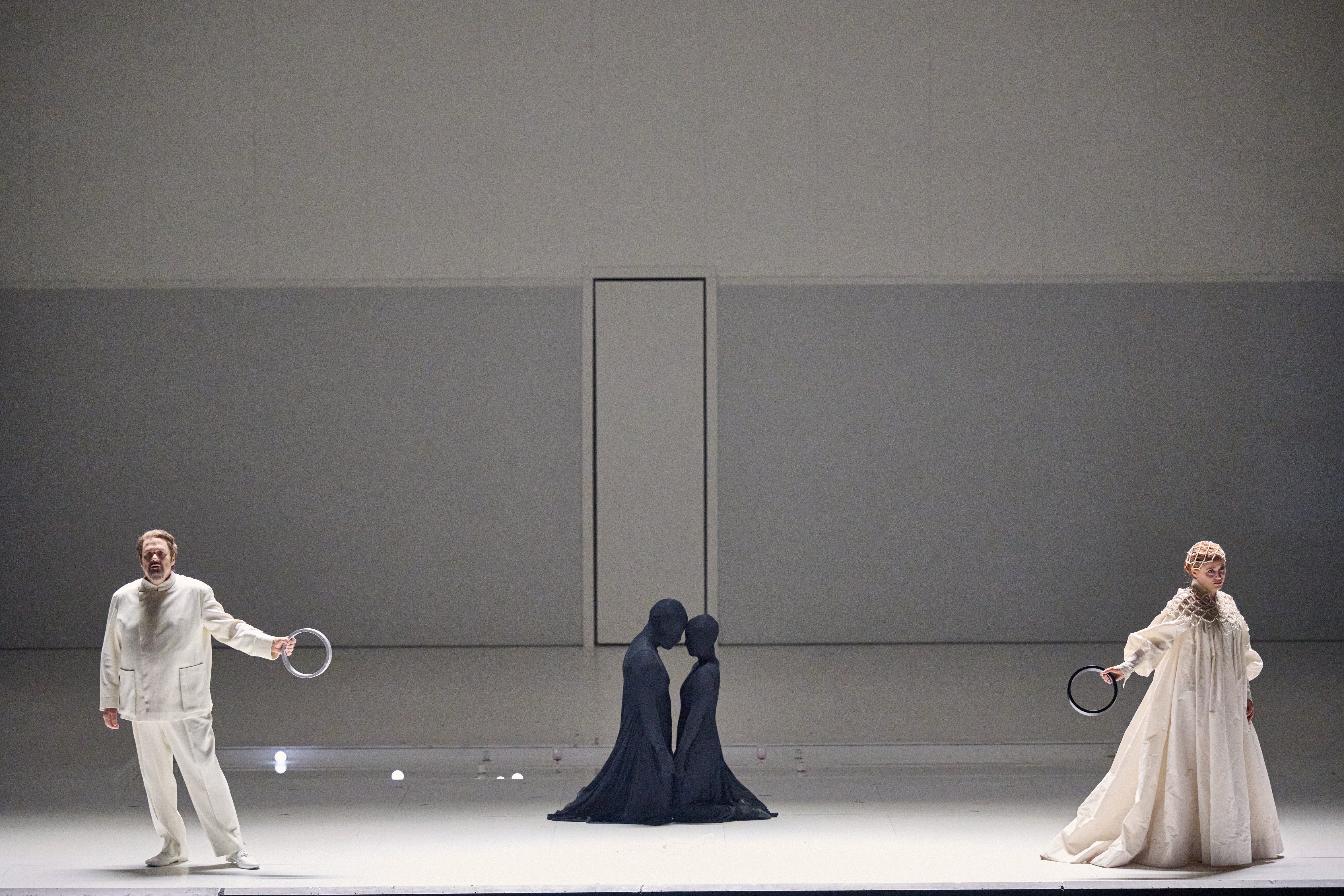
Yet, despite the distance, a single thin rope pulls them closer — that awkward, noodly spaghetti moment from Lady and the Tramp, slow and shaky, tying their hearts together one tentative bite at a time. It’s sweet, clumsy, and perfectly imperfect — just like their love.
But they’re not alone. Two black-clad shadows silently trail their every move — sometimes showing more affection than Otello and Desdemona themselves can muster. Are they ghosts? Fantasies? Hormonal hallucinations? These mysterious figures reappear throughout the evening. Maybe they’re what the couple longs to be? Or what they fear they never will?
Wait, How Long Is This Thing?
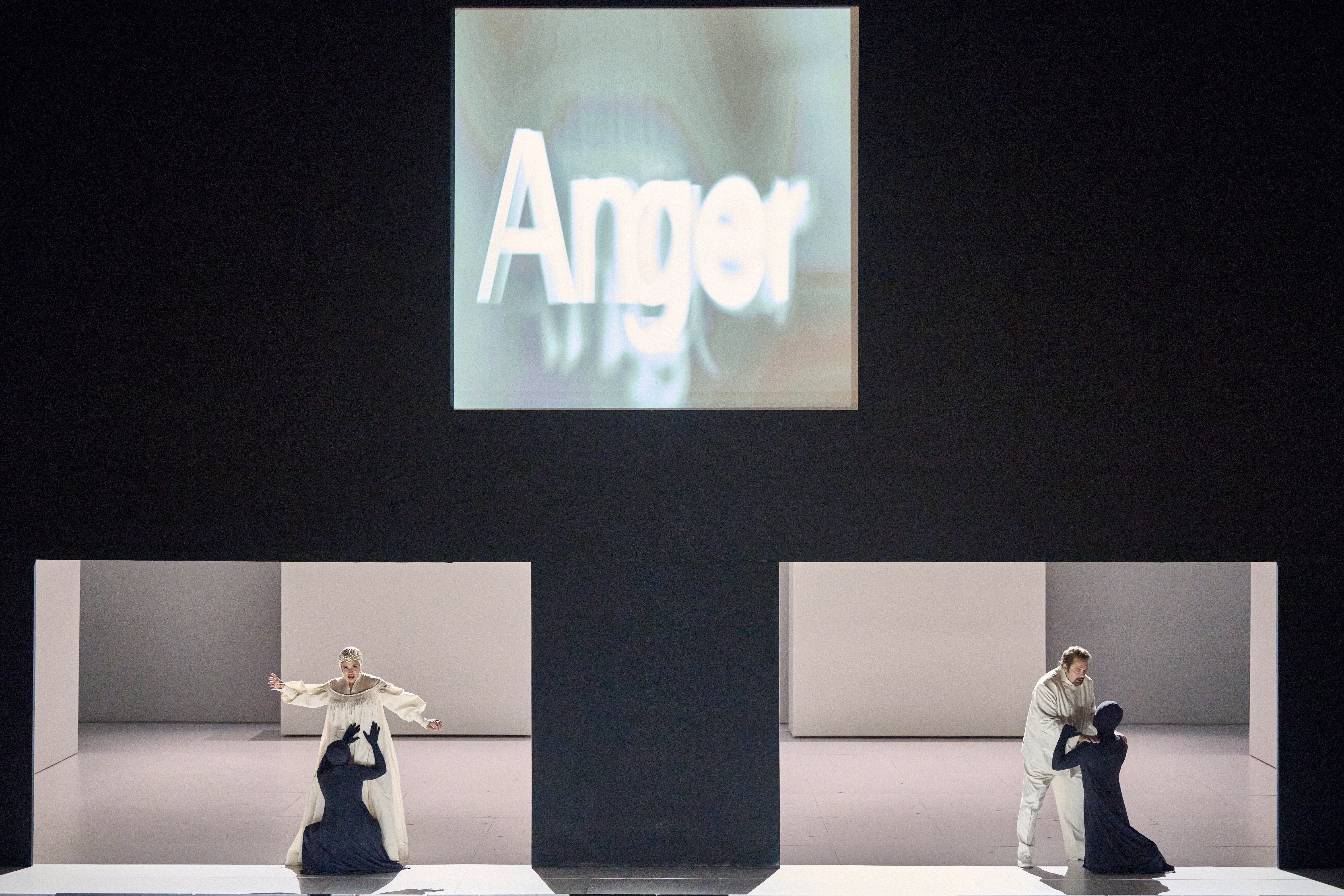
According to the program, Acts One and Two run a solid 90 minutes, with Acts Three and Four coming in at about 80. Huh? That can’t be right. Otello isn’t that long… is it? I checked again. And again. Is Stefano Montanari treating the tempo like a Sunday afternoon nap — slow and easy? Fifteen minutes longer than usual? Nah, there is more to it!
Before each act, we’re treated to short videos: a man in a crisp white shirt staring blankly into the distance. At first, it’s innocent enough—just waves and wind—but soon, things get heavier. Flashbacks? References to Black Lives Matter? Words like “uncertainty,” “flaw,” “exposed,” “threat,” and chillingly, “I can’t breathe” flash across the screen. It’s clear there’s a political undertone — or maybe overtones…
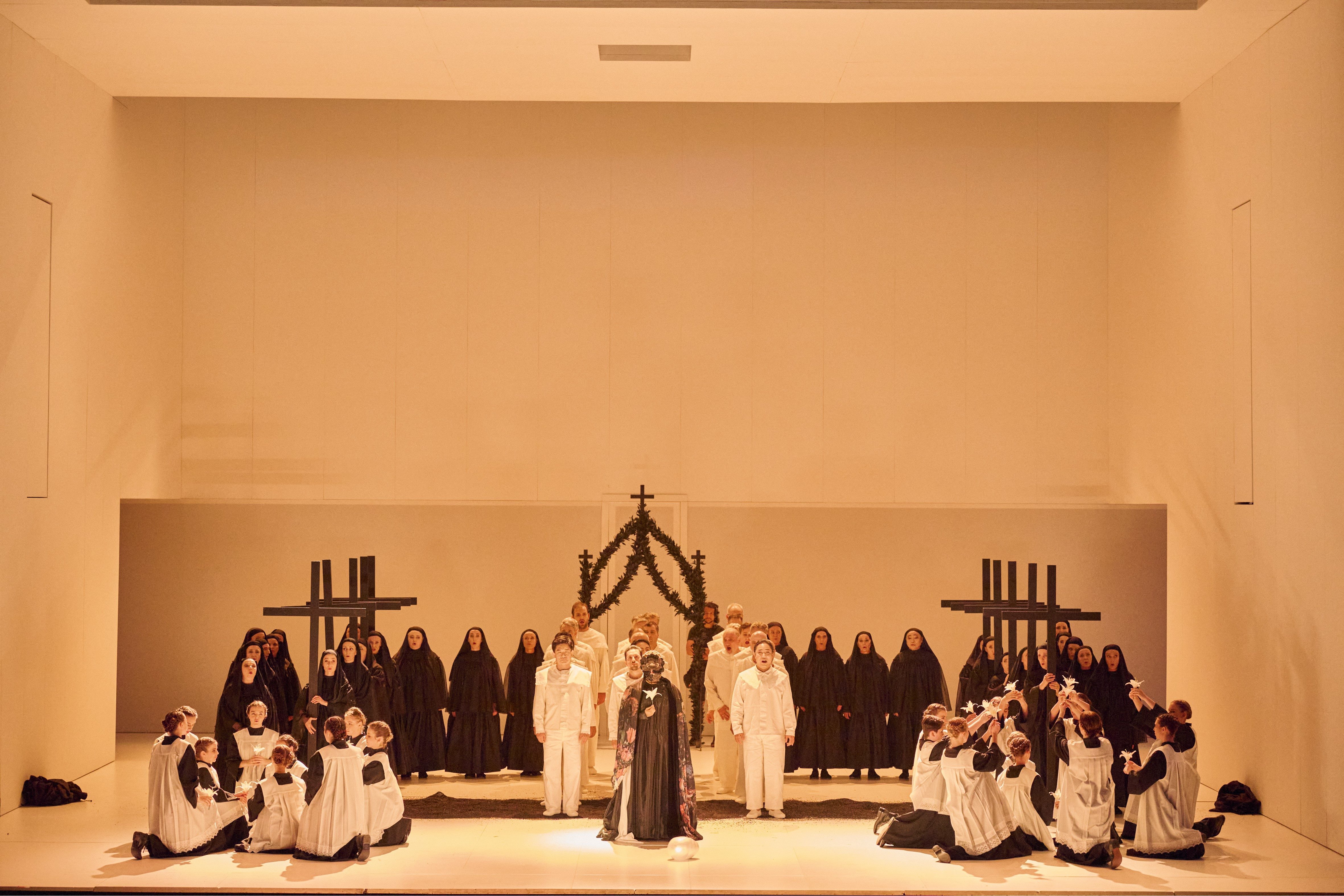
Esther Dierkes (Desdemona), Staatsopernchor Stuttgart, Kinderchor der Staatsoper Stuttgart. Photo: Martin Sigmund
The videos came with a mishmash of nature sounds and ambient, almost cosmic noise. But instead of adding atmosphere, it mostly added to the confusion. The concept? No clue. The videos dragged on way too long, and any link between them and the staging was pretty much a mystery. Seems like many agreed — a good number of people took the chance to catch up with their neighbors instead.
When In Doubt, Grab A Pillow Or A Handkerchief
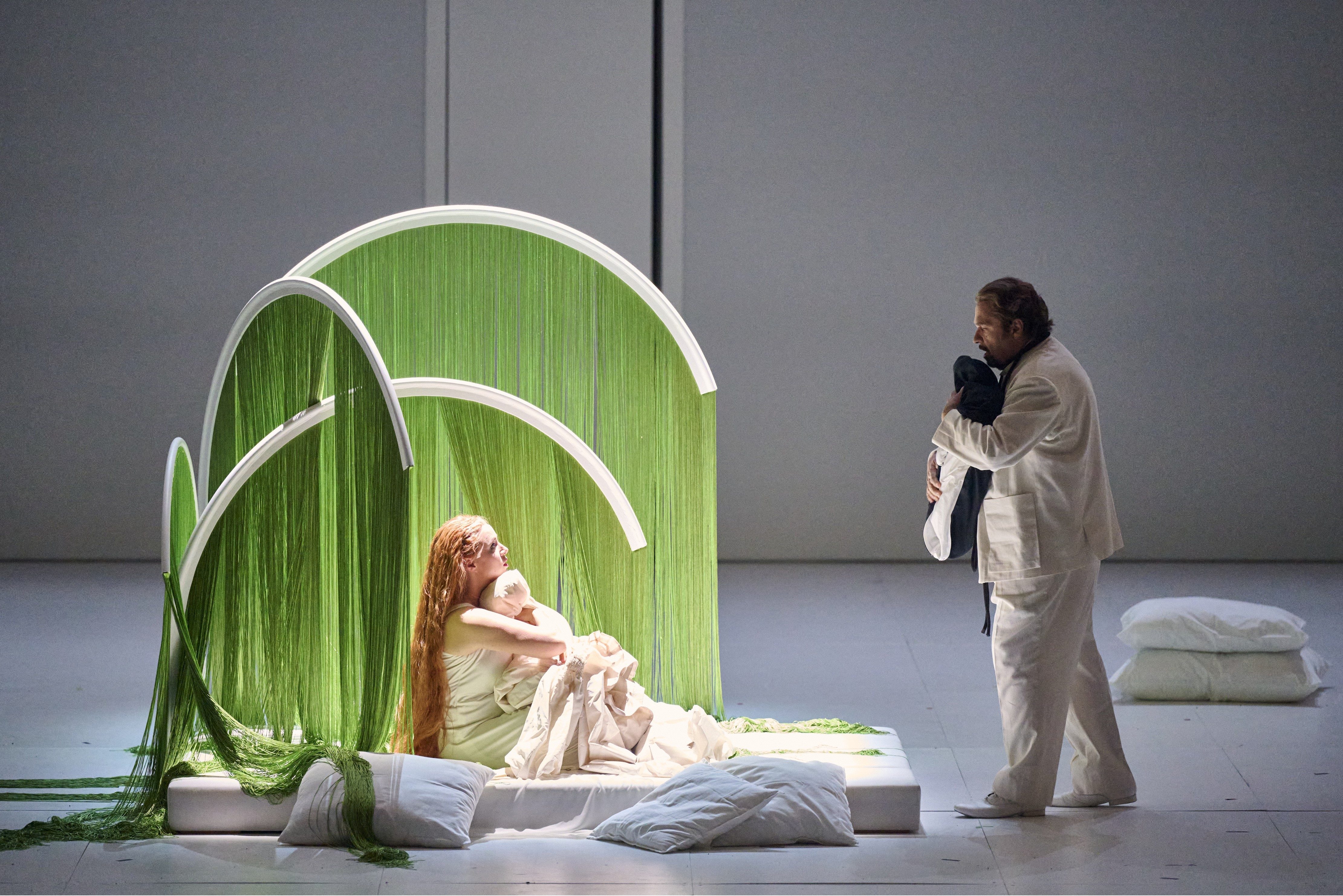
In the grand finale, Otello storms into Desdemona’s bedroom, green-eyed and murderous. But instead of a dramatic struggle or a final embrace, we get… pillows. Lots of them. Desdemona calmly covers her face with a handkerchief, while Otello strangles a pile of cushions.
And when it’s time for him to die? No sword, no fall, no nothing. Just a ghostly white cloth floating gently down onto his head — like a napkin surrendering to gravity. It’s not so much a tragic fall as a slow fade — a standing death, quiet, composed… and kind of confusing.
Welcome To The Mountains
Otello is no walk in the park vocally — more like a hike with rocks in your shoes. Marco Berti had his fair share of stumbles: a few wobbly notes, some pitchy detours… you could tell the role was testing him. Still, there’s something clean and cutting about his tone, and by the end, he pulls out a genuinely moving final scene. His last lines weren’t just sung, they were felt.
There’s no shortage of emotion from Olga Busuioc either. As Desdemona, she saves her strongest card for Act IV — when love has soured, hope has packed its bags, and all that’s left is a flickering prayer. She sinks to her knees at a mini altar, folds her hands, and begins her “Ave Maria” in a breath so soft it might drift out the window unnoticed (which, fair enough — it is a prayer). It’s fragile, haunting, and heartbreakingly sincere. That is, until the prompter decided to chime in like an unwanted spiritual guide. Even so, Busuioc holds the whole thing together with the kind of grace that doesn’t need a spotlight — just silence.

Daniel Mirosław gives us a broad, dark baritone Iago with just the right dose of danger. No need to twirl a mustache (his is too short either way). His Iago doesn’t scream evil — he smiles it. And while we’re handing out compliments: a well-deserved nod to Itzeli del Rosario, who brought both vocal strength and quiet steel to Emilia.
Storm passed, hat on head, umbrella still standing. Perhaps it wasn’t quite as wild as it looked.
Fun Fact!
Verdi actually thought about calling the opera Iago, since Rossini had already done an Otello. But he still stuck with Shakespeare’s title — and I don’t think I need to tell you which one gets performed more these days.
Trailer:
Cast:
- Conductor: Stefano Montanari
- Director and Stage Director: Silvia Costa
- Co-Director: Rosabel Huguet Duenas
- Co-Stage photos: Michele Taborelli
- Costume Designer: Gesine Völlm
- Video: John Akomfrah
- Lightning Designer: Marco Giusti
- Dramaturg: Julia Schmitt
- Otello: Marco Berti
- Cassio: Sam Harris
- Desdemona: Olga Busuioc
- Emilia: Itzeli del Rosario
- Herold: Kyung Won Yu
- Jago: Daniel Mirosław
- Lodovico: Goran Jurić
- Montano:Aleksander Myrling
- Rodrigo: Alberto Robert
Staatsorchester Stuttgart, Staatsopernchor Stuttgart, Kinderchor der Staatsoper Stuttgart


