

In the Austrian Alps, in a village where cows outnumber people, something sacred is unfolding. But not in a chapel — in a black sharp-edged, futuristic hall nestled into the mountainside like a spaceship that decided to settle down, and unpack its oboe. Get ready for some Wagner.

This is the Tiroler Festspiele in Erl — a pocket-sized but bold festival that blossoms a few times a year like a musical mountain magnolia.
Two performances of Parsifal, both sold out. One of Wagner’s longest, slowest, most sacred sound marathons, staged in a hall so fitting it’s almost suspicious: silent hills outside, heavenly acoustics inside.

Welcome to Wagner’s World
It begins like a whisper. Not from the pit, but from the walls, the ceiling, the floor — as if the building itself is breathing Wagner.
The Parsifal prelude unfolds like a mist, creeping in from a place you can’t quite name. Soft strings, a shimmering breath from the winds, and then — suddenly — the room is alive. This music doesn’t demand understanding — it asks to be absorbed, like it’s sinking into your skin. And in Erl’s spacious, resonant acoustics, it’s perhaps as close as you can get to the sound Wagner wrote for in his Festspielhaus in Bayreuth.
The scene unfolds in a vast sea of white, almost blinding in its purity. At the center, a man lies on a shimmering veil, gazing up as if he’s pondering the very secrets of the cosmos. Surrounding him are six towering, harp-like structures, frozen in place like ancient guardians. Slowly, over the course of the acts, these will begin to stir, shedding their blankness and taking on new colors. But for now, it’s all eerily calm — until the others waltz in…

Draped head to toe in white — snowy beard included — Gurnemanz strides in like a holy ghost from medieval times. The cross on his chest leaves no doubt: this man is on a mission. Brindley Sherratt fills the hall with ease, his voice slicing through the soundscape like a silver spear. Even when he stumbles on a word or two, he speaks with the steady, storytelling strength of someone who’s seen it all — and is now about to spill the tea.
And then crashes Kundry. Not exactly the shy, silent type — she storms in, shoves the poor guy from the opening scene straight into the shallow pool at center stage, and stands there like she owns the place. Except she clearly doesn’t. While everyone else is draped in sterile whites, she’s in a bubblegum-pink puff-sleeve top that screams outsider. The knights recoil when she approaches, taking careful steps back as if she might bite.
Why is there a puddle in the middle of the stage, you ask? Well, Amfortas has a wound — a nasty one — and it needs washing. He wheels in like a broken king, and just as his feet touch the water, the oboe lets out a fragile sigh. It’s not just soundwaves — it’s as if the instrument speaks for him, echoing pain he can’t put into words.
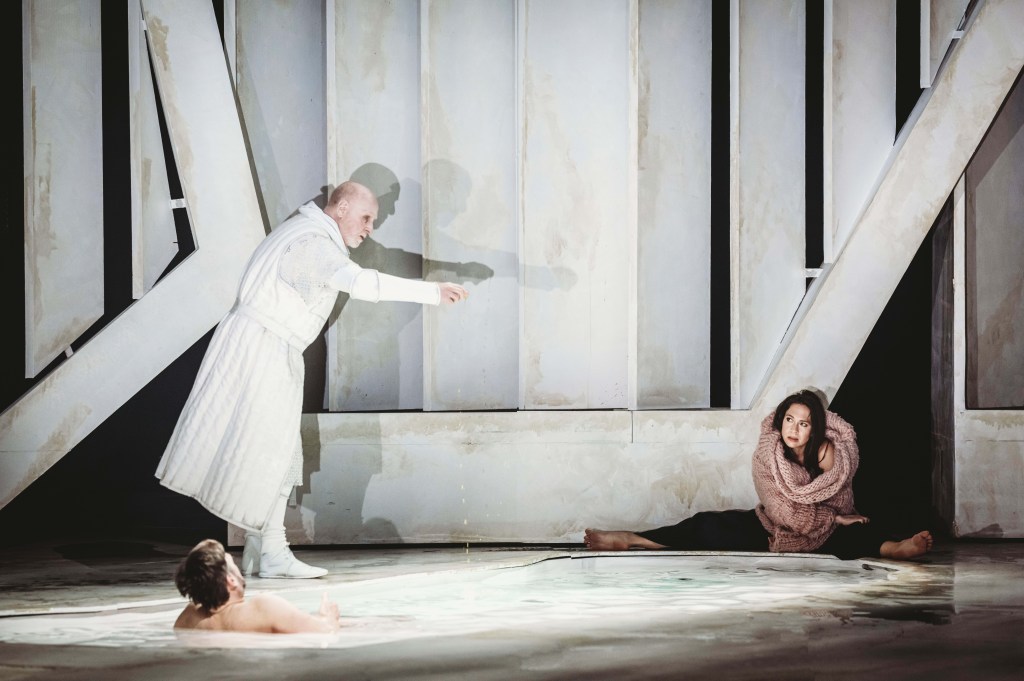
Michael Nagy is our Amfortas — king of the Grail Knights, cursed and tormented. His only hope? “Der reine Tor.” And when he sings those words, there’s no fuss, no frills. Just air, clarity, and a straight tone on “reine” — pure, plain, painfully honest. Fitting, really, when salvation lies in the hands of a “pure fool.”
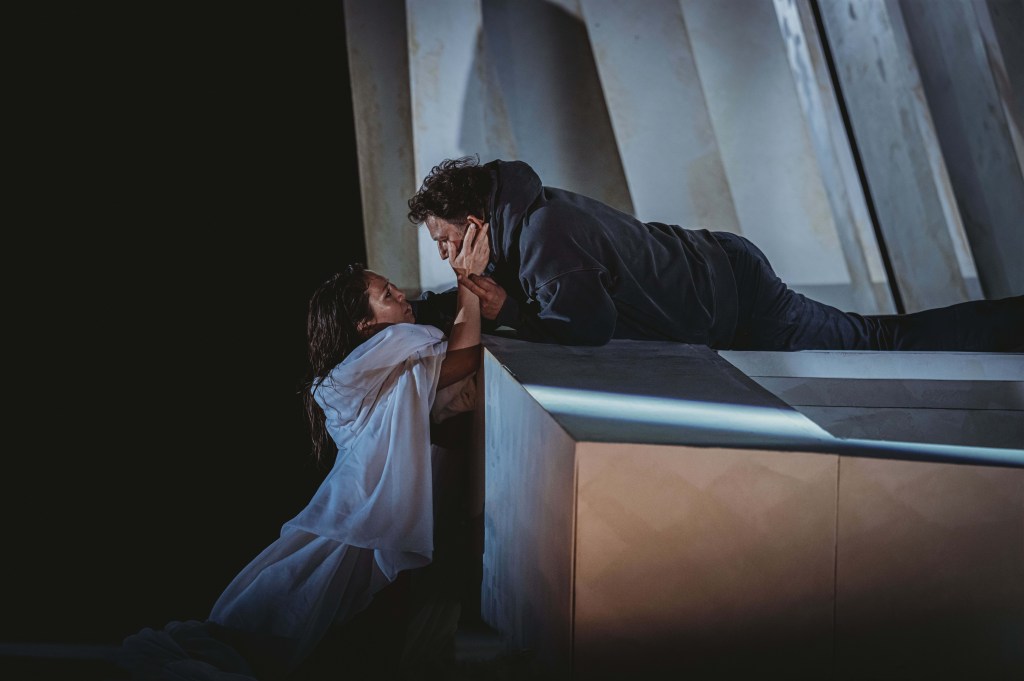
So, who exactly is this reine Tor, this pure fool? Well, that’s the mystery we’re here to unravel. It might just be the very man at the heart of the piece: Parsifal himself. And who else to take on the role but the Festspiele’s own intendant, Jonas Kaufmann. No one shapes vowels like he does. His tone is uniquely his, with an ability to sound plaintive and full of yearning, as if his voice is constantly searching for something just out of reach.
During the transition music in the first act, the giant white harp-like structures are shuffled around like oversized pieces on a cosmic chessboard. From the floor, a secret compartment opens, and voilà — the golden grail floats up like some divine elevator ride. In the background, a video shows a waterfall — or maybe we should call it a waterrise? The water is defying gravity. Is Amfortas the new Moses?

Drama, Surprises, and a Touch of Technical Trouble
Act 2 delivers drama — and a bit of unexpected comedy. Klingsor, spear in hand, orders Kundry to seduce Parsifal, with his flower maidens ready to lend a hand. But when Klingsor strikes the same pose as Amfortas earlier, standing over the magic compartment, nothing happens.
The choir hums softly, but the grand reveal? Stuck. Cue the uncomfortable silence. It’s not until conductor Asher Fisch halts the orchestra, and Klingsor (Georg Nigl) taps his spear on the floor — as if giving the maidens a gentle nudge, like, “Hey, it’s showtime, ladies!” — that Jonas Kaufmann steps out, informing the audience about the unexpected glitch.
Nigl, with a grin, says, “Den Zauber hat nicht funktioniert,”(the magic didn’t work) and laughter ripples through the hall. These things happen, and there’s no use in stressing over it.

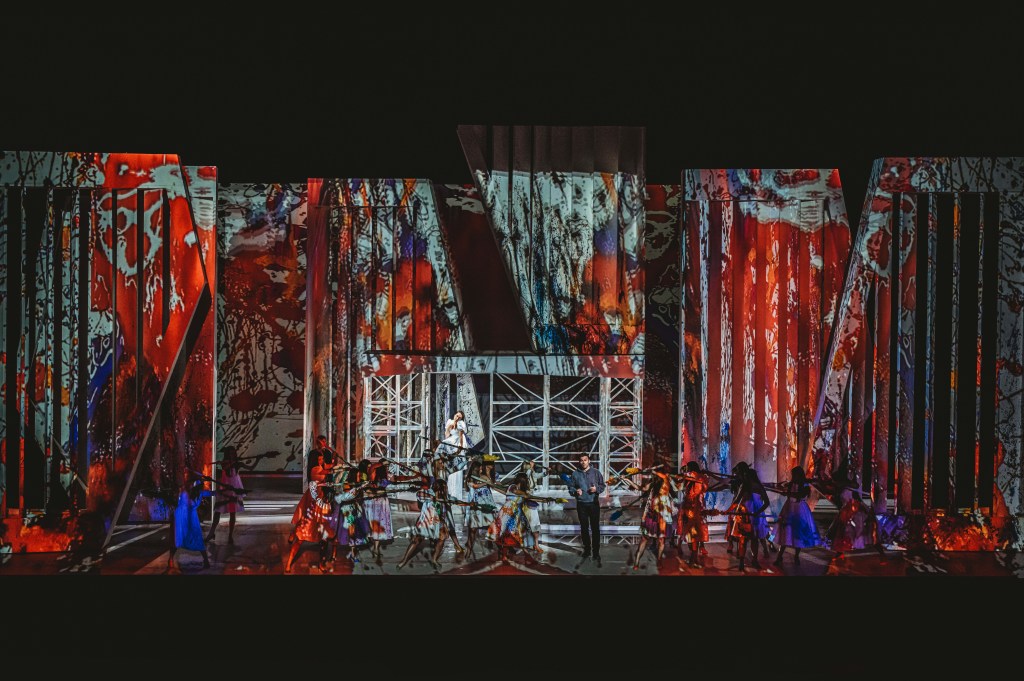
A few moments later, they’re back on track, and the flower maidens finally make their grand entrance. Clad in white, but with vibrant splashes of color color as if they’ve just stepped out of a painter’s studio. Even the towering white harps get a fresh coat of flair.
After the playful antics with the flower maidens, the spotlight shifts to Kundry, brought to life by Irene Roberts. In her portrayal, Kundry’s voice soars with confidence, especially in the higher registers. However, there’s a certain rawness missing in her portrayal — the edge that would give Kundry her full complexity. It’s as though the focus leans more towards hitting the notes perfectly than letting the words tell the story. That said, when it comes to tone, there’s absolutely nothing to fault. Her voice is rich and resonant, a beautiful instrument in its own right.
What is going on?
Turns out, we’re not stuck in the “white world” after all. Now and then, videos flicker across the stage — glimpses of the festival hall, the building next door, a blink here, a hallway there. I try to connect the dots, squinting for meaning, but eventually resign myself to the fact that this might be one of those productions. The kind where you’re not supposed to decode everything like a puzzle. It’s abstract, ambiguous — and maybe that’s the point. Still, there are clues. Eyes keep popping up, quietly staring from different corners. Maybe a hint that someone’s always watching? Or perhaps a nod to Kundry’s gaze, always trailing Parsifal just a second too long?
Or perhaps one of the evening’s most striking moments: when the Grail is supposed to be revealed in the final scene, there’s no chalice. Oh no, another technical glitch? Nah, don’t worry. Instead, the backdrop lifts — and in walk people in everyday clothes. No robes, no halos, just regular folks who could easily be your neighbours, your barista, or you. They slowly make their way forward, singing as they ascend the stairs toward the audience. And then, as if that weren’t enough, the orchestra pit begins to rise, lifting the musicians up to stage level like a musical revelation. So what is the Grail? Us? The collective? Or maybe even the music itself?
Fun Fact:
At the final Parsifal in Bayreuth in 1882, Wagner stole the baton during the Verwandlungsmusik and secretly conducted to the end. First and last time he ever conducted in his own opera house!
The Cast:
- Conductor: Asher Fisch
- Director: Philipp M. Krenn
- Stage Director: Heike Vollmer
- Costume Designer: Regine Standfuss
- Lightning Designer: Stefan Schlagbauer
- Video: Thomas Achitz
- Dramaturg: Werner Hintze
- Amfortas: Michael Nagy
- Titurel: Clive Bayley
- Gurnemanz: Brindley Sherratt
- Parsifal: Jonas Kaufmann
- Klingsor: Georg Nigl
- Kundry: Irene Roberts
- 1. Gralsritter: Marius Pallesen
- 2. Gralsritter: Lukas Enoch Lemcke
- 1. Knappe: Annina Wachter
- 2. Knappe: Maya Gour
- 3. Knappe: Hyunduk Kim
- 4. Knappe: Lukas Siebert
- 1. Blumenmädchen I: Annina Wachter
- 2. Blumenmädchen I: Stefani Krasteva
- 3. Blumenmädchen I: Zoe Hippius
- 1. Blumenmädchen II: Evelina Liubonko
- 2. Blumenmädchen II: Maya Gour
- 3. Blumenmädchen II: Karis Tucker
- Stimme von Oben: Karis Tucker
Orchester und Chor der Tiroler Festspiele Erl

 Blogfløjten