
Frauenliebe und -sterben – Woman’s Love and Death. It sounds solemn, tragic, and suitably Schumannesque – and it is. But somewhere between romance, ruin, and a remarkable amount of Reuter-related wreckage, the evening may leave you wondering less about love and more about Johan Reuter’s truly terrifying kill count…
From Bridal Bliss to Burial Business
First up is Robert Schumann’s song cycle Frauenliebe und Leben, staged in a grand living room straight out of Schumann’s own day. Everything looks perfectly polished – at least until the plot starts drawing blood… The costumes keep us firmly in period, which is only fitting for a cycle composed in 1840.
American mezzo-soprano Kate Lindsey takes us through all eight songs, following one woman (Clara Schumann perhaps?) from love at first sight to wedding delight, lullabies, and a cracked heart. With only voice and piano, it begins as chamber music and ends as emotional chambers of doom.
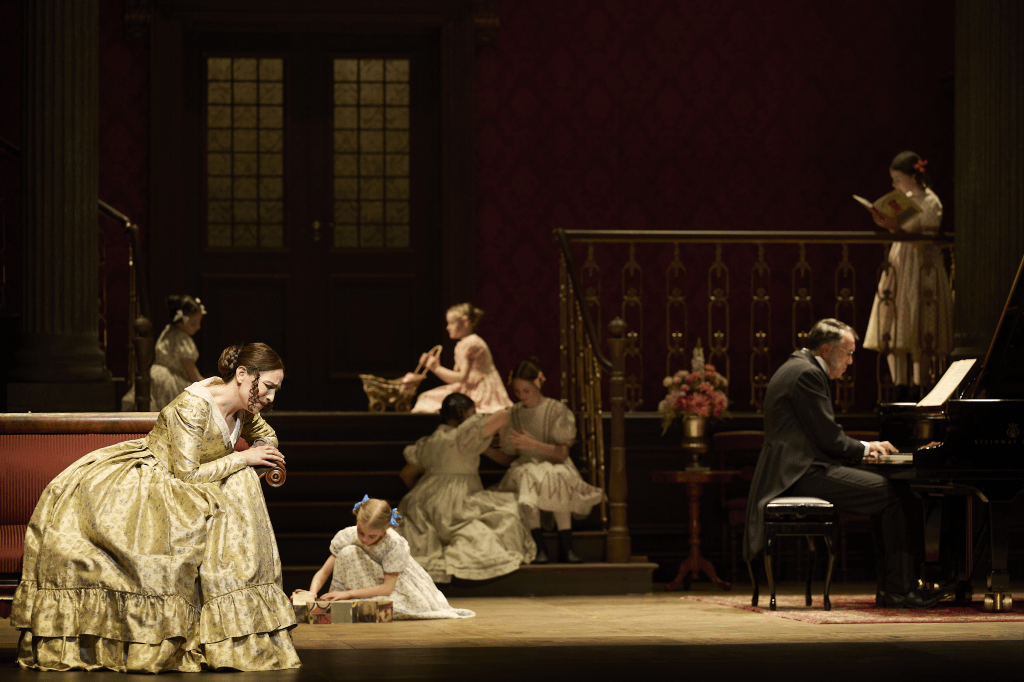
Funny thing about going to the opera and ending up with just one instrument (besides the singing) – and then barely hearing it. The piano gets swallowed by the room a little too easily. That big black grand might have made a grander impression closer to the front of the stage. As it is, the whole thing feels strangely split. Intimate, because it’s just one voice and one piano. Yet oddly distant at the same time.
Luckily, the playing itself is anything but lost. Éric Le Sage brings real lightness to the score – sage by name, and sage in touch – guiding the unnamed woman through each turn of her tale with elegant ease. He does not just accompany her songs; he seems to accompany her whole life. Right there in her own sitting room, we watch love turn to lullabies, and lullabies turn to laments. By the end, Schumann’s Frauenliebe und Leben has quietly become Frauenliebe und Leiden – and finally, Frauenliebe und Sterben.
Then we find ourselves at her funeral – and before the mourners have even had time to fold up their handkerchiefs, the deep strings surge up and drag us straight into Béla Bartók’s Bluebeard’s Castle. Now we are in a marriage with some very questionable housing choices. Judith has just married Bluebeard and is seeing his place for the first time: no windows, no daylight, and tooooo many locked doors…
Knock Knock: Who Is There…?
In Tobias Kratzer’s staging, though, we are still in the very same apartment as before. The furniture is familiar, but the mood has darkened considerably. And there, once again, is Danish baritone Johan Reuter as the husband (this time actually singing) – only now we have moved forward in time, and whatever passed for romance in Frauenliebe und Leben has clearly gone from wedded bliss to Bluebeard abyss.
Once Judith has had a look around, she discovers seven locked doors. That is the engine of Bartók’s opera: one by one, she insists on opening them. In Kratzer’s version, though, these are not literal doors. They are doors into the past – into Bluebeard’s memories, emotions, and carefully buried secrets.
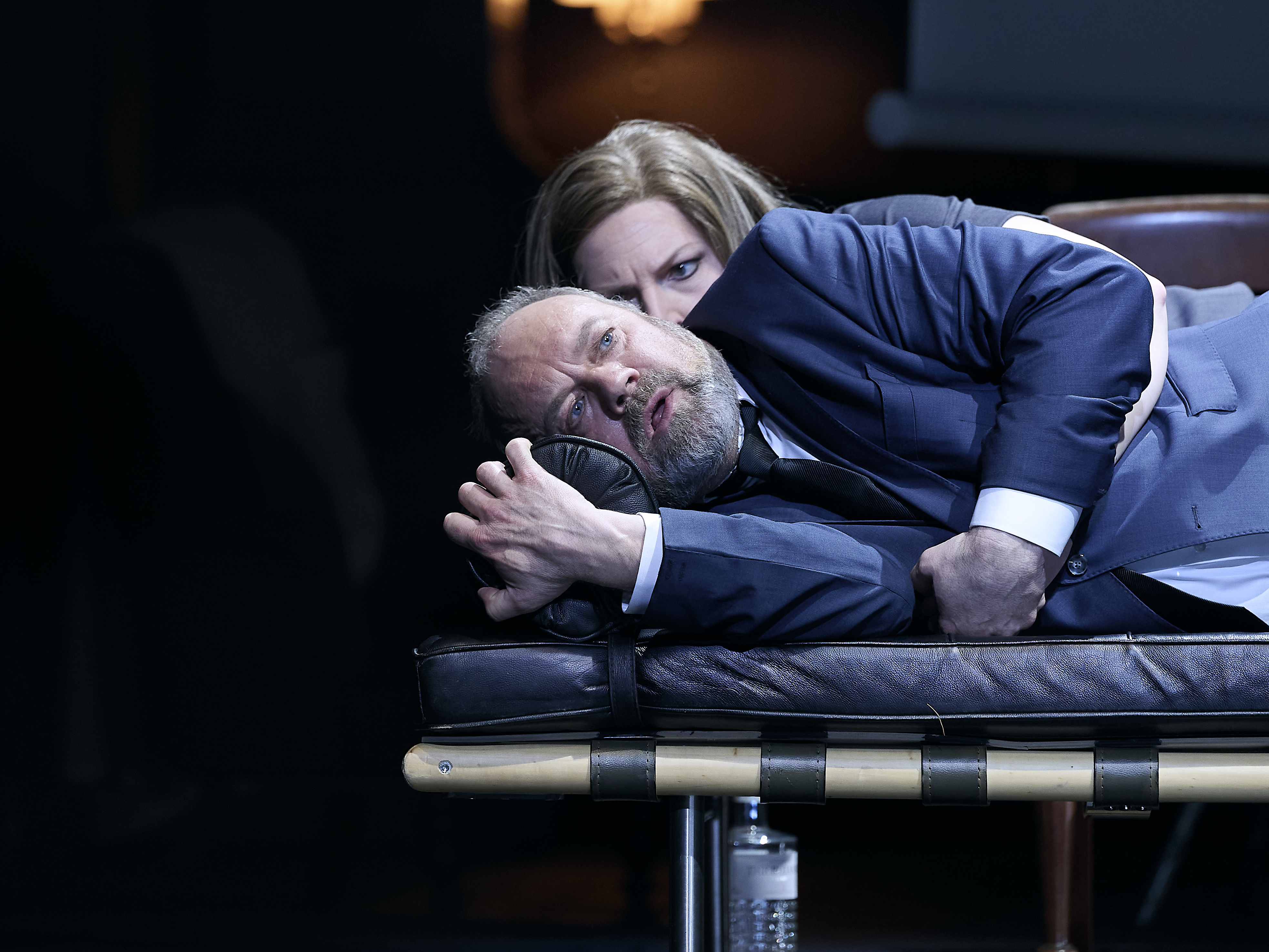
The first “door” is the diary of the dead woman from Schumann’s cycle – neatly tying the two works together. We also glimpse the coffin again, as if the first story (or woman) is refusing to stay buried. Behind door number two comes a cabinet of weapons. While Bluebeard disappears inside, we see two women kissing. When he returns in uniform, rifle in hand, one shot rings out, and death takes command.
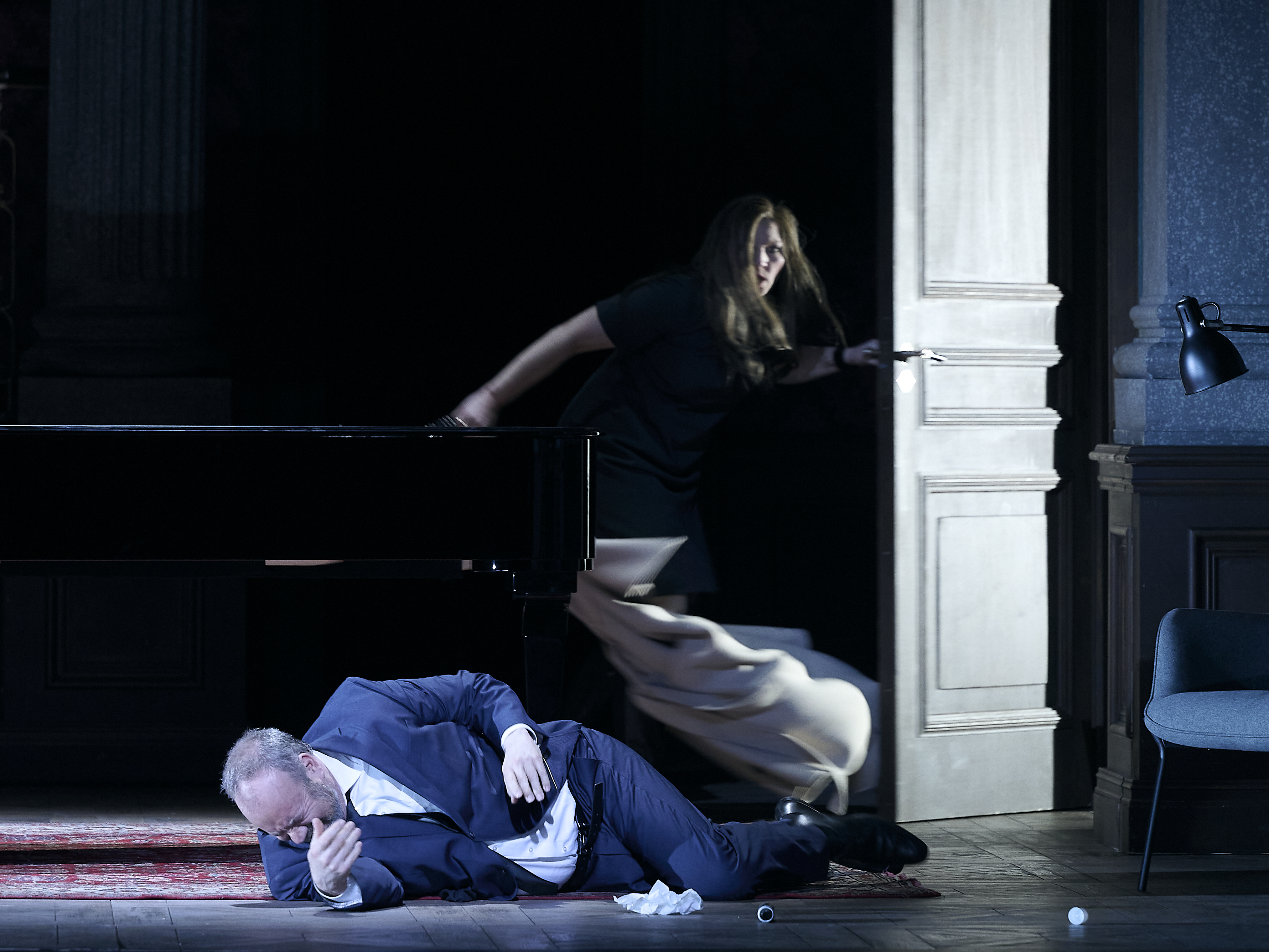
Door four is harder to pin down. Suddenly there is the moon landing, people in tin-foil hats, two children playing, and Bluebeard behaving suspiciously sweetly toward more than one woman at once… At this point, it starts to feel as though Johan Reuter is no longer playing just one man, but an entire anthology of male menace. Before long, two more women are dead – one on video, another taking a fatal tumble down the stairs. That is quite enough for Judith. She tries to run. Bluebeard attacks. But Judith, wisely, has come prepared: out comes the pepper spray…
Florentine Flames and Fatal Games
The final piece is another one-act opera: Alexander Zemlinsky’s Eine florentinische Tragödie. Like Bartók’s Bluebeard’s Castle, it’s from the 1910s – clearly a period with flair for compact operas and catastrophic relationships. And this one is – in case the title was not ominous enough – yet another love story gone gloriously wrong. This time, it’s a triangle.
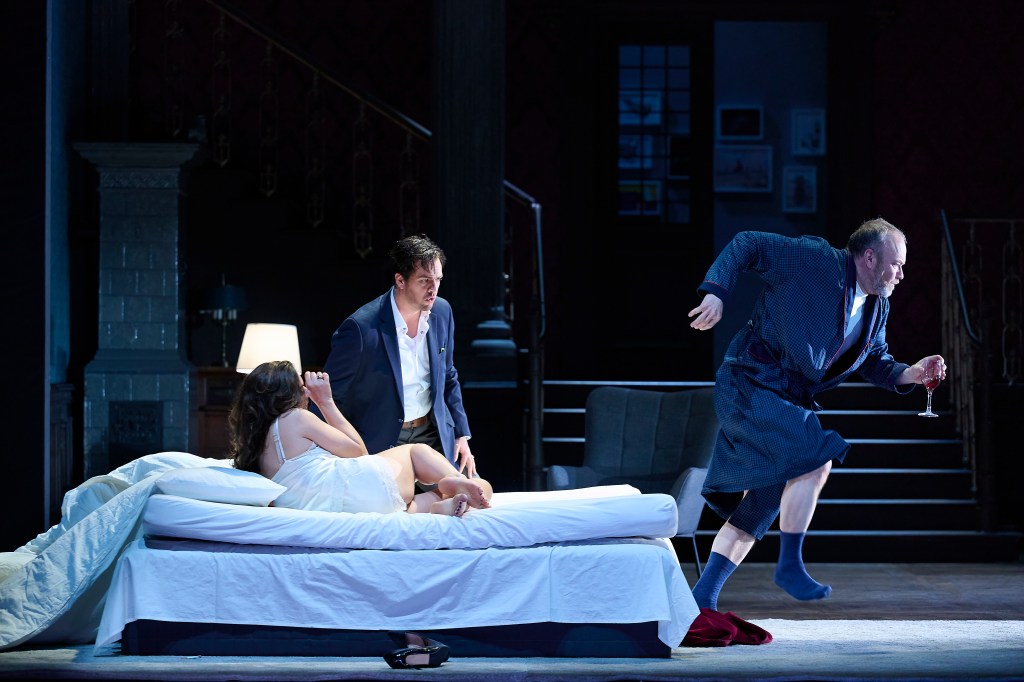
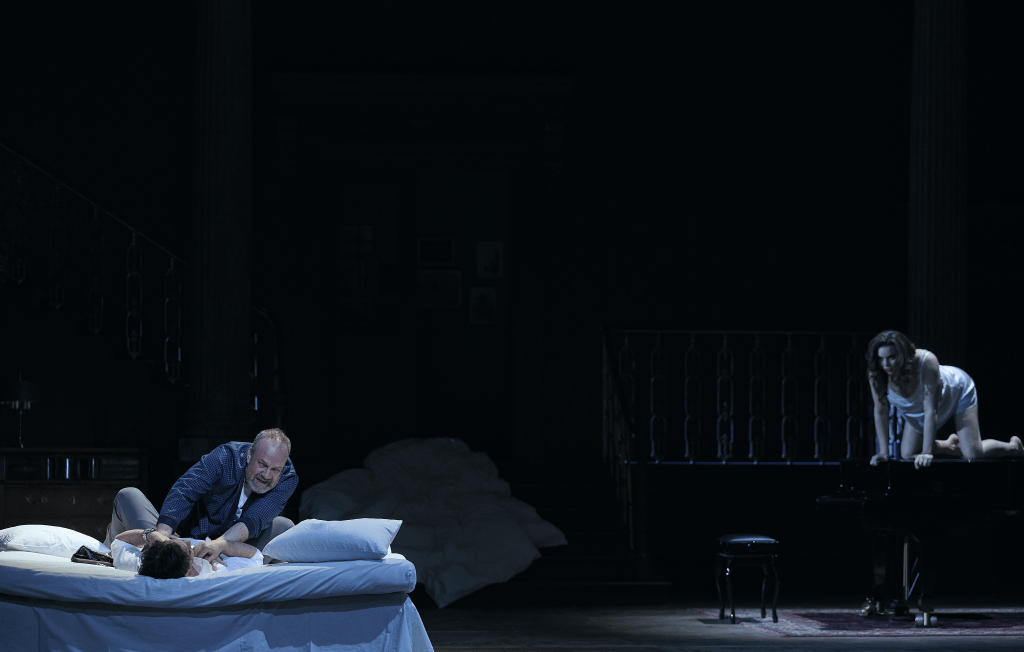
It begins with Bianca and Guido Bardi in bed together, only to be interrupted by Bianca’s husband Simone, who comes home earlier than expected. If this sounds like the sort of awkward situation that might end in uncomfortable small talk over dinner, think again: Zemlinsky – with Oscar Wilde grinning in the wings – has no interest in polite domestic drama. This love triangle is less about angles and more about sharp edges.
Musically you can clearly hear that these two operas are not the works of the same composer. Hungary and Austria may be neighbours, but Bartók and Zemlinsky speak very different musical languages. Bartók’s score leans toward something more earthy and national in flavour, with folk-like colours simmering beneath the surface. Zemlinsky, by contrast, seems to have one ear turned firmly toward Richard Strauss. You hear it in the harmonic language, but even more in the orchestration.
Zemlinsky’s orchestra is wonderfully chatty. The instruments do not just accompany; they gossip, argue, and occasionally break into little solo flourishes of their own. They support the drama, yes, but they also seem to sing along with it – commenting on the action like extra cast members who just happen to be armed with violins.
What Is Kratzer Really After with this trilogy?
Eine florentinische Tragödie opens with an advertisement for “the modern man”: the sort of spotless specimen who is loving, considerate, and apparently also knows his way around household chores. It is a little clue to what Kratzer is doing with these three works.
And, it should be said, he has a cast fully capable of carrying it, with the singing level consistently first-rate throughout the evening. He is not just stitching together three tales of doomed relationships for the fun of it. He is tracing a darker history of men and women across generations: from Schumann’s romantic ideal of devoted womanhood, through Bartók’s psychological violence, to Zemlinsky’s dark game of seduction, dominance, and destruction.
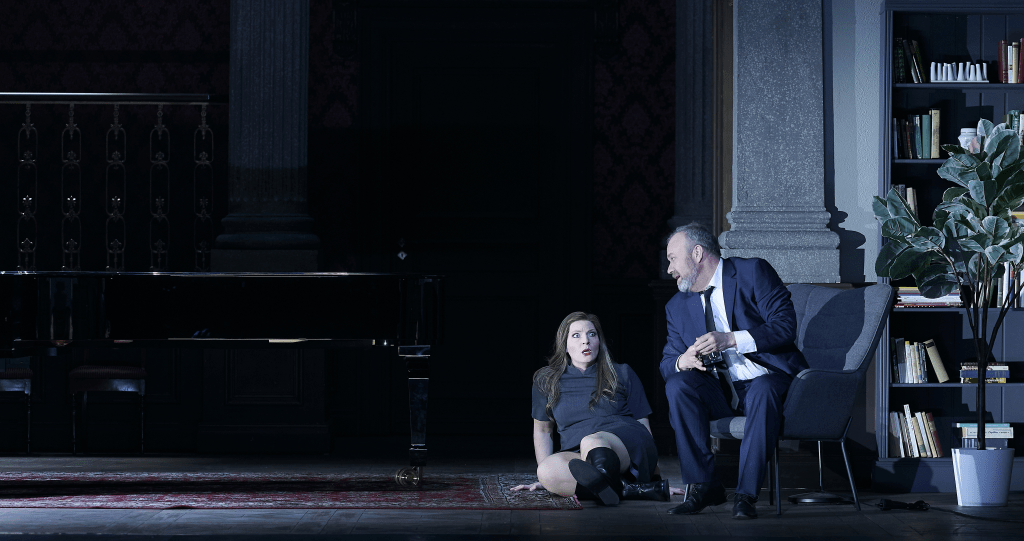
Different as these relationships are, they all share one unsettling truth: each of them could still describe a relationship we might recognise today. That is perhaps Kratzer’s sharpest point – not that these stories belong to the past, but that their patterns of devotion, control, jealousy, and violence remain stubbornly present.
What makes the trilogy clever is precisely that the first piece is not an opera at all.
Schumann’s Frauenliebe und Leben might seem like the odd one out, but in Kratzer’s hands it becomes the emotional blueprint for everything that follows. Its image of love – tender, idealised, and entirely shaped around the woman’s devotion to a man – is where the evening begins.
The two operas that follow then crack that ideal wide open, exposing what can lurk beneath it: secrecy, control, manipulation, and violence. In that sense, the Schumann is not a detour. It is where the whole tragic chain reaction begins. And after three hours of love, lies, locked doors, and lethal husbands, one question remains: has anything really changed?
Frauenliebe und Leben (1840), Robert Schumann
Bluebeard’s Castle (1918), Béla Bartók
Eine florentinische Tragödie (1817), Alexander Zemlinsky
Fun Fact!
Trailer:
Bartók wrote Bluebeard’s Castle in 1911 for a competition – and found the judges firmly behind closed doors. He tried again in 1912, but they still thought two characters in one room were not enough to unlock real drama. Only in 1917, after rewriting the ending, did Bartók finally find the key to giving Bluebeard’s Castle the last word.
Cast:
- Conductоr: Karina Canellakis
- Directоr: Tobias Kratzer
- Stаge Designer and Costume Designer: Rainer Sellmaier
- Video Designer: Manuel Braun
- Lightning Designer: Michael Bauer
- Dramaturg: Henriette von Schnakenburg
Frauenliebe und Leben:
- Pianist: Éric Le Sage
- Singer: Kate Linsey
Bluebeard’s Castle:
- Bluebeard: Johan Reuter
- Judith: Annika Schlicht
Eine Florentinische Tragödie:
- Simone: Johan Reuter
- Bianca: Ambur Braid
Guido: Thomas Blondelle
Philharmonisches Staatsorchester Hamburg
- Innocence, The Royal Danish Opera 2026
- Die Walküre, Hamburgische Staatsoper 2026
- Werther, The Royal Danish Opera 2026
- Macbeth, Royal Danish Opera 2026
- Tosca, Opera Hedeland 2026
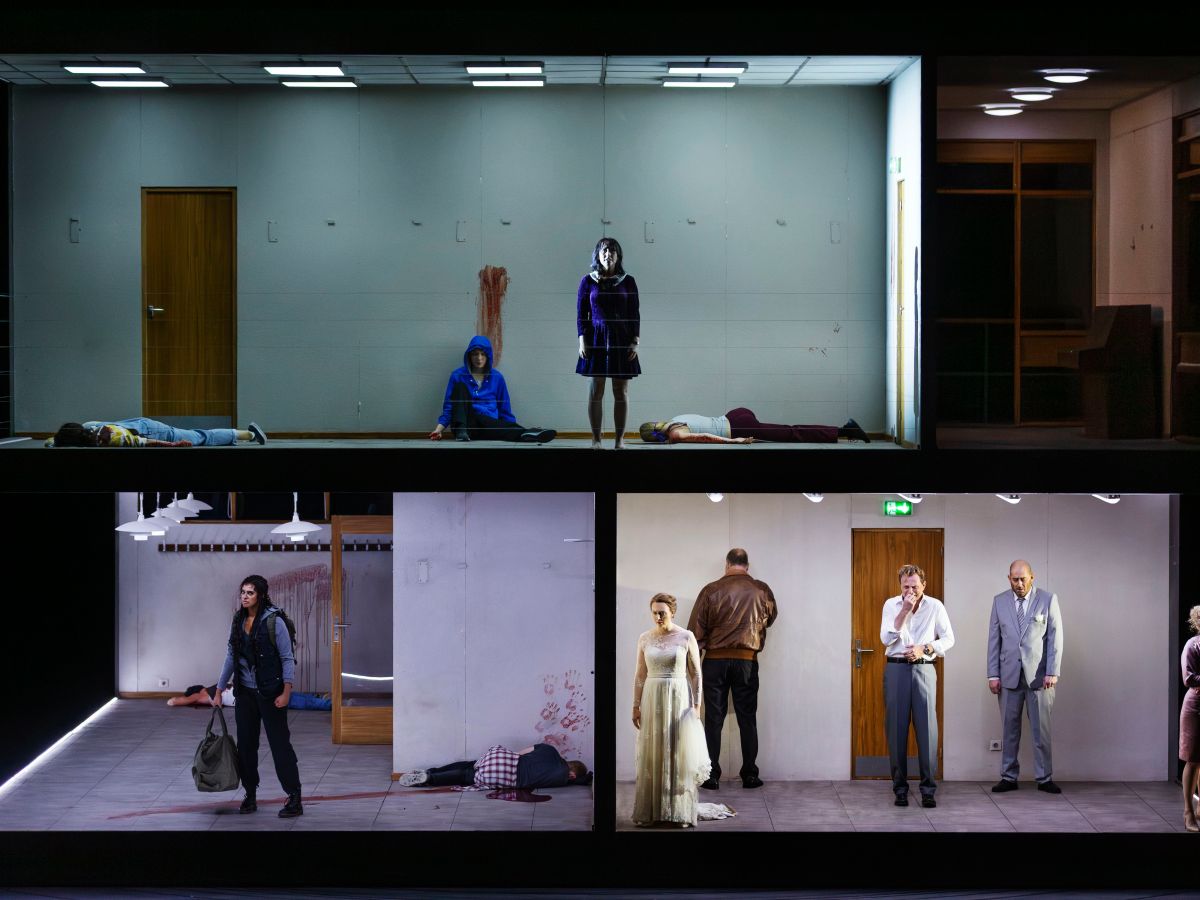
Innocence, The Royal Danish Opera 2026
Guilt is a funny thing. You don’t have to pull the trigger to be caught in the aftermath. Sometimes, simply being there – or being related to the person who did it – is enough. We like to think we’re innocent. But scratch the surface, and who knows what you might find? In Kaija Saariaho’s…

Die Walküre, Hamburgische Staatsoper 2026
How much control do we really have over our own lives? We make decisions, change our minds, take wrong turns and tell ourselves that, ultimately, we are the ones behind the wheel. But what if the steering wheel isn’t really ours to begin with? In Claus Guth’s now 18-year-old production of Die Walküre, control is…
Werther, The Royal Danish Opera 2026
Werther you like it or not, doomed love is back on the menu. Think Tristan and Isolde, but with the drama dialled down a notch. The music is a little Wagner, a little Puccini – just without the same oomph. Chief conductor Marie Jacquot keeps the orchestra on its toes, steering the whole thing with…

