

Richard Wagner wrote Parsifal for his very own theatre in Bayreuth. Ideally, that’s where it would have lived happily ever after. It didn’t. Clearly.
Because Parsifal isn’t just an ‘opera’, it’s a piece of architecture in sound. Written for that exact acoustic, those stubborn wooden seats, the wide, bowl-shaped hall, the hidden orchestra pit, the distant choir that seems to sing from nowhere and everywhere at once.
You sit in the dark. No distractions. Then the strings begin to stretch upwards joined by a bassoon and a clarinet. The sound doesn’t point in a direction; it drifts. Is it coming from the side? From above? From somewhere under your seat? You can’t quite tell. It just hovers, then slowly, quietly, creeps closer – until it’s no longer around you, but inside your ears – under your skin.
Floris Visser’s new production starts in total darkness. No applause for Daniele Gatti, no polite beginning. Just black – and then the music begins to breathe.
And yes, however heavenly the music may be, keeping the lights off all night would turn Parsifal into more of a holy endurance test than a holy stage festival. Luckily, salvation comes early.
There’s plenty to look at. Parsifal may be one of the longest – if not the longest – residents of the repertoire, but in this production, boredom doesn’t even get a foot in the door. There’s always something shifting, something stirring. A shadow sliding across the stage, a figure flickering in and out of sight.
Where Are We?
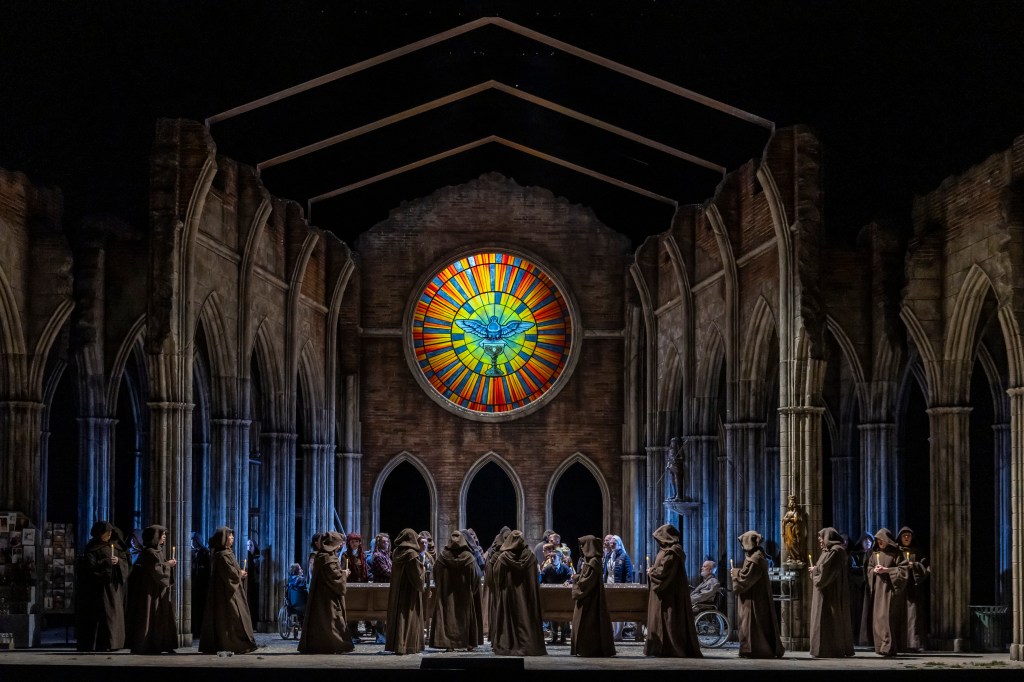
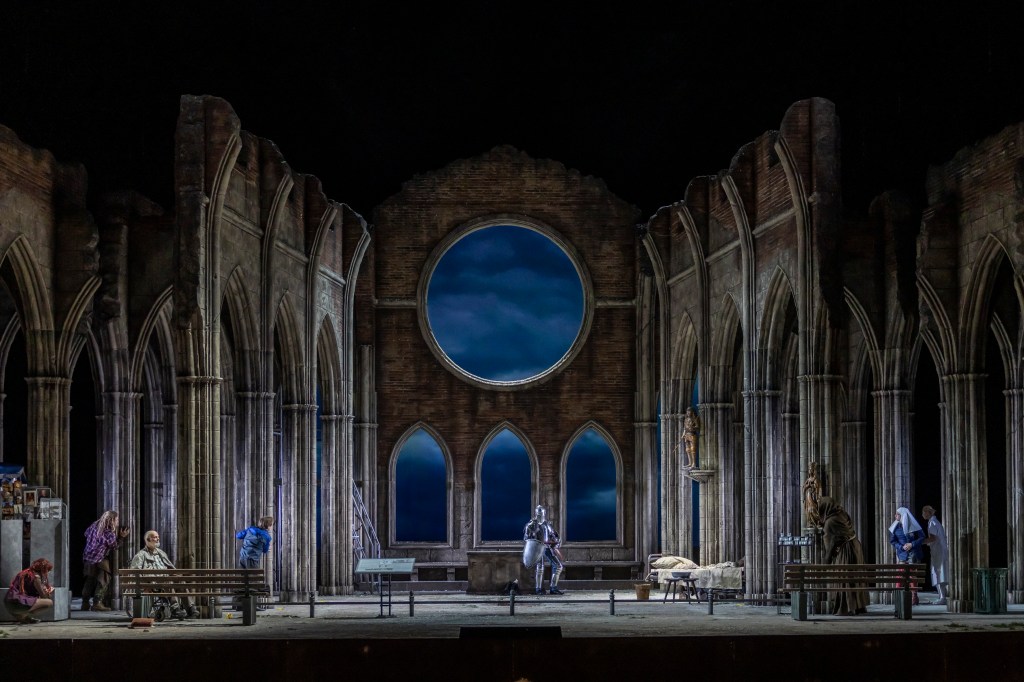
Somewhere between myth and museum, it seems. Most likely the old Monsalvat – once the sacred stronghold of the Grail knights, now apparently upgraded with opening hours and a gift shop.
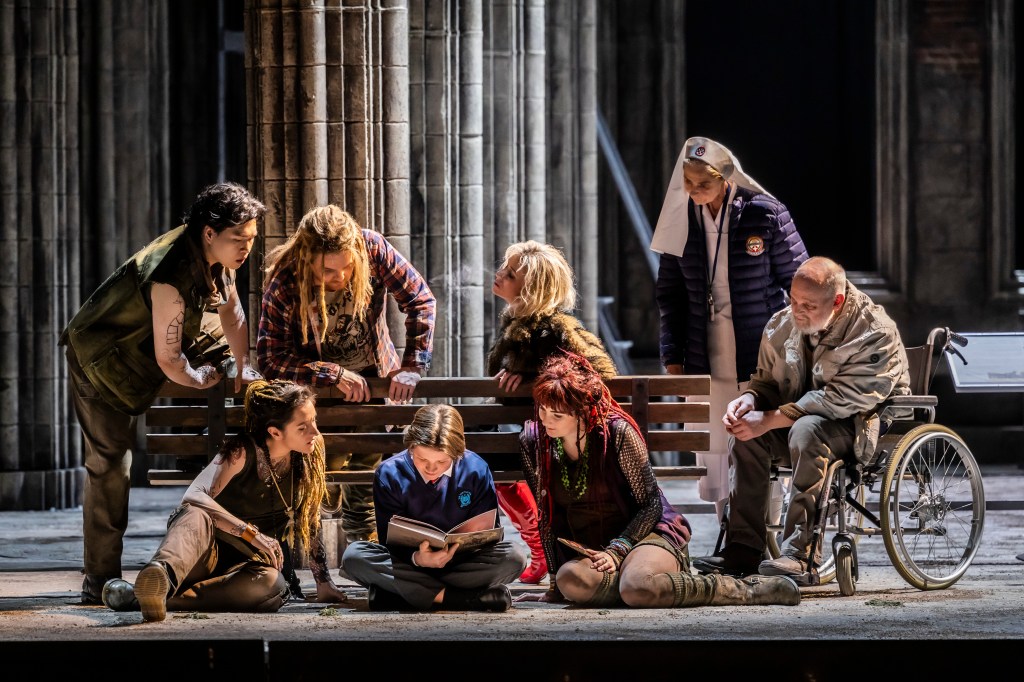
In come the visitors: backpacks, sun hats, the occasional school class marching in with matching uniforms and mild enthusiasm. They all want a glimpse of the old sacred space. A quick cultural checkbox. Snap a photo, move on.
But wait – one boy isn’t playing along.
He keeps drifting off, nose buried in a book. While the group shuffles forward, he slips away, breaks free, finds a bench, and sinks into his story. People gather around him.
And just like that, we’re no longer in a museum.
We’re inside his imagination. Inside his story. Which, as it turns out, is Parsifal.
So for the rest of the evening, we follow the boy.
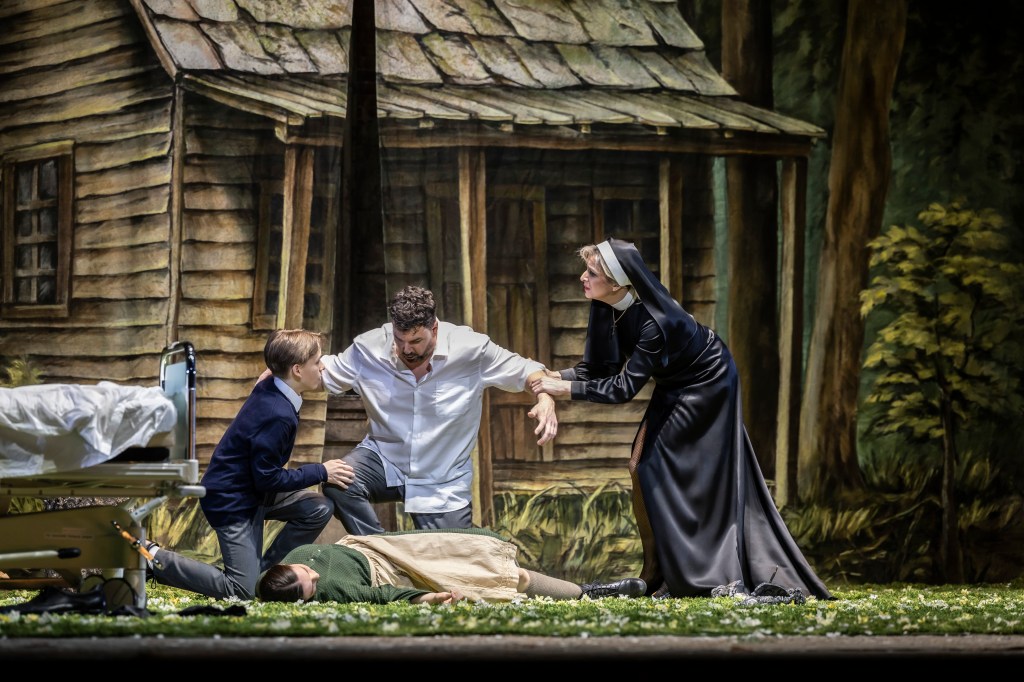
He watches it all unfold: the swan is shot, Parsifal is tempted by Klingsor’s dangerously persuasive flower maidens, and Kundry… well, she’s busy injecting herself with something she definitely shouldn’t. Even though the boy repeatedly tries to take it away from her…
But he’s not just watching like the rest of us, politely planted in our seats.
He interferes. He steps in. He tries – again and again – to help, to fix (no, not like Kundry), to nudge the story in a slightly better direction.
Gurnemanz appears like a monk in a modest brown robe. Quite the contrast to Kundry, who storms in loud in red, thigh-high mode. And Parsifal? He occasionally clanks around in full armour – because, well, someone has to commit to the knight-code.
When Gurnemanz starts telling the backstory, the production basically goes: “Talking? No no – we’ll show you.”
Suddenly, his words don’t just hang in the air – they turn into scenes. We see how Amfortas was lured in, how Kundry played her part, and how he ended up with that stubborn, side-wound that simply refuses to heal. Ever. (Well…almost.)
Because, of course, there’s a catch: only the spear – now in the hands of Klingsor – can heal him. And that’s exactly where Parsifal enters the picture, armour and all, whether he fully understands the assignment or not.
In general, whenever someone starts telling a story, the staging gently nudges it into existence. Not just words, but small scenes unfolding right in front of us.
When Gurnemanz sings the famous line “Zum Raum wird hier die Zeit”, he pulls out… a snow globe. You know the type – tiny perfect world inside, everything neat and calm. Give it a shake and suddenly it’s full-on snow chaos. Then it slowly – or rather snowly – settles again, like time itself just needed a quick spin and a moment to pull itself together.
And that’s exactly where we’re pulled in.
As the transformation music begins in Act I we’re inside that globe. The one with those deep, echoing church bells…
…well, usually, at least.
Holy Timing
This time, we had to make do with a slightly sleepy recording. The bells were there, but rounder, softer – less dunk and more… ding. Which meant they didn’t quite cut through the space the way they’re supposed to. And maybe that’s also why Daniele Gatti occasionally seemed to wrestle a bit with keeping it all lined up with the orchestra.
There were a few other moments too – some choral entries that didn’t quite land together, a couple of slightly wonky entrances from the orchestra. Nothing dramatic. Nothing disastrous. Just… not entirely in sync with the sacred machinery. But still – it’s a good orchestra. Just with a few human fingerprints on it.
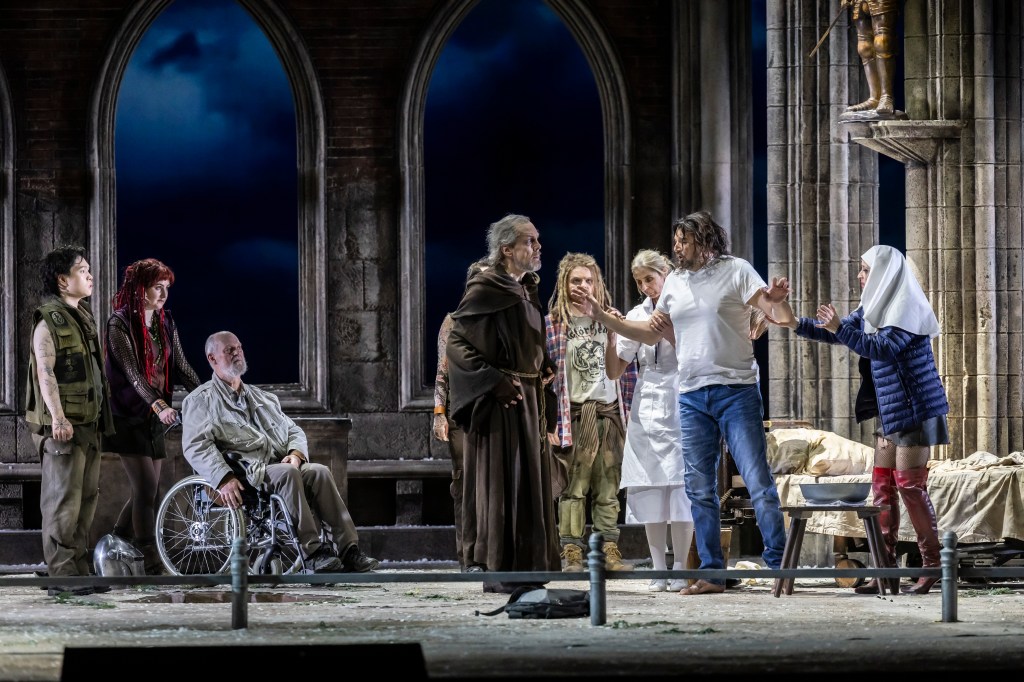
A Gentle Push from Gurnemanz
Daniele Gatti’s video-recording from Metropolitan Opera in 2013 is unbelievably slow. Like, time-stretches-and-takes-a-nap kind of slow. So I half expected something along those same lines here. Turns out, I was wrong.
We never really got close to Hans Knappertsbusch’s expansive tempi. Except, maybe, in the final act – where things occasionally felt like they wouldn’t have minded a gentle nudge forward from the podium.
And I’m not entirely convinced Georg Zeppenfeld was completely sold on it either. At times, it felt like he was subtly trying to move things along… just giving the tempo a slight push forward.
That said, there is a silver lining to taking things a touch slower. The inner voices begin to shimmer into focus, the layers unfold, and suddenly the music isn’t just moving forward – it’s breathing sideways. You hear the details, the hidden lines, the quiet conversations within the orchestra that might otherwise slip past unnoticed.
Aside from that, the conducting was all right (or left, depending on where you were sitting). You could think of the dynamics like waves on the sea – big, rolling swells that suddenly rise up, only to drop you right back down into a quiet dip where everything almost stands still.
Daniele Gatti lets the music surge and settle like that – never completely static, always gently shifting. One moment it’s full and forceful, the next it pulls back, leaving you suspended in a kind of calm, hovering in between. He definitely has his own way of shaping this music.
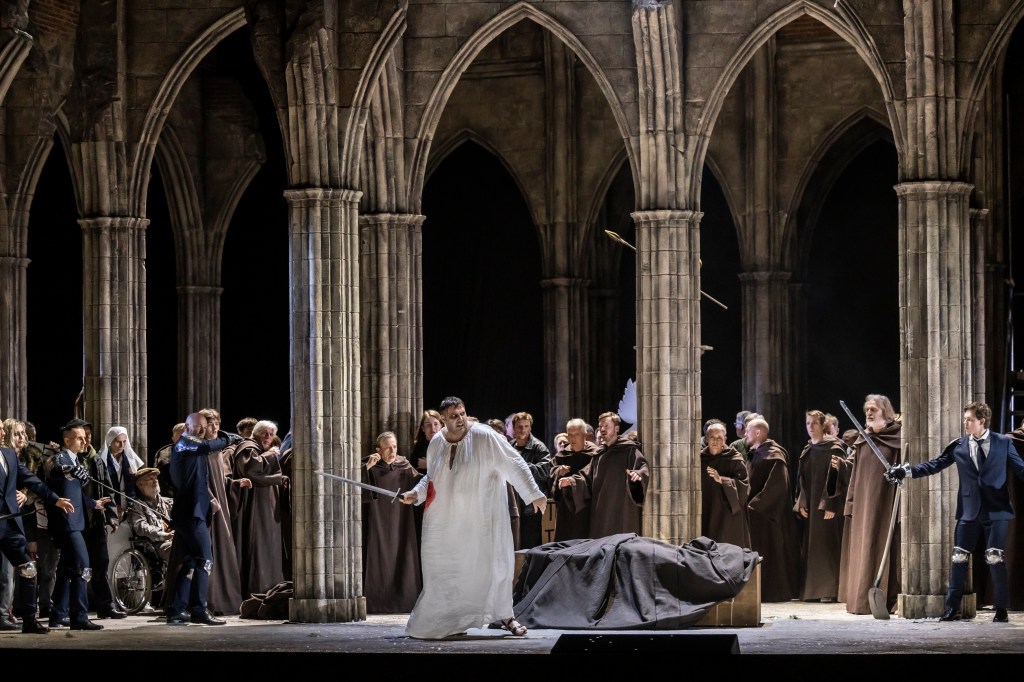
Georg Zeppenfeld is the singer I’ve heard most often as Gurnemanz – and he still hasn’t disappointed.
There’s a clarity to everything he does. The crisp articulation, the calm, compelling storytelling, the way the overtones seem to bloom out of the sound, the sheer richness of the voice. And despite Gurnemanz being an absolute marathon of a role, you’d never guess it from him. No strain, no struggle. Just steady, spacious singing, like he’s got all the time in the world.
At this point, it almost makes you wonder… could we get a Gurnemanz 2.0?
You know how some pianists take a perfectly good piece and add a few extra runs, a couple of sparkling flourishes just because they can? Same idea. Not because anything is missing, but simply because Zeppenfeld makes it sound like there’s still more to give.
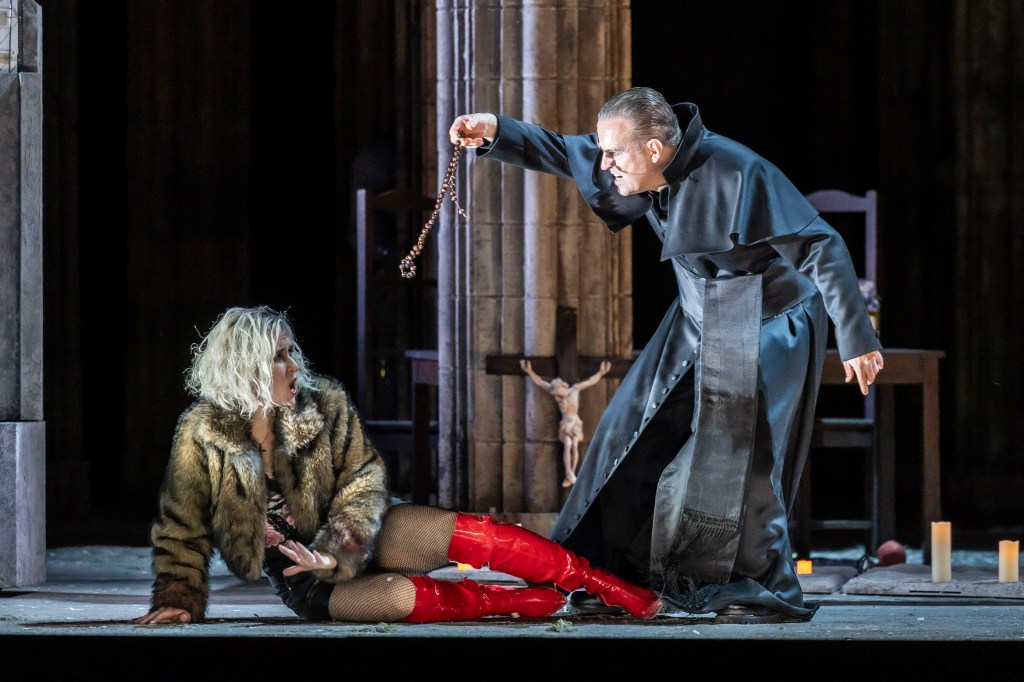
The Canadian mezzo-soprano Michèle Losier presents a more lively Kundry. Her voice is firmly grounded in the chest, and when she takes those big leaps – from the high B down to C♯ (almost two octaves) – she does it so smoothly you barely notice the register shift.
The final chorus of Parsifal alone is enough to make you want to stay for the entire evening. And this time, it wasn’t just singing.
Yes, art tends to be political, and there was no escaping it here. We’d already been given hints along the way: “Black Lives Matter,” “Make peace not war,” “There is no planet B” and a not-so-subtle nod to that president over in the United States.
And then comes the final scene.
Everything looks resolved. Reconciled. Almost suspiciously harmonious. But just as the chorus settles into that sense of closure, the signs go up. One by one. Quietly, but unmistakably. And just like that, we’re no longer in some distant, mythical past – we’re snapped straight back into 2026.
One of them reads: “The end is near.”
Which, to be fair… accurate on multiple levels.
A few seconds later, the final note fades – and before it can fully settle, the applause crashes in and pulls us right back into reality.
Fun Fact:
Hermann Levi conducted the word premiere of Parsifal – even though Richard Wagner didn’t want him.
As director of the Munich opera, Levi had powerful backing and Ludwig II of Bavaria made it very simple: no Levi, no orchestra.
Trailer:
Cast:
- Conductоr: Daniele Gatti
- Directоr: Floris Visser
- Stаge Designer: Frank Philipp Schlößmann
- Сostume Designer: Jon Morell
- Light Designer: Malcolm Rippeth
- Video Designer: Will Duke
- Dramaturg: Jörg Rieker, Martin Lühr
- Choreography: Demi Wals
- Сhoir: Jan Hoffmann
- Amfortas: Oleksandr Pushniak
- Titurel: Albert Dohmen
- Gurnemanz: Georg Zeppenfeld
- Parsifal: Eric Cutler
- Klingsor: Scott Hendricks
- Kundry: Michèle Losier
- 1. Gralsritter: Mario Lerchenberger
- 2. Gralsritter: Tilmann Rönnebeck
- 1. Knappe: Jasmin Delfs
- 2. Knappe: Ekaterina Chayka-Rubinstein
- 3. Knappe: Aaron Godfrey-Mayes
- 4. Knappe: Jin Yu
- Blumenmädchen 1/1: Jasmin Delfs
- Blumenmädchen 1/2: Rosalia Cid
- Blumenmädchen 1/3: Winona Martin
- Blumenmädchen 2/1: Magdalena Lucjan
- Blumenmädchen 2/2: Elena Gorshunova
- Blumenmädchen 2/3: Ekaterina Chayka-Rubinstein
- Stimme aus der Höhe Michal Doron
Sächsischer Staatsopernchor Dresden, Kinderchor der Semperoper Dresden, Sinfoniechor Dresden – Extrachor der Semperoper Dresden, Sächsische Staatskapelle Dresden
- Innocence, The Royal Danish Opera 2026
- Die Walküre, Hamburgische Staatsoper 2026
- Werther, The Royal Danish Opera 2026
- Macbeth, Royal Danish Opera 2026
- Tosca, Opera Hedeland 2026
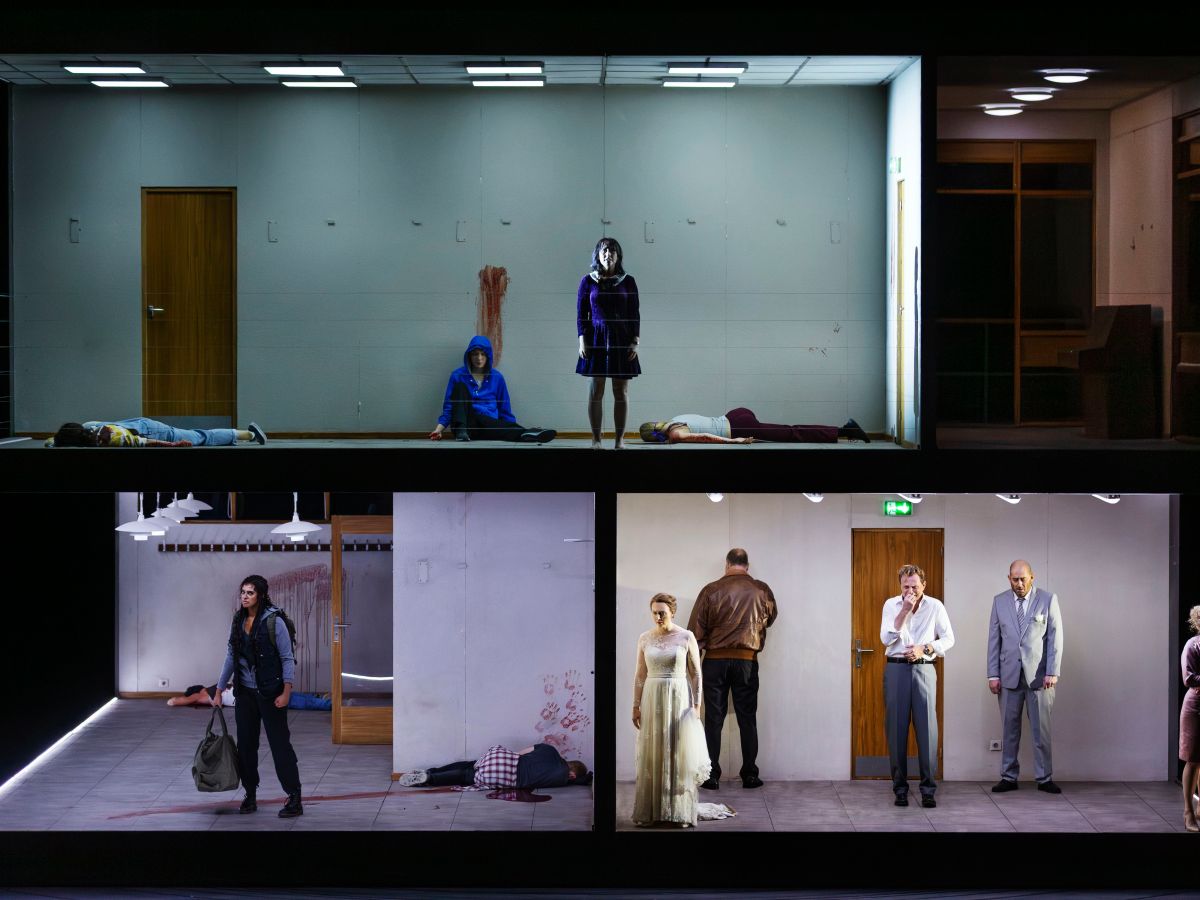
Innocence, The Royal Danish Opera 2026
Guilt is a funny thing. You don’t have to pull the trigger to be caught in the aftermath. Sometimes, simply being there – or being related to the person who did it – is enough. We like to think we’re innocent. But scratch the surface, and who knows what you might find? In Kaija Saariaho’s…

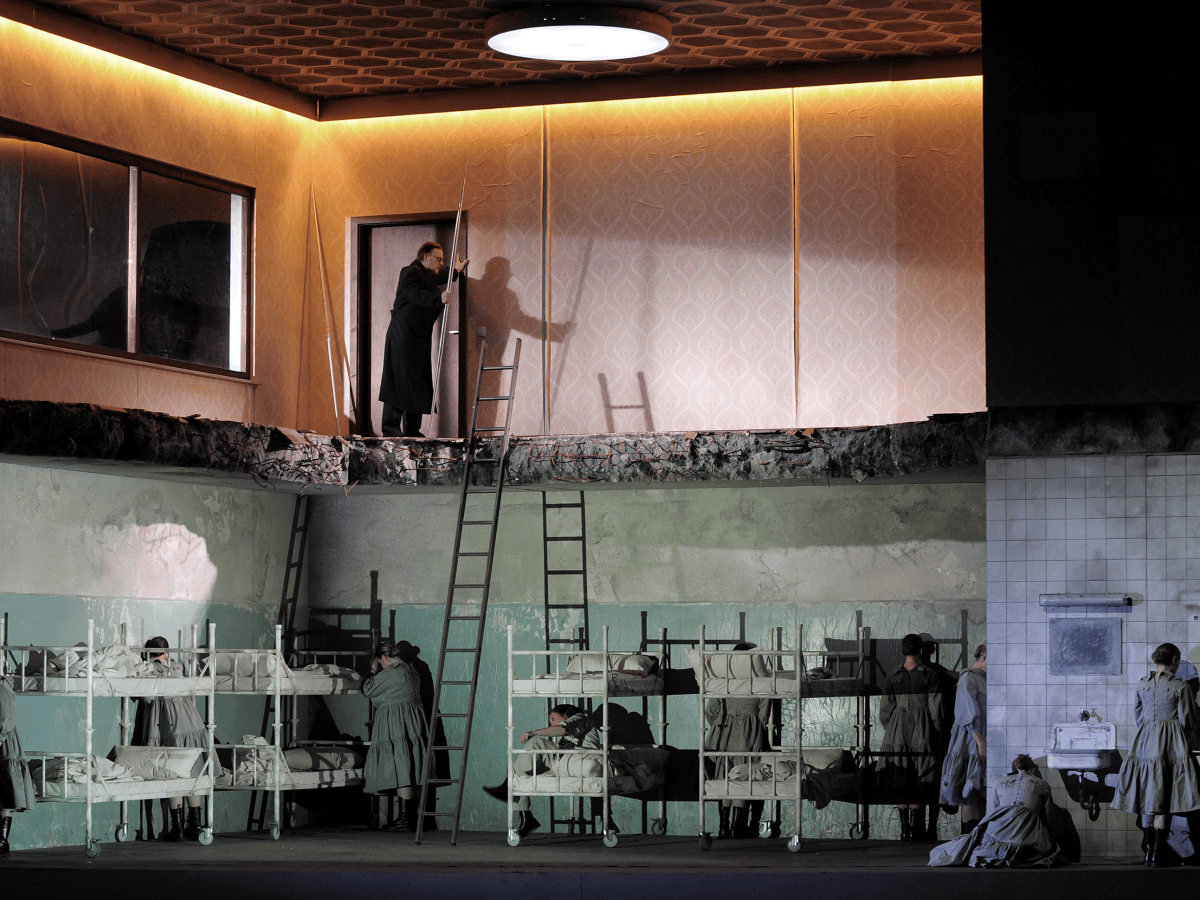
Die Walküre, Hamburgische Staatsoper 2026
How much control do we really have over our own lives? We make decisions, change our minds, take wrong turns and tell ourselves that, ultimately, we are the ones behind the wheel. But what if the steering wheel isn’t really ours to begin with? In Claus Guth’s now 18-year-old production of Die Walküre, control is…
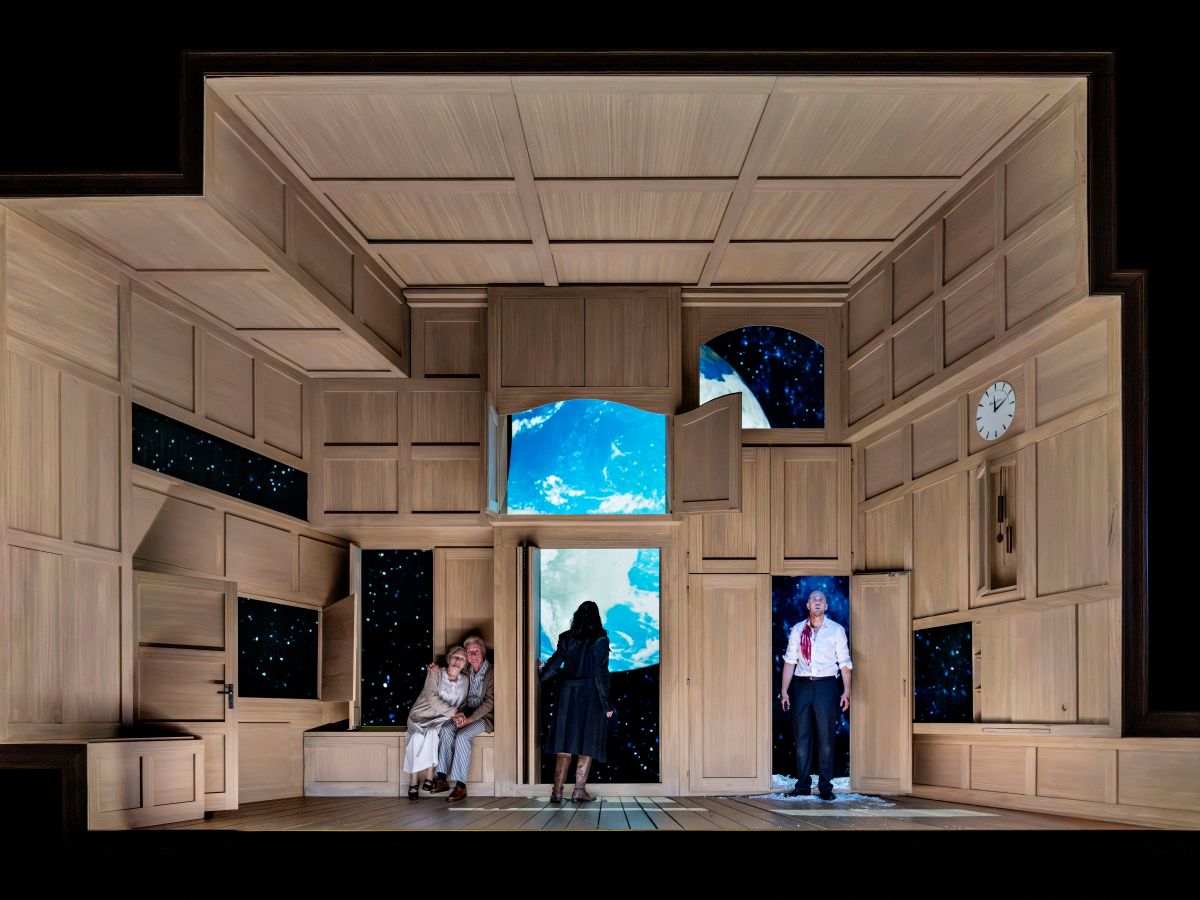
Werther, The Royal Danish Opera 2026
Werther you like it or not, doomed love is back on the menu. Think Tristan and Isolde, but with the drama dialled down a notch. The music is a little Wagner, a little Puccini – just without the same oomph. Chief conductor Marie Jacquot keeps the orchestra on its toes, steering the whole thing with…

