
Can you translate an opera into another language?
A hundred years ago, when Der Rosenkavalier was fifteen years old, the answer was pretty much: of course you can. Translate, tweak, turn. Almost everything was sung in the local language. It wasn’t until the second half of the 20th century that people started getting a bit more loyal to the original language.
Are they singing it in Danish at the opera in Copenhagen, you might be thinking?
Sensible suggestion. But no… not tonight.
So, why bring it up?
Well, the ever-sharp duo Hugo von Hofmannsthal and Richard Strauss drop us straight into Vienna, around 1740. And in Vienna, people speak German. Or at least… something that smells like it.
What really sets Der Rosenkavalier apart is (among other things) the libretto. It’s not just up to the singers to sprinkle a bit of dialect on top – it’s baked right into the text. Tiny tweaks everywhere: “nit” instead of “nicht”, “mei” instead of “mein”, “ik” instead of “ich.” Not to mention all the words where the endings just… disappear. You can practically hear the accent jumping off the page before anyone even opens their mouth.
Which also means something slips through the cracks when the surtitles don’t play along. Or when Baron Ochs goes full Hochdeutsch – neat, complete, and a bit too clean. Maybe forcing a dialect would have felt… slightly too seen?
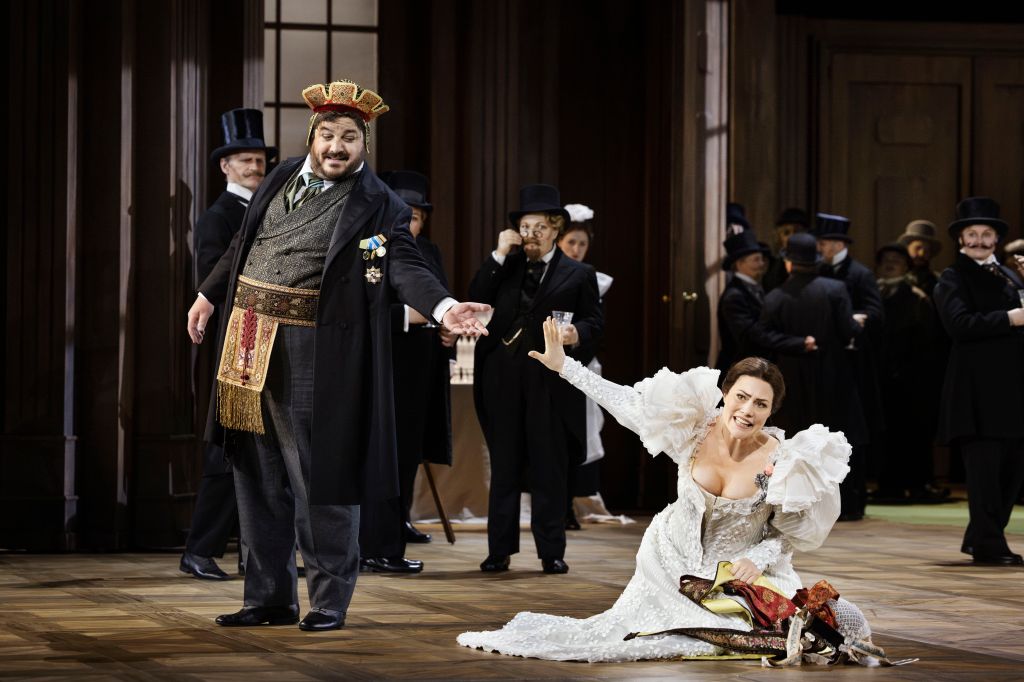
Either way, the role sits vocally great with the German bass Patrick Zielke. And with acting that dances right on the edge of “is this too much?,” he carries an interesting Baron. Whatever gets lost in language is made up for in sly, slippery stage presence: the kind of character who clearly thinks he’s impressive… without quite convincing anyone else. You probably know the type.
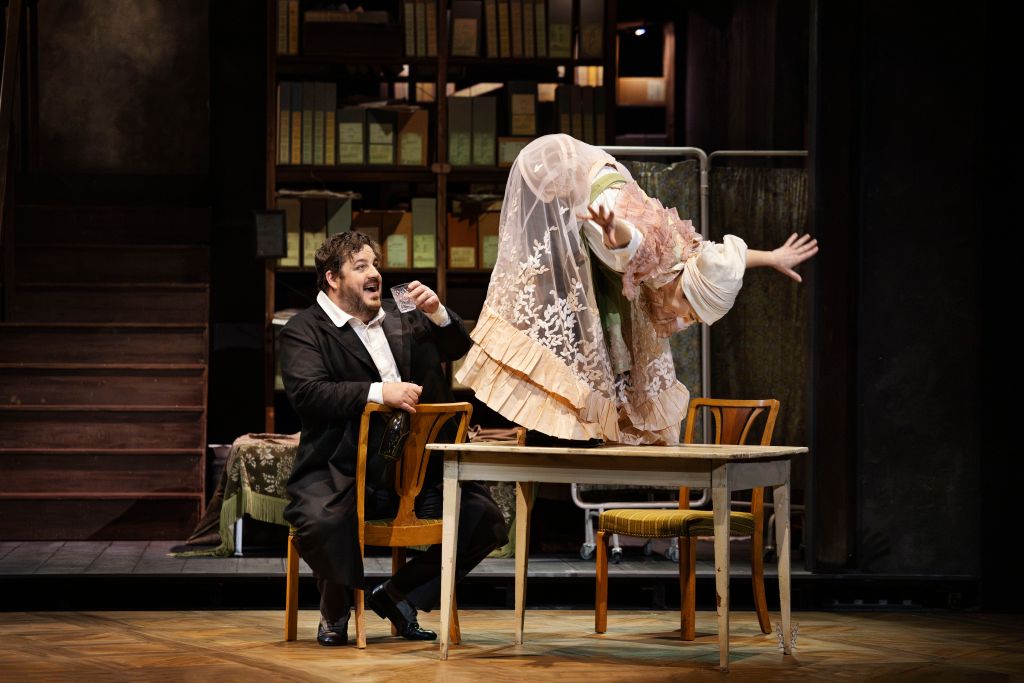
Ochs – as we call him – is a full-time flirt and a part-time fiancé. He may be on his way to marrying Sophie, but that doesn’t stop him from going… exploring elsewhere.
Even when “the lady” in question is actually a man in disguise – who is, in reality, a woman (yes, opera logic). A trouser role that’s just ditched the trousers and slipped into a dress. As one does.
Well… it doesn’t exactly go well for him. On several fronts.
It All Goes Down
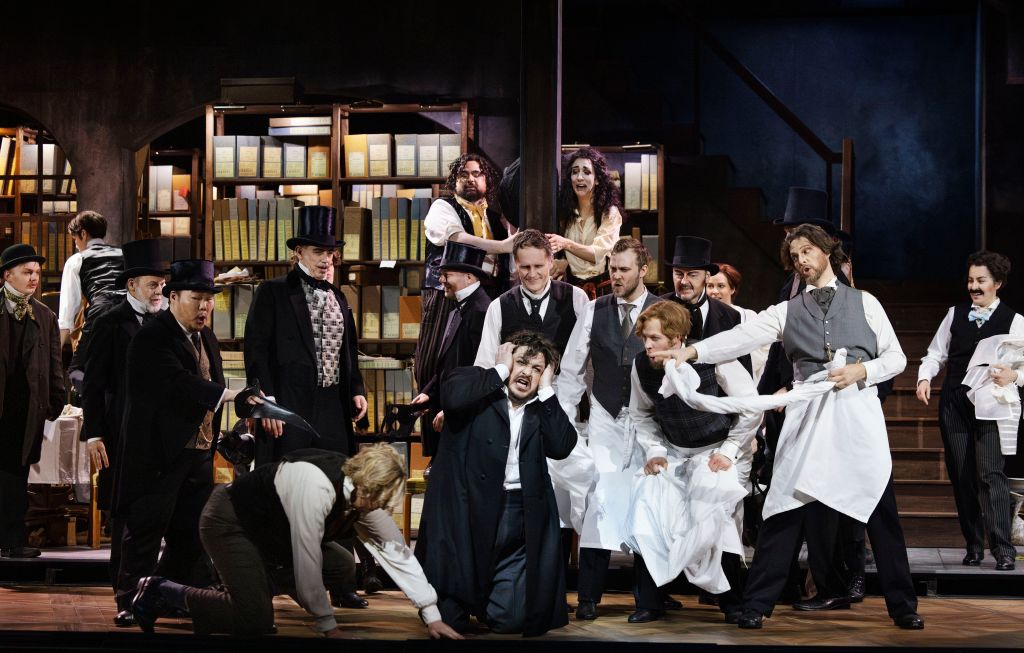
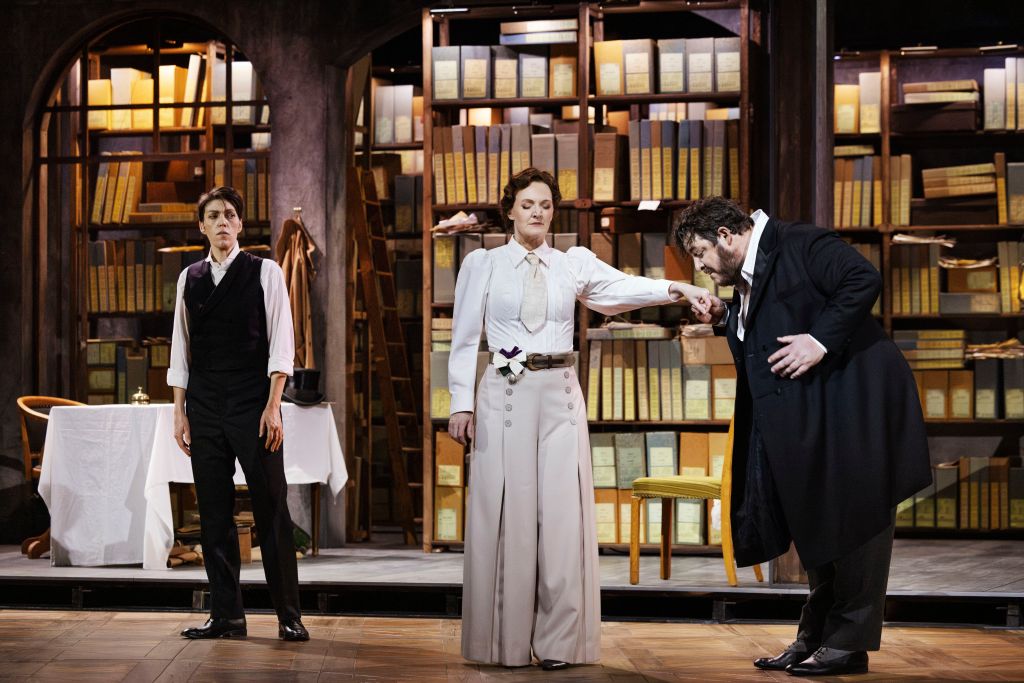
In Act III, in the Royal Danish Opera’s own opera chief Elisabeth Linton’s staging, we’re dropped into something like an archive basement – all shelves and shadows – and suddenly Ochs is caught in a full-blown fever dream: teetering bookcases, ghostly figures, flickering lights, chaos closing in from every corner. He’s left completely disoriented, dizzy and desperate.
In the first two acts, we’re boxed in by the same tall, brown walls. The kind that don’t just whisper money – they sort of murmur it in mahogany. The Marschallin is lounging on something seriously shiny – and no, it’s not (just) Octavian’s silver armour.
And the staffing? Slightly absurd. Two servants per door. Per door. That’s four people stationed outside one set of double doors, just waiting for someone important to… exist dramatically. Peak aristocratic overkill.
By Act III, you’re almost ready to file a complaint with the walls – and right on cue, they make an exit. Up they go, lifting towards the ceiling reveal what’s been hiding underneath: the basement.
Now From the Top…
Right at the beginning, we start inside a painting. A thin, almost see-through canvas shows a group of men in black suits and top hats – stiff, serious, and slightly too similar – sharply contrasted by one brightly dressed woman in the middle.
And then… click. Time to put on your imaginary 3D glasses.
Chief conductor Marie Jacquot starts things off on a slower and heavier side. Not a bad thing – it’s just a tempo you sometimes hear with a little more bounce. A different flavour.
Throughout, she shapes the score with a romantic sweep, combined with a chamber-music touch. Small figures are brought forward, textures thin out, and suddenly you’re not just hearing the orchestra – you’re peeking inside it. Little instrumental details flicker into focus – fast, fine and fleeting.
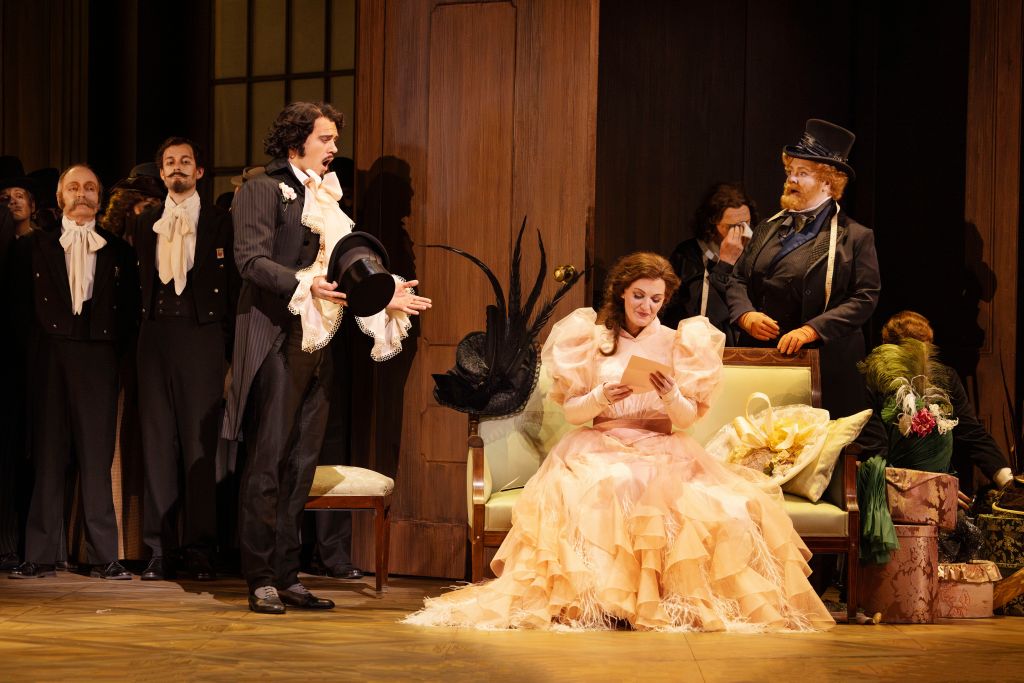
In the first two acts, the balance between singers and orchestra felt slightly o(r)ff – the orchestra occasionally flexing a bit too much. But in the final act, Jacquot reins it in, giving the singers more room.
Especially in the very last scene with the love-struck duo, Octavian and Sophie. The orchestra starts soft, almost shy, then swells – mirroring the moment as feelings rise and Octavian makes his move – before settling again, gently, as their final lines land. A musical inhale, a rush, and then… release.
The Swedish mezzo-soprano Elisabeth Jansson gives us an Octavian who is both shy and steady – a slightly hesitant presence, but with a voice that stands its ground. She sings with weight and warmth.
In the first act, it seems like Clara Cecilie Thomsen is holding back – which makes sense. Sophie is holding back too, after all. But as the evening unfolds, it becomes a little less clear whether it’s entirely a choice… or just the way the voice sits. Even when she leans in more later on, she doesn’t quite rise above Jansson in their duet.
That said, it doesn’t really break anything. The soprano naturally cuts through the texture in a different way – brighter, more forward – and Thomsen still delivers a voice that carries well.
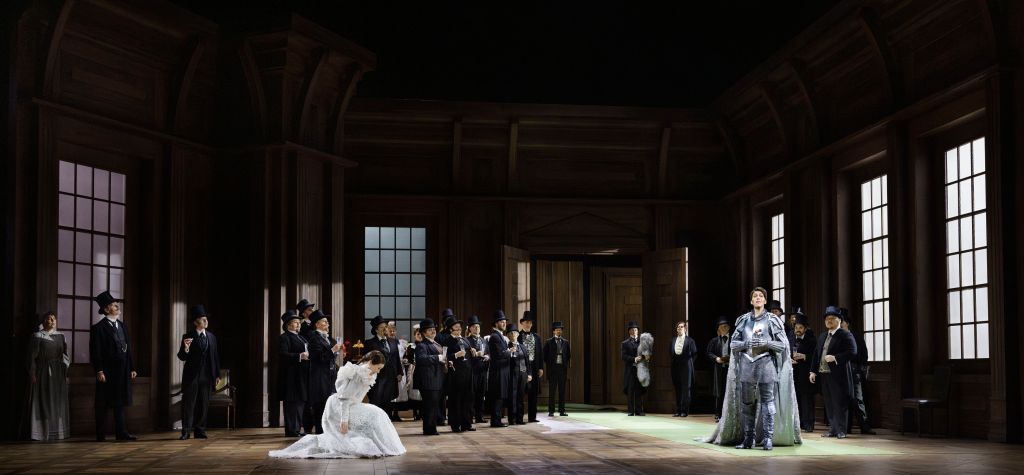
In Act II, Jansson enters in silver armour to present Sophie with the silver rose. The doors glide open, swords are raised, and he advances with full ceremonial confidence – not on a red carpet. This one is green.
Why green? Is it because he’s still a little green himself – young, slightly out of his depth, stepping into a role that’s just a size too large?
While Ochs is busy learning absolutely nothing, the Marschallin quietly does the opposite. Sung by Gisella Stille, she doesn’t just deliver text and tone – she actually says something.
The phrasing loosens, the rhythm bends ever so slightly. It all feels less polished, more personal. Not everything lands perfectly on the beat – but that’s exactly why it lands. It breathes.
Funny how that works – no translation needed.
Fun Fact:
Die Marschallin is only around 32 years old – yet she’s often portrayed as a much older woman.
Cast:
- Conductor: Marie Jacquot
- Director: Elisabeth Linton
- Stage Designer: Julia Hansen
- Costume Designer: Anja Vang Kragh
- Light Designer: Ulrik Gad
- Choreography: Miles Hoare
- Dramaturg: Henrik Engelbrecht
- Die Feldmarschallin: Gisela Stille
- Der Baron Ochs auf Lerchenau: Patrick Zielke
- Octavian: Elisabeth Jansson
- Herr von Faninal: Jens Søndergaard
- Sophie: Clara Cecilie Thomsen
- Jungfer Marianne Leitmetzerin: My Johansson
- Valzacchi: Jens Christian Tvilum
- Annina : Francine Vis
- Ein Polizeikommissar: Morten Staugaard
- Der Haushofmeister bei der Feldmarschallin: Liam Macnally
- Der Haushofmeister bei Faninal: Carl Rahmqvist
- Ein Notar: Simon Schelling
- Ein Sänger: Jacob Skov Andersen
- Adelige Waise: Berte Wiggers Lyneborg
- Eine Modistin: Helena Bjarkadottir
- Ein Tierhändler: Lars Bo Ravnbak
- Kindern: Morten Lassenius Kramp, Albin Ahl, Kenneth Reid, Per Strömberg
- Der Rosenkavalier, The Royal Danish Opera 2026
- Dialogues des Carmélites, The Royal Danish Opera 2026
- Monster’s Paradise, Hamburgerische Staatsoper 2026
- Dialogues des Carmélites, Semperoper Dresden 2026
- Lohengrin, Staatsoper Berlin 2026
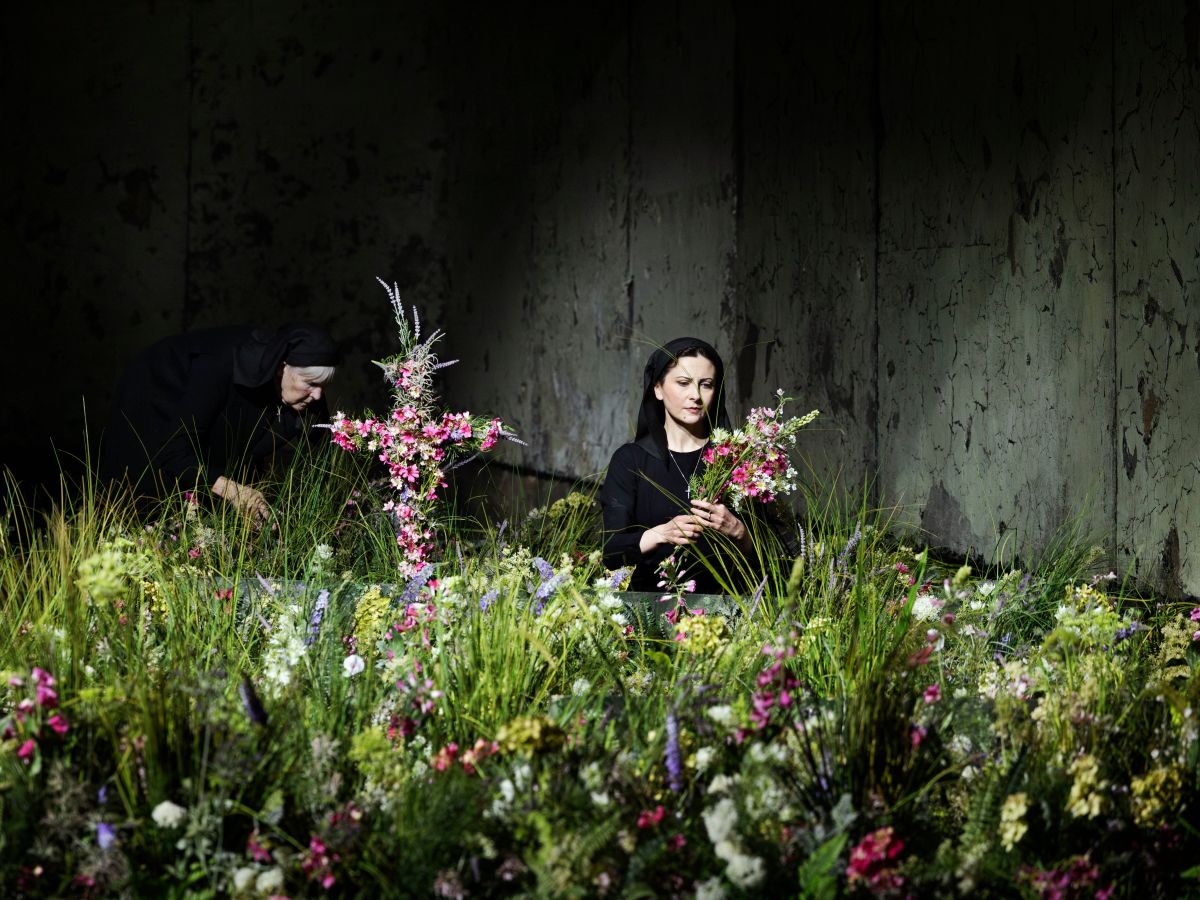
Dialogues des Carmélites, The Royal Danish Opera 2026
If you’re waiting for something to break, Act III is your moment. In Barrie Kosky’s production of Poulenc’s only long opera, it’s not the people – it’s the wall. We’re stuck in the same room. Boxed in by the same walls. First, inside the de la Force family. Then we convert to the Carmelites. Grey…

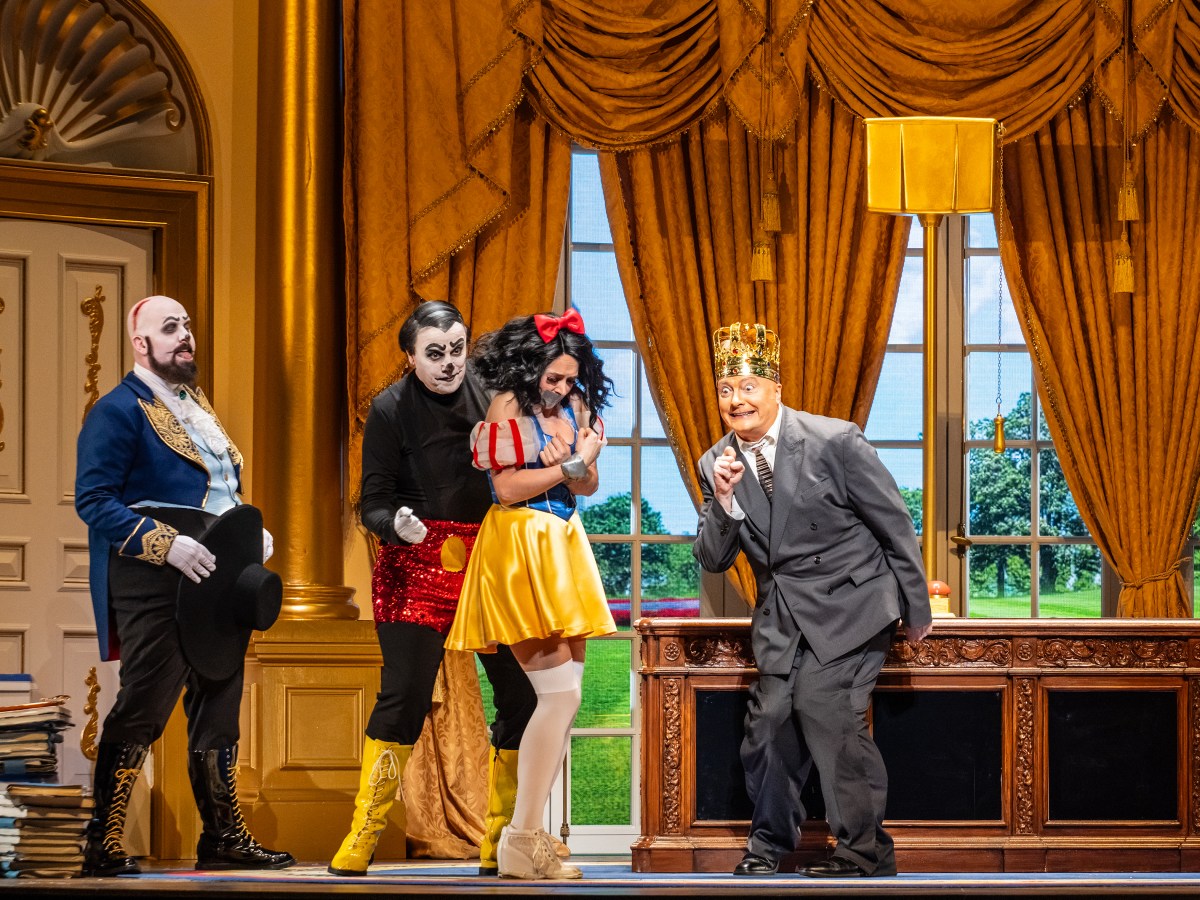
Monster’s Paradise, Hamburgerische Staatsoper 2026
World premiere! A brand-new opera by Austrian composer Olga Neuwirth. Which basically means: no one knows what we’re about to listen to or experience. No map, no manual, no “how it’s usually done.” What is an opera, anyway? At what point do we decide that something is one? If this hadn’t taken place inside the…
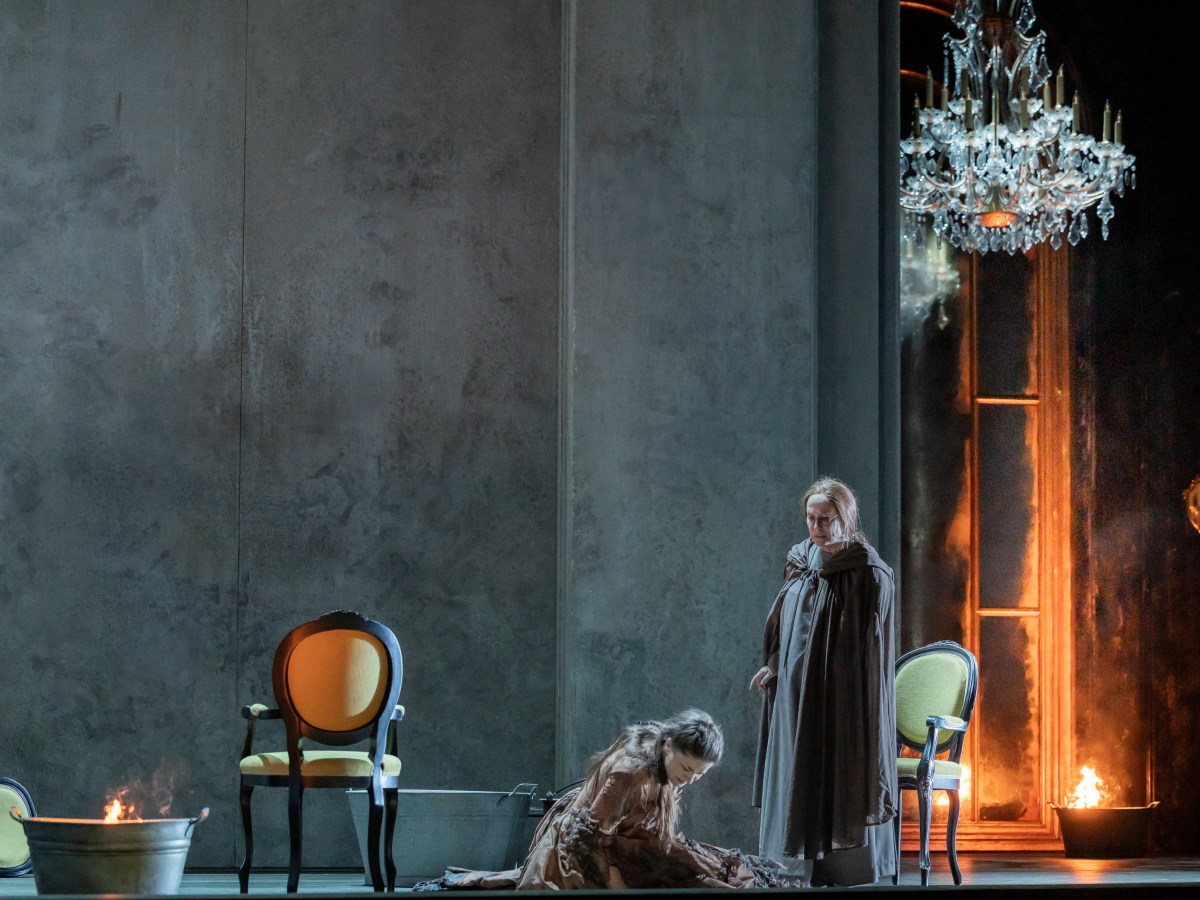
Dialogues des Carmélites, Semperoper Dresden 2026
Did someone say Poulenc? At the Semperoper? For the first time ever with Dialogues des Carmélites? Yes, you heard that right. The French composer’s second opera has found its way to Dresden, in a production directed by Dutch Jetske Mijnssen. The prelude is silent. Curtain up. Blanche is already there, standing alone in a wide,…
 Blogfløjten