
If you’re waiting for something to break, Act III is your moment.
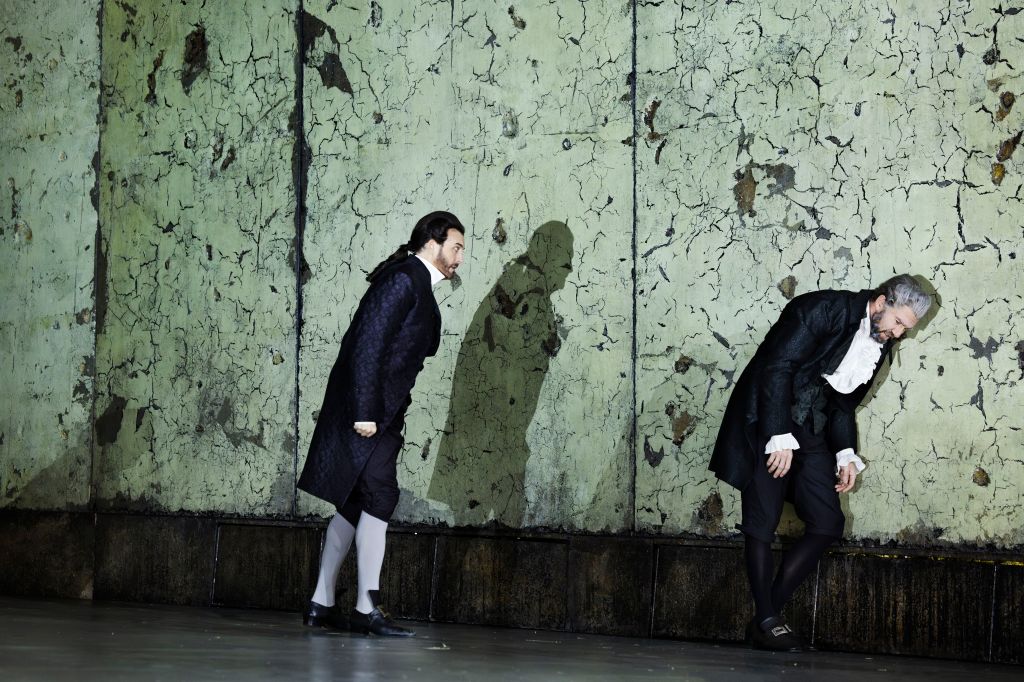
In Barrie Kosky’s production of Poulenc’s only long opera, it’s not the people – it’s the wall.
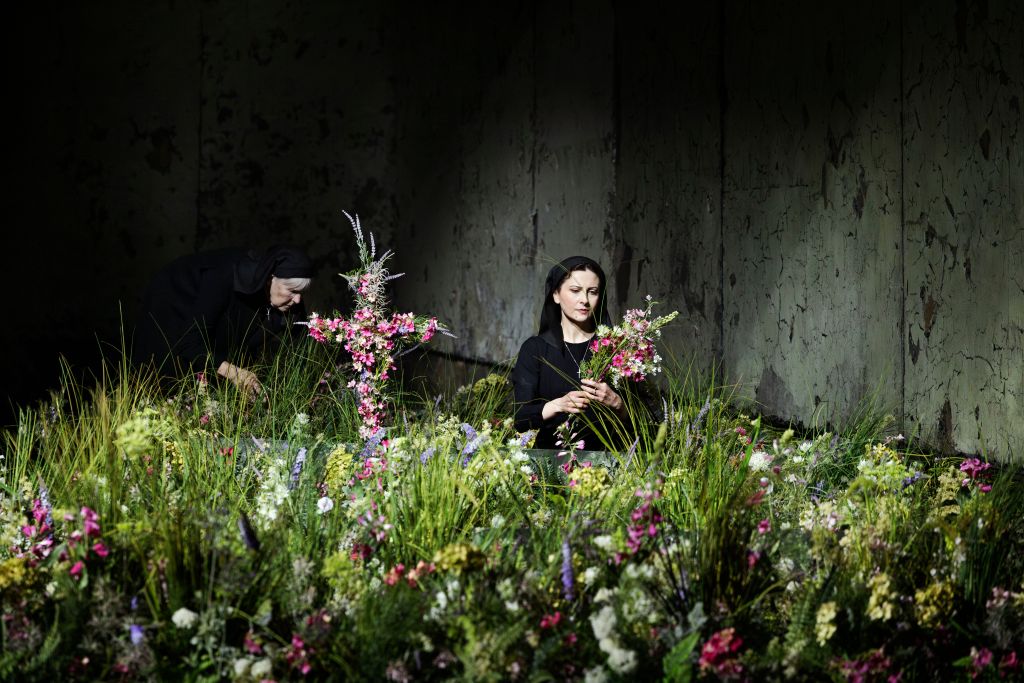
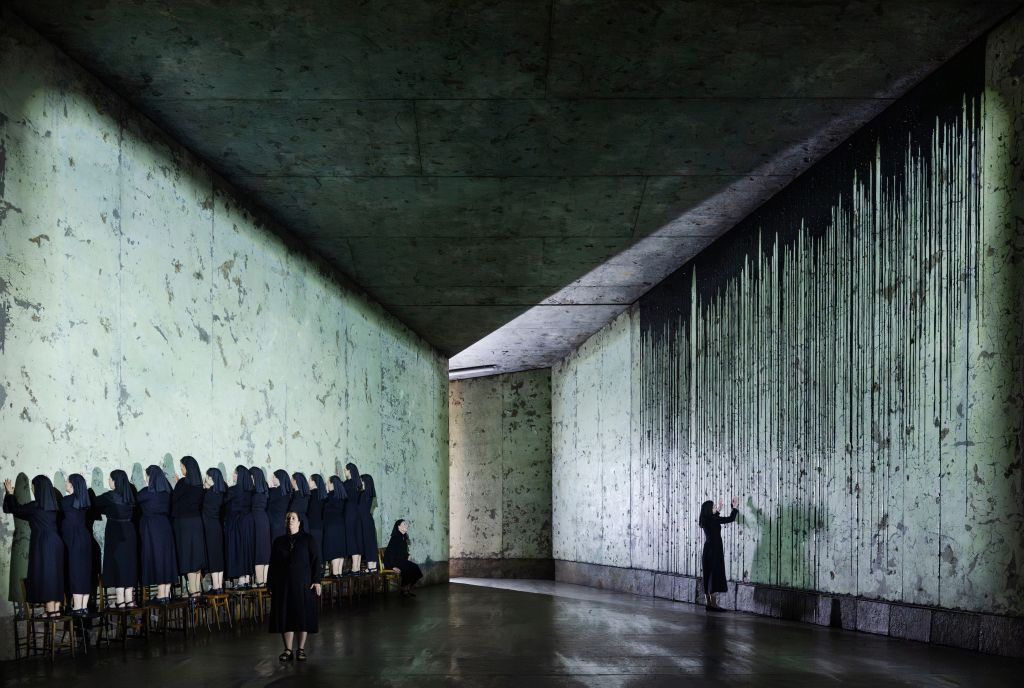
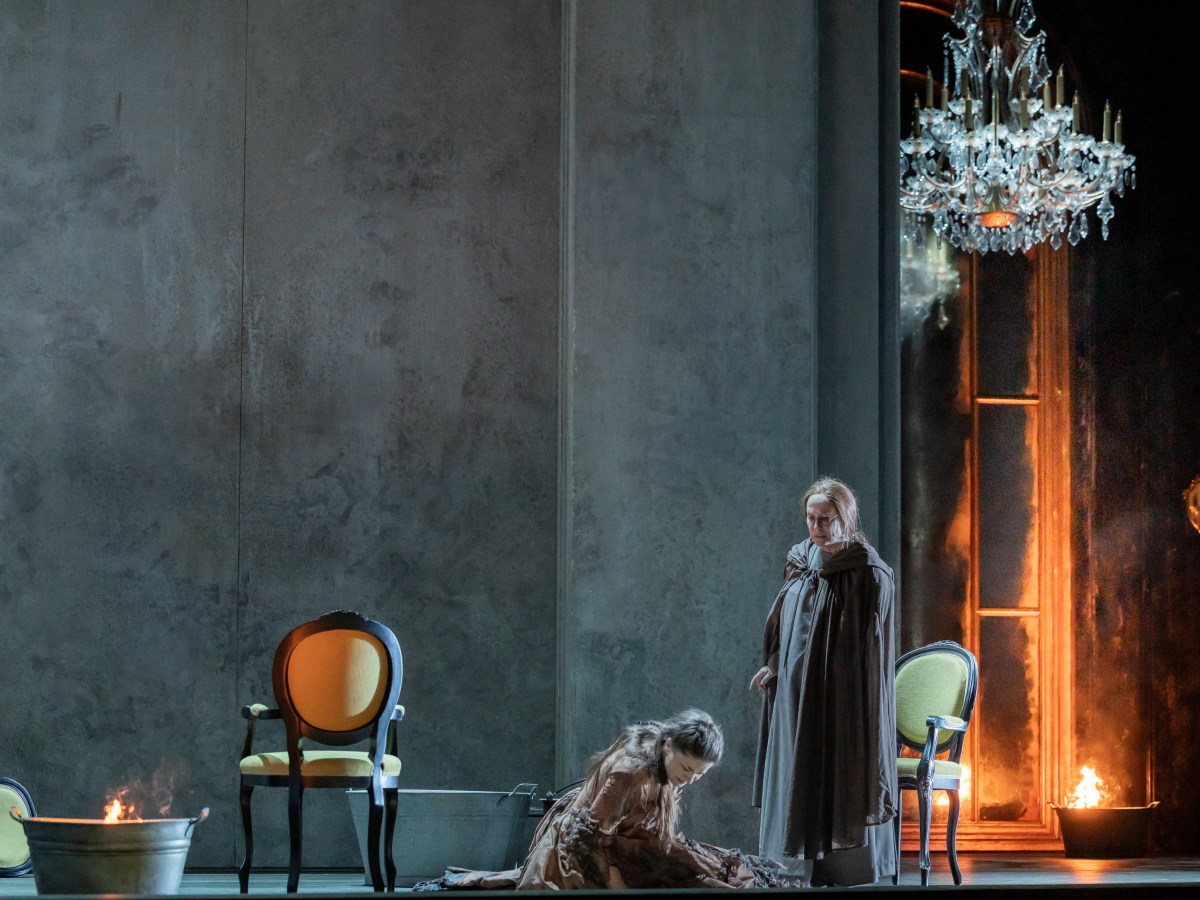
We’re stuck in the same room. Boxed in by the same walls. First, inside the de la Force family. Then we convert to the Carmelites. Grey walls with peeling paint. In Act II, blood runs down one of them – dark, thick, a spreading taint. You can hear the drops hit the floor. Drip… Drip. There’s no way out. No escape route. Fate has locked the door and swallowed the key. Goddammit…
Okay, hold on. Wait a second. Déjà vu.
Because this feels very familiar – think Jetske Mijnssen’s Dialogues des Carmélites in Dresden, just last week. Same walls, same fear, same “oh, there’s no way out, is there?” feeling (you can read about it here).
What In the Wall?
Well, you can’t hide forever. Or maybe you can – but hang around long enough, and the world will work its way in.
In the first two acts, we’re safely tucked away behind the walls. Everything happens indoors, contained, controlled. A beam of light slips in through a small opening, just enough to make you briefly wonder if there might be something brighter on the other side of those dark walls. Some kind of alternative.
But mostly, you sit with it. The walls. The waiting. Visually, it can start to feel a little long. The same room, holding its breath… Until the interval. When we return, everything changes.
In Kosky’s production, the wall gives up its stones. They come crashing down, hitting the ground with a brutal sound, leaving two huge holes behind. What used to feel solid just… isn’t anymore. On more than one level… Through those holes, people come pouring in. Masks on, protective vests strapped tight, absolutely no chill. The room tightens and tenses, shrinks and squeezes, until the air runs thin and someone can’t quite catch their breath.
Up until this point, the nuns have been able to hide – behind walls, rituals, and the tidy routines of convent life. The costumes in Act I place us neatly in the late 1700s, during the French Revolution, at a safe historical distance, complete with period vibes.
Never mind that being a nun at that point was, strictly speaking, not exactly allowed. The illusion works. Until it doesn’t…
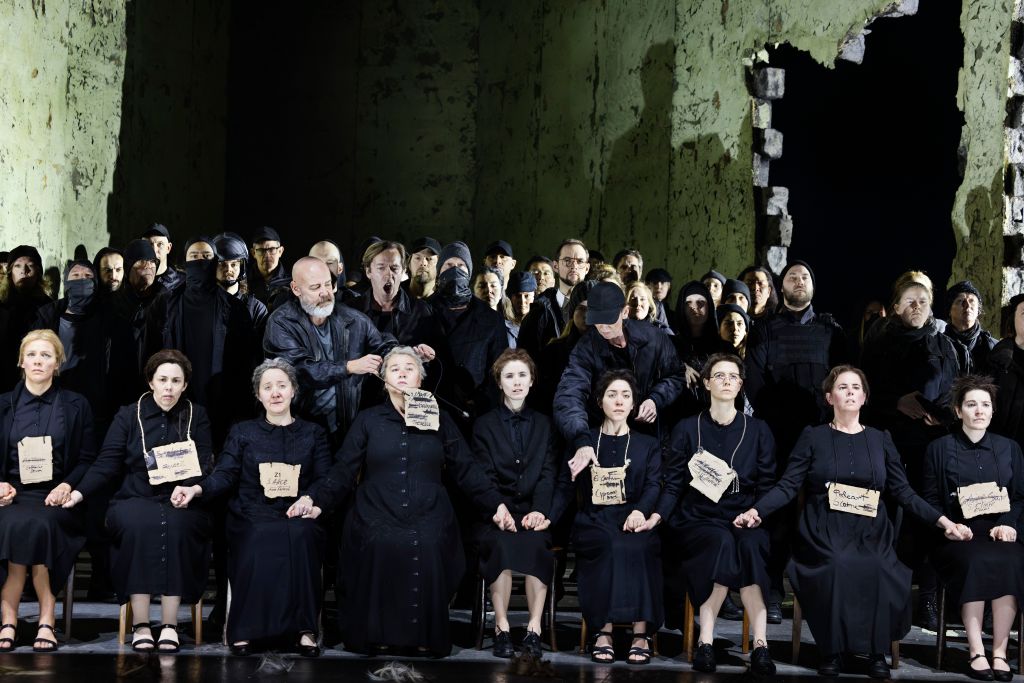
Because what comes crashing in doesn’t look like 1794. It looks like us. Collective rage. Anonymous aggression. Do they even realise these are people, too? Real people. With fear, feelings, bodies, breath… all that stuff. Forgotten. The revolution stops being an idea; it turns into a mechanism – something that keeps repeating itself. Again. And again. And again. In different outfits but with the same ugly efficiency. The comfort of “this happened a long time ago” quietly evaporates.
Maybe this is where Gurnemanz’ line from Parsifal lands: “Zum Raum wird hier die Zeit.” Time turns into space – something you can step straight into. At that point, history stops being something you read about. It turns up in the room. Right there. Not something you can keep at arm’s length. Violence doesn’t really care about centuries anyway.
Turns out time travel is real – violence has been doing it forever. It just changes its outfit, updates the vibe, and shows up again. Same engine, new packaging. It keeps coming back, no matter how many walls we put up. The time is a curious thing…
Suddenly, this is no longer history: it’s headlines.
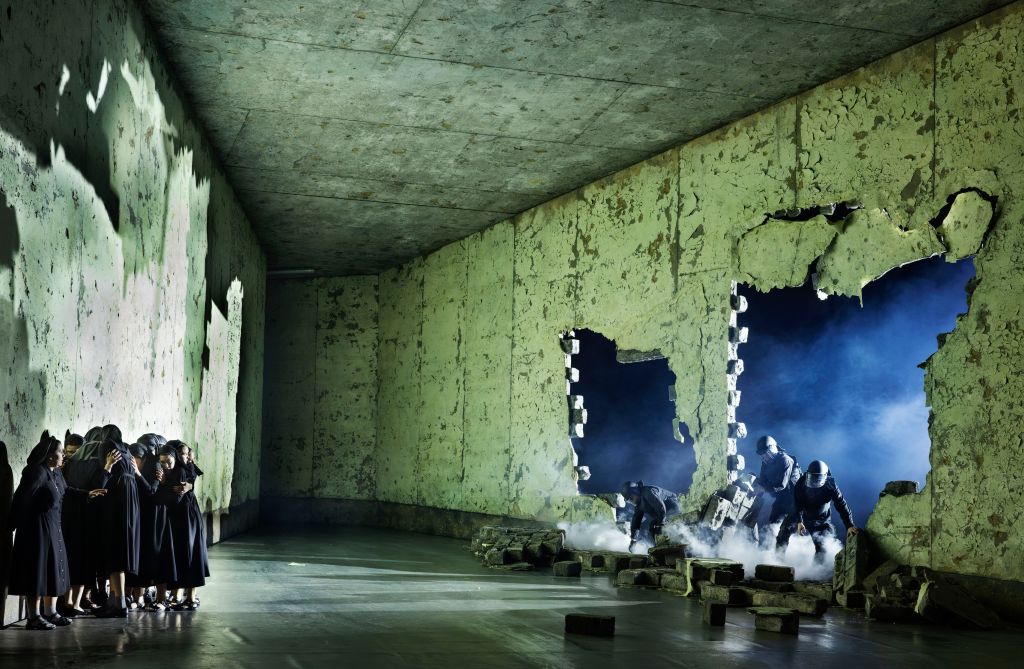
It all becomes too much. We need a pause. Or rather – that’s what we’re given.
The double bar line between each of the twelve scenes is taken very seriously. Like, very seriously. Hard stops all the way through. It does mess with the flow a bit. I know, I know, pauses do things, too. They slow everything down. Make you listen differently.
And that’s where Blanche comes in. The silence sits with her. “The world is a place in which I cannot live,” she says. If someone said that today, a suicide hotline would probably be dialed.
The Russian soprano Elena Tsallagova – making both her house and role debut – brought Blanche’s inner life straight to the surface with her slightly darker-toned soprano. Clear, direct, and emotionally grounded, with a warm, rounded sound that carried easily into the room. There was never any doubt about hearing her over the orchestra, which often sounded more restrained than usual.
The beginning felt a bit thin, and the playing didn’t always have the bite one might have hoped for. Still, conductor Asher Fisch clearly had a plan. A long one. And in the end, everything was drawn together – and lifted – in Salve Regina.
The nuns are going to die.
You know it, I know it, everybody knows it. One of them breaks down – a full-blown panic attack. Hyperventilating, crying, the kind of raw distress that makes your stomach knot just watching it. And then it happens.
Dressed only in white underslips, black shoes in their hands, they walk towards death. One by one. Underdressed. Stripped down to almost nothing. Not as an aesthetic choice, but as a final reduction – the removal of identity before the removal of life.
There is no guillotine in sight. Instead, the choir simply grows thinner and thinner as the nuns disappear through the gaping hole in the wall. The music keeps going. The bodies don’t.
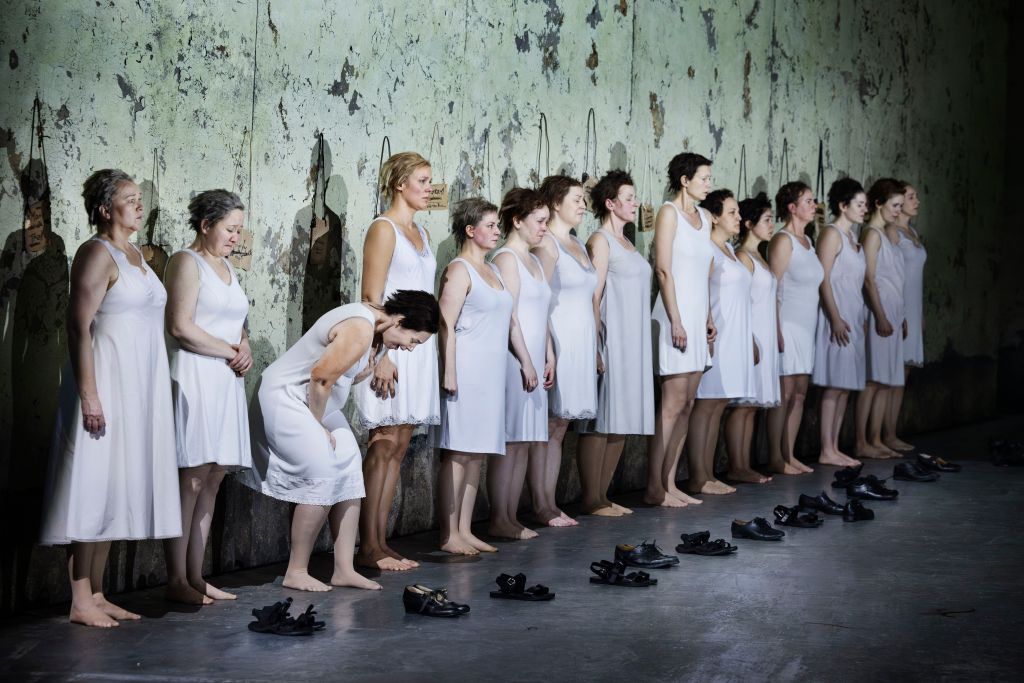
After each slice of the guillotine, a pair of shoes is hurled back through the hole – slammed against the opposite wall, then left to fall. Sixteen times. The pile of shoes keeps growing. Pair by pair. While the stage is gradually stripped of people, of voices, of life in the air, almost bare.
The slicing sound is amplified and blasted through the speakers. Which is… a choice. Slightly overkill, perhaps. Anyway, message received.
It’s an incredibly powerful ending. Not least because the orchestra is at its most forceful here, sonically speaking. Silence does a lot of the work – as it has all along – but now the music grows with it. With each nun who falls silent, the sound changes. The absence becomes audible. More and more unavoidable.
The power doesn’t come from excess, but from accumulation. Sound against silence, voice after voice, until there’s nowhere left for the music to go.
Nothing breaks here in the end. Everything simply runs out.
Fun Fact…
Although the story is set in the 1790s, Poulenc wrote the opera after the Second World War. Its themes – mass fear, ideological violence, and individuals crushed by systems – speak as much to the twentieth century as to the French Revolution.
Trailer:
https://www.facebook.com/reel/1493348728848177
Cast:
- Conductor: Asher Fisch
- Staging: Barrie Kosky
- Set Design and Costume Design: Katrin Lea Tag
- Lighting Design: Alessandro Carletti
- Le Marquis de la Force: Jens Søndergaard
- Blanche: Elena Tsallagova
- Le Chevalier: Juan Francisco Gatell
- Madame de Croissy: Doris Lamprecht
- Madame Lidoine Sinéad: Sine Bundgaard
- Mère Marie: Diana Haller
- Sœur Constance: Juliana Zara
- Mère Jeanne: Aileen Itani
- Sœur Mathilde: Sidslen Aja Eriksen
- Beichtvater: Jens Christian Tvilum
- First commissioner: Michael Kristensen
- Second commissioner: Morten Lassenius Kramp
- Jailer: Magnus Berg
- Officer: William Pedersen
- Thierry: Frederik Rolin
- Doctor Javelinot: Asmus Hanke
- Dialogues des Carmélites, The Royal Danish Opera 2026
- Monster’s Paradise, Hamburgerische Staatsoper 2026
- Dialogues des Carmélites, Semperoper Dresden 2026
- Lohengrin, Staatsoper Berlin 2026
- Das kalte Herz, Staatsoper Berlin 2026
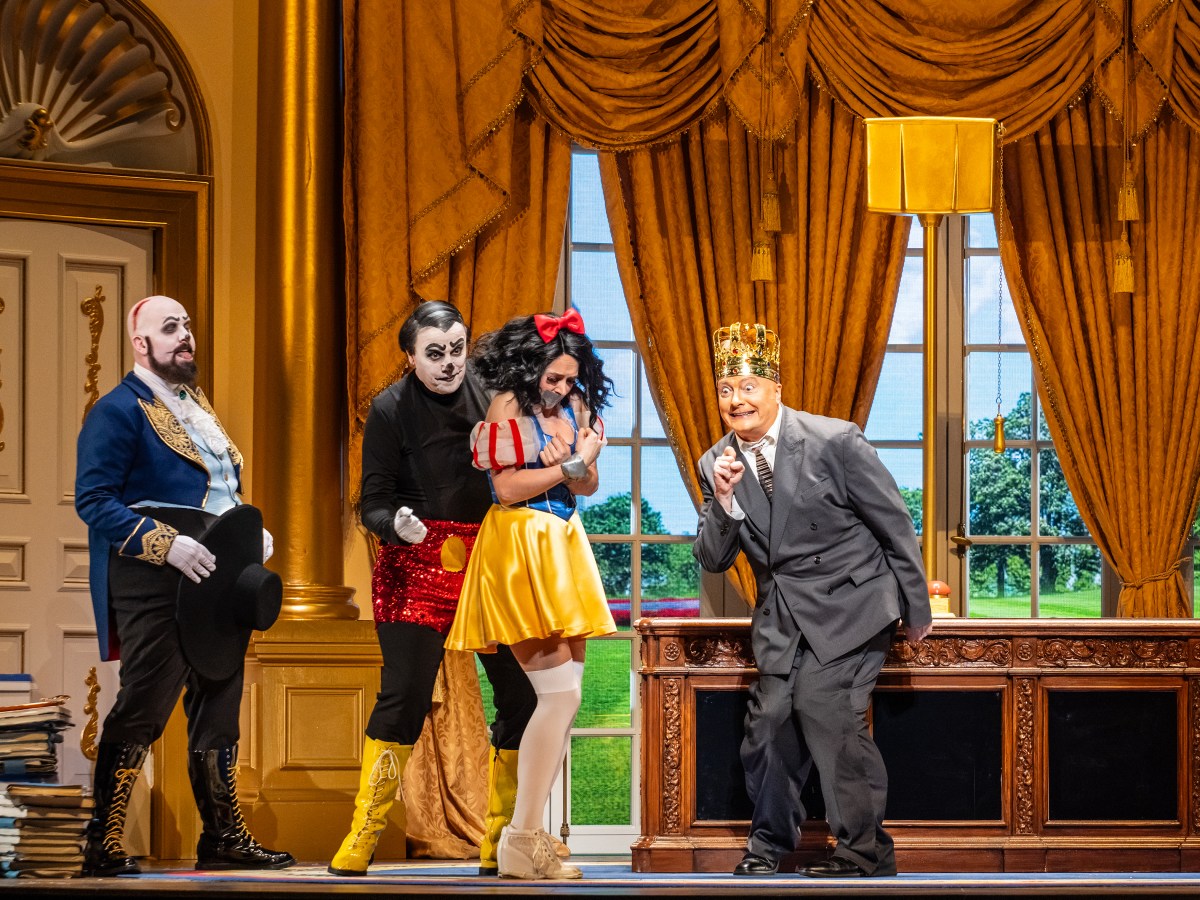
Monster’s Paradise, Hamburgerische Staatsoper 2026
World premiere! A brand-new opera by Austrian composer Olga Neuwirth. Which basically means: no one knows what we’re about to listen to or experience. No map, no manual, no “how it’s usually done.” What is an opera, anyway? At what point do we decide that something is one? If this hadn’t taken place inside the…

Dialogues des Carmélites, Semperoper Dresden 2026
Did someone say Poulenc? At the Semperoper? For the first time ever with Dialogues des Carmélites? Yes, you heard that right. The French composer’s second opera has found its way to Dresden, in a production directed by Dutch Jetske Mijnssen. The prelude is silent. Curtain up. Blanche is already there, standing alone in a wide,…
Lohengrin, Staatsoper Berlin 2026
Calixto Bieito. Say the name, and ears prick up. Eyebrows too. Along with opinions. Sharp ones. By-the-book director? Yeah… no. With Bieito, I’m not even sure the book made it past the front door. Wagner, however, definitely did. Right now, Bieito is knee-deep in the composer, busy building his Ring in Paris (with Siegfried premiering…
 Blogfløjten