
Calixto Bieito. Say the name, and ears prick up. Eyebrows too. Along with opinions. Sharp ones. By-the-book director? Yeah… no. With Bieito, I’m not even sure the book made it past the front door.
Wagner, however, definitely did. Right now, Bieito is knee-deep in the composer, busy building his Ring in Paris (with Siegfried premiering just last week). Here in Berlin, his five-year-old take on Lohengrin is still strutting its stuff at the Staatsoper.
The door isn’t kicked in by conductor Simone Young. It opens quietly. The music steps inside, takes off its coat, and maybe pours a glass of water. This is Wagner without too much weightlifting. The result is fine, light, and flexible. At times, almost transparent – less wall of sound, more see-through scenery.
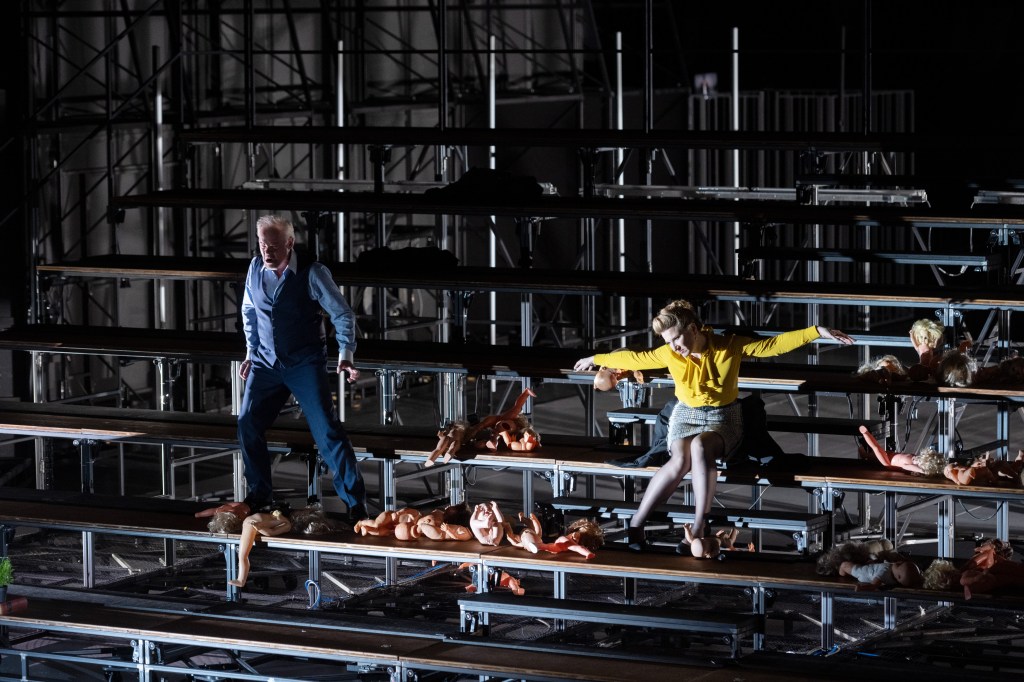
Photo: Monika Rittershaus.
That transparency suits the music well, reminding us that Lohengrin is an earlier Wagner work, written before the swollen Romanticism really took over. Every now and then, though, the tempo starts to sag a little. Take the wonderfully almost-quintet moment at the end of Act I: it stretches time just enough to make you wonder if it might tip over. It holds. Balanced but barely.
Still, Young knows exactly what she wants. Almost every ritardando and tempo shift lands cleanly, and switching effortlessly between seated and standing conducting, she keeps a firm hand – and baton – on the music throughout.
So, what’s the Deal With the Spanish Director?
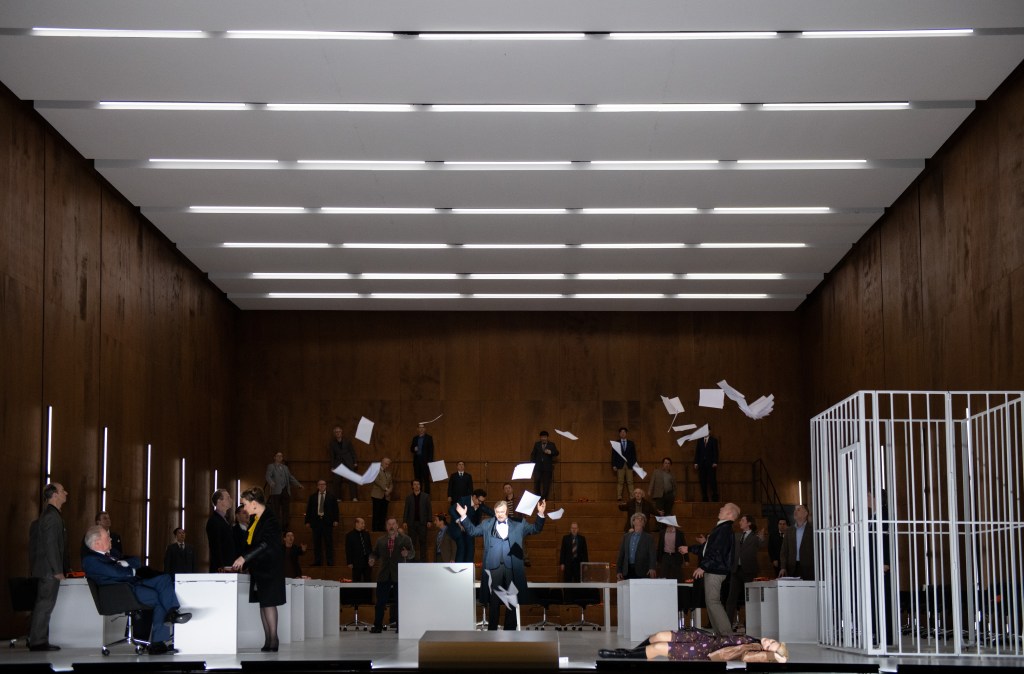
Calixto Bieito doesn’t throw us in at the deep end. Not in the beginning, at least. He starts somewhere that actually feels… reasonable. The curtain rises, and we’re not in a fairytale forest. We’re in a room that feels cold, formal, unforgiving… A courtroom.
Elsa lies on the floor. Alone, but not really alone. Eyes on her from all sides. Did she kill her brother, Gottfried, or didn’t she?
Actually, this isn’t quite where it begins. Before a single singer opens their mouth, a video flickers to life. During the prelude. We see a swan, curled up inside the belly of a pregnant (human!) body… (Later on: swan birth. How and why? Don’t ask.)
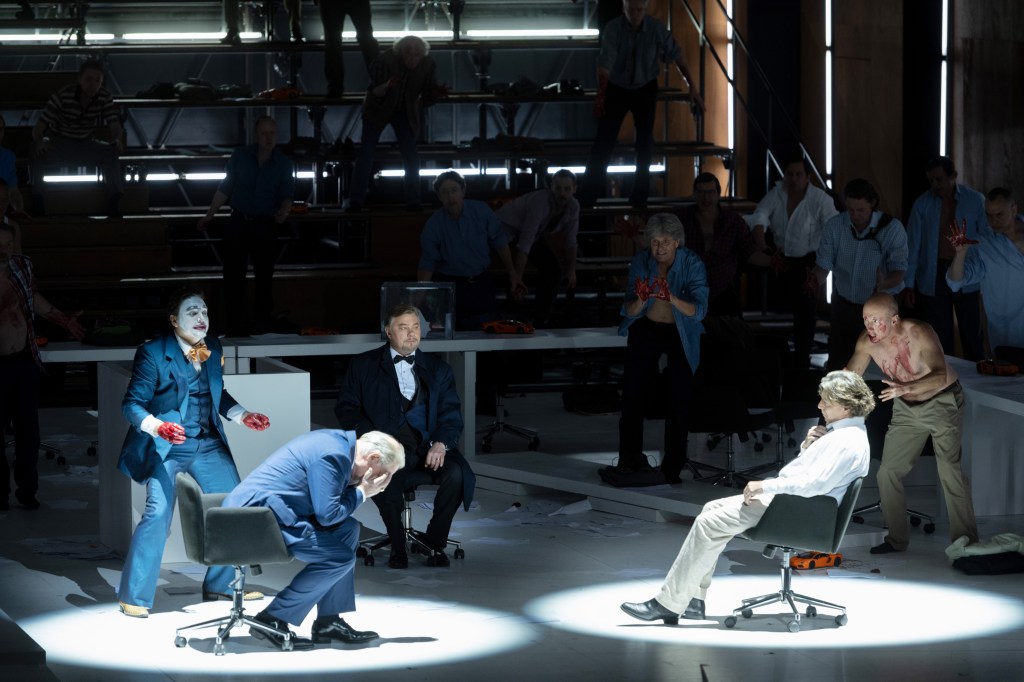
Photo: Monika Rittershaus.
Then the image shifts. A small boy. A pool. Chlorine-blue light. Panic on full. He’s struggling. Fighting for breath. Fighting for his life.
Oh. Poor Gottfried.
At this point, the case is already cracked. We know Elsa is innocent. The mystery isn’t what happened – it’s how on earth the others are going to be convinced of it before Friedrich and Ortrud make too much of a mess. Or before Bieito does….
A trial. A question. A woman under suspicion. Simple, at first. Then it all gets messy.
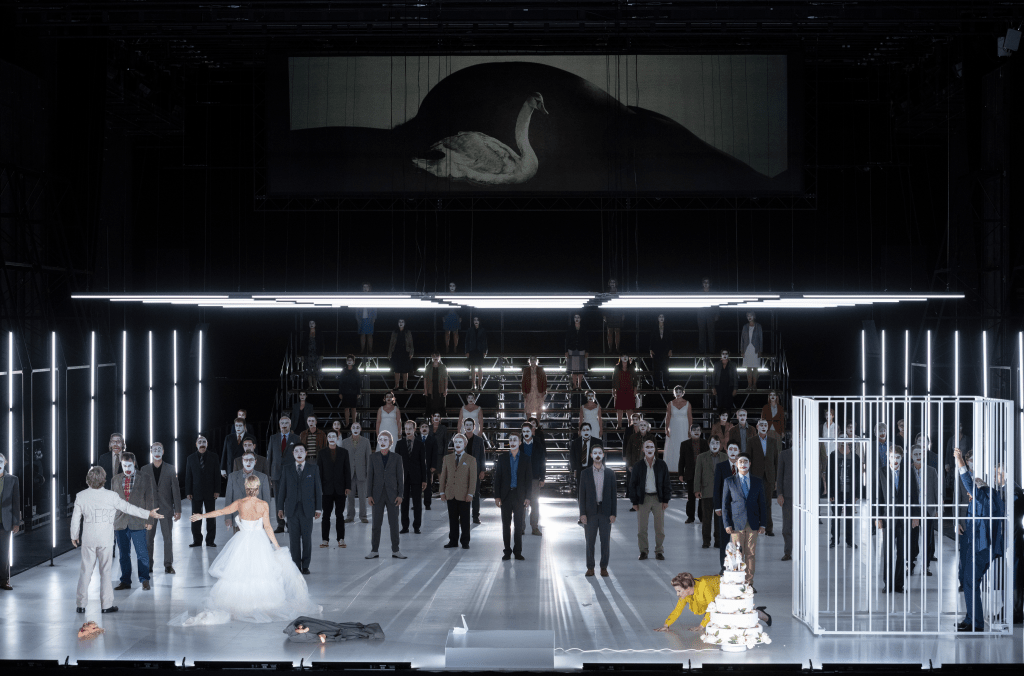
Everyone is dressed to impress. Tailored suits, polished shoes. Heinrich looks like he’s stepped straight out of the Vienna Opera Ball.
The Herald follows the same dress code… kinda. The suit is there, yes, but it’s topped with a bright orange bow tie, slightly too large, and a matching pocket square crammed into the left breast pocket.
And then he starts moving.
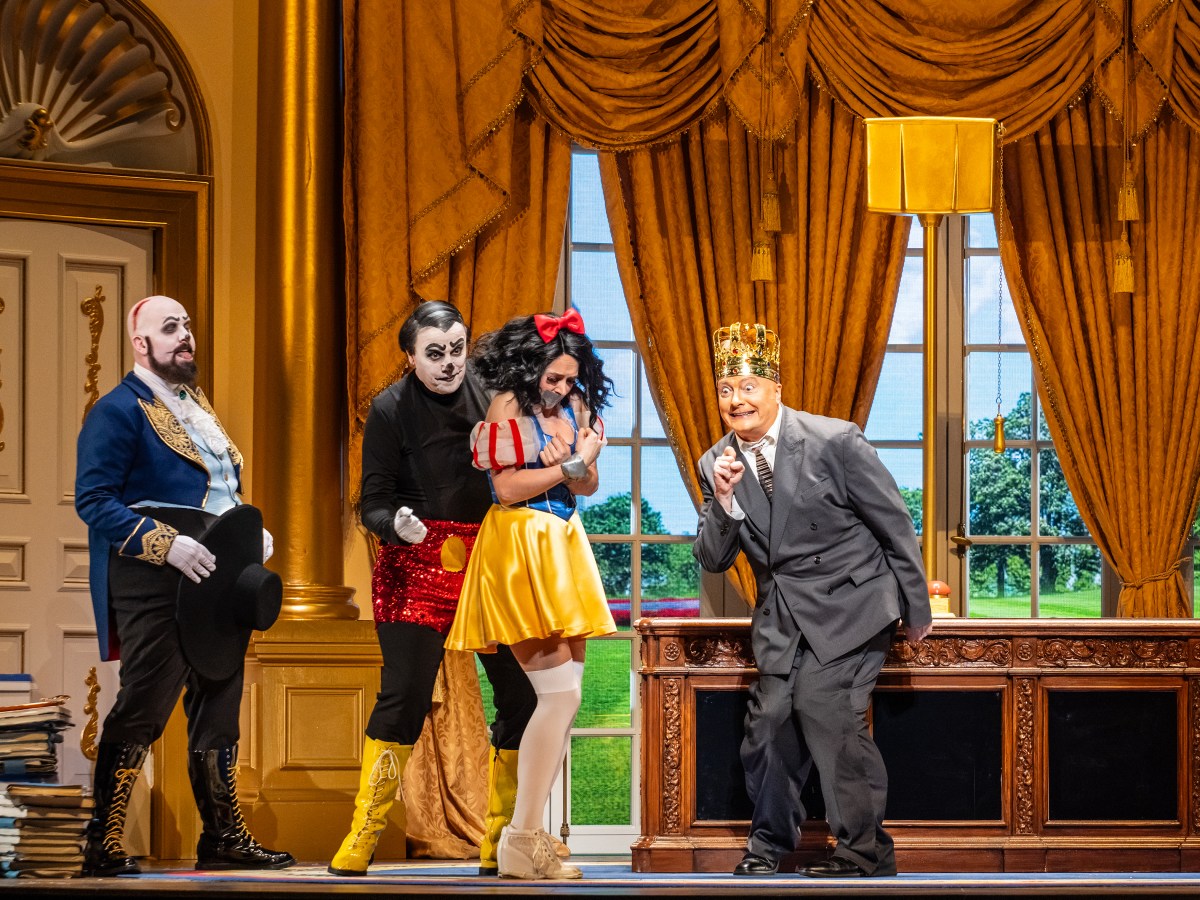
Big gestures. Exaggerated arms and legs. Cartoon energy, pulling focus from the rest. A Disney side character who keeps waving and wobbling while everyone else is busy with the actual drama. This time, though, it doesn’t quite land. It feels off. Out of hand. Like a joke from another show, dropped in the middle, stealing the flow.
Why does he paint his face white, like a clown? And why, at one point, do the others start doing the same?
If there’s a meaning here, it forgot to introduce itself.
Since We’re Already Asking Questions, I Have A Few More
Ortrud, what’s with all the dolls? Whole ones. Half ones. All scattered around her. Is this about lost childhood? Broken innocence? Is she jealous of the pregnant lady with the swan?
Then there’s the cage. Why do different characters take turns being inside it – trapped, displayed, punished, or… what’s the deal?
And how exactly does Lohengrin win Elsa? With a staring contest? Why does Friedrich suddenly drop to the floor – footballer-style, without being touched? Is he defeated? Exposed? Overwhelmed? Because he certainly isn’t touched. Not even a little.
Phew, as you can probably tell, I never quite get my bearings. Bieito keeps throwing ideas at us – fast and furious. Where are we actually going with all this? What’s the intention? What, in the Wagner, is he trying to say?
Act II Turns Into Something of A Visual Snooze
Especially during the Ortrud–Elsa duet, which for large parts unfolds underneath a gigantic white (wedding?) veil.
The problem is simple: you can barely see them. They both sing great, no doubt about that, but visually? There’s not much to hold on to. And at that point, it almost doesn’t matter how strong Anja Kampe and Elza van den Heever are as actors. If you hide them under a giant piece of fabric, you’ve essentially staged a concert for ears only.
What definitely isn’t dull is Eric Cutler’s Gralserzählung (the Quest) in Act III. I honestly can’t remember hearing this scene told with such poise, patience, and persuasive power.
This isn’t the moment for a tenor to say, “listen to me and my magnificent voice.” It’s the moment to say, “listen to my story.” It’s not about the flex, it’s about the text. Cutler clearly knows the difference.
Yes, his voice is big, broad and bright. He made that clear within his very first phrases three hours earlier. At first, it even felt a little too much for Lohengrin, slightly oversized, slightly overcaffeinated. But not for long. He soon finds his footing, his focus, his flow. The sound settles into a natural, unforced glow.
Maybe it was just opening-night adrenaline, pushing him into a higher gear than intended. Either way, by the time the Gralserzählung arrives, everything aligns. The sound serves the story.
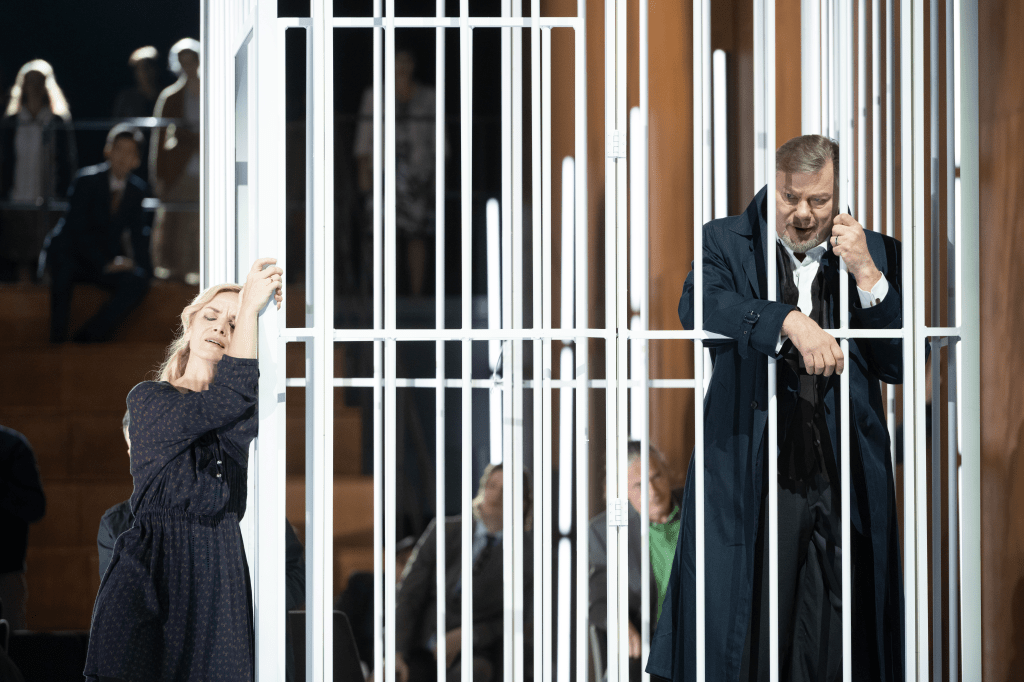
Photo: Monika Rittershaus.
Wolfgang Koch has clearly found his place as well. I’ve heard the German baritone a handful of times by now, but tonight he finally convinced me. Friedrich suits him like a glove. Or better: like a role written exactly where his voice and character meet. Vocally and dramatically, he’s right in the sweet spot.
René Pape. A German bass-baritone who’s very much not new to the business, and yet still arrives armed with a voice that cuts clean through the room. Even in ensembles and choral traffic, you spot him instantly: that rich, resonant, overtone-stuffed sound.
Then there’s the storytelling. Pape doesn’t perform lines – he speaks them, quite possibly with one hand casually tucked into his pocket. Nothing sounds studied or safely stored; everything feels freshly found. As if he’s making it up as he goes along. It gives his performance a wonderful sense of spontaneity.
What definitely isn’t alive, though, is Gottfried.
He died at the beginning – remember? Which makes what follows feel oddly symbolic, and strangely hard to decipher. When Lohengrin sings of his return, he hands Elsa a plastic sword, a trumpet with brightly coloured valves, and a ring. She stands firm on the promt box, arms stretched high, holding hope in hard plastic and shiny things.
Does she know he’s not coming back? Is this a promise, a performance or a polite goodbye?
So yes, eyebrows raised. Opinions engaged. Bieito, as expected.
Fun Fact!
The very last thing Lohengrin says before leaving is “Zum Führer sei er euch ernannt!”
Führer is a fraught word — historically heavy, tied to one very specific (and not particularly pleasant) person. Unsurprisingly, the line has caused debate over the years, especially in Bayreuth. In some productions, it’s therefore replaced with Schützer – “protector” – to avoid the associations.
Trailer:
Cast:
- Musical Director: Simone Young
- Director: Calixto Bieito
- Revival director, assistant director: Caroline Staunton
- Set Design: Rebecca Ringst
- Costumes: Ingo Krügler
- Light: Michael Bauer
- Video: Sarah Derendinger
- Chorus Master: Dani Juris
- Heinrich der Vogler: René Pape
- Lohengrin: Eric Cutler
- Elsa of Brabant: Elza van den Heever
- Friedrich of Telramund: Wolfgang Koch
- Ortrud: Anja Kampe
- The King’s Herald: Arttu Kataja
Staatsopernchor, Staatskapelle Berlin
- Dialogues des Carmélites, The Royal Danish Opera 2026
- Monster’s Paradise, Hamburgerische Staatsoper 2026
- Dialogues des Carmélites, Semperoper Dresden 2026
- Lohengrin, Staatsoper Berlin 2026
- Das kalte Herz, Staatsoper Berlin 2026
Dialogues des Carmélites, The Royal Danish Opera 2026
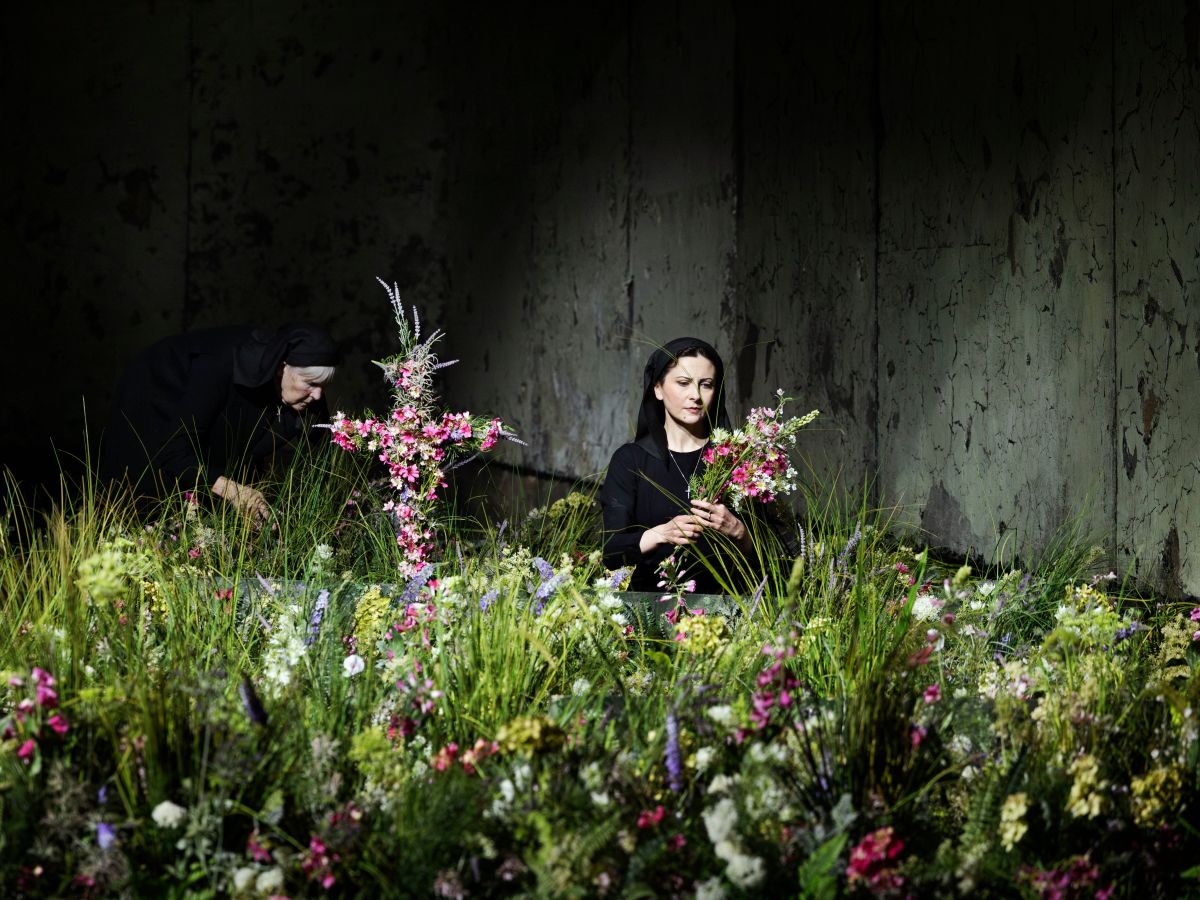
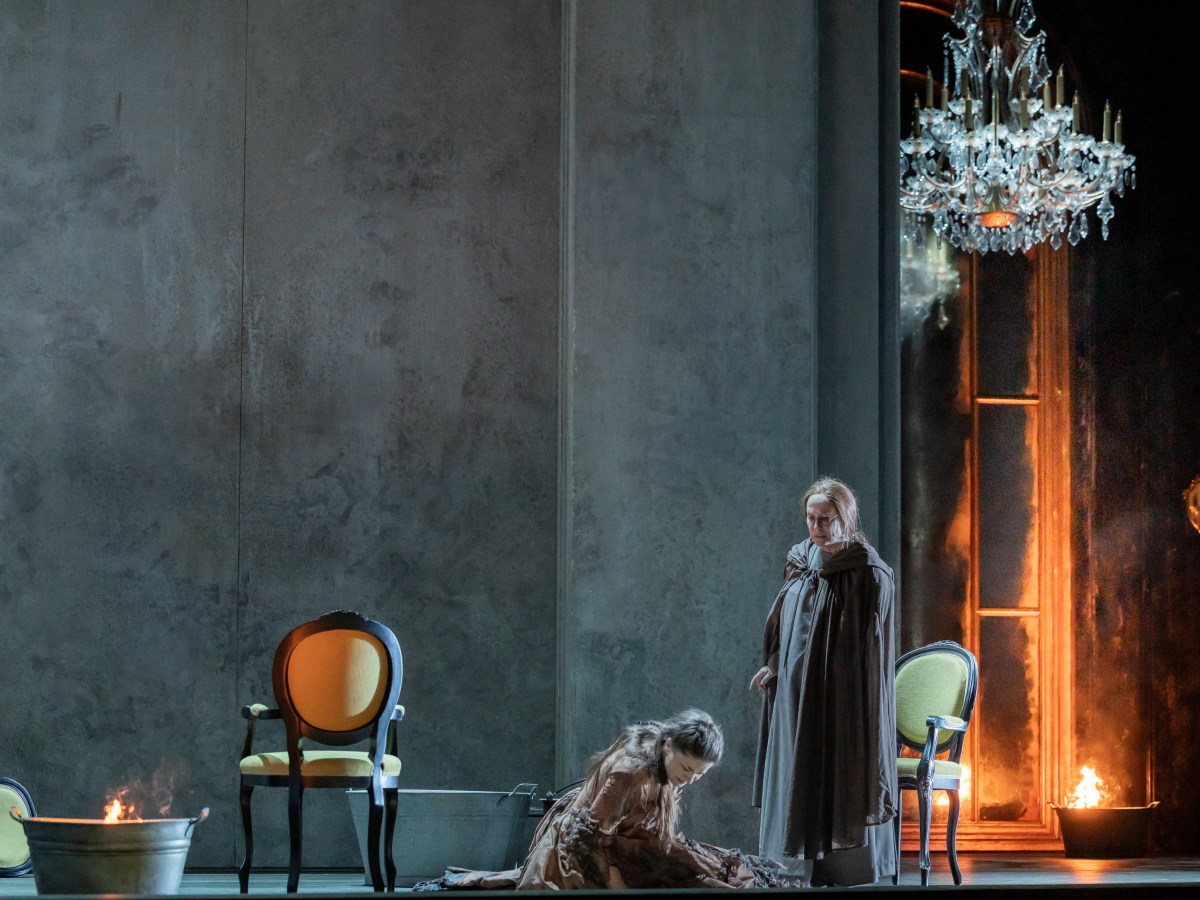
If you’re waiting for something to break, Act III is your moment. In Barrie Kosky’s production of Poulenc’s only long opera, it’s not the people – it’s the wall. We’re stuck in the same room. Boxed in by the same walls. First, inside the de la Force family. Then we convert to the Carmelites. Grey…

Monster’s Paradise, Hamburgerische Staatsoper 2026
World premiere! A brand-new opera by Austrian composer Olga Neuwirth. Which basically means: no one knows what we’re about to listen to or experience. No map, no manual, no “how it’s usually done.” What is an opera, anyway? At what point do we decide that something is one? If this hadn’t taken place inside the…
Dialogues des Carmélites, Semperoper Dresden 2026
Did someone say Poulenc? At the Semperoper? For the first time ever with Dialogues des Carmélites? Yes, you heard that right. The French composer’s second opera has found its way to Dresden, in a production directed by Dutch Jetske Mijnssen. The prelude is silent. Curtain up. Blanche is already there, standing alone in a wide,…
 Blogfløjten