

“It wasn’t my fault,” I’d say as a kid whenever I ended up fighting with my little brother. But whose fault was it then? I mean, I was still in it – throwing the punches, shouting back. It can’t all have been his idea. Still, blaming someone else feels so much easier, doesn’t it? We tell ourselves we’re innocent. But are we ever, really?
The Finnish composer Kaija Saariaho passed away two years ago, and four years ago her final opera, Innocence, had its world premiere in Aix-en-Provence in France. Since then, it’s been sailing steadily on. In fact, it’s made such a splash that I’ve already managed to catch it live twice! The first time was at the Semperoper in Dresden last spring. If you’re curious to read more about the plot and my first impressions of the work, you can click right here.
So, when I saw that Nuremberg had Innocence on the program, there was simply no point pretending to resist.
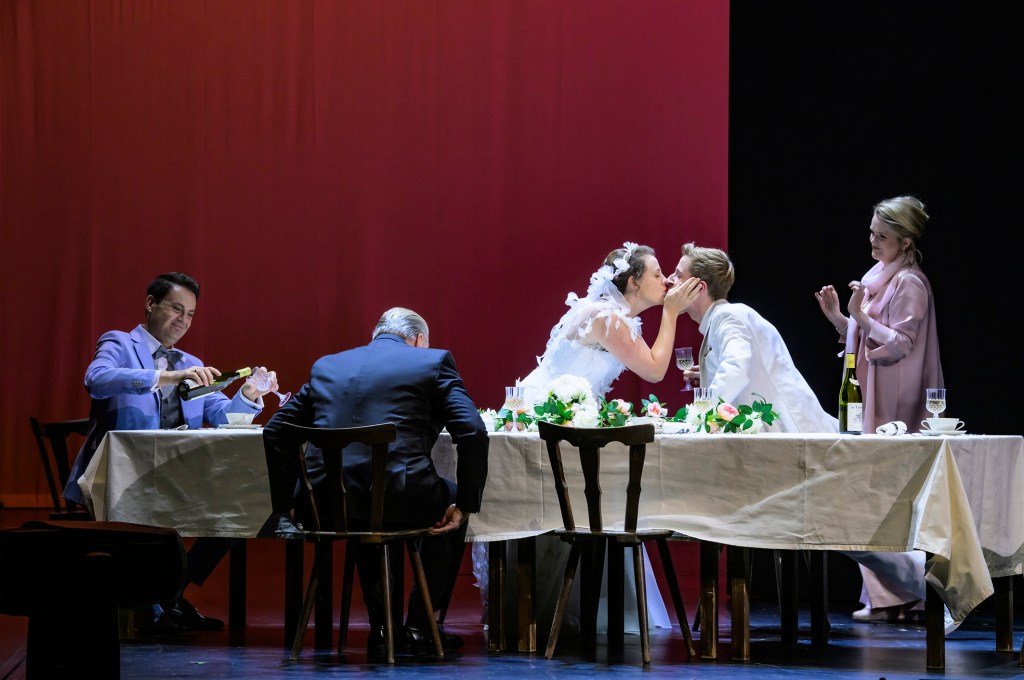
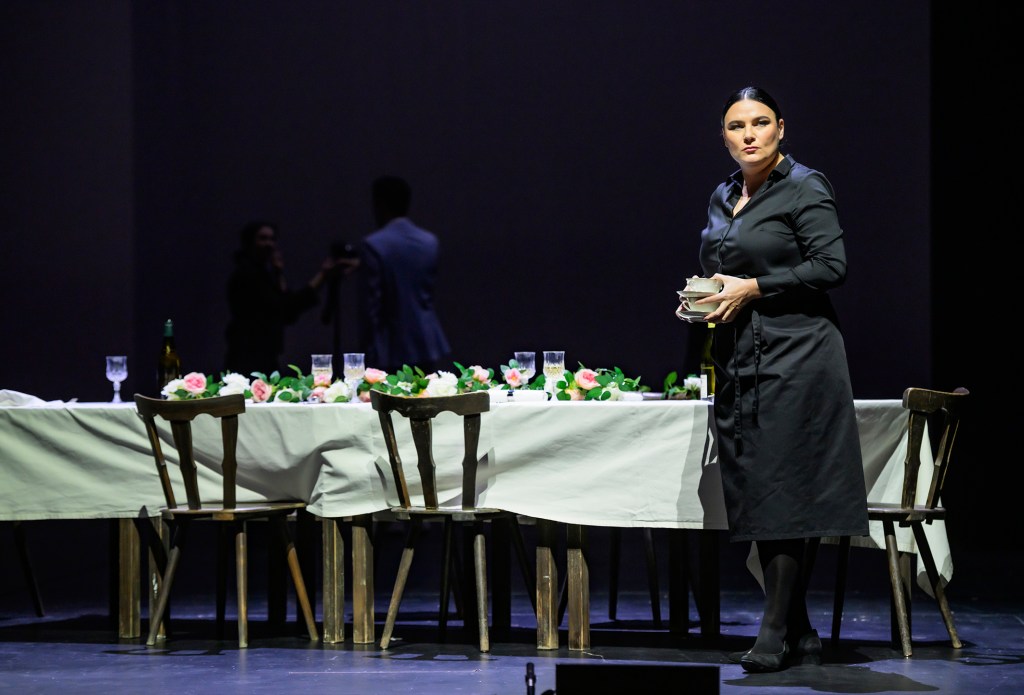
Platz (Tuomas), Chloë Morgan (The Mother-in-Law (Patricia)). Photo: Bettina Stoess.
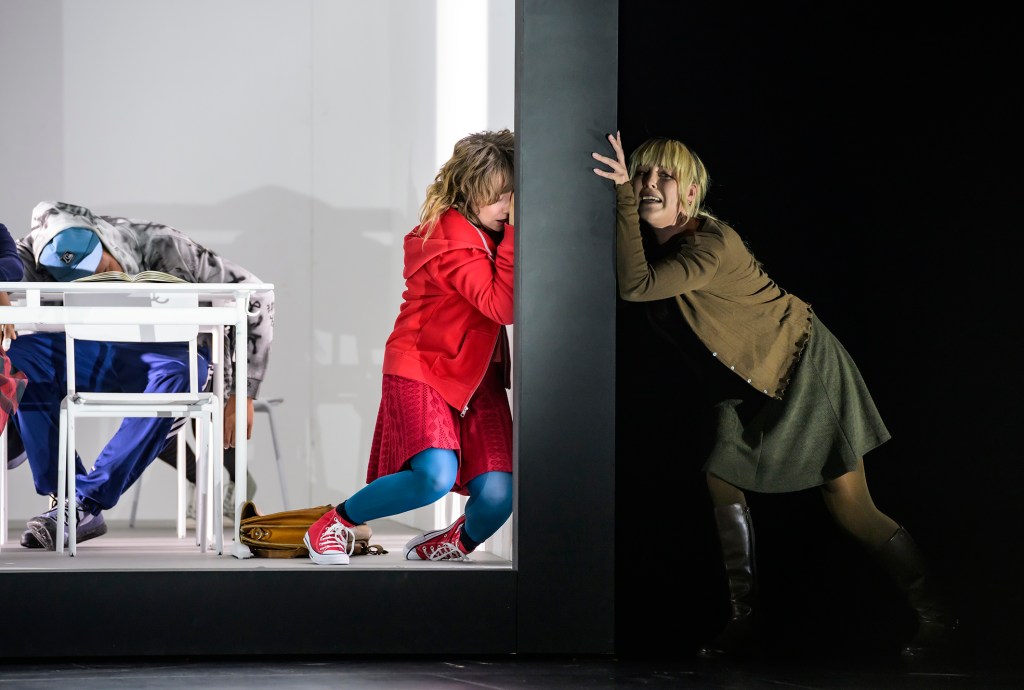
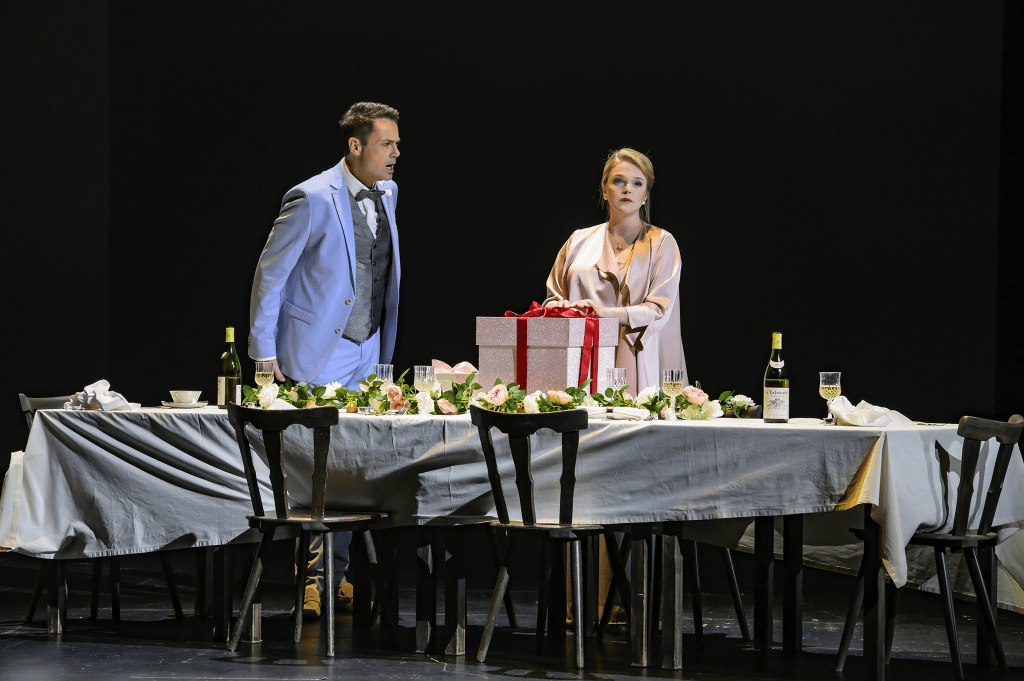
Piano, contrabassoon and double bass kick off the party with a deep, unsettling C. And yes, a party, because Tuomas and Stela have just gotten married. The table is beautifully set: white tablecloth, wine glasses, flowers. Everything white, sharply contrasting with the giant black box that turns and reveals a half-transparent white wall. There are people behind it, trying to get out, but they’re trapped. Trapped in the box, in the past, in their own minds. The box turns once more, and the next time we see that side, the “wall” is gone. We’re suddenly inside the box too, along with six others.
Someone starts to speak. Yes, speak, because almost half of the roles in this opera are spoken rather than sung. They share their haunting thoughts from back then. From ten years ago, when one of their classmates took his father’s gun and killed ten students and a teacher. How do they live (or rather, don’t live) with it today? Slowly, bar by bar, the small secrets surface, and the picture grows darker. Maybe they weren’t all as innocent as they once believed…
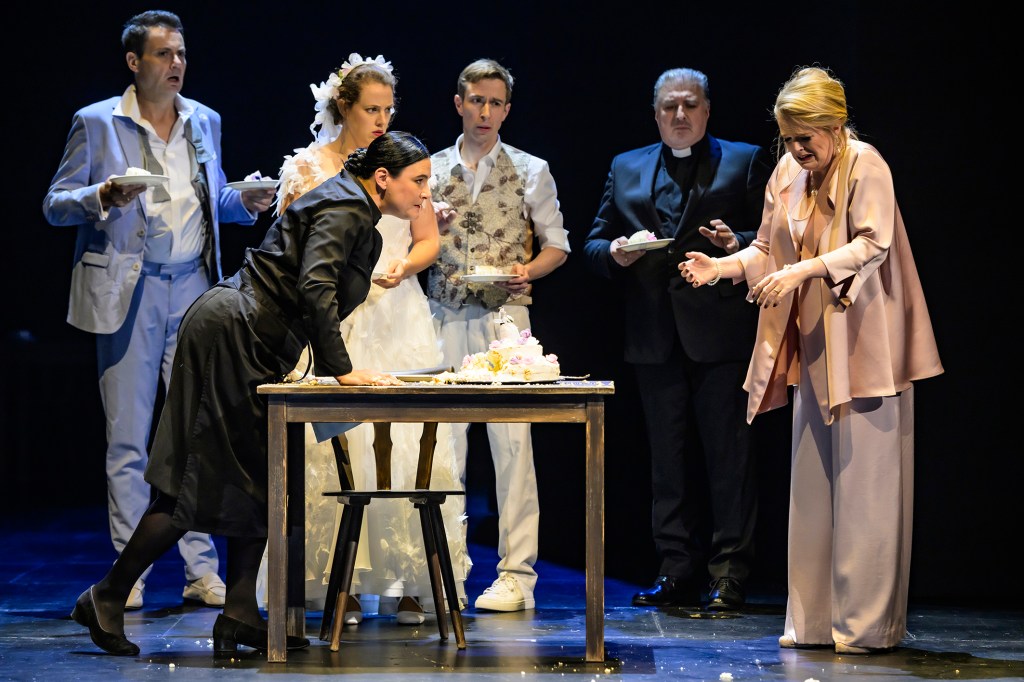
Platz (Tuomas), Chloë Morgan (The Mother-in-Law (Patricia)). Photo: Bettina Stoess.
It’s a classic trick, but it works
The clash of two colors, black and white. Stela’s in a white wedding dress (no surprises there, she just got married). The groom? Also white. His parents? Pale as marshmallows, officially labeled The Mother and Father-in-Law. Telling us that basically, everything we see is filtered through Stela’s lens.
The whole production loves to play with the contrast between the two colours. That box the students are trapped in? Black. A dark, haunting reminder of their past, set against the hopeful, bright white they all desperately try to reach.
There’s one character dressed entirely in black. Her hair is pulled up into a tight bun – not a single strand out of place, glued perfectly to her scalp. Tereza. She is, without a doubt, trapped by the dark past. She still buys the same apples her daughter used to love, still buys birthday presents, even though it’s been ten years since her teeth could bite into a tart, juicy apple. Left uneaten, they’ve gone bitter and somehow, so has she. Angry. Sad. Her rage is so big she sometimes has to lean against the wall. Almost unbearable.
Saariaho’s favorite voice type was the soprano, and you can tell. The way she writes for it – those lines and melodies – you won’t find anywhere else.
Tereza’s daughter, Makéta, is dead. She died that day. Out on the staircase. Shot three times in the heart. Dead before she even hit the ground. She still haunts her mother. But not alone. The choral voices hide behind the stage curtain, whispering, wailing, commenting on everything that unfolds. You might not catch every word they sing, and it’s not titled, but one thing is certain: it’s nothing about flowers, nothing about sunny days.
Mekáta sings, but through a microphone. Erika Hammarberg is not an opera singer – and Saariaho didn’t need her to be. The lines demand something different, something Finnish (and no, I’m not just saying that because she sings in Finnish). Saariaho shaped the role with a presence that is, almost by nature, beautiful, otherworldly, haunted. And that final scene with her mother… it can press down on your chest, clutch at your throat, almost too much to take in.
Shadows from the past and on the wall
Fabio Antoci’s lighting design is more than just decoration in Jens-Daniel Herzog’s production. The lights create small, parallel scenes on stage, allowing the audience to follow several moments at once. At the same time, the lighting sets the mood, plays with the audience’s imagination, and supports how the singers’ actions and emotions are expressed.

Ah, the singers!
Almerija Delic’s attempt to bring Tereza to life was the most convincing tonight. Not just through her acting, but through her voice as well — full of power and presence in both the bright, ringing tones and the deeper register.
Overall, there’s plenty of good things to say about the opera singers!
The actors – the surviving classmates and their teacher – had a bit more of a challenge, which perhaps wasn’t made any easier by conductor Roland Böer (also GMD) occasionally choosing tempi that leaned a little on the slow side. This made the singers’ carefully measured rhythms feel less like expressive text and more like exercises in precision, rather than words trying to truly communicate.
Beyond that, I think he really brought out a lot of the good stuff in Saariaho’s score. The tiny solos, the long ritardandi, the building lines. His clear conducting kept the whole gang in line, which was a relief, because this isn’t a score that just tosses around quarter and eighth notes. As a musician, you really have to stay on your toes. Luckily, Staatstheater Nürnberg had their pointe shoes on tonight, ready to kick up their legs and spin through it all.
A special detail was how Böer savored the pauses and fermatas. There were moments when I could see people around me practically lifting out of their seats almost like following a thriller.
For the record: I’m still pretty sure it was usually my brother’s fault that we fought.
But if I asked him now… he might claim he never thought.
Fun Fact!
As a child, Saariaho believed melodies flowed straight through the pillow. She’d ask her mum to “turn it off” when the tunes in her head got too loud. It all felt perfectly normal. Didn’t everyone hear music like that?
Cast:
- Conductоr: Roland Böer
- Directоr: Jens-Daniel Herzog
- Stаge Designer: Mathis Neidhardt
- Сostume Designer: Sibylle Gädeke
- Light Designer: Fabio Antoci
- Dramaturg: Georg Holzer, Hans-Peter Frings
- Сhoir: Tarmo Vaask
- The Waitress (Tereza): Almerija Delic
- The Bride (Stela): Julia Grüter
- The Mother-in-Law (Patricia): Chloë Morgan
- The Bridegroom (Tuomas): Martin Platz
- The Father-in-Law (Henrik): Jochen Kupfer
- The Priest: Taras Konoshchenko
- The Teacher: Fredrika Brillembourg
- Student 1 (Markéta): Erika Hammarberg
- Student 2 (Lilly): Caroline Ottocan
- Student 3 (Iris): Lou Denès
- Student 4 (Anton): Manuel Ried
- Student 5 (Jerónimo): Emanoel Velozo
- Student 6 (Alexia): Martha Sotiriou
Staatsphilharmonie Nürnberg, Chor des Staatstheater Nürnberg
- Dialogues des Carmélites, The Royal Danish Opera 2026
- Monster’s Paradise, Hamburgerische Staatsoper 2026
- Dialogues des Carmélites, Semperoper Dresden 2026
- Lohengrin, Staatsoper Berlin 2026
- Das kalte Herz, Staatsoper Berlin 2026
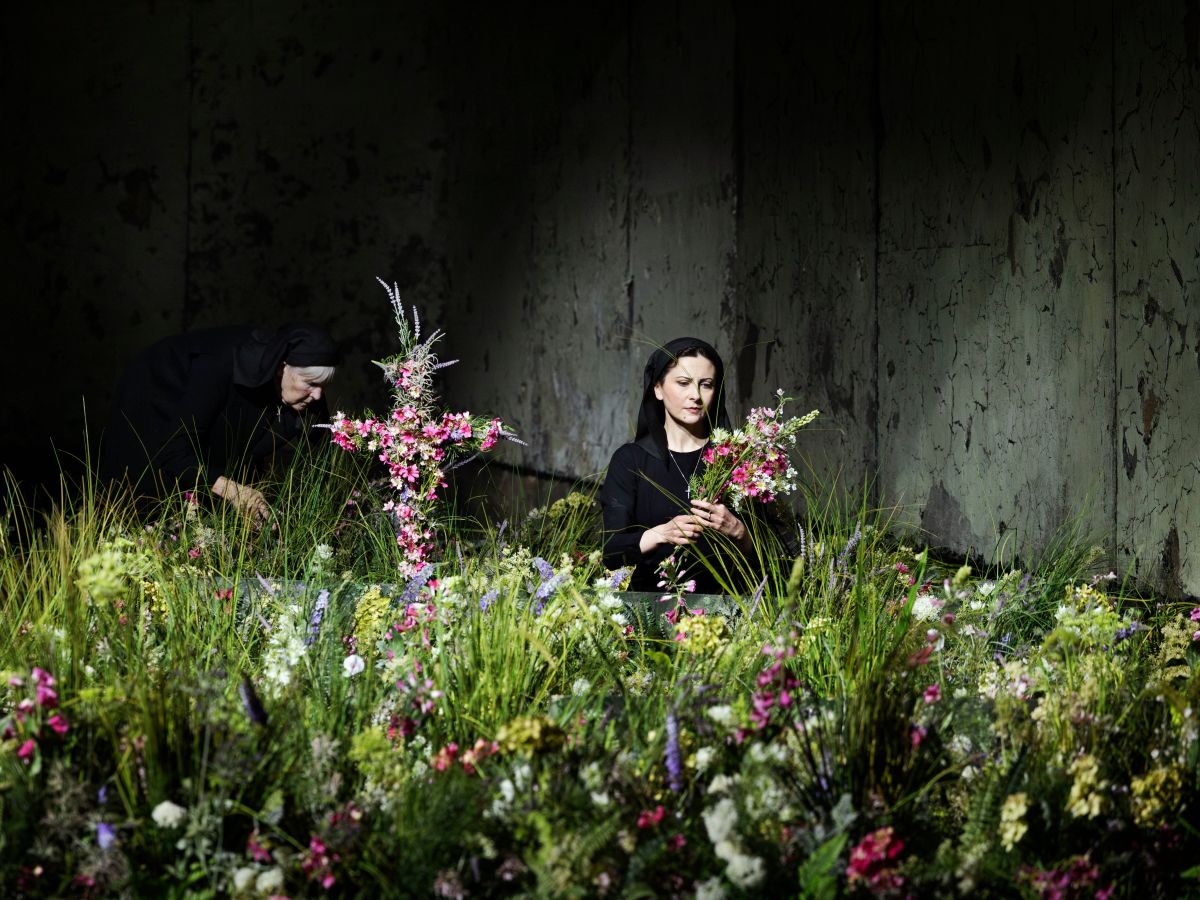
Dialogues des Carmélites, The Royal Danish Opera 2026
If you’re waiting for something to break, Act III is your moment. In Barrie Kosky’s production of Poulenc’s only long opera, it’s not the people – it’s the wall. We’re stuck in the same room. Boxed in by the same walls. First, inside the de la Force family. Then we convert to the Carmelites. Grey…

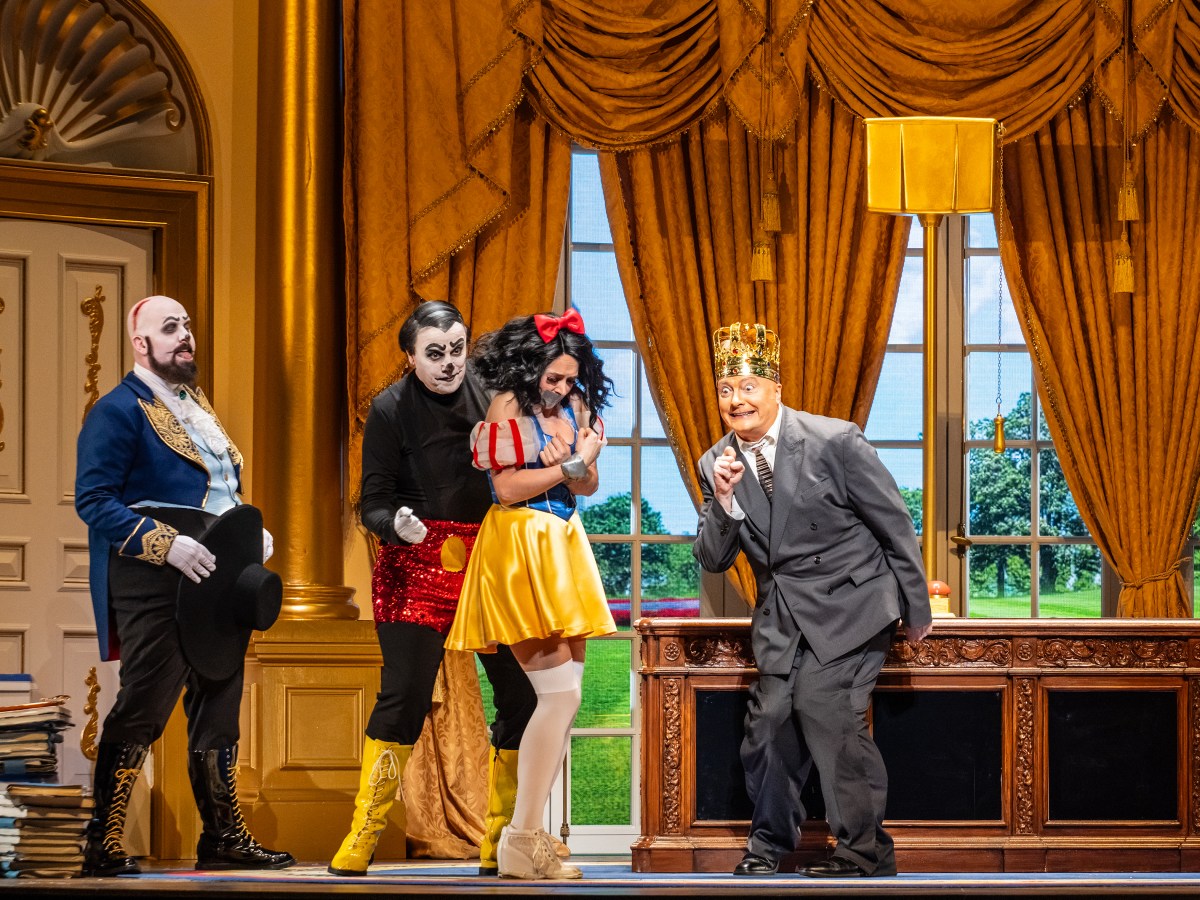
Monster’s Paradise, Hamburgerische Staatsoper 2026
World premiere! A brand-new opera by Austrian composer Olga Neuwirth. Which basically means: no one knows what we’re about to listen to or experience. No map, no manual, no “how it’s usually done.” What is an opera, anyway? At what point do we decide that something is one? If this hadn’t taken place inside the…
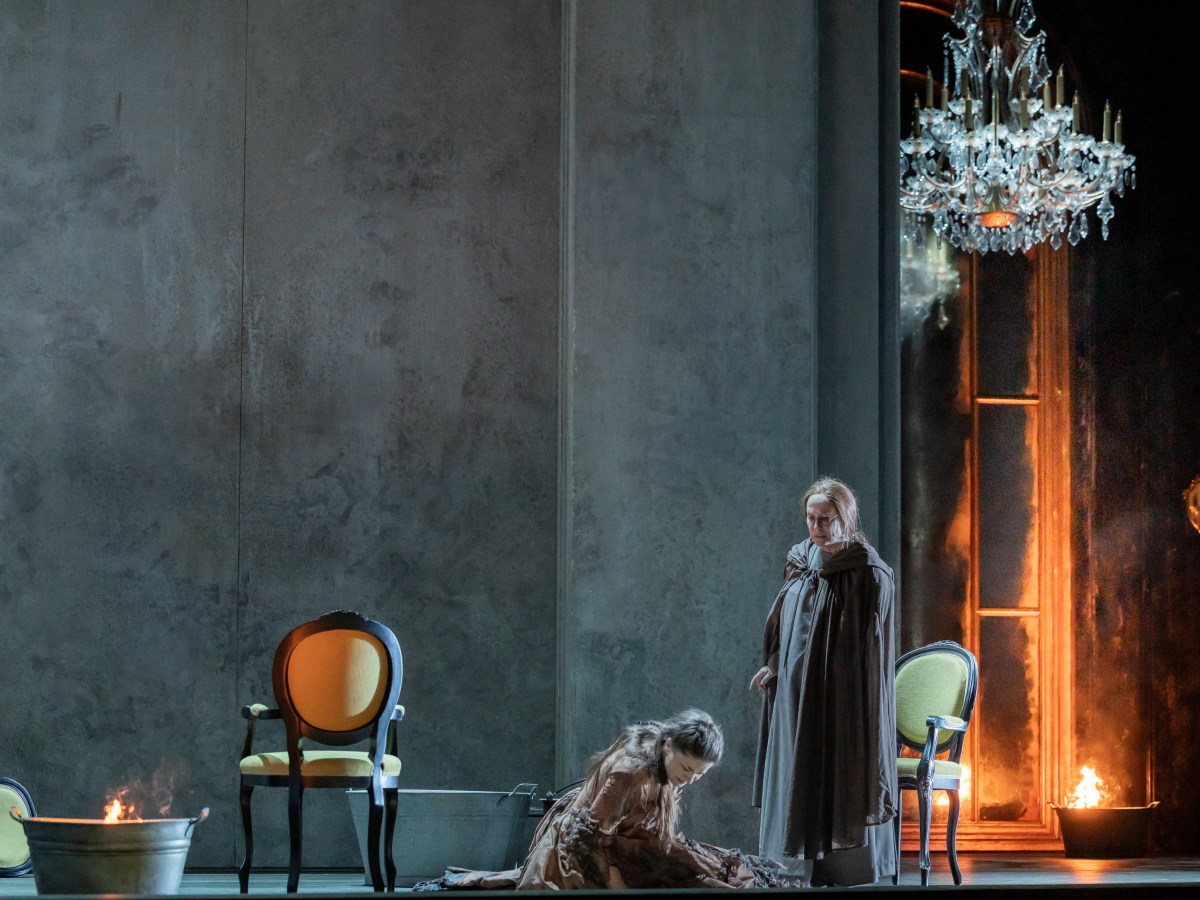
Dialogues des Carmélites, Semperoper Dresden 2026
Did someone say Poulenc? At the Semperoper? For the first time ever with Dialogues des Carmélites? Yes, you heard that right. The French composer’s second opera has found its way to Dresden, in a production directed by Dutch Jetske Mijnssen. The prelude is silent. Curtain up. Blanche is already there, standing alone in a wide,…
 Blogfløjten