

Germany’s got more than 80 opera houses. Eighty! At this point, it feels like every other town’s got one tucked between a Döner stand and a drugstore. I’ve barely scratched the surface, but honestly – what’s in the German water that makes (almost) every opera house this solid?
Lübeck’s house, with (very specific) 792 seats, isn’t exactly a palace of grand proportions – but they know how to put on a grand opera.
From the very first rising horn line followed by that almost tutti tumble, it was clear: this orchestra can play. No, they’re not the best orchestra in the world – but do they really need to be for it to be a joy to listen to? They hit that sweet spot between polished and pleasantly alive.
Richard Strauss’ fifth opera premiered in Dresden in 1911. The post-shock therapy after he’d just served Salome and Elektra on a silver platter. This time, we’re sipping coffee in Vienna around 1740. Down to the dialect – very precise, very particular, very… Vienna. As my opera buddy and I agreed, this isn’t exactly the kind of piece that screams “bring in a spaceship!” or “add a bathtub!” Honestly, I’d be impressed if anyone could stage it with a concept that doesn’t make you go, “Hä?”
In Lübeck, director Michael Wallner has pretty much played it by the (libretto) book. His first Rosenkavalier waltzed through Graz in 1993 – but clearly, one dance wasn’t enough. So here he is, taking the piece for a second spin!
How about this production?
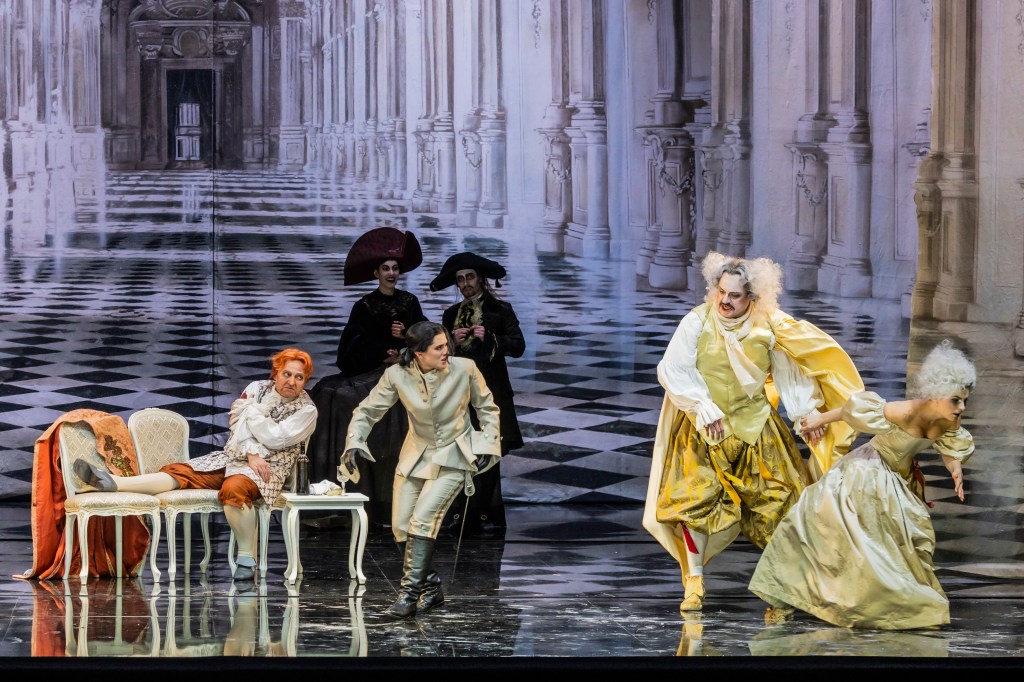
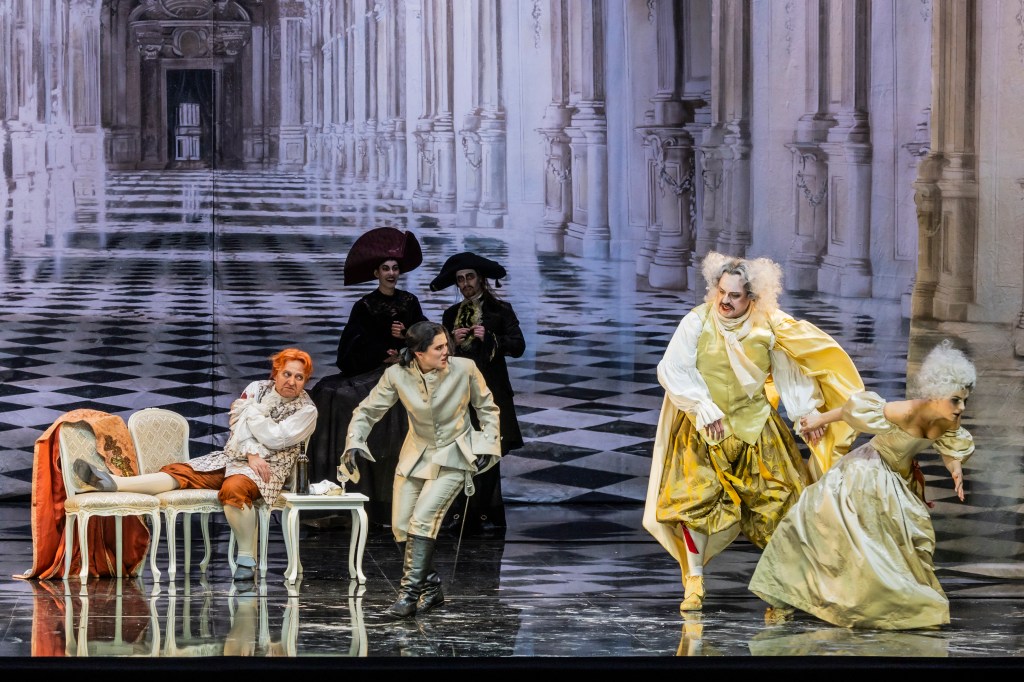
Wide wigs, knee-high knickers, and hips so humongous you’d need a running start to squeeze through the door. Can you imagine? Back then, people had one extra thing to style when picking an outfit: their “hair”. And if you got it right, it could actually look… sorta stylish? Just look at Baron von Ochs, clearly a creature completely committed to cocoa-orange. Socks included. On. Point.
Quick heads-up: here’s the deal with Der Rosenkavalier
Act I: The Marschallin is sneaking around with her much younger lover, Octavian – all cozy, all romantic, all “don’t tell anyone!”. Then her pompous cousin, Baron von Ochs, stomps in.
Act II: Ochs wants to marry young Sophie. Cute idea, right? Wrong. Biggest player. When Octavian hands over the traditional silver rose, sparks fly, tempers flare, and chaos erupts. Swords? Check. Drama? Double check.
Act III: With a clever disguise and a few tricks, Ochs’ nonsense gets exposed. The Marschallin? She glides in for one last, stylish mic-drop of a goodbye. Love wins, Ochs… not so much.
What does the stage actually look like?
Well, in Act I, we basically just get one giant bed… with at least four extra pillows you didn’t ask for.
They also have a lot of fun with the lighting. Red can mean love, sure, but it’s also the colour of blood… ooooh dramatic, right? And also, isn’t it kind of romantic to sing a beautiful duet under a sparkling, starry sky?

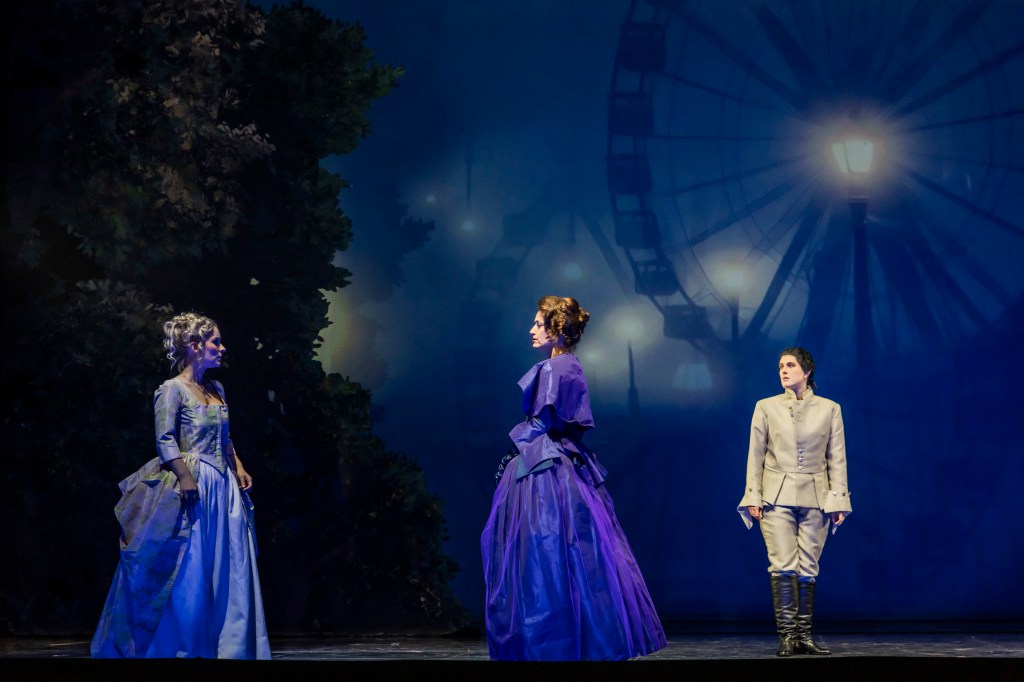
The set is sparse and two-dimensional. Kind of reminds me of Alvis Hermanis’ Tosca production at the Staatsoper in Berlin… But the visuals are striking enough to give the impression that we’re in a bedroom, in a lavish house with black-and-white checkered marble floors, and in an amusement park…? A giant glowing Ferris wheel, a horse with glowing red eyes that doesn’t look very friendly, and an equally unfriendly clown creature, also with red eyes. Are we still in the 18th century?
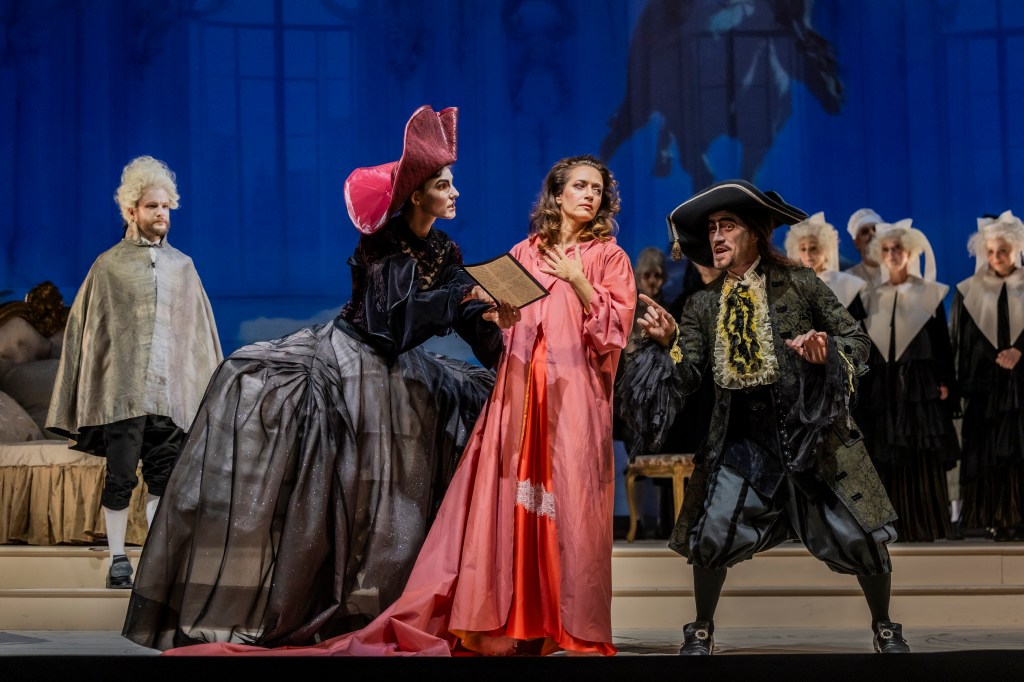
Even though there are plenty of comic elements, it’s not all fun and games. There’s a bit of critique in there, too – maybe that’s why some of the singers are spinning in costumes that took a wrong turn at crazy town? Pirate hats? Circus frills? Funeral vibes? Who knows. A playful poke at the absurdity of the upper class and their over-the-top ways?
“I weiss halt nit, ob i dös derf.”
One of the things that keeps popping up throughout the whole opera is the language (well, makes sense, since they do sing most of the time). Thank you, Hugo von Hofmannsthal. Why? It’s set in Vienna, and if there’s one thing Viennese people do, it’s talk in a funny way (no offense). Naturally, that has to come through in the opera – even the surtitles are written in a kind of spoken-dialect style, trying to capture the rhythm and quirks of it.
With Johannes Maria Wimmer as Baron von Ochs, this part didn’t feel too far off – after all, he is Austrian… With a bass that was not too wide nor too narrow, he delivered a satie-sfying performance. In the first act, though, there were moments where it was a bit tricky to catch every word. Was he mumbling? Or just skipping a few consonants? At times, he was also drowned out by the other singers and the orchestra. But it improved as the performance went on, and honestly, he was far from boring – there was plenty of character, charm, and stage presence to enjoy also!
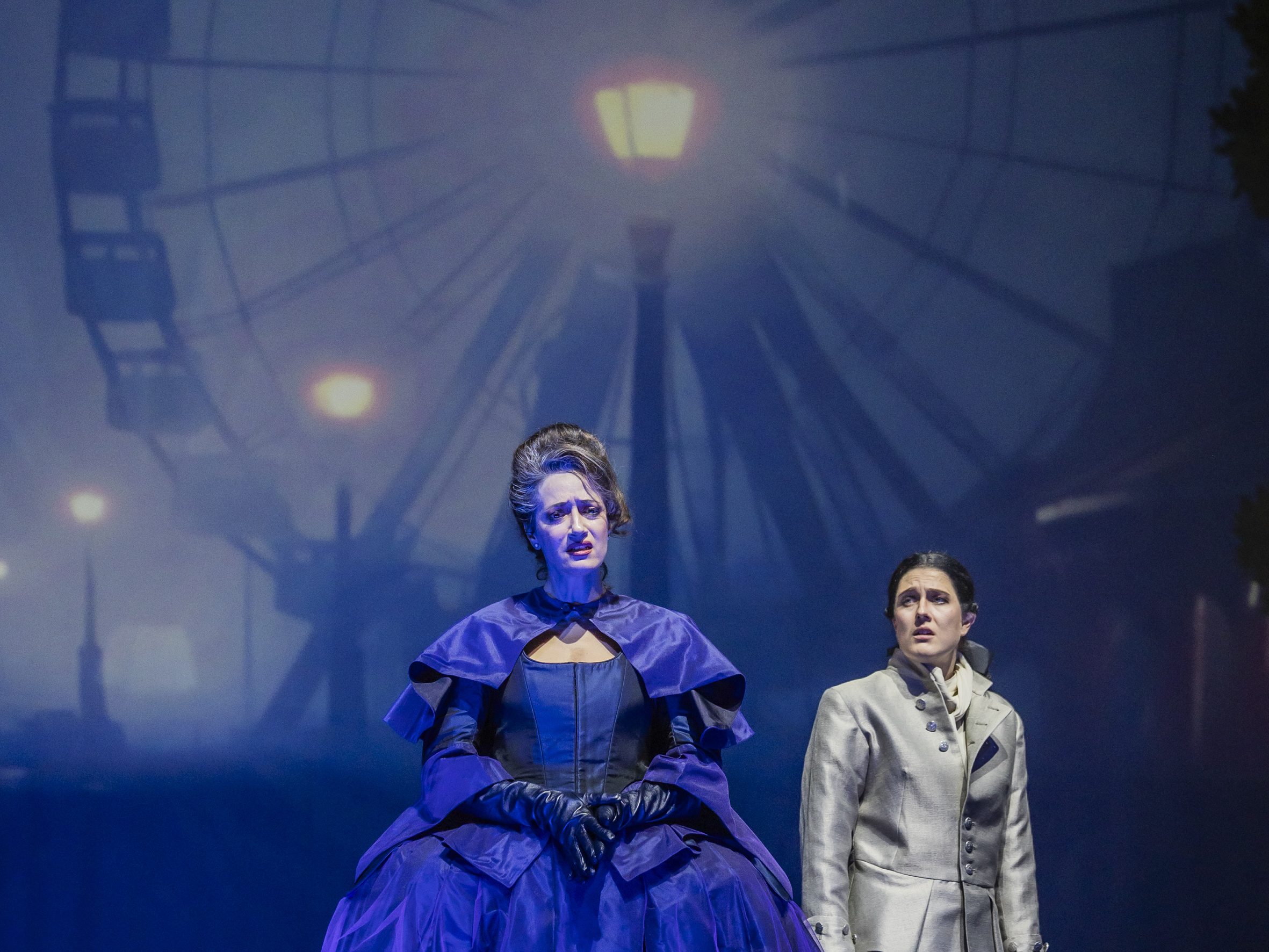
The opera is probably best known for that divine moment toward the end. Three women going all out, singing about love, loss, and letting go. And there they stand – perfectly still at the edge of the stage, doing nothing… except, singing (duh). Letting the music do all the heavy lifting. I know, cliché alert, but seriously? The music does all the talking.
Three well-casted roles, with Evmorfia Metaxaki (the Marschallin) probably leaving the biggest impression. Her tone could just float into the air, all decorated with a lovely vibrato at the end. She was incredibly clear with her diction – which, let’s be honest, is something you don’t always get from sopranos (sorry…). Every single vowel and consonant was thrown out into the air. It also helped that she sang in a very storytelling way, really giving every line a bit of narrative flair.
Oh, and did I mention the harps were set up right at audience level in the stalls? Perfect for spying on the musicians’ little moments of joy. Now I’ve got a pretty good handle on when the harp kicks in and how Strauss uses them.
But the best part? Catching one of the harpists absolutely lighting up when that Ab7 chord hits just before the trio – a grin plastered across her face, a tiny happy dance, the whole “oh yeah, this is so good” energy. Honestly, it’s impossible not to smile watching people clearly loving what they do!
Fun Fact!
In 1917, Strauss conducted the 100th performance of his own Rosenkavalier in Dresden. Just a year later, in March 1918, he was already waving the baton for the 700th!
Cast:
- Conductоr: Stefan Vladar
- Directоr: Michael Wallner
- Stаge Designer: Stefan Rieckhoff
- Сostume Designer: Tanja Liebermann
- Light Designer: Falk Hampel
- Dramaturg: Jens Ponath
- Choreography: Kati Heidebrecht
- Сhoir: Jan-Michael Krüger
- Die Feldmarschallin: Evmorfia Metaxaki
- Der Baron Ochs: Johannes Maria Wimmer
- Octavian: Frederike Schulten
- Herr von Faninal: Steffen Kubach
- Sophie: Karola Sophia Schmid
- Jungfer Marianne: Andrea Stadel
- Valzacchi: Noah Schaul
- Annina: Delia Bacher
- Ein Polizeikommissar: Viktor Aksentijević
- Der Haushofmeister bei der Feldmarschallin/Der Haushofmeister bei Faninal: Svjatoslav Martynchuk
- Ein Notar: Changjun Lee
- Ein Sänger / Ein Wirt: Franz Gürtelschmied
- Drei adelige: Waisen Therese Meinig, Therese Fauser, Iris Meyer-Zentner
- Eine Modistin: Aditi Smeets
- Ein Tierhändler: Wonjun Kim
- Vier Lakeien der Marschallin, Vier Kellner: Yong-Ho Choi, Tomasz Myśliwiec, Young-Soo Ryu,
Chor des Theater Lübeck, Statisterie des Theater Lübeck, Philharmonisches Orchester der Hansestadt Lübeck
- Dialogues des Carmélites, The Royal Danish Opera 2026
- Monster’s Paradise, Hamburgerische Staatsoper 2026
- Dialogues des Carmélites, Semperoper Dresden 2026
- Lohengrin, Staatsoper Berlin 2026
- Das kalte Herz, Staatsoper Berlin 2026
Dialogues des Carmélites, The Royal Danish Opera 2026
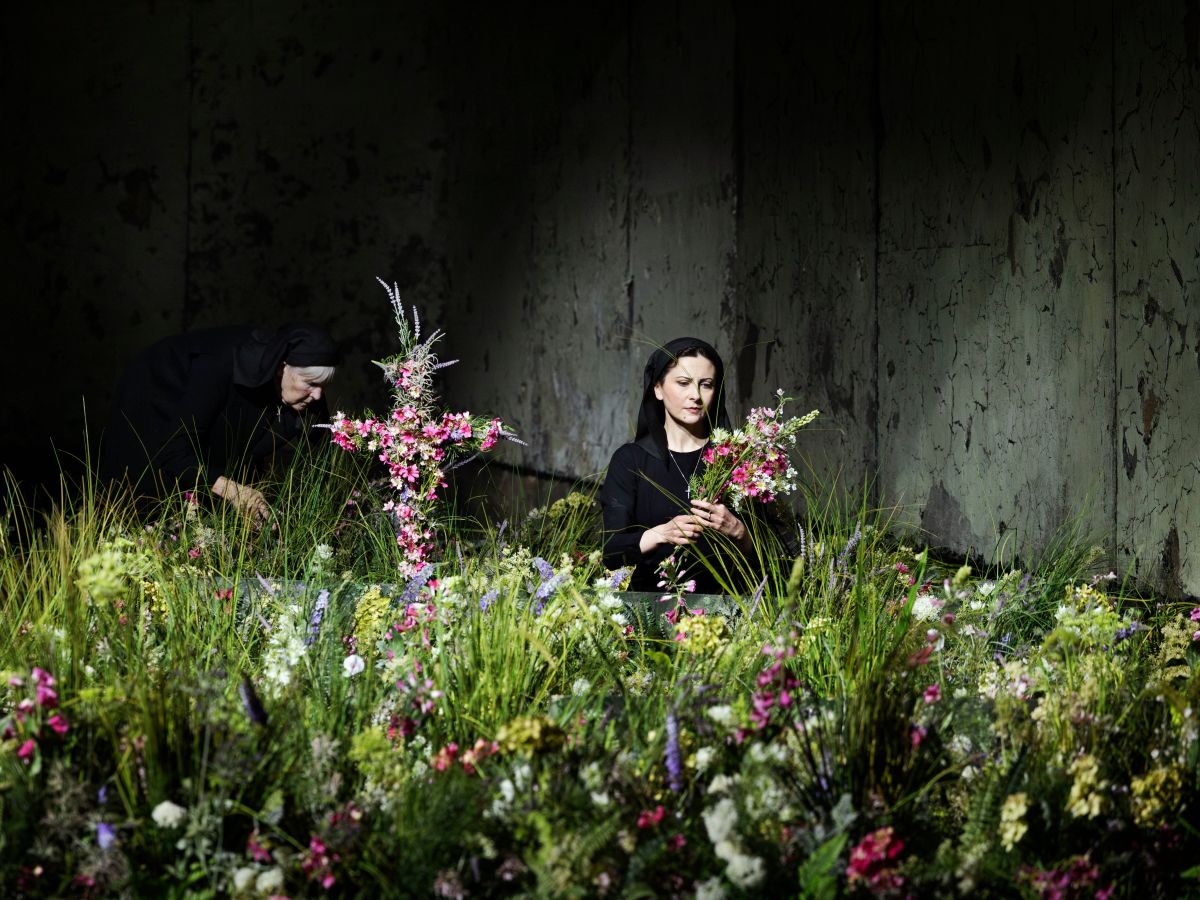
If you’re waiting for something to break, Act III is your moment. In Barrie Kosky’s production of Poulenc’s only long opera, it’s not the people – it’s the wall. We’re stuck in the same room. Boxed in by the same walls. First, inside the de la Force family. Then we convert to the Carmelites. Grey…

Monster’s Paradise, Hamburgerische Staatsoper 2026
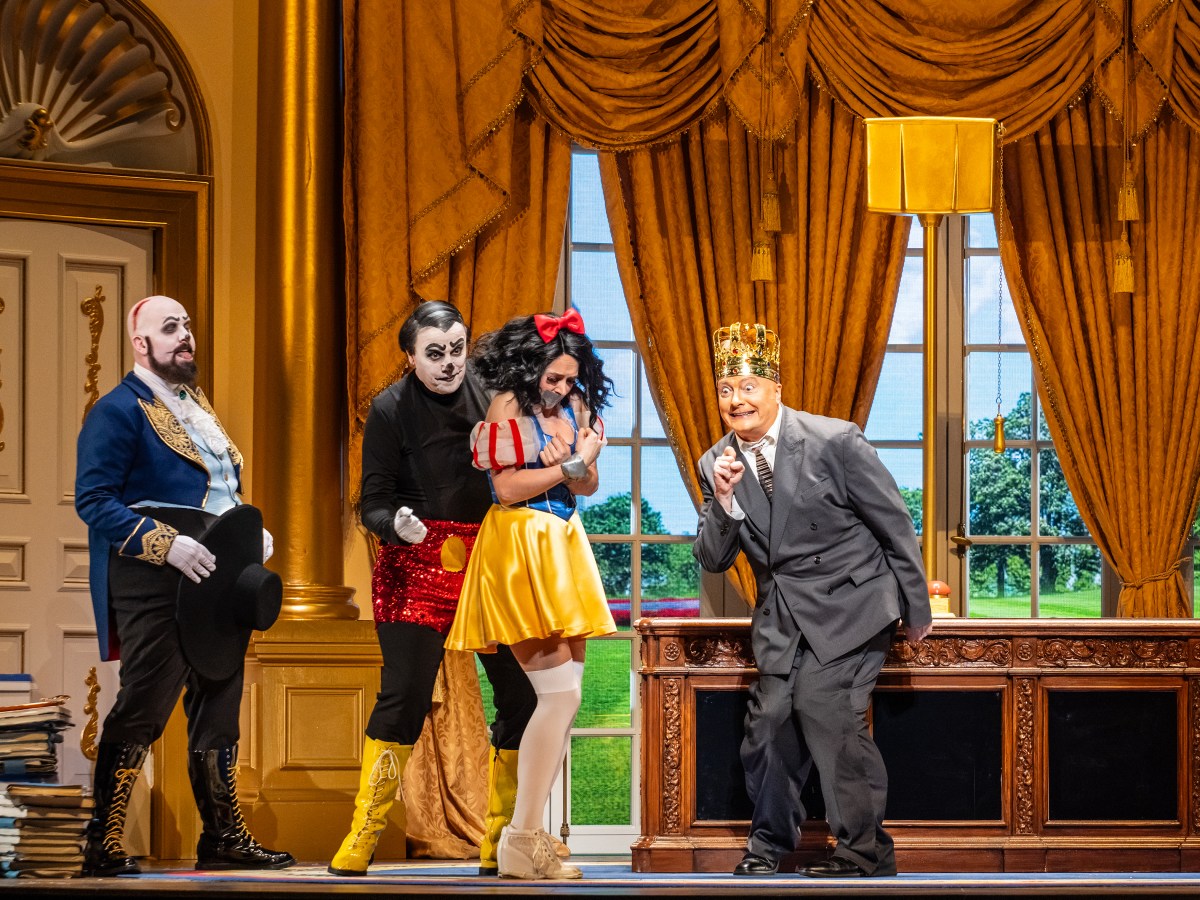
World premiere! A brand-new opera by Austrian composer Olga Neuwirth. Which basically means: no one knows what we’re about to listen to or experience. No map, no manual, no “how it’s usually done.” What is an opera, anyway? At what point do we decide that something is one? If this hadn’t taken place inside the…
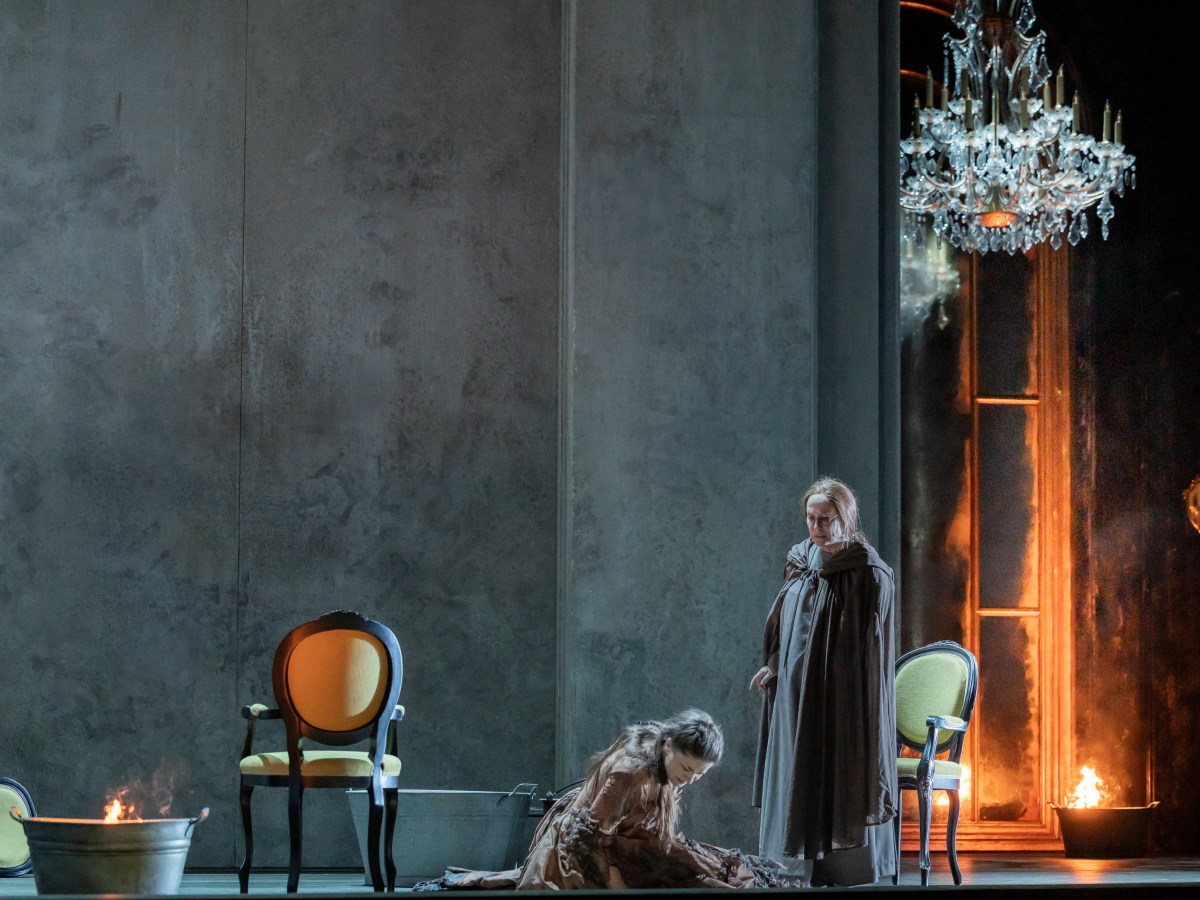
Dialogues des Carmélites, Semperoper Dresden 2026
Did someone say Poulenc? At the Semperoper? For the first time ever with Dialogues des Carmélites? Yes, you heard that right. The French composer’s second opera has found its way to Dresden, in a production directed by Dutch Jetske Mijnssen. The prelude is silent. Curtain up. Blanche is already there, standing alone in a wide,…
 Blogfløjten