

Two different composers, two different dramas – yet somehow they often seem to show up at the same party. Marching under the same banner: verismo. From the Italian vero, meaning “truth.” The idea? To show life as it really is. No filters, no fairytales – just passion, pain, and people behaving badly (and oh boy, they do).
Speaking of reality, in the Pagliacci production, we’re hit with a 1945 postcard. War’s over. World’s wrecked. And “entertainment”? Yeah… suddenly it’s not just a laugh. It’s a lifeline. Or, well… of course, it depends on the angle you’re looking from…
Alright, first stop: Cavalleria rusticana
This little Italian gem was written by Pietro Mascagni (the ultimate one-hit-wonder) for a competition in 1890. And guess what? He won. Big time. Overnight. Boom, fame. All his other works? Yeah… not so much.
The first violins sneak in alone, a soft, tender F – like the first rays of an Easter morning light slipping through a cracked window. Just a whisper at first. Then the rest of the strings slide in, one by one. It develops into something that sounds like a dominant chord – you know, full of tension, itching to resolve somewhere safe… but hold on. It doesn’t go where we expect. Instead, it twists, it turns, it surprises – what music theory geeks call a “deceptive cadence.” It lets us down, like a promise unkept.
Wait, isn’t that just like the story?
Santuzza is with Turiddu, the man she loves. But he doesn’t quite live up to her hopes. But honestly? He’s kinda… meh. Never really had the plan to be all-in anyway. His heart belongs to Lola. Only problem? While he was serving his country, Lola went and married Alfio. So Turiddu… well, he took what he could get…
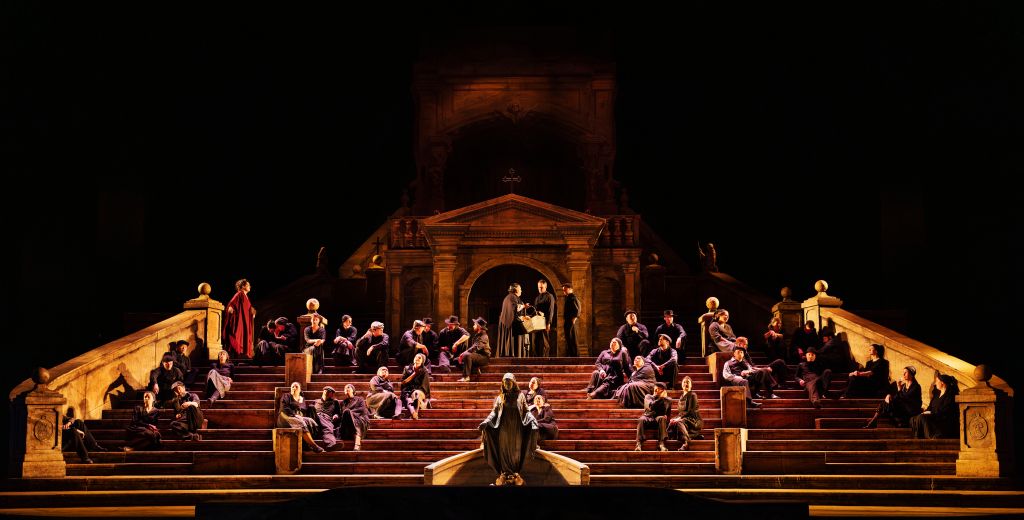
Kasper Holten, who’s directing, gives us a skyhigh staircase. “La scala,” we could call it. It stretches up, up, up, and at the very top? A church.

Santuzza’s sitting on the stairs, all smiles, just enjoying a tiny bubble of happiness. But then…from somewhere far off, she hears Turiddu singing about Lola, how much he loves her. Her smile shatters. Her chest tightens, tears spill. She’s shaking, can’t stay still.
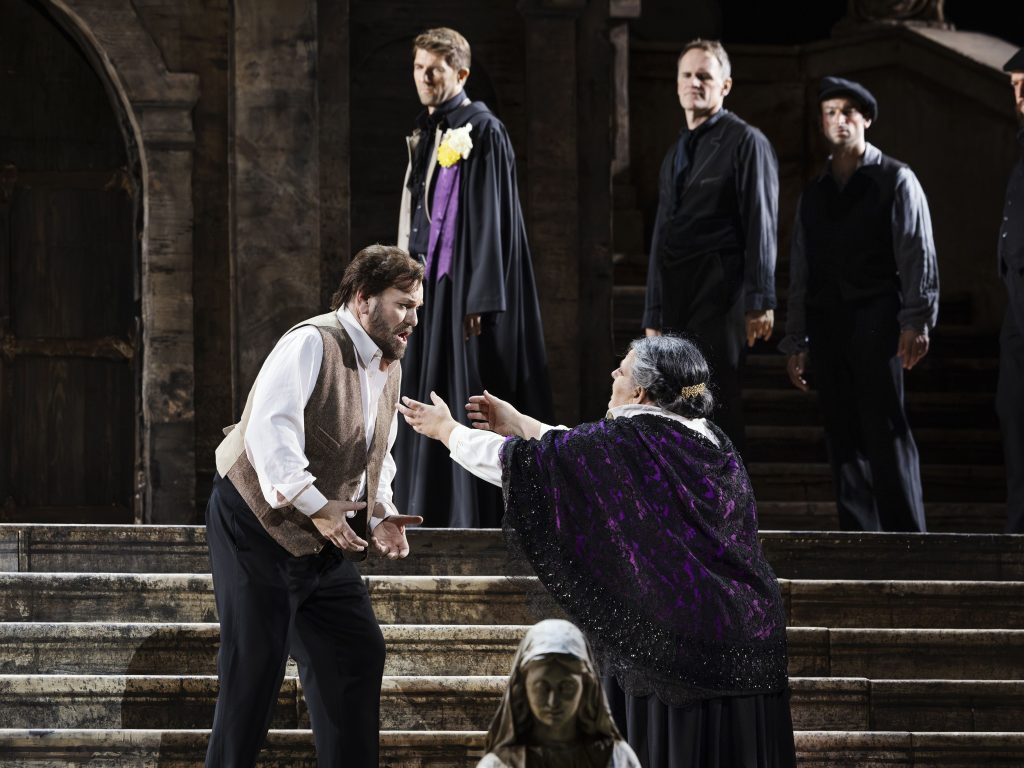
A little later, we meet Lola’s husband – aka Mr Smart-Ass, going by the name Alfio. He struts around with all the confidence in the world (pretty sure he’d call it “swag”), arms flailing, face full of that classic YOLO expressions. “Alfio, always in a good mood,” they’d say. But yeah… that isn’t gonna last…
Amen
The hymn to the Virgin Mary, Regina Coeli, with choir and organ. At first, the choir isn’t on stage yet, so you hear them faintly in the distance. That makes the “pauses,” where the organ plays its one note across two octaves, feel a little… weird. The balance is off – the choir feels small, while the organ dominates, filling the hall.
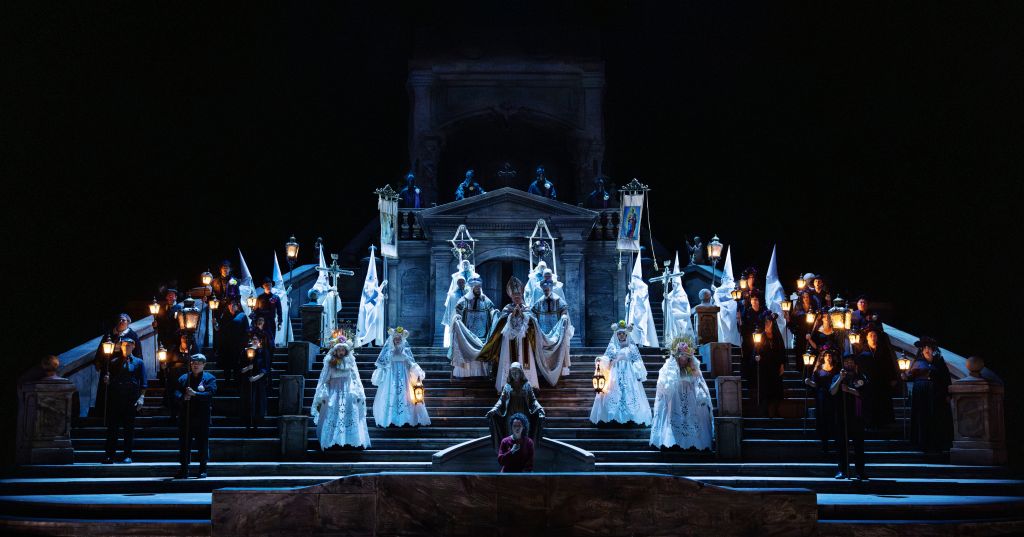
Gradually, folks trickle out from the church. Those in black slip to the sides, the ones in white take the middle. Candles flicker, the stage glows, and the choir grows stronger – not just from stepping forward, but thanks to conductor Giulio Cilona, building it layer by layer.
At one point, they belt out a passage so powerfully that you might think, “Okay, that’s it. That’s their peak.” But no. If you thought that… you were wrong. The real showstopper comes at the very end of this choral section: a great ritardando, followed by greater, soaring tones that match the grand scale of the stage.
The real banger in this melodrama?
The intermezzo, sliding in toward the end. Sometimes it even gets performed on its own in a concert hall.
The score might look relatively simple on paper, but it sure doesn’t play itself. To make it really come alive, you need a conductor with something to say. Enter Giulio Cilona. You can feel the melodies moving, never still, always chasing somewhere – like waves rolling toward the shore, then pulling back, pausing, teasing. And not at one steady tempo, of course. Pauses? They’re music too – at least in Cilona’s hands, creating tension, space, drama.
Santuzza is a role that, like our one-act buddies Salome and Elektra, is on stage (almost) the whole time. Trine Møller, a Danish dramatic soprano who has sung Brünnhilde (Der Ring des Nibelungen) in Copenhagen and Esbjerg, has now ventured into verismo territory. Soon, she’ll take on Brünnhilde again in Herheim’s Ring at Deutsche Oper Berlin – which, just so you know, I fully plan to catch.
No doubt about it: she knows every word tonight, and she sings them with full-on heart and intensity.
A Small Note
There’s a lot of play in the colours of the costumes. Or… actually, almost none. Mostly black and white. But it’s not random who wears what. And right smack in the pack? Santuzza, standing in her red dress, no less. The colour of love, yes – but also of hate and rage.
The piece ends with a soulful scream. Why? Ah, see that’s the million-dollar question. Go figure.
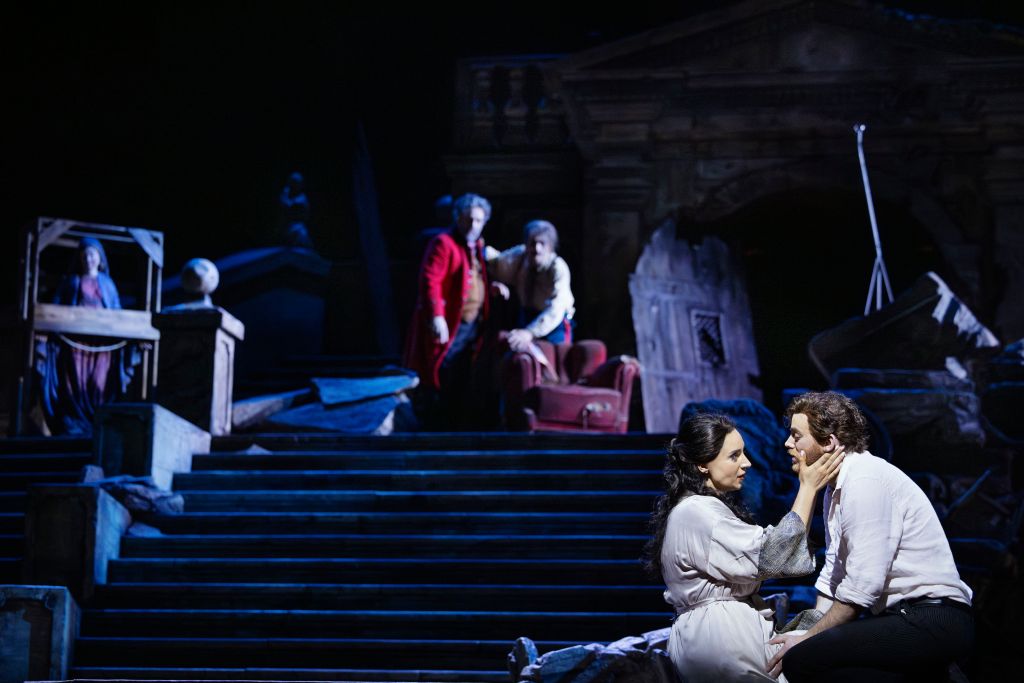
After the intermission, it’s time for the second piece: Pagliacci.
Just like the production that premiered at the Bayerische Staatsoper last year (check it out here if you’re curious), the two stories kind of collide. Same staircase, but now we’ve jumped about fifty years into the future. American flags everywhere, soldiers, and oh yes – the right side has turned into a black hole…
That’s a pretty weird location, huh?

Pagliacci is directed by Paul Curran, and by the way, the whole production actually premiered back in 2011.
It’s about a travelling troupe bringing entertainment wherever they go. And placing it right after the war? People were craving for a little normalcy and culture. Take Jewish-American violinist Yehudi Menuhin, for example: in June and July 1945, he played for “displaced persons” – Holocaust survivors – even near where the Bergen-Belsen camp had been (a concentration camp, torn down just a month earlier). On piano? Benjamin Britten. And they weren’t the only ones – lots of artists were touring, bringing music, hope, and maybe a little distraction to a world that really needed it.
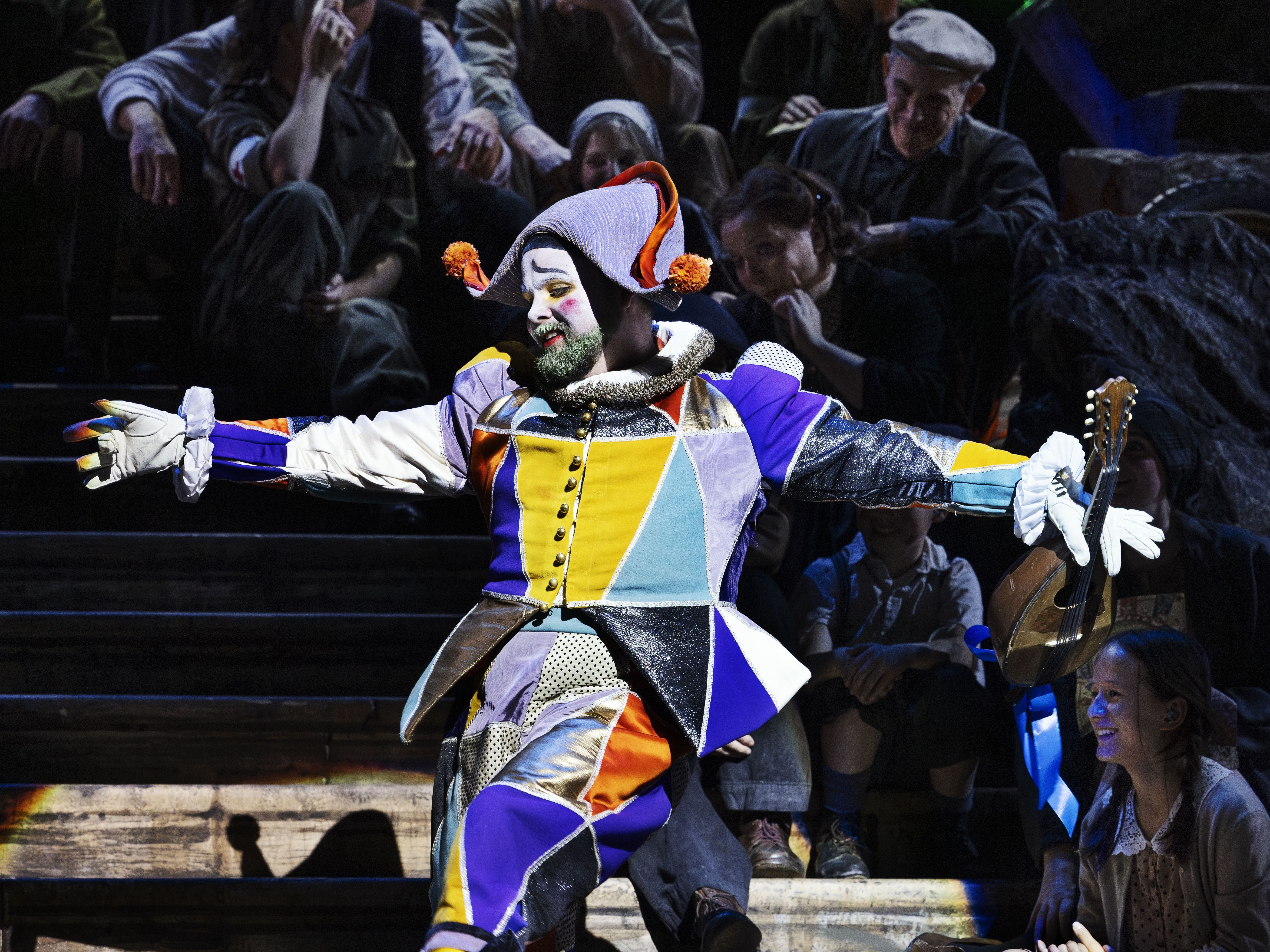
They had lost everything. Back then, “entertainment” wasn’t just for fun. And Pagliacci proves it – a story about clowns that’s really about pain, jealousy, and the masks we wear to hide it. Or at least try to. Just look at Tonio: he’s got a giant painted-on smiley (or maybe a mustache?) on his face, but honestly? He’s anything but mega-happy.
Danish baritone Jens Søndergaard, who’s often seen around here at the opera, had two roles tonight: Alfio in Cavalleria rusticana and the sly Tonio in Pagliacci. Clearly, Tonio was the one who suited him best. Even though he’s a funny, charming guy, his voice seemed to fit Tonio better – both in tone and in character.
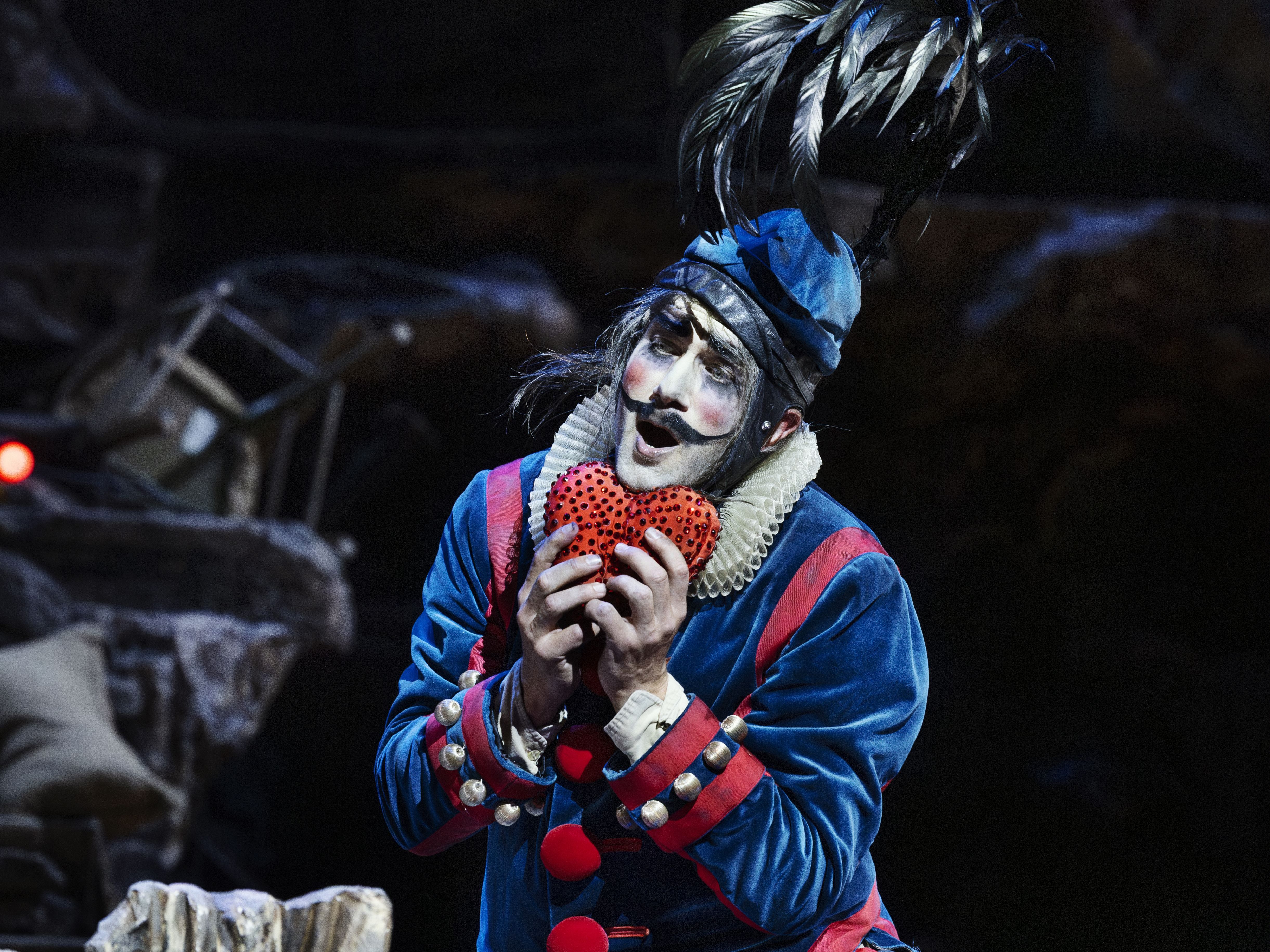
Another Dane, Niels Jørgen Riis, took on both Turiddu and Canio tonight – a very satisfying performance in both halves. In his big “Vesti la giubba” in Pagliacci, he sings about putting on a costume and making people laugh, even though he’s completely broken inside. He’s just found out that his wife… well, let’s say, she’s not exactly on his team. He sings it with enormous disappointment. Not that he disappointed but his vibe is kinda like, “Not angry… just disappointed.” A random woman comes in, but he shoves her away. He’s not the bad guy. He’s the sad guy.
On the other hand, soprano Caitlin Gotimer as Nedda? A strong, powerful voice, with a sparing, measured use of vibrato. And even though the music might start off by “letting us down”, tonight was anything but disappointing.
Fun Fact!
Cavalleria rusticana means “Rustic Chivalry” – which is kind of ironic, since it’s all about betrayal and revenge rather than, you know, actual chivalry.
Pagliacci means “Clowns.”
Cast:
- Conductоr: Giulio Cilona
- Directоr: Kasper Holten and Paul Curran
- Stаge Designer: Mia Stensgaard
- Сostume Designer: Anja Vang Kragh
- Light Designer: Bruno Poet
Cavalleria rusticana
- Santuzza: Trine Møller
- Turiddu: Niels Jørgen Riis
- Lucia: Johanne Bock
- Alfio: Jens Søndergaard
- Lola: Francine Vis
Pagliacci
- Nedda: Caitlin Gotimer
- Canio: Niels Jørgen Riis
- Tonio: Jens Søndergaard
- Peppe: Fredrik Bjellsäter
- Silvio: Theodore Platt

 Blogfløjten