
Dear Diary,
That was it. A whole week wrapped in Wagner. Four evenings in the same seats, with the same seatmates night after night. By now, I know the guy to my right and I already have at least nine performances lined up together in our calendars – promise, it’s a coincidence!
It’s funny what you pick up along the way: the singers’ quirks, the conductor’s cues, the orchestra’s outbursts, even the toilets’ traffic flow. Tricks, tips, and tiny traditions. It’s all part of the package.
And then… it’s suddenly over. Curtain down. Twilight time. What now?
Well, luckily I’m still hanging on to the Valkyrie’s wing in this very moment of writing. So let me tell you how the final hours unfolded.

Crash course
Siegfried leaves Brünnhilde to go out and “see the world,” stumbles straight into the Gibichungs, and gets slipped a potion that makes him forget who he actually loves. Next thing you know, he’s marrying someone else. Brünnhilde is furious, Hagen is weaving his wicked web, and Siegfried doesn’t see the dagger coming. And in the end? Flames, floods, and a fresh start.
If you’ve been following along (and if not, well… now’s your chance! Rheingold, Walküre and Siegfried), you’ll know that Dmitri Tcherniakov, of course, doesn’t let the story unfold quite like that.
The Concept
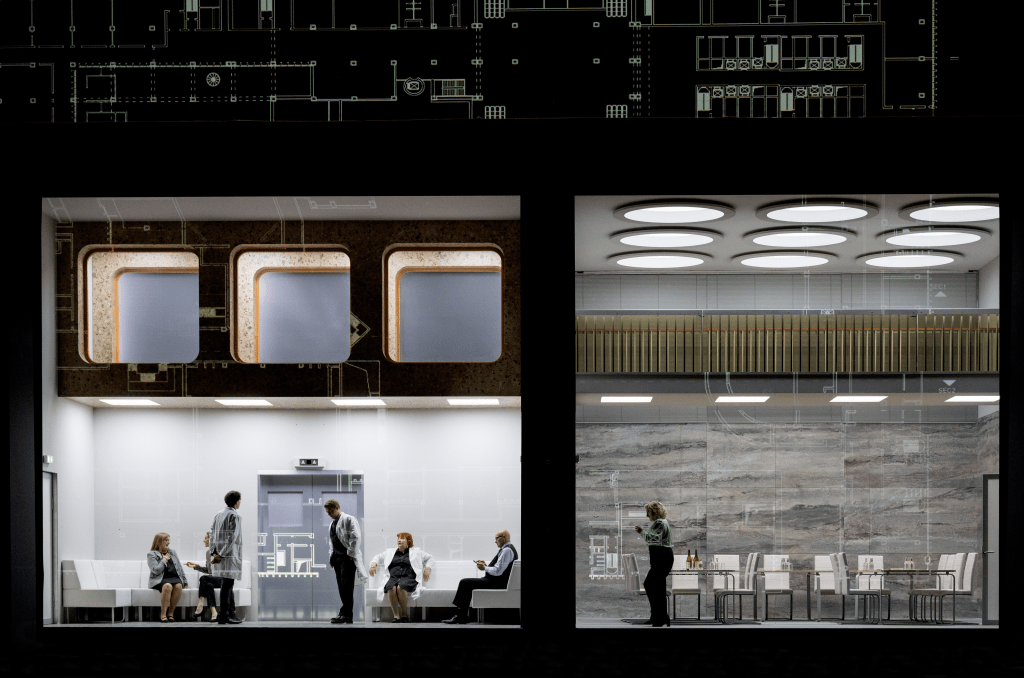
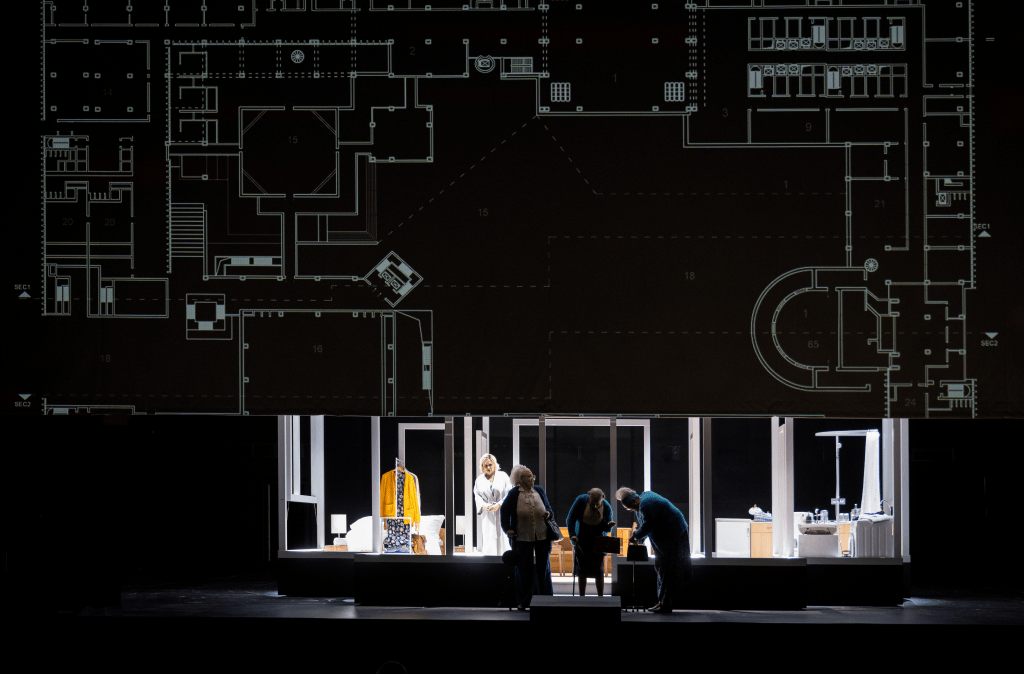
So, this time our favorite flat is filled with Siegfried and Brünnhilde. No Wotan watching from the walls this time – his office has vanished, poof! Before he heads off, Siegfried gives Brünnhilde a spin, then steps into the Gibichung hall, letting the drama begin.
We’ve seen this room before, but it’s got new walls now, so… maybe we don’t really know it at all.
Gunther messes with Hagen, but you can tell he’s also kinda scared of him. When Siegfried shows up, him and Gutrune can’t help teasing him – like laughing at the toy horse in his bag. They’re both a bit awkward and clumsy. Gunther moves and reacts like a kid, which just makes those glasses constantly sliding down his nose even funnier. Shout-out to Lauri Vasar – rarely have I seen acting this precise and playful on stage.

Gunther’s a bit of a coward, so it’s Siegfried who has to fetch his future fiancée for him. Normally, that’s the moment where Siegfried just pops on the Tarnhelm, slips into Gunther’s shape, and gets the job done. But not on Tcherniakov’s turf.
This time, it’s Siegfried himself who shows up – no disguises, no magic tricks, no nothing. At first, Brünnhilde’s all “who are you?” and I’m sitting there thinking huh, can’t she recognize him? He looks the same!
But as a friend cleverly pointed out during the intermession, she’s not questioning his looks – she’s questioning his lousy behaviour. He’s acting like a proper prat, and that version of him she doesn’t recognize.
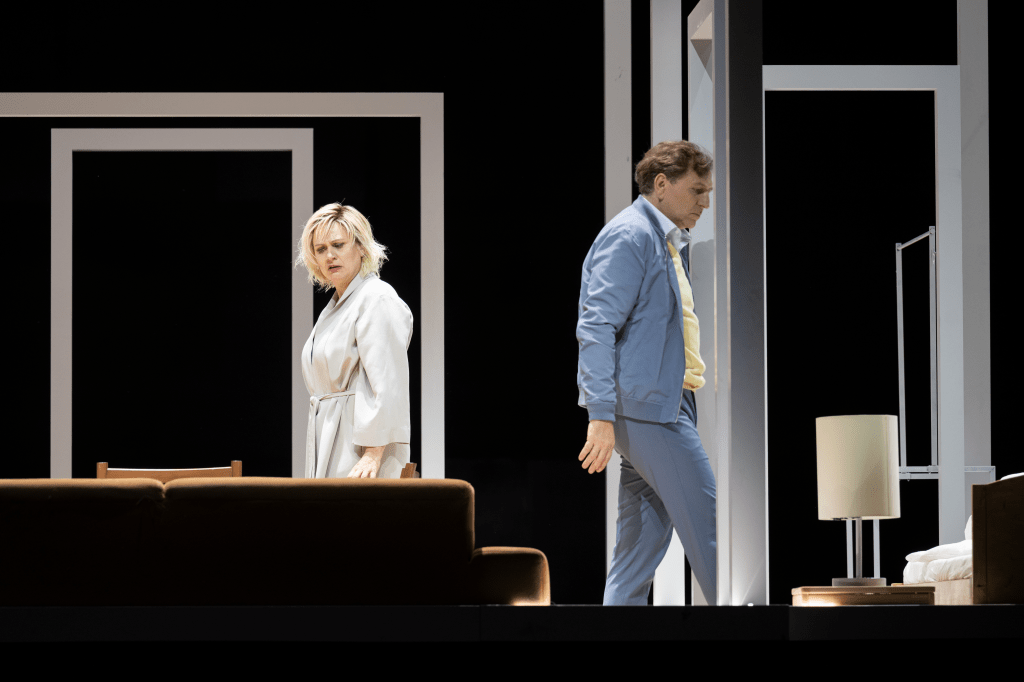
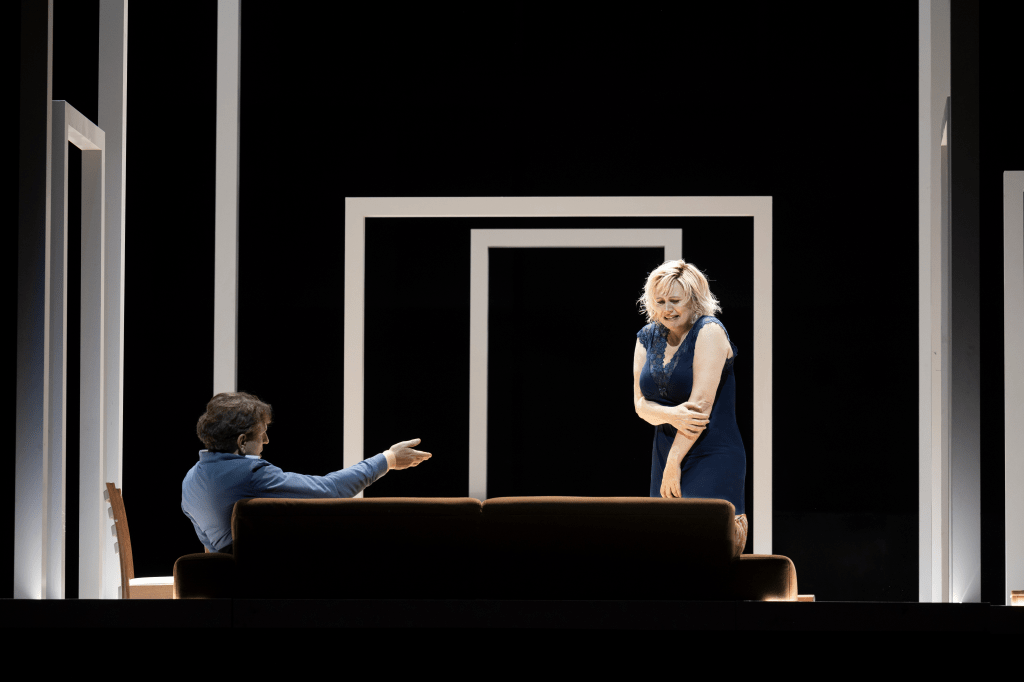
Siegfried doesn’t just act like a jerk – he is one. In this production there’s no potion to blame, no spell in the frame, just Siegfried being… well, lame. He just does whatever pops into his head, completely clueless – or careless – about how it affects anyone else.
Which, when you think about it, is kind of how Wagner actually wrote him. The whole “memory potion” thing is just a convenient cop-out. Because maybe, just maybe, Siegfried isn’t some tragic hero under a spell – maybe he’s just a self-absorbed man-child who thinks the sun rises and sets by the swing of his sword.
And in this case, he even assaults his own wife. So yeah… cheers to our fearless hero…
What’s the deal with Alberich? He popps up in the most random places, almost stark naked, just wrapped in a sad little piece of cloth that barely qualifies as underwear. And then he’s knitting socks for Hagen – because, of course, why not? What is Tcherniakov trying to tell us here? Is Alberich a tragic villain, a dad on a budget, or just really into DIY?

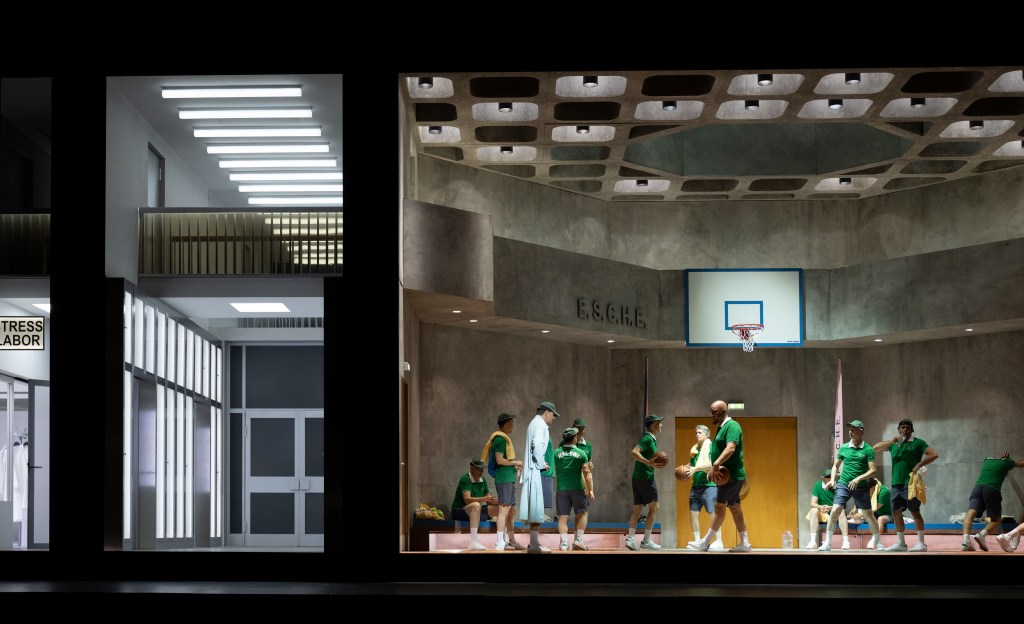
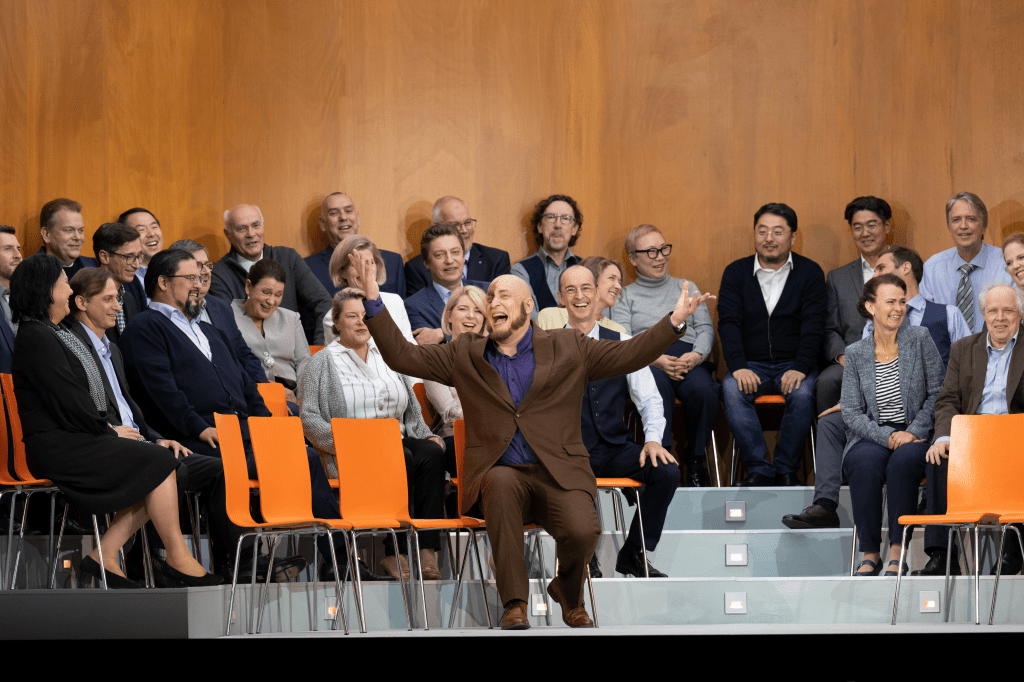
Alright, time for the finale… in basketball… or at least the guys are on some kind of team. Now Siegfried isn’t just juggling metaphorical balls anymore…
And then there’s the scene with the Rhinemaidens… what’s even going on? Physical therapy? A follow-up on the experiment? Are we even still in one at this point?
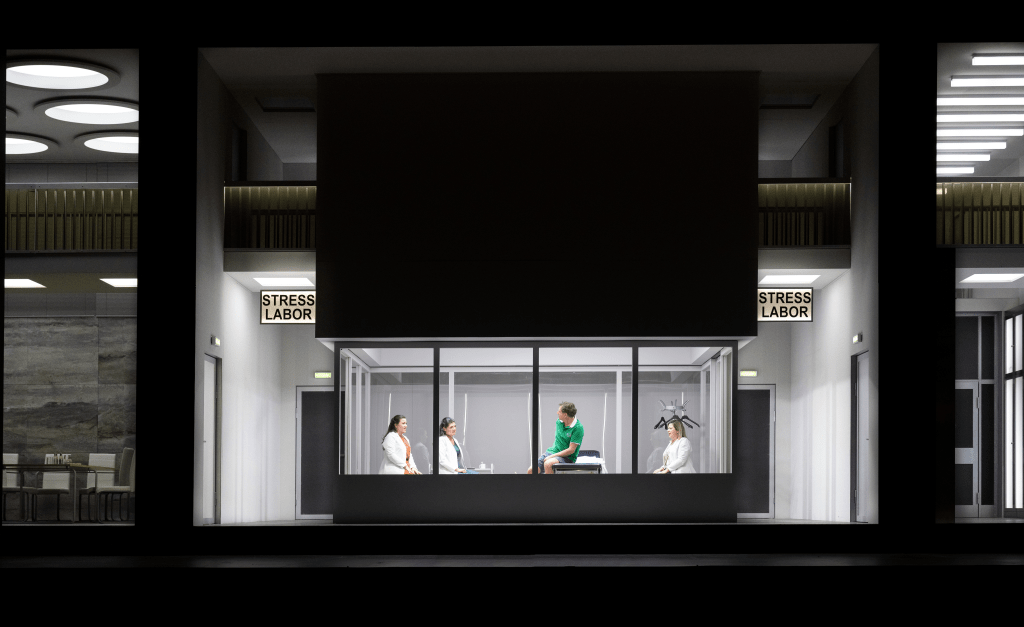
So, is this whole thing an experiment or what’s the plan? I have an idea about Brünnhilde’s role, but I’m not going to spill it – that would ruin the ending a bit too much. As for how Götterdämmerung fits into the big picture… well, I’m not entirely sure I get it.
Did you, btw, notice that the door handles in the basketball hall together actually form a ring?
The Muuusic
You know that feeling when you’re out for a run and there’s just 200 meters left, so you throw in one last frantic sprint? Not me, but apparently Christian Thielemann and the Staatskapelle Berlin do. The whole evening felt like we were racing in one gear higher than any of the other nights. And it’s all about to go down…
That also meant the singers sometimes drowned in dynamics – especially the Norns at the start, though they’re otherwise a classy cast. It was probably more the orchestra’s overzealous oomph than any singer slipping up. I’ve already raved about Anna Kissjudit. Take German soprano Daniela Köhler for example – I’ve also heard her sing Siegfried-Brünnhilde in Bayreuth. Brünnhilde! And here, she’s “just” singing a Norn. Same goes for the Rhinemaidens. It doesn’t look like they skimped on the cast tonight!
Anja Kampe (Brünnhilde) and Mika Kares (Hagen) didn’t disappoint – clearly still sprinting in the final stretch, keeping up with Thielemann and the orchestra’s last-200-meters gear.
Originally, Johannes Martin Kränzle was supposed to sing Alberich, but he had to bow out not too long ago. Welcome Jochen Schmeckenbecher! Solid singing, sure, but I do miss Kränzle’s clever, character-crafting chaos. Still, no complaints about the voice itself.
Same goes for Andreas Schager (Siegfried). He’s got his own quirky quirks, too. But like I wrote in my diary on day three, this is definitely a role he can handle (which, of course, he does). He seemed a bit tired today, a touch worn at the edges, but he still sailed strongly through. Siegfried on the other hand… let’s just say his voyage hits some rather rocky reefs.

When Hagen strikes down Siegfried (might be spoiling a bit here, but Wagner himself considered calling the work Siegfried’s Death, so I think I’m allowed), the musical pauses are really drawn out. It moves slowly. Almost comes to a standstill – like Siegfried’s heart.
This is the big climax – Siegfried’s Trauermarsch. The music gradually grows and grips: soft strings say hi, then the brass add a majestic, menacing might. The trumpets enter with the sword motif, holding the note, building the crescendo. Dynamics swell, the brass blast boldly, and… BOOOM BOOOM! The fortissimo crashes like thunder. If you weren’t blown away before… All the while, it’s still carefully balanced for the slightly smaller Staatsoper Berlin hall. Last time Jordan when conducted, his music didn’t quite have the same sense of what the hall could hold…
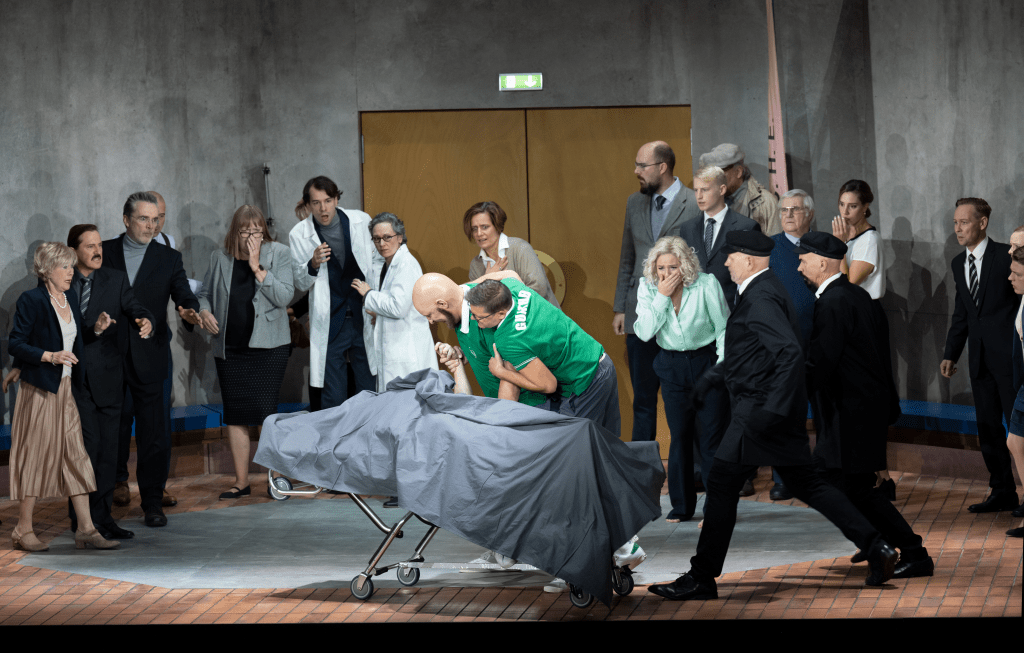
Here, CT shows off what he does best: building, tension, building, more tension. Direction, dynamism, drama… the way he pushes us forward in these rolling, roaring waves of sound is honestly almost impossible to put into words. Well… you could try, but really, it’s one of those things you just have to experience yourself.
And even though not everything goes exactly as planned – a ritardando that slips, a slightly out-of-sync chorus, a bunch of brass barging in at least half a bar too early – well, that’s all part of the fun. Luckily, there are plenty of musical marvels that made it reach heavenly heights.
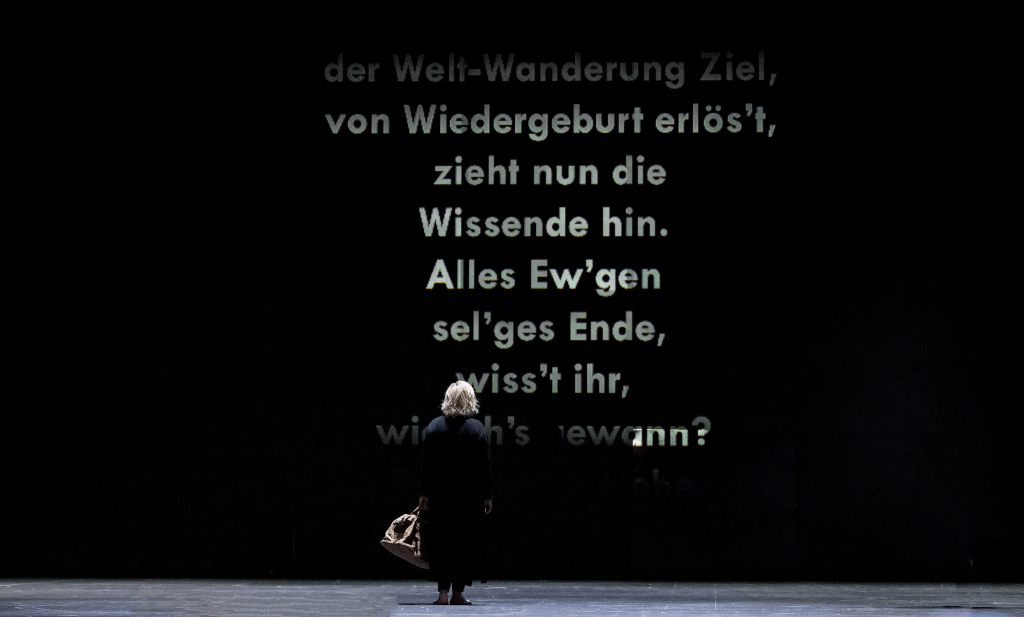
Just like in his Elektra production, Tcherniakov adds his own little twist at the end (I’ll resist saying what). What I can say is this: there’s text. Lots of text. I mean, how are you ever supposed to focus on what the rolling words on the back wall are saying when Thielemann is making musical magic right in front of us? Honestly, there’s almost no music that can top the ending of Götterdämmerung – especially not like it was played tonight.
So… that’s it. Curtain falls, pages are full, diary comes to an end. Time to step back into the real world….
Fun Fact!
True to his German roots, Wagner ditched the word ‘act’ after Lohengrin. From then on, each section is an Aufzug – yes, the proper German term. Just in case you’re feeling technically precise.
Trailer:
Cast:
- Musical Director: Christian Thielemann
- Director, Set Design: Dmitri Tcherniakov
- Revival director: Thorsten Cölle
- Assistant director: Caroline Staunton
- Costumes: Elena Zaytseva
- Light: Gleb Filshtinsky
- Video: Alexey Poluboyarinov
- Siegfried: Andreas Schager
- Gunther: Lauri Vasar
- Alberich: Jochen Schmeckenbecher
- Hagen: Mika Kares
- Brünnhilde: Anja Kampe
- Gutrune: Clara Nadeshdin
- Waltraute: Marina Prudenskaya
- Erste Norn: Anna Kissjudit
- Zweite Norn: Kristina Stanek
- Dritte Norn: Daniela Köhler
- Woglinde: Evelin Novak
- Wellgunde: Natalia Skrycka
- Floßhilde: Ekaterina Chayka-Rubinstein
Staatsopernchor, Staatskapelle Berlin
- Dialogues des Carmélites, The Royal Danish Opera 2026
- Monster’s Paradise, Hamburgerische Staatsoper 2026
- Dialogues des Carmélites, Semperoper Dresden 2026
- Lohengrin, Staatsoper Berlin 2026
- Das kalte Herz, Staatsoper Berlin 2026
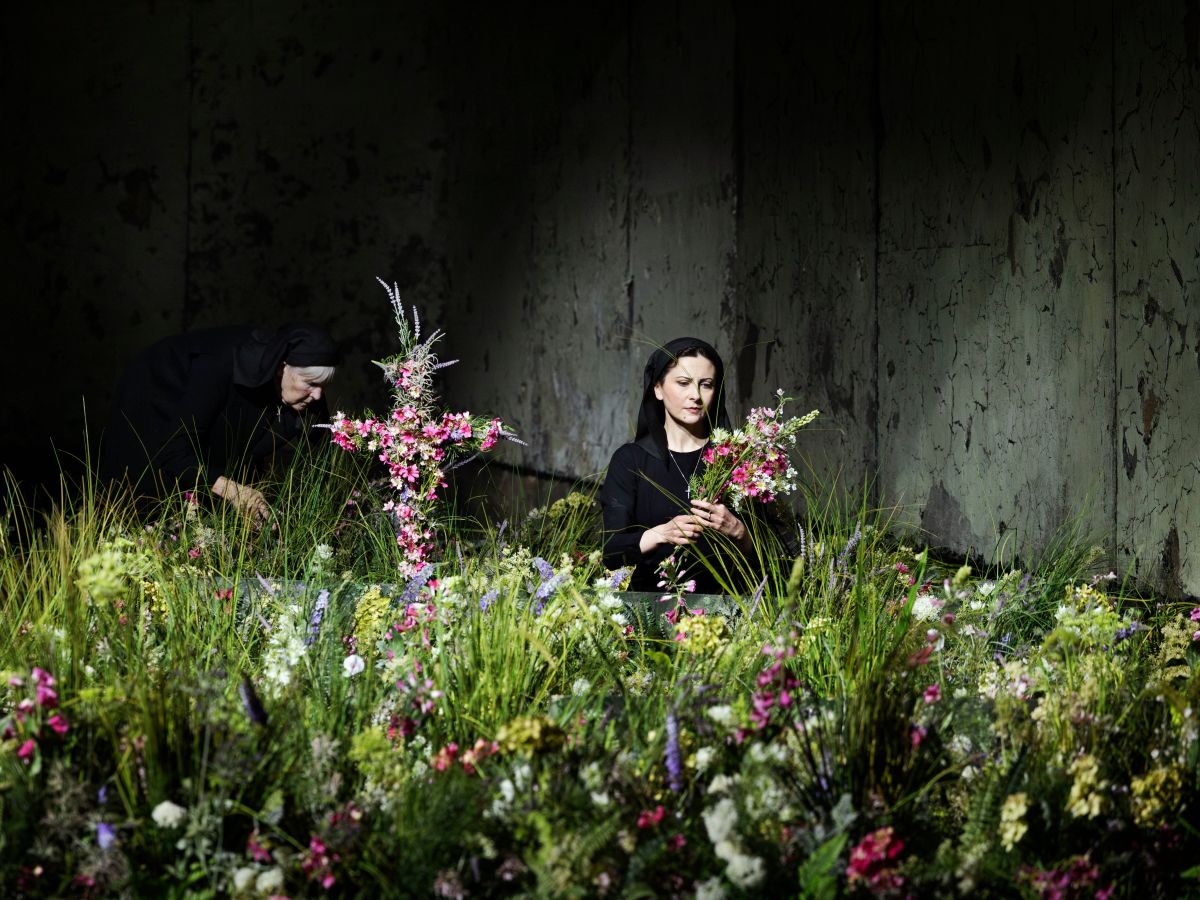
Dialogues des Carmélites, The Royal Danish Opera 2026
If you’re waiting for something to break, Act III is your moment. In Barrie Kosky’s production of Poulenc’s only long opera, it’s not the people – it’s the wall. We’re stuck in the same room. Boxed in by the same walls. First, inside the de la Force family. Then we convert to the Carmelites. Grey…

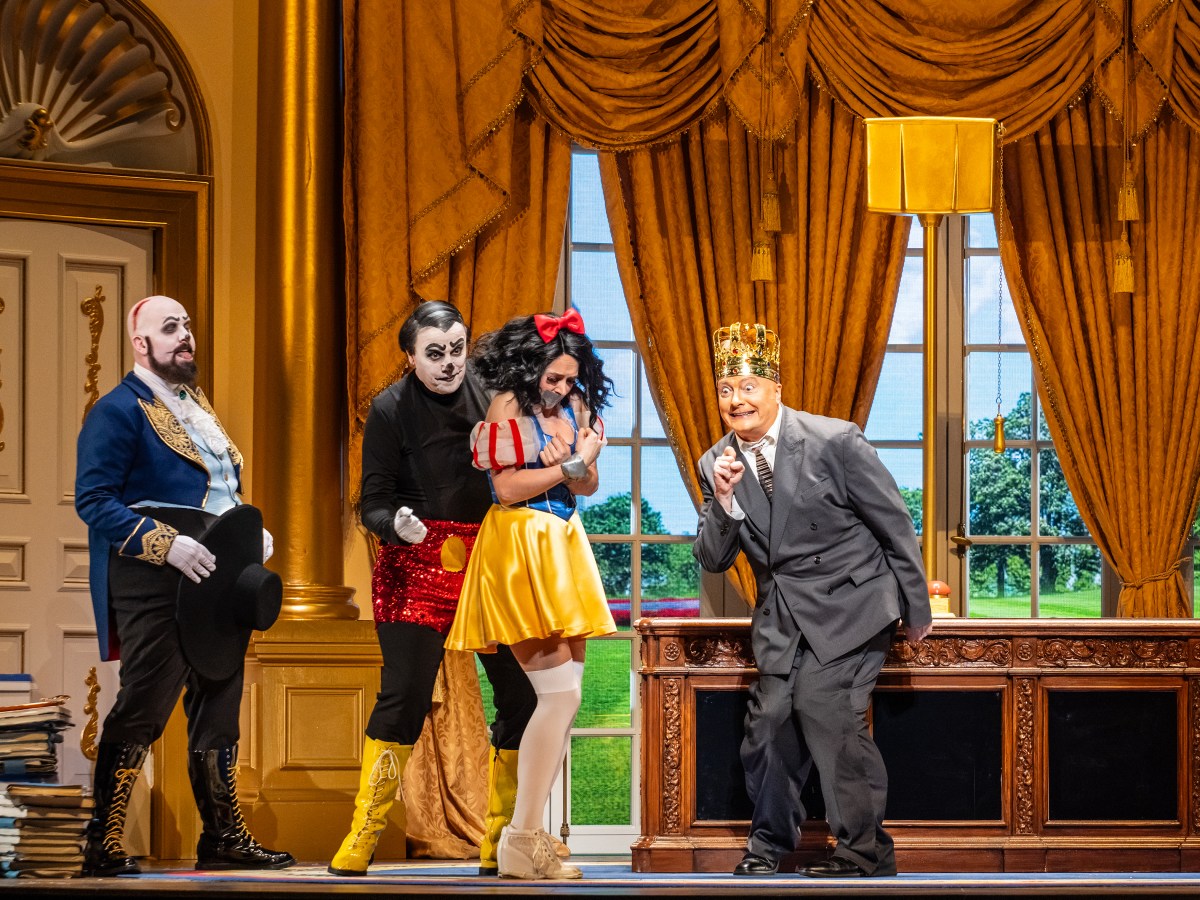
Monster’s Paradise, Hamburgerische Staatsoper 2026
World premiere! A brand-new opera by Austrian composer Olga Neuwirth. Which basically means: no one knows what we’re about to listen to or experience. No map, no manual, no “how it’s usually done.” What is an opera, anyway? At what point do we decide that something is one? If this hadn’t taken place inside the…
Dialogues des Carmélites, Semperoper Dresden 2026
Did someone say Poulenc? At the Semperoper? For the first time ever with Dialogues des Carmélites? Yes, you heard that right. The French composer’s second opera has found its way to Dresden, in a production directed by Dutch Jetske Mijnssen. The prelude is silent. Curtain up. Blanche is already there, standing alone in a wide,…

 Blogfløjten