
BOOM! BAAAM! A massive B-flat major chord crashes down in fff – Triple forte, full force, no remorse. Gentle openings? Tiptoeing into the evening? Forget it. Puccini kicks down the door and hurls us headfirst into what might be the loudest chord of the night – and an equally explosive plot. Some fancy folks might call it in medias res. Translation: hang onto your socks or jam them firmly into your Crocs (because, of course, that’s what we’re all wearing).
And where do we land? In a church. But not just any church. This is Sant’Andrea della Valle in Rome – holy, hefty, and highly specific. Unlike so many operas that keep things vague. Here we’ve got a concrete setting. And that’s exactly where Danish director Kasper Holten (also the CEO of the house) places us in Act One. Or at least in something that looks like a Catholic church.
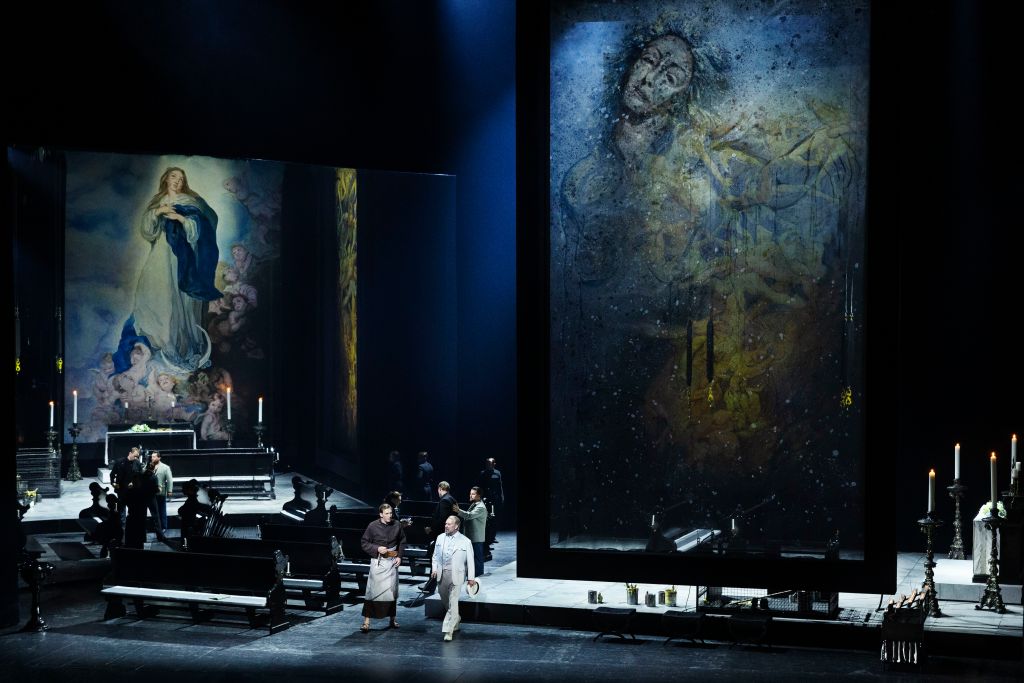
The left wall is a massive mirror. So you don’t just get the joy of seeing the singers head-on, oh no – you also get the full side view!
Elsewhere, the church is fully decked out: brown wooden pews, tiny altars, flickering candles, and yes, those little votive lights you usually buy that sit in sand.
And sneaking around behind it all? Angelotti. Who’s he again? Chill, we’ll get there.

Ah yes – Angelotti! A fellah who’s escaped from prison, where the savage Scarpia had him locked up as a political prisoner. And that, my friends, is basically what the next two hours are all about: where is he hiding? Who can you trust? (Spoiler: not many)
Holy Drama
Enter Cavaradossi, the painter with a big heart (and an even bigger love for Tosca – what did you expect?). He’s helping the fugitive, but of course, Rome’s nastiest cop is already hot on his heels. Scarpia? He’s not just after the runaway—oh no—he’s after Tosca too. Duh duh duh DUUUH! Not Beethoven, but dramatic enough.

The same goes for the Italian maestro Daniele Squeo’s direction. It makes sense, of course, but sometimes it can feel a bit like a ship without a rudder. We start off with a full-throttle bang (thrilling, yes!)… which also means the big climaxes later feels a bit like, “Oh, we already did that, didn’t we?” In the end, the piece drifts a little, missing a clear overall shape. Squeo handles the different dynamics well enough but even a simple forte can be played in so many ways: it can roar, blaze, surge, or sweep gently over you, depending on how you approach it…
Anyway, the orchestra can definitely play. It’s also not like it’s been ages since this was on stage – just three years, in fact. Makes you wonder why they’re bringing it back so soon. Don’t get me wrong, it’s a banger, a total crowd-pleaser… but then again, there are so many other wonderful works out there, right?
Something About Stars
The opera has three acts, and even though the last two aren’t Wagner-long, we still get two full intermissions. Perfect for stretching, grabbing a snack, or, you know, giving your opera glasses a little readjustment.
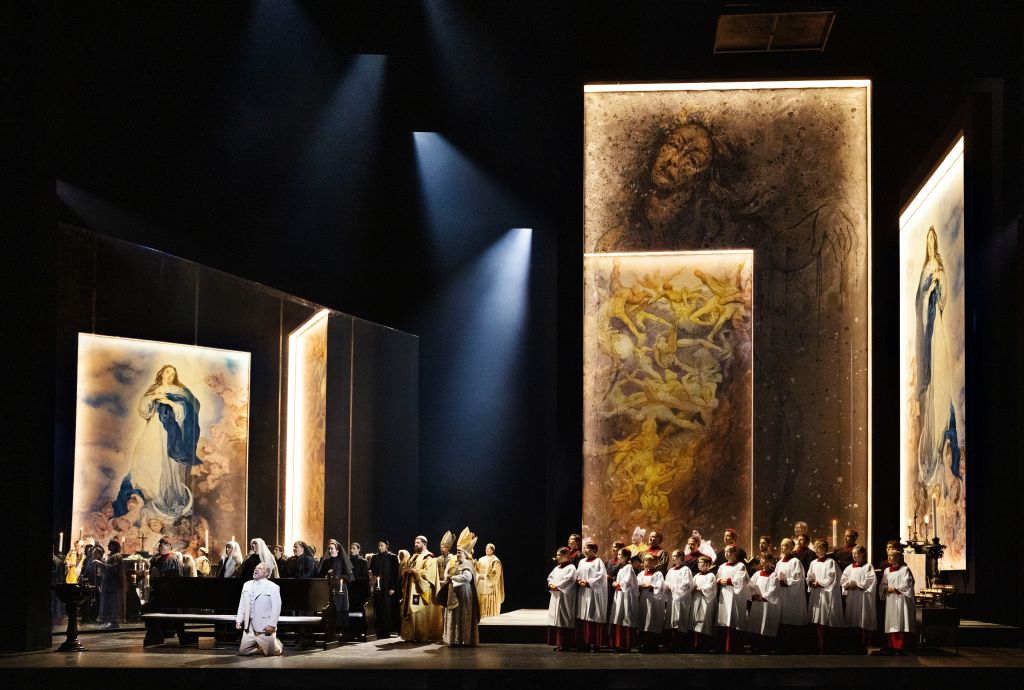
Between each act, bits of a letter slowly appear on the stage backdrop. By the second intermission, it ends with the words “e lucevan le stelle.” Cue to the big aria that tenor Matteo Lippi is soon about to drop.
But first, we get a tiny little teaser from the cello section, before a chord in the harp, and then John Kruse swoops in on the clarinet. Sneaky and vulnerable… just like Cavaradossi. The guy’s convinced he’s about to bite the dust, so of course he whips out a heartfelt letter to his beloved Tosca. You know, classic last-minute life stuff.
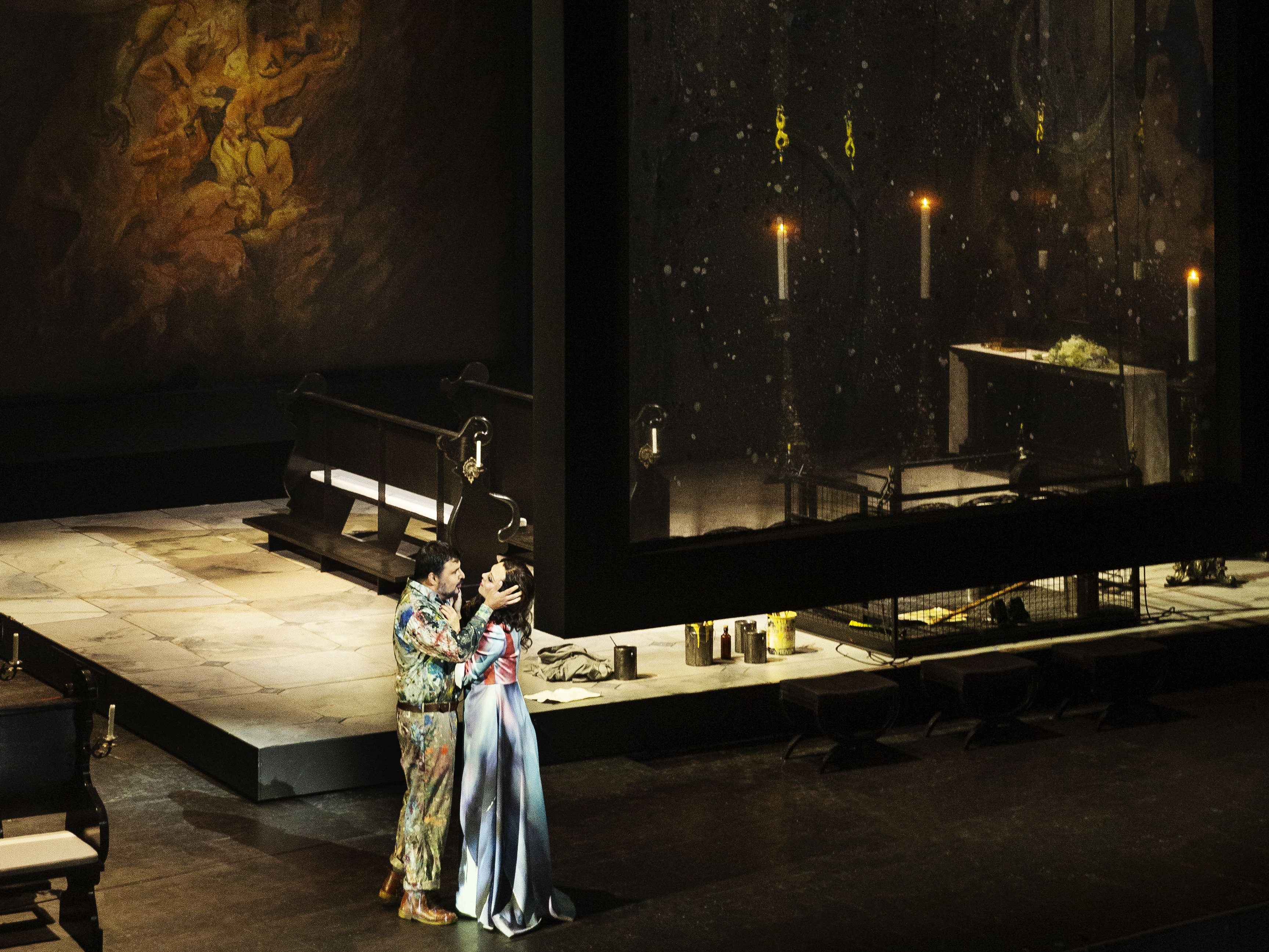
Lippi is from Italy, which you can hear in the way he shapes and sings the text. It all felt relatively simple for him. He sings it with deep feeling, but not over the top. A lovely balance. Not quite the same balance between him and the orchestra, though, they’re not aaalways in perfect sync.
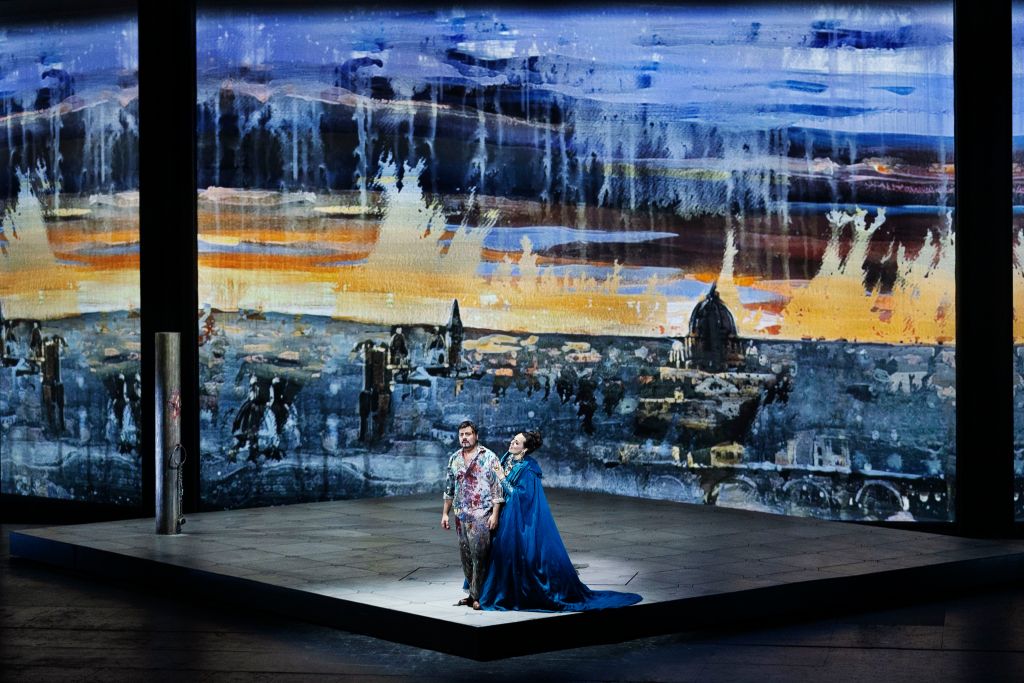
The whole scene kind of gives off major Calaf vibes from Turandot, you know, belting out Nessun dorma (“None shall sleep!”). He looks like he’s just “hanging out” on a rooftop, and behind him is a slowly but constantly changing painting of the city. At times, it even gives off a hint of Vincent van Gogh: the colors, the way the shapes twist and move. Showing how the light changes over the city at night.
Wait… thought Angelotti was the prisoner? Well, yes, but no one could find him. So Scarpia just goes ahead and grabs Cavaradossi, hoping he’ll spill the hiding spot. Surprise, surprise… he doesn’t. So now Scarpia has to get a little… inventive. And yes, that means putting the squeeze on Tosca too.
So while you’re hearing Cavaradossi getting tortured in the background, Scarpia is trying to sweet-talk Tosca into spilling the beans.

Shine Bright Like A Diamond
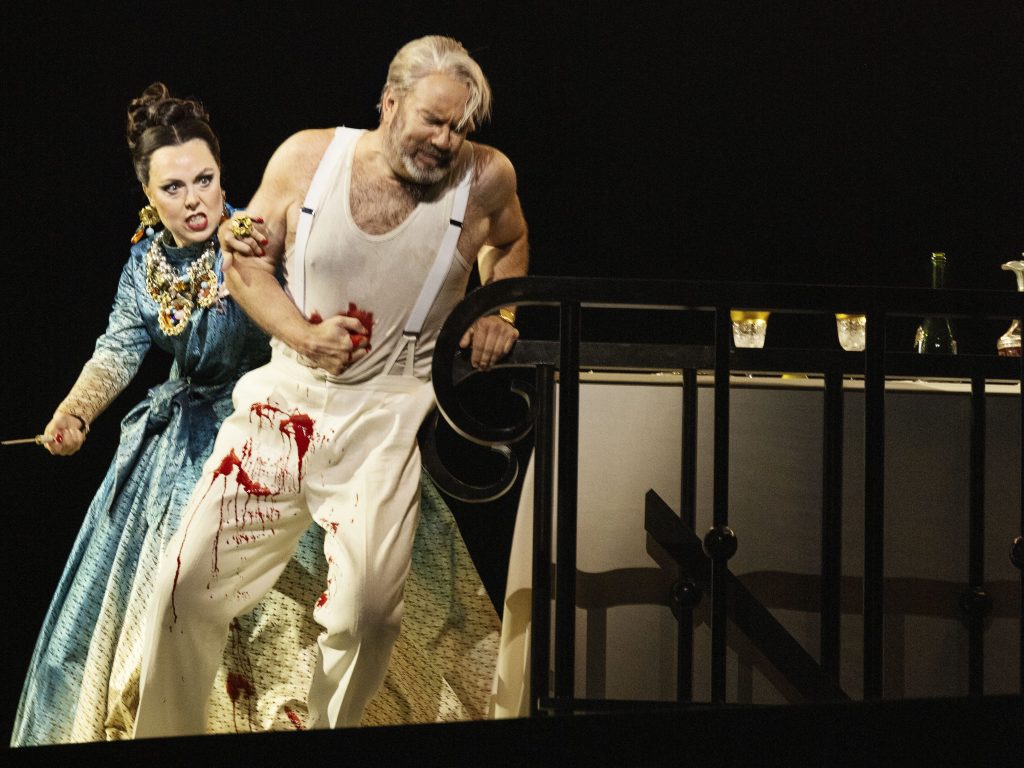
Opera can be pretty black-and-white sometimes: the good guys in bright colors, the bad guys in dark. So imagine my surprise when Danish Johan Reuter walks onto the stage in a totally white suit. Total contrast, all eyes on him… like, okay, is God just popping by? But let’s be real, he’s not exaaactly God. The closest thing you could compare him to is Loke, but even he’s only a half-god, sooo… yeah, still not quite divine.
Reuter plays a slightly more lyrical kind of police chief but don’t be fooled – his intentions are crystal clear. “God made women and good wine. I want to taste it all.” Yep… you can probably guess the rest. He also says (or sings, if you will), “Yes, they say I can be bought. But for women, the price is not money.” Hmm… okayyyy… red flag, anyone?
Act Two kicks off on a square stage with a fresco-looking painting hanging above. On one side, there’s a choir; on the other, a banda (an ensemble actually jamming on stage). In generel it looks like a classic staging… haha, nope! Fooled you! Before you know it, the floor drops us straight into the basement, where Scarpia is up to his sneaky, scheming shenanigans. Time gets a little wibbly-wobbly here. We’re in the 1800s, but also… kind of not.

Tosca’s dress is definitely not something you see every day. Probably never, unless you’re walking around a palace or something. Huge, dramatic, and dripping in equally gigantic jewelry. It suits Francesca Tiburzi’s powerful voice perfectly. It’s not too much – unlike, say, Lise Davidsen in Vienna last December… Tiburzi’s voice is what you might call a spinto soprano—a mix of lyrical and dramatic—and she brings out a strong, commanding Tosca, especially in her chest voice. Hmm… maybe she’s a little mezzo too?
On top of that, she really knows how to play with her eyes. I don’t think I’ve ever seen anything quite like it. Unfortunately, the same can’t be said for the scene where she (spoiler alert!!) finds out that Cavaradossi is dead. Honestly… that might be one of the weakest moments I’ve seen. She doesn’t even look at him properly, and definitely doesn’t bend down or anything before announcing it. Oof… a tiny poke in an otherwise solid performance.
You should never make a deal with the devil. Thought we’d all learned that by now? Apparently not… desperate times, I guess. The drama really kicks in when the church bells start ringing. Giving major Wagner’s Parsifal vibes. Today, they sound amazing echoing through the orange, pumpkin-shaped hall.
Tosca, of course, isn’t about to give in completely. She gives Scarpia a kiss… but not the kind he was hoping for. And just for good measure, there’s a delicious pause in the orchestra right here. A little trick that conductor Squeo actually pulls off several times throughout the evening.
Fun Fact!
At Tosca’s premiere in 1900, most critics were… not impressed. Few foresaw its future success, and a bomb threat didn’t exactly lighten the mood. The real kaboom? Worldwide fame.
Cast:
- Conductоr: Daniele Squeo
- Directоr: Kasper Holten
- Stаge Designer: Philipp Fürhofer
- Сostume Designer: Anja Vang Kragh
- Light Designer: Jonas Bøgh
- Floria Tosca: Francesca Tiburzi
- Mario Cavaradossi: Matteo Lippi
- Scarpia: Johan Reuter
- Angelotti: Morten Staugaard
- Sakristanen: Henning von Schulman
- Spoletta: Fredrik Bjellsäter
- Sciarrone: Simon Duus
- A guard: Simon Schelling

 Blogfløjten