
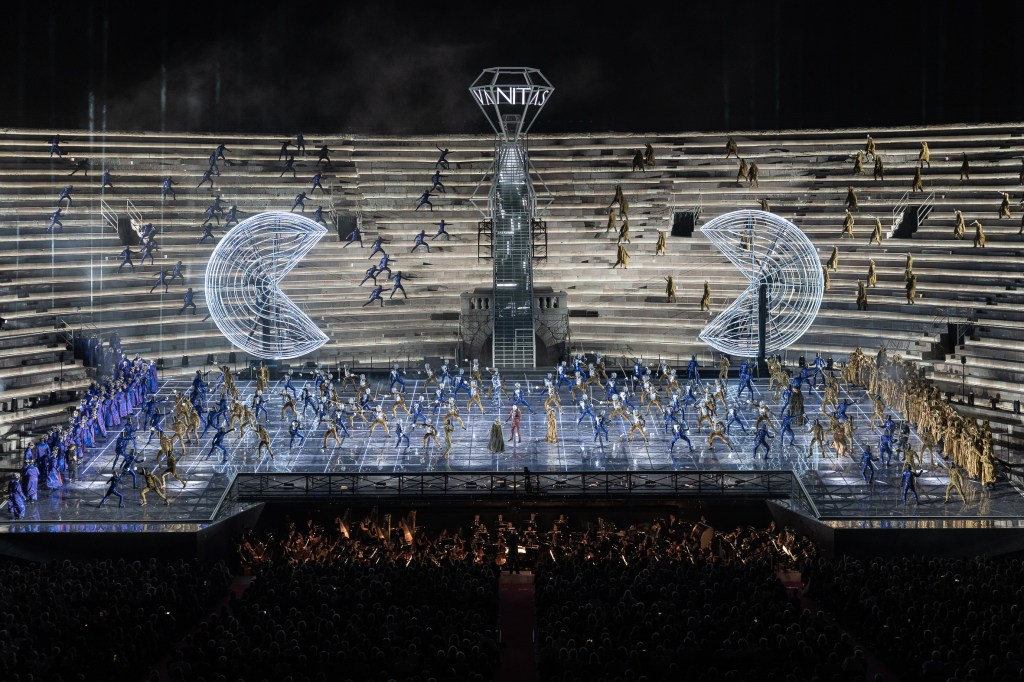

It’s wild to think people once fought for their lives right here in this arena. Back then, screams bounced off the stone. Not for high notes or curtain calls, but for survival. Now, around 15,000 folks roar with cheers and applause from those same ancient seats—luckily, no one’s life’s at stake. Well, unless you count Verdi’s characters.
For 102 summers, opera lovers have gathered here to experience what sonic spectacles the stone stage has in store. This season features five operas – four of them by Verdi. Leading the charge is a fresh new Nabucco.

Apparently, all you need is one Stefano Poda
He’s the brain (and hands) behind (almost) everything in this producction – directing, lights, costumes, stage, the whole shebang. And it’s not just this one – his Aida (also on this year’s program) is another one-man-show behind the scenes.
And show really is the word. It’s less about who-feels-what and more about who-stands-where. Huge choruses storm in, freeze like statues, then slide into new shapes and lines.
They’ve thrown a whole squad of dancers into the chaos too – sometimes they’re doing smooth ripples, other times it’s like an all-out dance battle royale. Makes total sense, since this opera’s basically about two teams going head-to-head.

Okayokay, but what exactly is it about again?
Nabucco throws us straight into Jerusalem, 587 BC, where the Babylonians are in full invasion mode and the Israelites are just trying to hang on to their god. In storms King Nabucco, shouting that he’s basically divine. Cue a loud bang, the unmistakable smell of something burning, and boom: he loses his mind (and crown).
Meanwhile, his two daughters are tangled in a love triangle with a Hebrew guy stuck in the middle who looks about as thrilled as you’d expect.
One daughter decides to free all the prisoners, the other is more of a “let’s just kill everyone” type. Add a load of drama, a heap of daddy issues, and a smash-hit chorus sung by a homesick people, and there you have it.
What has Poda cooked up for us?
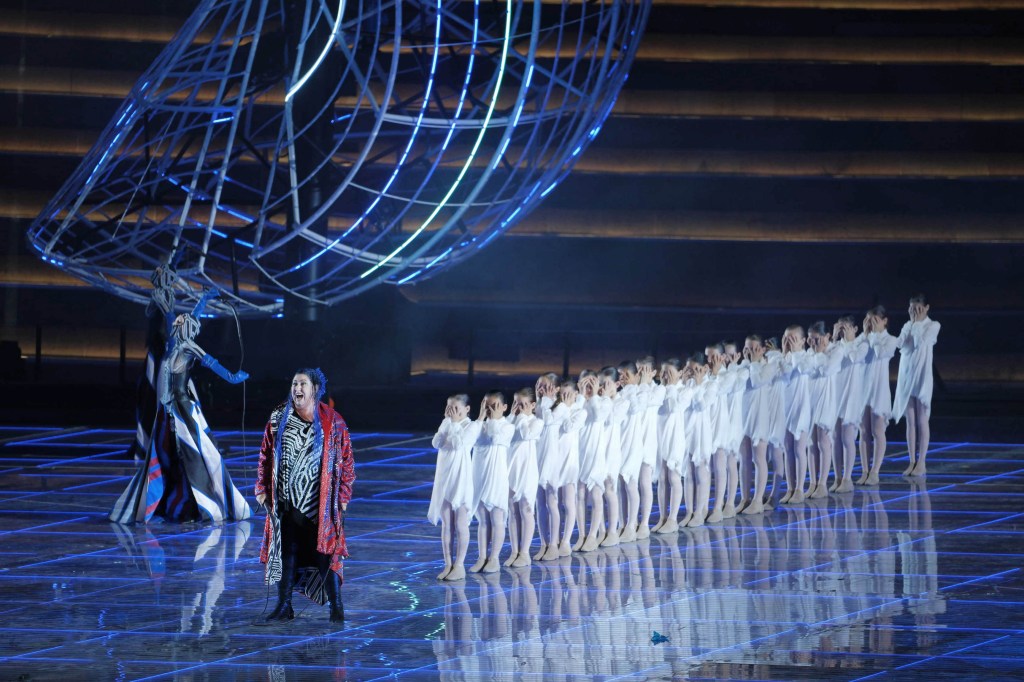
Well, colour-coding is the name of the game. Everyone’s decked out in team colours – super handy when whole nations are running around shouting at each other. But when the sun dips? No sweat: just slap some lights on those costumes! The cast literally lights up, and the effect gets the audience bursting into applause by Act III.
And it’s not just the singers who glow – the stands behind the stage sparkle too, and there’s a massive hourglass flashing the word “Vanitas” (in case anyone missed the memo about existential doom).

Oh, and don’t forget the two giant bean-shaped light things on each side of the stage. They slowly spin and end up merging into one big, glowing volleyball right at the final.
Within the first few minutes, a wild choir decked out in what look like space suits gathers around a glowing atomic piñata. Is that a cheeky nod to our far-too-relevant present?
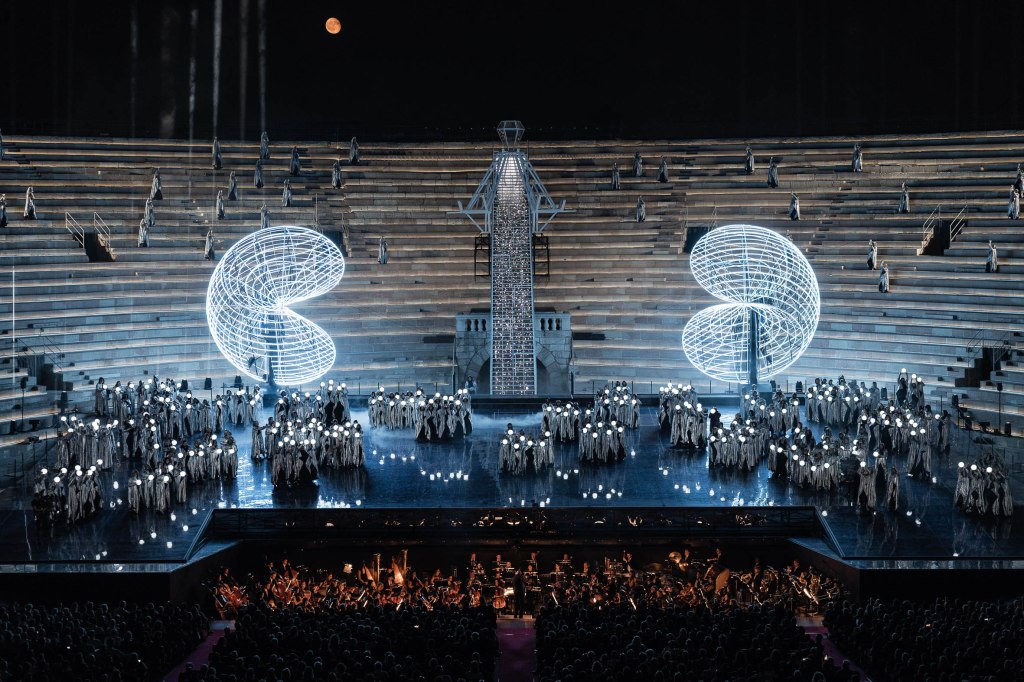
All in all, you can tell this production takes great care in crafting captivating and colorful scenes.
Can you even sing to that many people?
Well, yes and no. Some voices float away into the open air, disappearing before they reach you.
The orchestra sounds more like a polite whisper than a full-on roar. With everyone scattered (as socks tend to do after laundry day), it’s tricky to keep perfect timing – especially in Act 3, where things sometimes slip just a bit. It’s not about perfect sound, but about soaking in the whole open-air experience.

The Muuusic
Amartuvshin Enkhbat, a Mongolian baritone, takes on the title role with full throttle, easily reaching out to the audience. His character’s daughter, Fenena (Francesca Di Sauro), is sung with just the right mix of power and smooth, controlled vibrato. Definitely a voice worth keeping an eye on.

While the singing brings energy, Pinchas Steinberg, maestro for Budapest Philharmonic and tonight’s boss of the Orchestra dell’Arena di Verona, likes to toy with tempi. Sometimes things move fast, sometimes slow. Though often the dynamics and direction feel a bit stuck in neutral. The orchestra plays solidly, but it doesn’t quite light up the ears like fireworks.
In general, the cast was solid – not to mention Maria José Siri as Abigaille. Her final aria kicks off moody and melancholy with a solo cello—sad vibes incoming—but, of course, since it’s the grand finale, Verdi couldn’t resist crashing in with his signature cymbals to make sure it ends with a big bang…
Fun Fact:
Nabucco was Verdi’s first big hit. His third opera, written after the death of his wife and two children, and the flop of Un giorno di regno. Legend has it he vowed never to compose again… until Solera’s libretto fell open on the words “Va, pensiero.”
Cast:
- Conductоr: Pinchas Steinberg
- Directоr, Stаge Designer, Сostume Designe and Light Designer: Stefano Poda
- Сhoir: Roberto Gabbiani
- Nabucco: Amartuvshin Enkhbat
- Ismaele: Galeano Salas
- Zaccaria: Alexander Vinogradov
- Abigaille: Maria José Siri
- Fenena: Francesca Di Sauro
- Il Gran Sacerdote di Belo: Gabriele Sagona
- Abdallo: Matteo Macchioni
- Anna: Elisabetta Zizzo

 Blogfløjten