

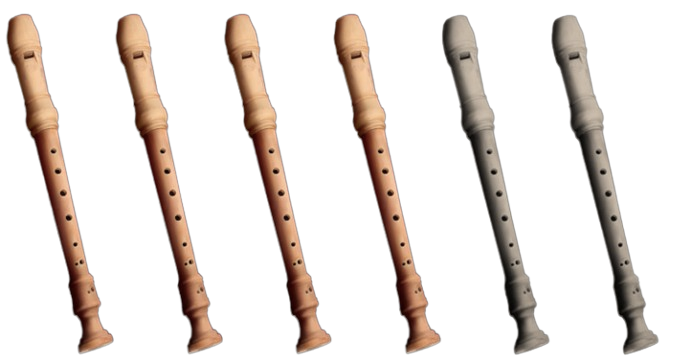
Somewhere between gloom and doom, Don Carlo sits all alone. The prison around him is quiet… or almost. From the depths below, the strings begin to stir — like bubbles in a warm bubble bath. And then, slicing through the shadows, an oboe floats into the tub. Lonely. Fragile. Almost like a tiny musical cry for help.
We’re at the Bayerische Staatsoper, deep into Act IV, Scene 2 of Verdi’s Don Carlo (even though the surtitles insisted on calling him Don Carlos — we’re in the Italian version, thanks.).
Five acts full of power plays, personal pain and political paranoia. But before things get all dark and dramatic in the dungeon, let’s flip back the score and figure out how all this royal drama kicked off.

Stage or Cage?
We’re stuck inside the box of an old-fashioned camera… well, okay, not exactly, but the room definitely has that long, cramped vibe. It’s the kind of set design that might sound a bit “meh” on paper and looks like the least exciting place to hang out. But it’s a total win for the singers: no flashy distractions, just their voices front and center!
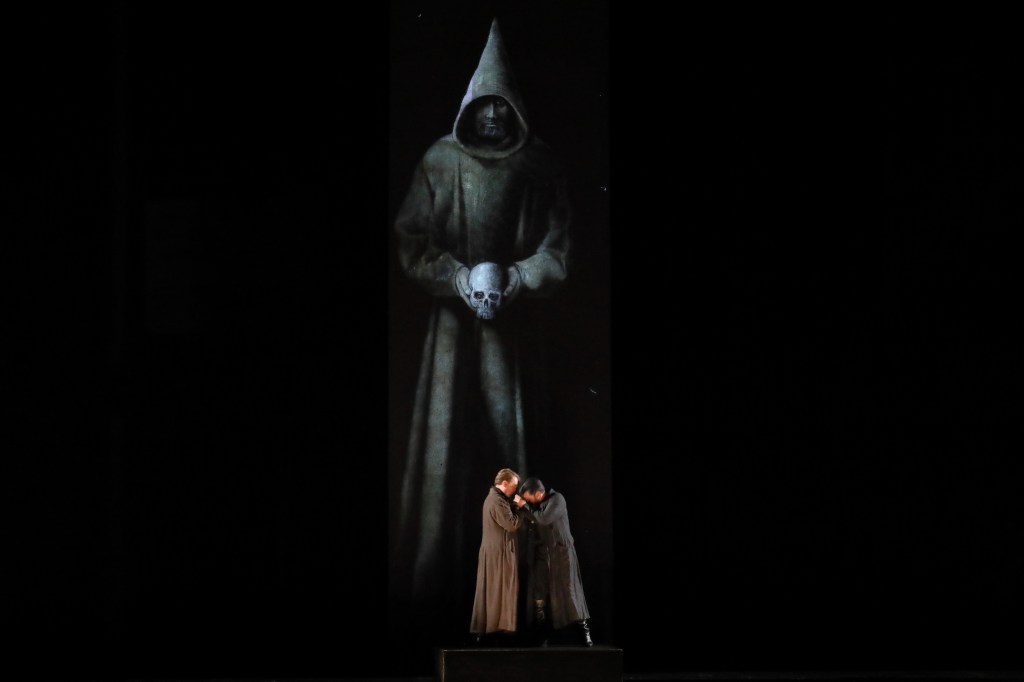
Leaning against the left wall, there’s a massive cross with a rather lifeless Jesus hanging from it. A motif that makes several cameo appearances throughout the night, in all sorts of sizes — like the visual equivalent of a nosy neighbor, constantly peering over the characters’ shoulders, judging everything they do.
And let’s not forget the monk! He pops up now and then, holding a skull like it’s his new bestie — both on the backdrop and on stage.
Room with a View… of No Escape
For most of the evening, we’re stuck in the same box. Sure, the libretto tells us we’re supposedly in a forest, a garden, or a royal chamber — but in Jürgen Rose’s production from 2000, we’re basically in a one-room flat with no escape. Every now and then, a bed or some chairs get wheeled in for variety, but the room? Still the same. Doesn’t matter where the characters think they are — they’re all stuck.
And maybe that’s the whole idea. In a world where nobody’s getting exactly what they want, why bother with moving walls? The set stays put, a silent witness to the chaos unfolding.
Crown in Crisis
This claustrophobic space sets the scene for Act IV. This time, it’s the music that opens the door — a solo cello rises from the orchestra, playing lines so hushed and hollow they sound like they’ve crawled up from the floorboards.
On the bed sits Erwin Schrott as King Philip II, dressed in his finest royal pyjamas… The aria is crafted with such dramatic precision that you get the sense he knows exactly how this story ends —well, of course he does, but he’s in no rush. His performance builds up slowly, dramatically, already carrying the weight of that final note.
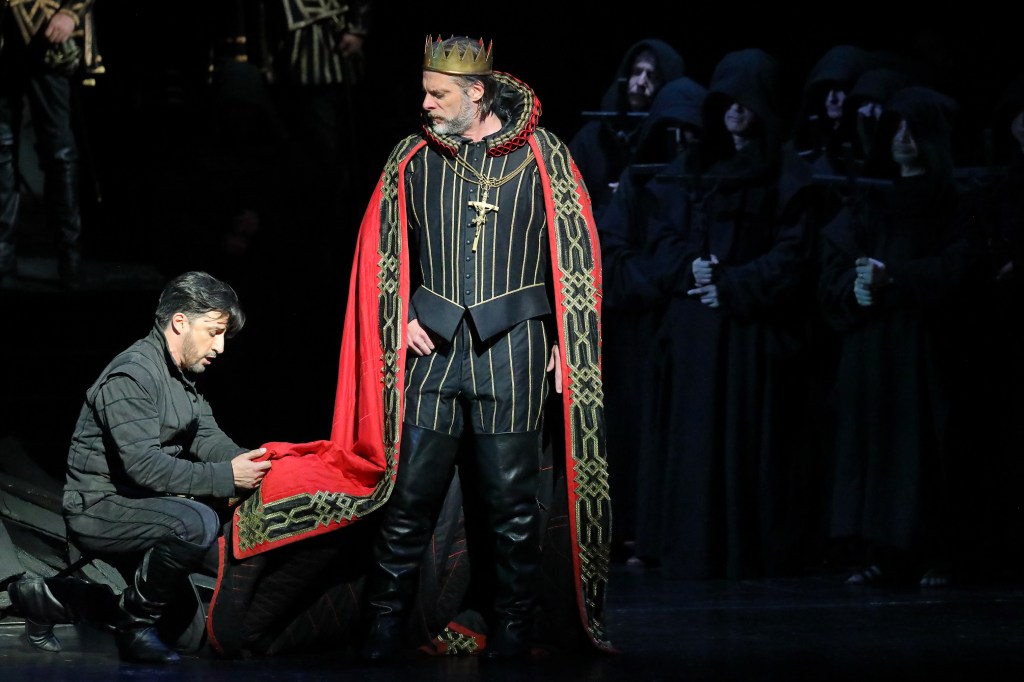
His Philip is surprisingly human — less tyrant, more tired dad trying (kinda…) to hold the royal household together. Instead of icy authority, Schrott gives us a man just trying to make sense of the mess he’s stuck in. And when disaster hits Carlo, he even places a tender hand on his shoulder. Who knew Philip had that kind of feelings? (Yeah okay, he still plans to kill him — but hey, everybody makes mistakes.)
A Royal Love Triangle Gone Wrong
Elisabeth was supposed to marry Don Carlo, but life had other plans — so she ends up wed to the king instead. All to secure peace between their countries. Carlo? Not so thrilled about it!
Meanwhile, his best buddy Rodrigo (Posa) is trying to untangle the political mess — but even with the best intentions, it’s like trying to fix a broken vase with duct tape… Throw in a religious zealot in the form of the Grand Inquisitor, and you’ve got a royal wreck full of betrayal, bitterness, and broken hearts.
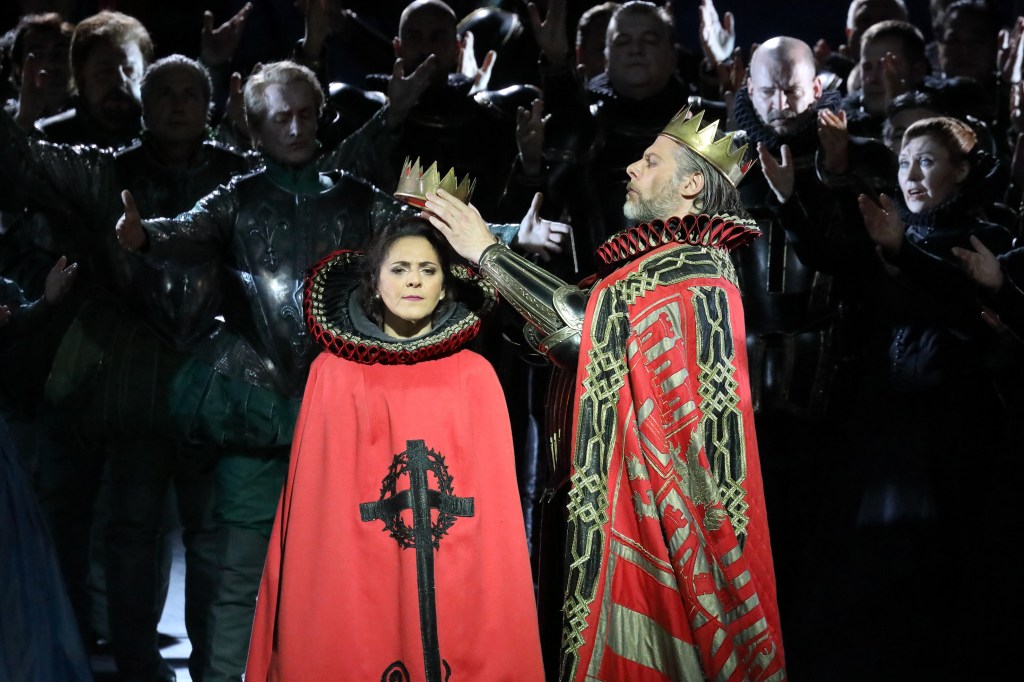
A Stage on Fire!
Visually, the evening doesn’t exactly dazzle — apart from one particularly pompous scene featuring real flames and prisoners about to be burned at the stake. But what the production lacks in spectacle, it more than makes up for in vocal power.
Two of the leading roles were taken on by American singers. Rachel Willis-Sørensen brought elegance and ease to Elisabeth, with a voice that felt both clean and controlled. She has a natural stage presence, and everything — phrasing, expression, movement — seems to flow effortlessly from her.
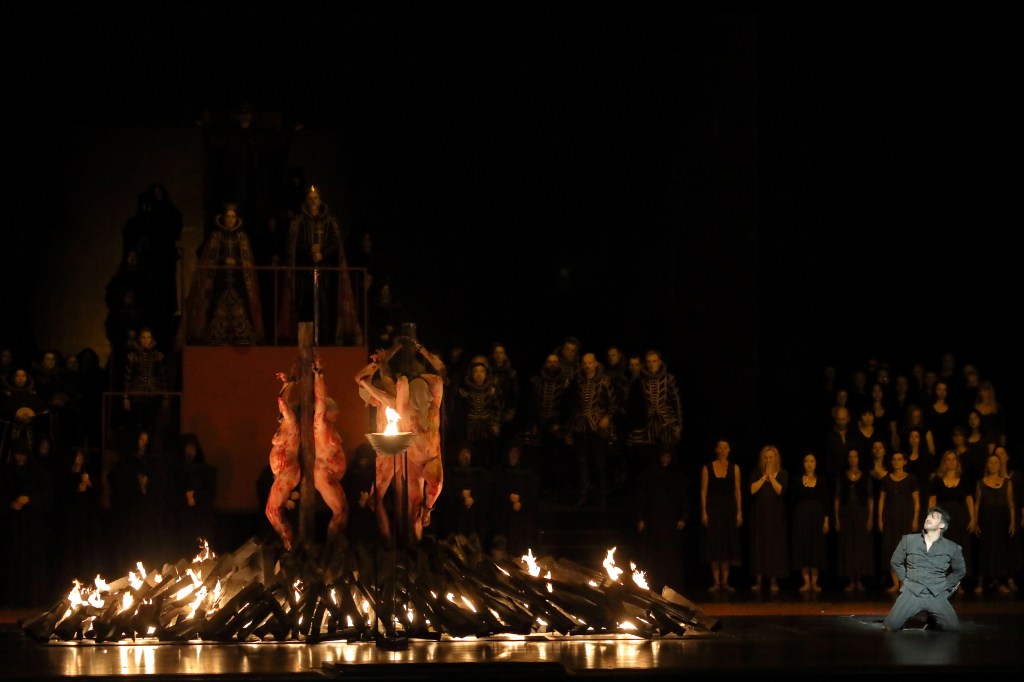
Stephen Costello, singing Don Carlo, delivered a solid vocal performance. It might not have been the most emotionally layered interpretation, and he didn’t offer much in terms of dramatic engagement — but vocally, there was nothing to complain about. He sings with power and confidence.
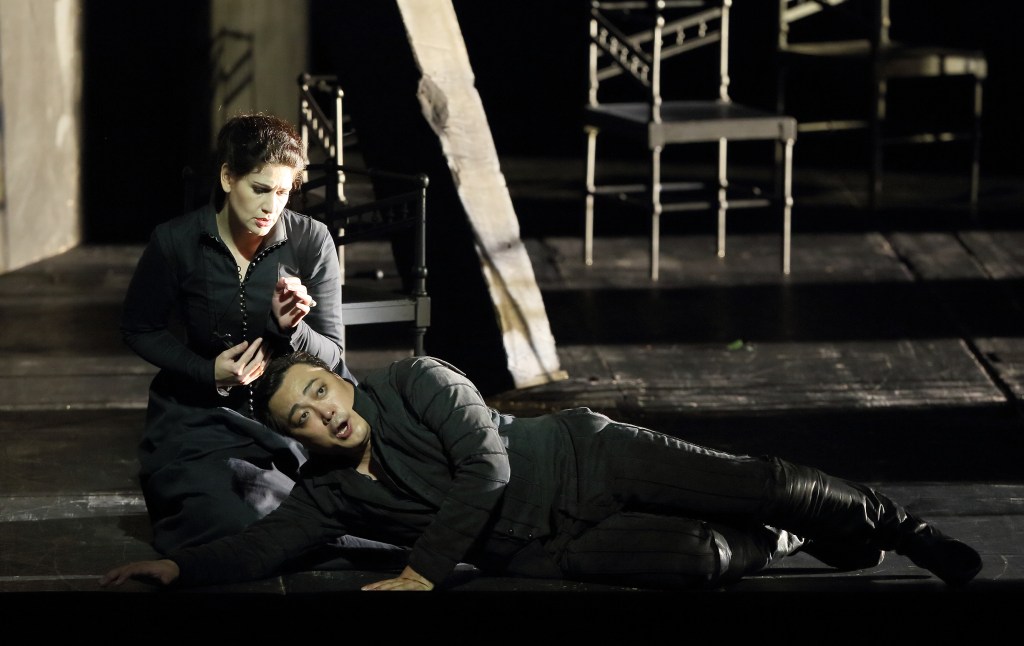
Ekaterina Semenchuk (Eboli) and George Petean (Rodrigo/Posa) also did some fine work. Especially in Acts IV and V, where the emotional stakes really rise. Petean found remarkable depth in the prison scene with Carlo. His voice carried both warmth and pain, and at the end he paused mid-phrase during an extra, softly added “addio…” just before his (spoiler alert!) final flop to the floor. Subtle. Touching. And, frankly, a very classy way to die.
Fun Fact!
Verdi’s Don Carlo(s) comes in almost every flavour imaginable: French or Italian? Five or four acts? With or without ballet? Today, directors mix and match versions to fit their own vision—kind of like opera’s answer to a remix.
Cast:
- Conductоr: Ivan Repušić
- Directоr: Jürgen Rose
- Light Designer: Michael Bauer
- Сhoir: Christoph Heil
- Philipp II., König von Spanien: Erwin Schrott
- Don Carlos, Infant von Spanien: Stephen Costello
- Elisabeth von Valois: Rachel Willis-Sørensen
- Rodrigo, Marquis de Posa: George Petean
- Die Prinzessin Eboli: Ekaterina Semenchuk
- Der Großinquisitor: Dmitry Belosselskiy
- Ein Mönch: Roman Chabaranok
- Tebaldo, Page Elisabeths: Elene Gvritishvili
- Der Graf von Lerma: Samuel Stopford
- Ein königlicher Herold: Zachary Rioux
- Stimme vom Himmel: Carine Tinney
- Flandrische Deputierte: Andrew Hamilton, Christian Rieger, Nikita Volkov, Daniel, Noyola, Yosif Slavov and Mark Kurmanbayev
Bayerisches Staatsorchester
Bayerischer Staatsopernchor


