


It’s like waking up in the middle of a fever dream — disoriented, dizzy, and possibly mid-exorcism. You stumble through a storm of spiralling dancers, cryptic catchphrases and musical explosions. Is Antichrist a person? A concept? A cosmic clapback to humanity’s holy arrogance? In Langgaard’s opera, don’t expect answers — just apocalyptic visions and theatrical thunder.
The Danish composer Rued Langgaard is no stranger to Berlin. His First Symphony was premiered by the Berlin Philharmonic in 1913, with a few of his other works tagging along for the ride. Right now, you can catch his only opera, Antikrist (Antichrist), at the Deutsche Oper Berlin — an hour and a half in hell. Well, okay, not exactly in hell… but we do get a visit from someone who knows the way.

Sketches of a Street
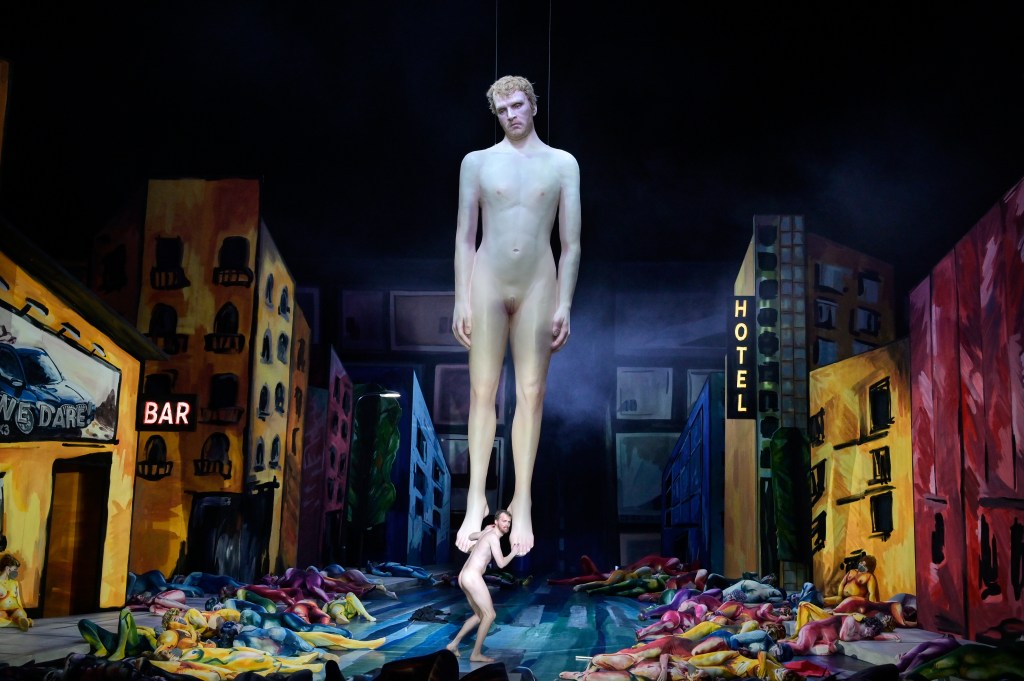
The scene opens to a dimly lit street, looking like something straight out of an expressionistic sketchbook. We see a line of dancers, moving up and down a curb as if they’re at some sort of fitness step class. It’s all completely out of sync — until, suddenly, it’s not. It’s like starting a bunch of metronomes at different times and tempos; eventually, they’re all bound to collide.
Langgaard’s music kicks in, and out of the red smoke at the end of the street, a naked man crawls into view. A lonely clarinet plays along. Is it a birth? Maybe… He definitely can’t walk yet, but he gives it a try. As he gets the hang of it, more woodwinds join in—like a weird little parade forming around him. By the time he’s found his footing, he’s standing at the very edge of the stage.
A Stage Without a Hero
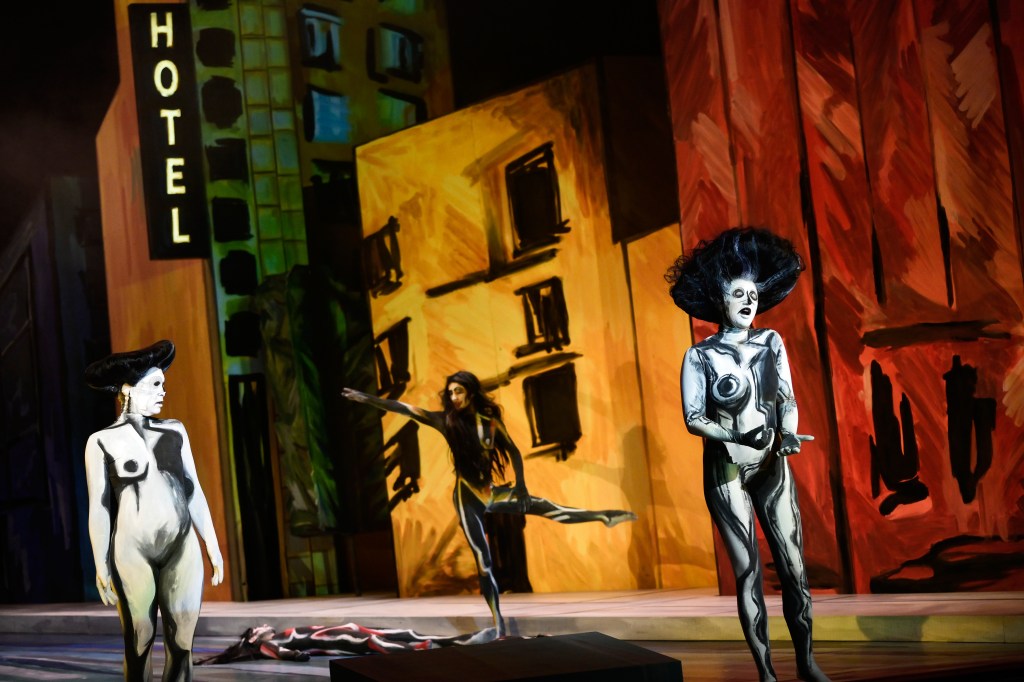
Antikrist is not your typical opera. There’s no clear chronological plot, no central characters, and mostly monologues. No love story. No protagonist singing their way to salvation or damnation. Instead, we meet a series of symbolic figures — Despair, Mouth Speaking Great Things, Humanity, Lie and Hate. Together, they all represent Antichrist.
You can see this in the costumes, too. Different variations of a white outfit with twisted shadows of black, highlighting various body parts. And then, the hairstyles — every child’s dream. For example, 30 cm of hair sticking straight up like you’ve just received the wildest electric shock.
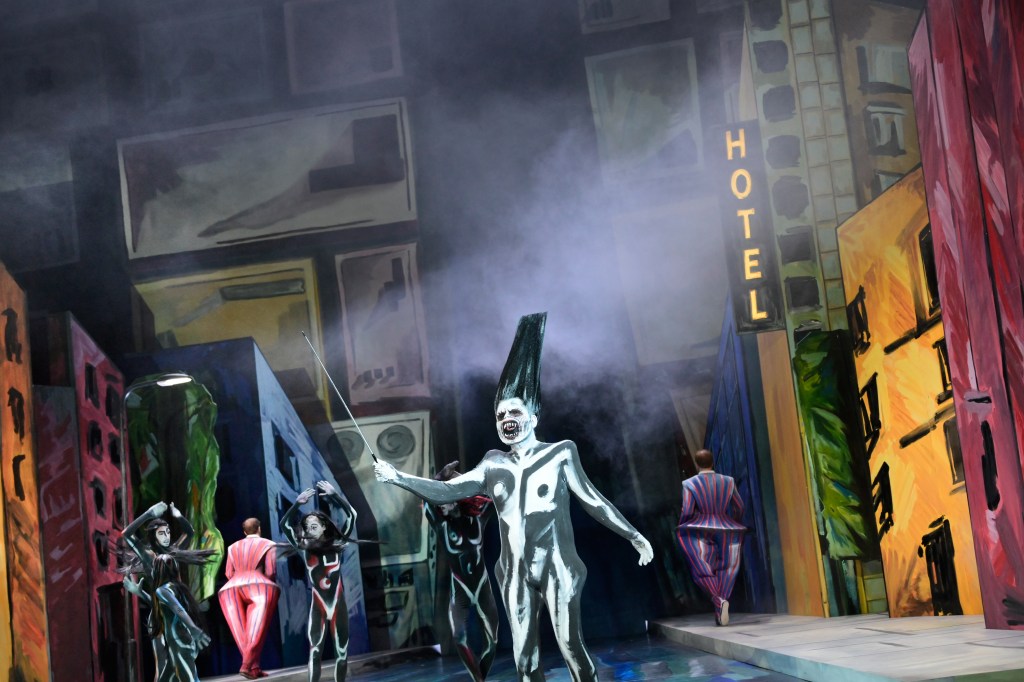
On stage, dancers move smoothly through the darkness. Is it night-time fog? Some inner drama? Or just people entangled in life’s many messes? Hard to say — maybe a bit of everything.
At the back of the stage, a new backdrop tumbles down — a collection of boxes, each with smaller ones inside, split by a road running down the centre. The squares resemble rooftops, giving us a view from above. BUT is it the road that’s ascending, or are we on stage, rising up and looking down at the world below?
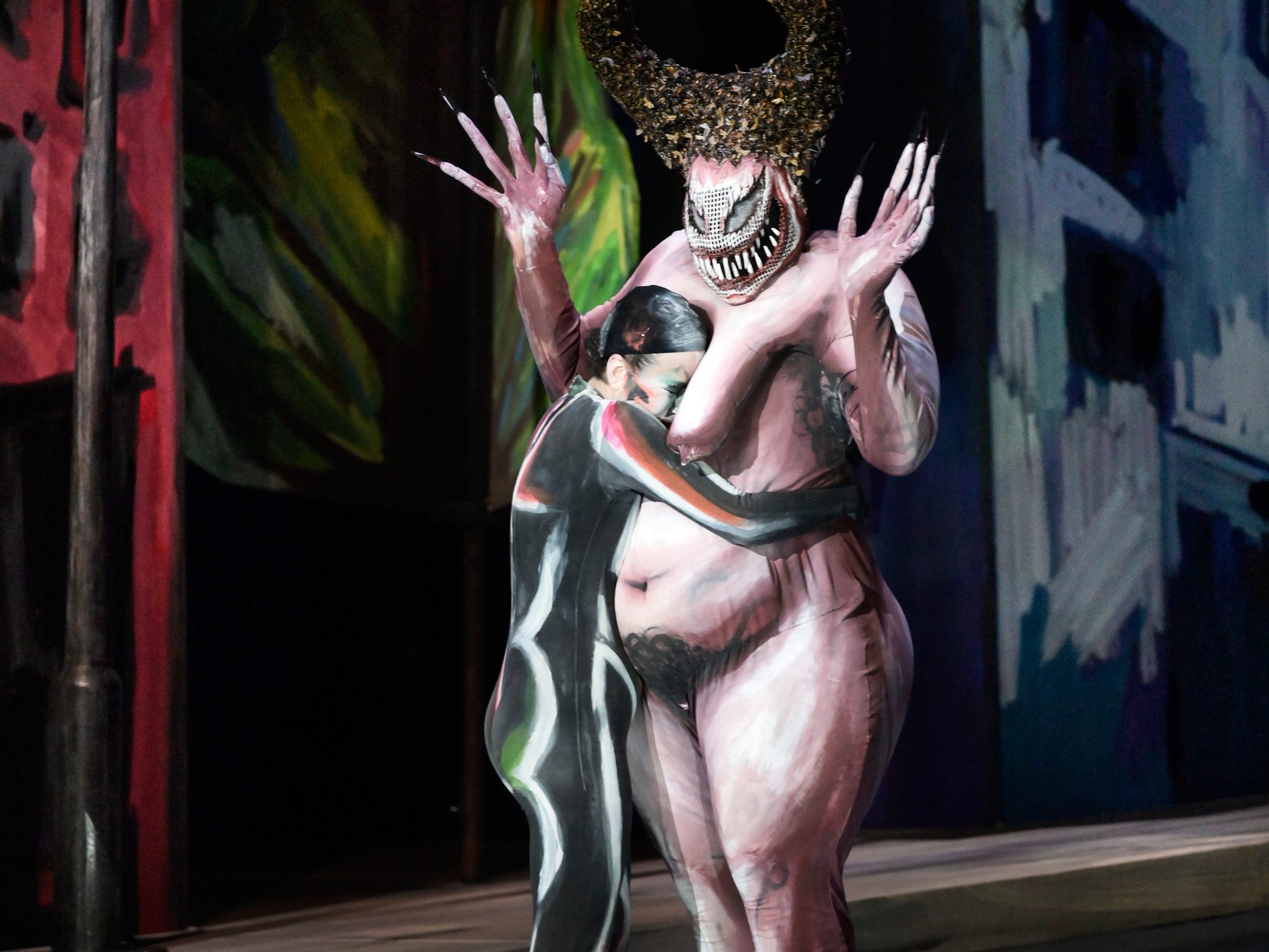
The production by Ersan Mondtag hides plenty of treats, half-hidden symbols, and references. Is that the clown IT we’re seeing, with a red balloon the size of a small yoga ball? What about the yellow taxi with “Apocalypse Now” written on it, or the number 666 painted on its side?

Wait, Who’s Langgaard Again?
Rued Langgaard was a Danish composer, organist, and… well, let’s just say, a bit of a character. He lived from 1893 to 1952 and was both a product of his time and completely out of step with it.
And then there’s his symphony — yep, his very first one was premiered by none other than the Berlin Philharmonic. And he was only 20! You’d think that would make him famous in Denmark, right? Well… think again. Denmark had other plans. Langgaard never quite became the rock star you might expect.
But Never Say Never
Langgaard spent most of his life being just a little too much for the established circles and a bit too odd to be taken seriously. Among other things, he wrote symphonies, oratorios, organ works, songs — and of course, Antikrist.
The latter, however, wasn’t performed until after his death, as it was considered too strange and incomprehensible at the time. He passed away as a church organist in Ribe, forever locked in a battle against the tastes of the era.
But times have changed. These days, people are starting to hear his music with new ears.
Even though Antikrist was composed in the early 1920s, you could easily believe Langgaard had written it a couple of decades earlier — perhaps with a bust of Wagner proudly sitting on the piano?
The opera has definite Parsifal vibes — from the long, floating melodies, almost fugue-like at times, to the bells ringing so solemnly, you half expect the Holy Grail to descend from the rafters.
The music moves in broad strokes, with voices winding around each other. But then, just as suddenly, it shifts into something completely different. The music undergoes several character changes, with interludes so long and symphonic that you might think you’re in the middle of a third movement! Not an opera.
And while it holds immense musical potential, it loses some direction under Stephan Zilius‘ baton. The long phrases sometimes feel like they’re drifting aimlessly, and a bit of dramatic propulsion wouldn’t hurt. But hey, Langgaard’s score isn’t exactly a walk in the park either.
The opera ends the way (almost) all grand operas do: with a chorus, timpani, triangle, and of course, a cymbal crash! It all culminates in a big fat F major chord—probably the most predictable moment in an otherwise wildly unpredictable piece!
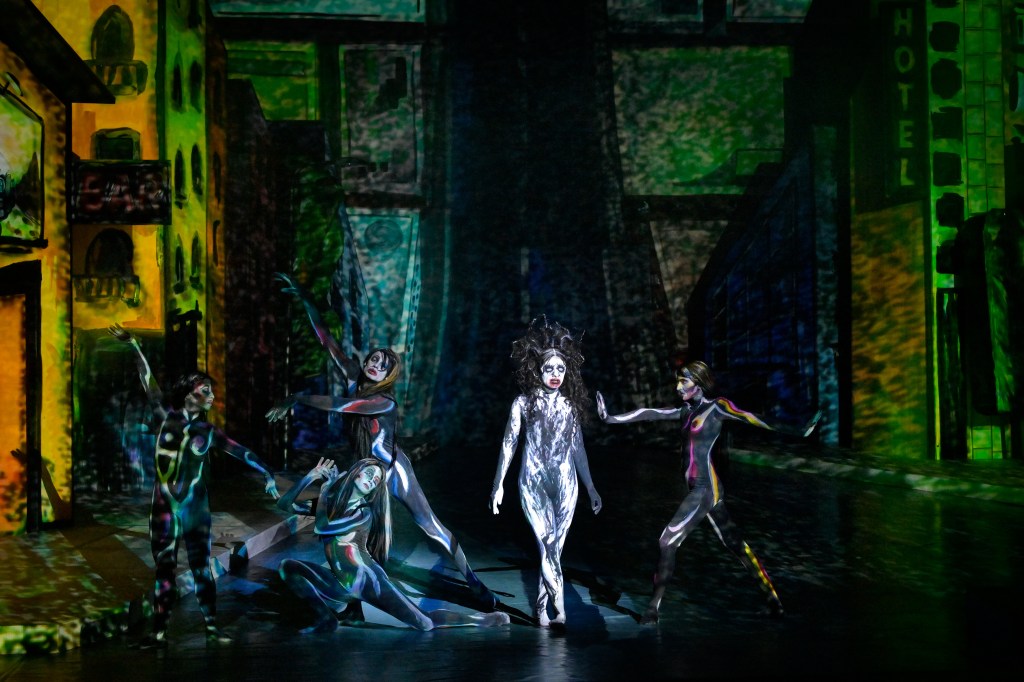
At the edge of the stage, a group of the evening’s characters stand close together, hands joined, staring out at us. There’s a stillness to the moment, almost like they’re caught in a frozen frame, all waiting for something — or perhaps this is the final image, the one that says it all?
Fun Fact!
Langgaard thought Antikrist was ready in 1923 and sent it to the Royal Danish Theatre. They said nope. So he revised it and tried again. Still nope. Then again. And again. Always nope. It finally made it to the stage—in 1999, 47 years after the composer himself had flown off… toward Antichrist?
Trailer:
Cast:
Conductоr: Stephan Zilias
Directоr, Stаge Designer and Сostume Designer: Ersan Mondtag
Costume Designer: Annika Lu
Light Designer: Rainer Casper
Dramaturg: Carolin Müller-Dohle
Сhoir: Jeremy Bines
Luzifer: Kyle Miller
Gottes Stimme: Jonas Grundner-Culemann
Das Echo der Rätselstimmung: Maria Vasilevskaya
Die Rätselstimmung: Arianna Manganello
Der Mund, der große Worte spricht: Thomas Blondelle
Der Missmut: Martina Baroni
Die große Hure: Flurina Stucki
Das Tier in Scharlach: Tadeusz Szlenkier
Die Lüge: Thomas Cilluffo
Der Hass: Philipp Jekal
Eine Stimme: Kyle Miller
Dancers: Derrick Amanatidis, Giorgia Bovo, Ana Dordevic, Sakura Inoue, Vasna Felicia Aguilar, Yuri Shimaoka, Joel Donald Small, Shih-Ping Lin, György Jellinek, Miguel Sanchez
Chor der Deutschen Oper Berlin
Orchester
Orchester der Deutschen Oper Berlin

 Blogfløjten