
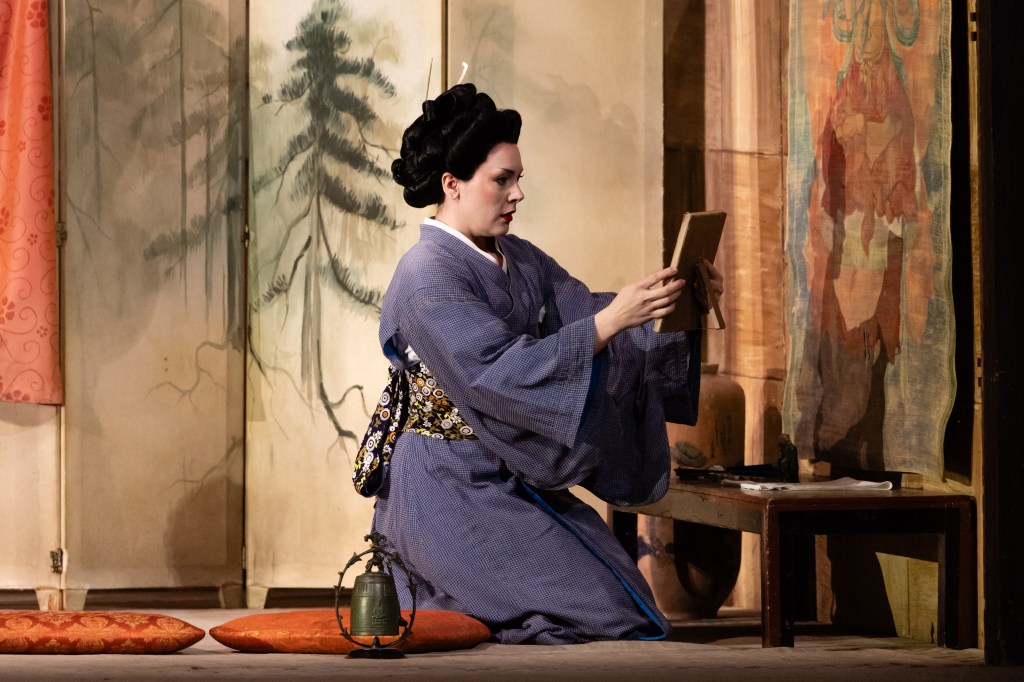
We’re leaping over a century back in time and flying some 9,000 kilometers east—to Nagasaki, Japan. Here, a young geisha named Cio-Cio-San is waiting. Waiting for a ship to appear on the horizon. Waiting for the man who once promised her the world. Waiting, still, for love to return. But in Puccini’s Madama Butterfly, hope can be as fragile as a paper fan—and just as easily broken.
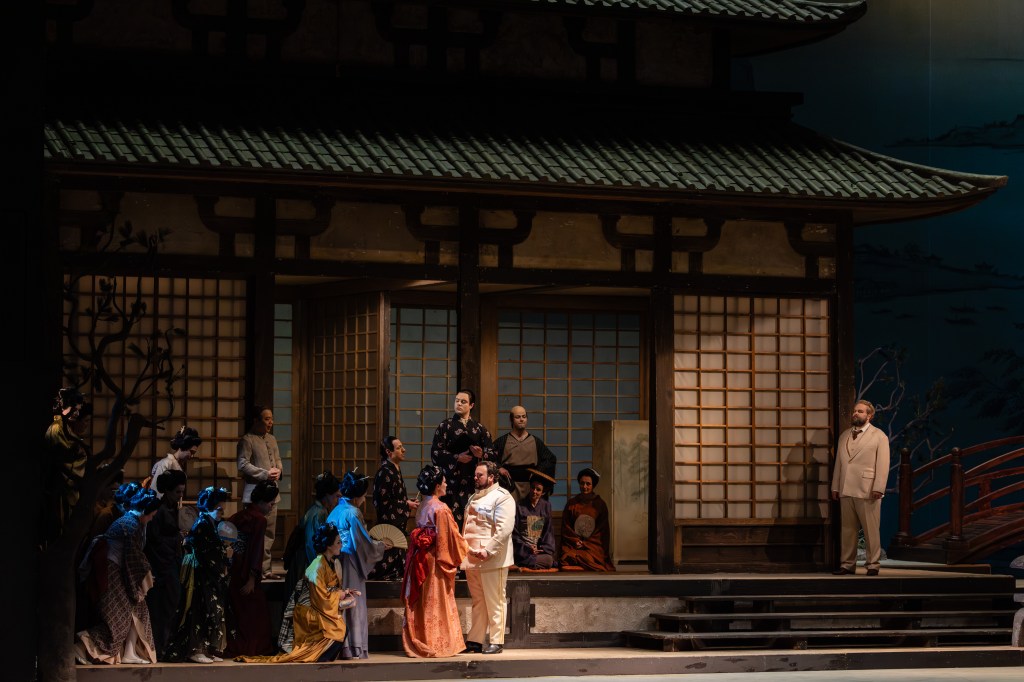
The production, a timeless staging by Wolf Busse dating back to 1973, invites us into a postcard-perfect vision of Japan. Nestled in a tranquil landscape, we find ourselves outside a traditional house with sliding shōji doors, where every entrance feels like the rustle of a secret. A delicate arched wooden bridge curves gently over an unseen stream, hinting at stillness and sorrow beneath the surface. It’s a world suspended between elegance and emptiness—a fitting frame for Butterfly’s fragile dream.
At the center of this serene setting is a story that couldn’t be further from peaceful. Young Cio-Cio-San, barely fifteen, marries an American naval officer who treats their union like a one-night stand but with a bit more paperwork. But for her, it’s a lifelong vow. As years pass and her hope clings to every passing cloud, the audience is drawn deeper into a tragedy where love, loyalty, and illusion unravel—note by heartbreaking note.
The Singing
Vocally, the first act faced some challenges. The singers at times struggled to project fully over the orchestra, their voices occasionally swallowed by Puccini’s lush, layered scoring. Perhaps the relatively open stage offered little acoustic support, or maybe the composer’s penchant for doubling vocal lines in the orchestra played its part. Either way, it created moments where emotional nuance risked getting lost in the sonic landscape.
But whatever imbalance lingered in the opening act, it melted away as the drama deepened. In the second and third acts, the voices soared with clarity and conviction, carried by both the music and the mounting emotional stakes. Suddenly, the sound world opened up—just as Butterfly’s own world began to close in.
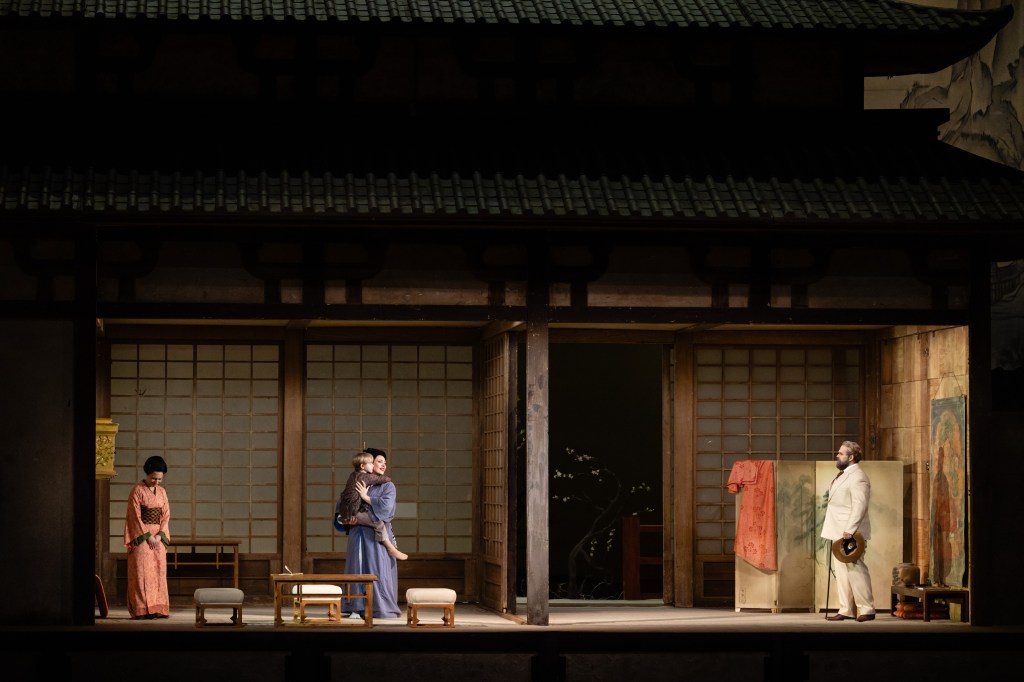
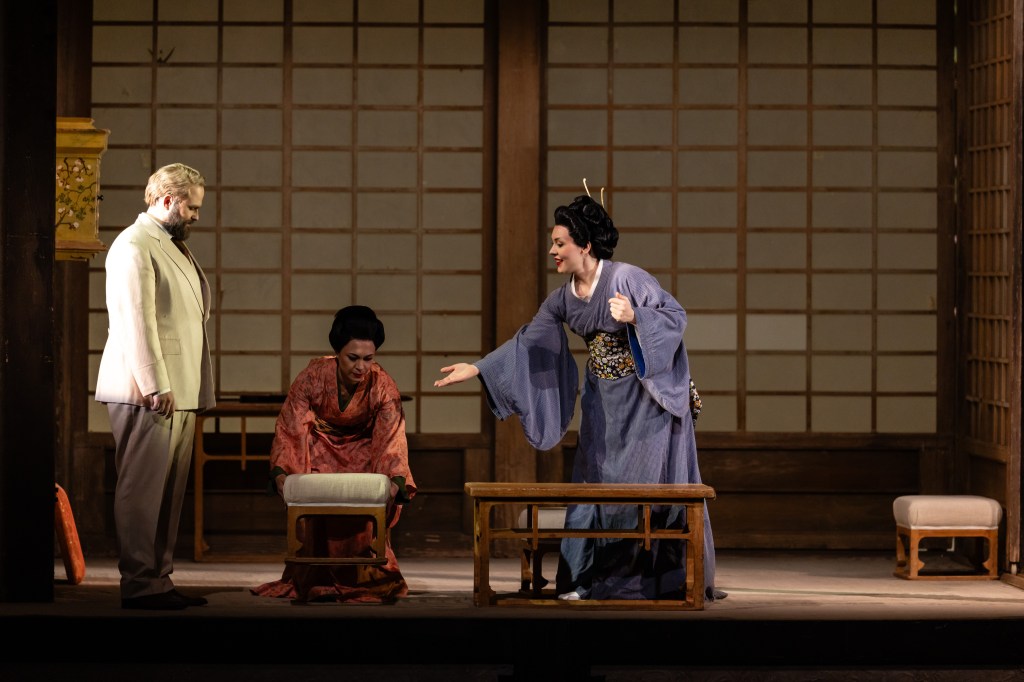
Dramatic soprano Elena Guseva as Cio-Cio-San—a role that demands both vocal finesse and emotional stamina. Guseva, who is set to return to Munich later this season as the Foreign Princess in Rusalka, delivered a Butterfly marked by poise and vulnerability. Her voice bloomed most beautifully in the upper register, though the middle sometimes lacked the same fullness. Still, her portrayal was nuanced and affecting—especially in the second act’s haunting moment of delusion, where she clung to a wooden pillar while singing of Pinkerton’s return, as if it were the last solid thing left in her world. You can practically feel the wood trembling beneath her grip.
As her loyal maid Suzuki, mezzo-soprano Irene Roberts offered a warm, grounded counterpoint. Her rich tone and quiet strength provided the emotional ballast to Butterfly’s more fragile hope.
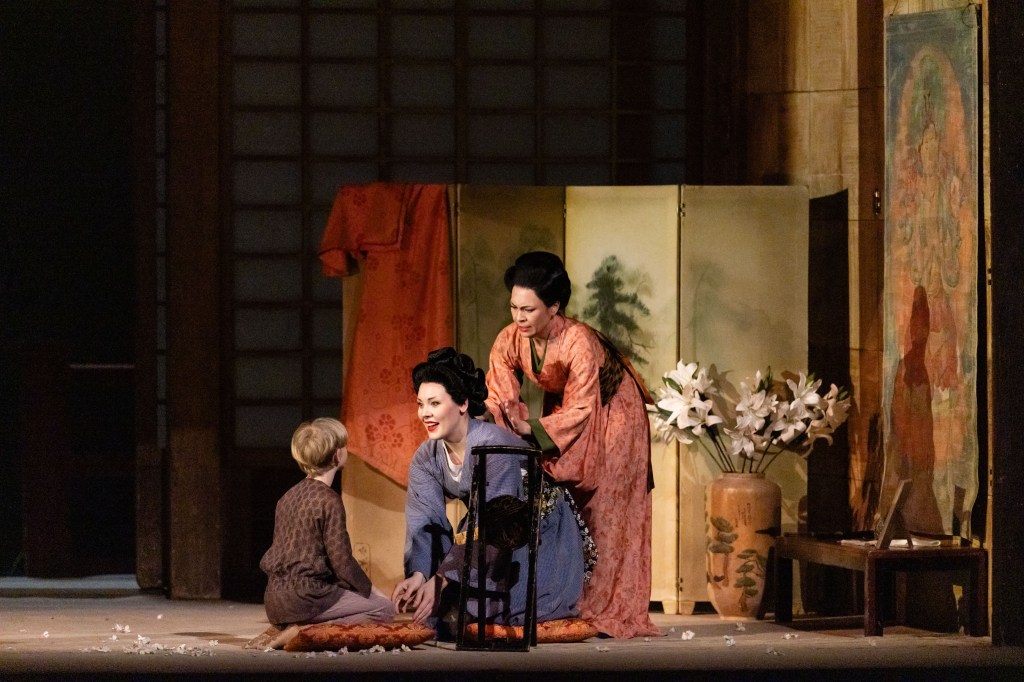
Tenor Riccardo Massi delivered a solid performance as Pinkerton, the kind of guy who would promise you the moon… and then forget to deliver the stars. Massi gave us a with a strong, steady voice that captured the character’s charm. His top notes were clear, and it was easy to see why Butterfly would believe in him—even if, from the start, we know his commitment isn’t exactly built to last. From the moment we meet Pinkerton, we know he’s like the bad Wi-Fi connection—only there when it’s convenient.
As Butterfly takes her final, tragic step, her body lies motionless on the floor, the red curtain slowly gliding over the stage. What was once a space full of hope now echoes with silence. The paper fan lies torn apart—like a forgotten dream, leaving only the cold, hard reality of her fate.
Fun Fact:
You might think Puccini was waving the Stars and Stripes by quoting The Star-Spangled Banner in Madama Butterfly—but nope! In his time, it was just the U.S. Navy’s anthem, not the national one (that came later, in 1931).
Cast:
- Conductоr: Emmanuel Villaume
- Directоr: Wolf Busse
- Stаge Designer: Otto Stich
- Сostume Designer: Silvia Strahammer
- Сhoir: Christoph Heil
- Cio-Cio-San: Elena Guseva
- Suzuki: Irene Roberts
- B. F. Pinkerton: Riccardo Massi
- Kate Pinkerton: Ekaterine Buachidze
- Sharpless: Aleksei Isaev
- Goro Nakodo: Ya-Chung Huang
- Der Fürst Yamadori: Christian Rieger
- Onkel Bonzo: Roman Chabaranok
- Yakusidé: Bruno Khouri
- Der Kaiserliche Kommissär: Yosif Slavov
Bayerisches Staatsorchester
Bayerischer Staatsopernchor


