
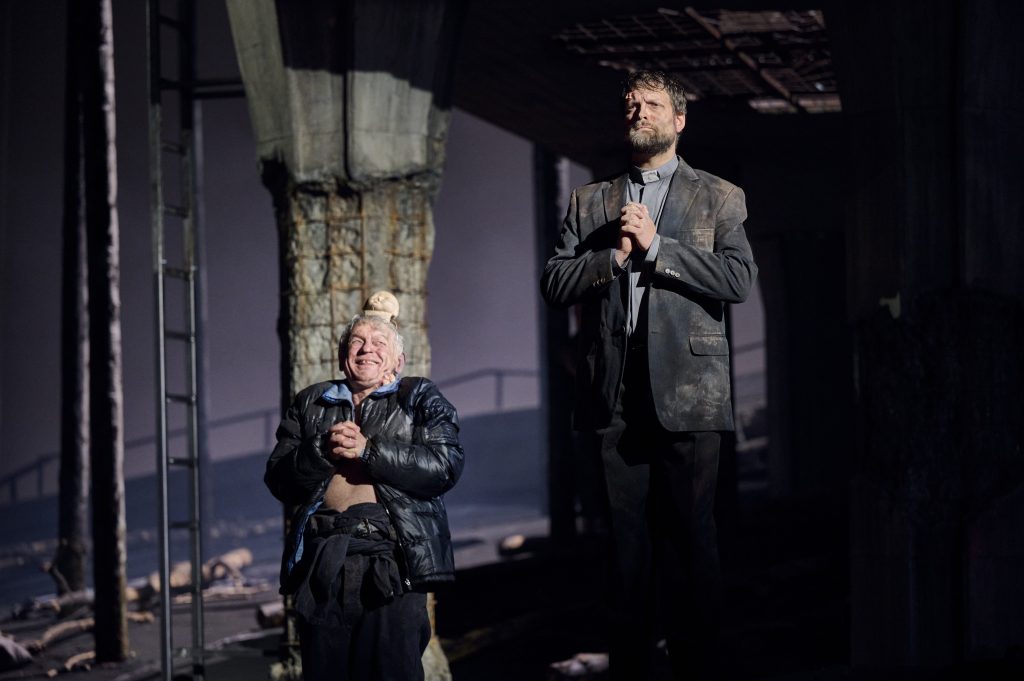
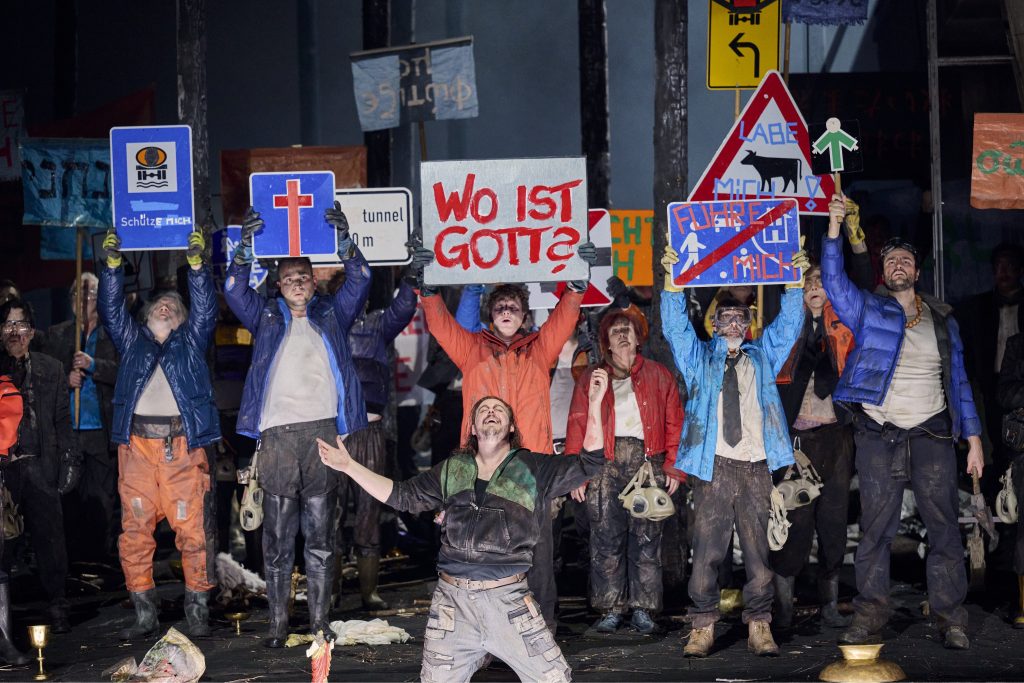
The world’s a mess. Under a crumbling concrete bridge, the knights of the grail have gathered—dusty, dirty, and dressed like they raided the nearest thrift store blindfolded. Nothing matches. Nothing makes sense. Except for old Gurnemanz, the pious priest who still clings to some sort of dignity. He seems oddly composed—until he isn’t. Turns out he’s got some inner demons too… which he lets out by literally whipping a child to death. Welcome to Parsifal, folks.

Spanish director Calixto Bieito first unleashed this production in 2010, and now it’s back on stage at Staatsoper Stuttgart—still grimy, still gutsy. And look who else stumbles into this smoky wasteland: Parsifal, the so-called “pure fool,” trying to find his way in a world gone sideways. Light beams slash through the haze, carving up invisible spaces like a rave designed by a philosopher.
Parsifal really is a fool. Like, proper clueless. He seems completely lost—maybe because he’s the only one without a gas mask? The others keep covering their faces like it’s tear gas o’clock.
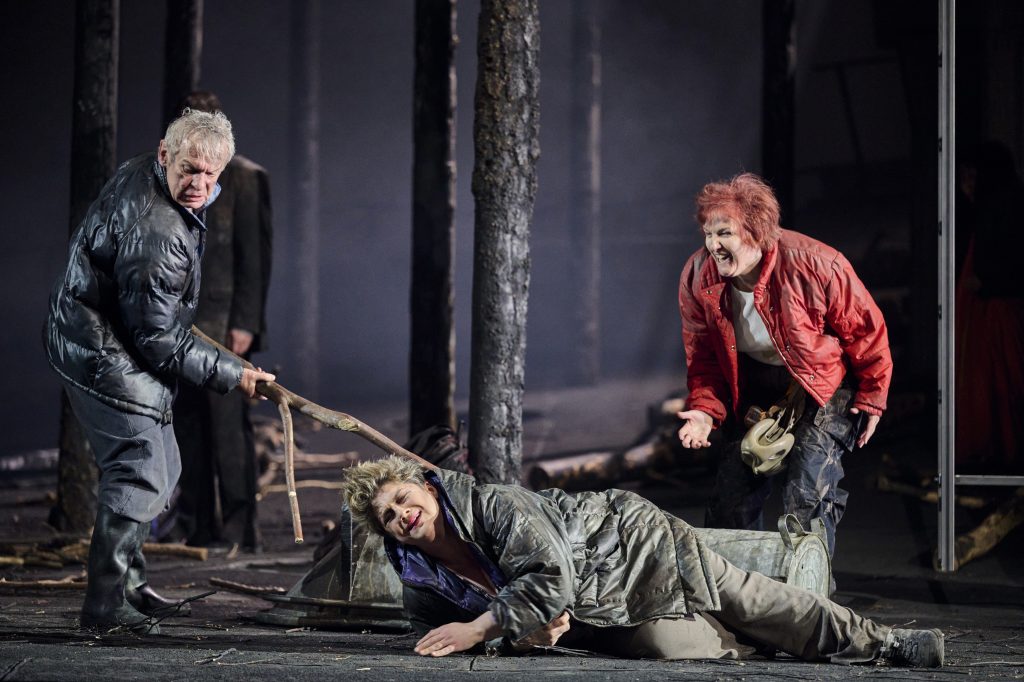
There’s no swan-shooting here, which is usually how Parsifal is introduced; instead, they bicker over the dead angel boy Gurnemanz whipped to death. And when Amfortas shows up, the others go (even more) wild—like sled dogs on espresso.
And blood? Nope. No visible wound. Instead, Amfortas drags a bathtub across the stage like a suburban Jesus hauling his cross. Everyone’s waiting for a savior, but until he turns up, Amfortas is stuck playing spiritual babysitter. When it’s time to reveal the grail, a giant bag floats down from the heavens—stuffed with church bling, holy trinkets, and gold-plated mystery.

And then there’s Kundry. A key character, who also seems to moonlight as a helper. During the gorgeous prelude, she lends her jacket to a naked and very pregnant woman. The baby? Best guess: Parsifal. Because later, when she tries to seduce him in Act II, she starts describing his childhood like she was there, diary in hand.
Parsifal’s off to retrieve the Holy Spear. Klingsor stole it, and he needs it back to save the day. Klingsor’s countermove? Women. Lots of them. Act II turns into one long, steamy fever dream. Bare skin everywhere, and armed with cheap red markers, scribbling across their bodies. At first, it looks like lazy body paint—but then the lines start to resemble cuts. Like they’re slicing themselves in some strange ritual.
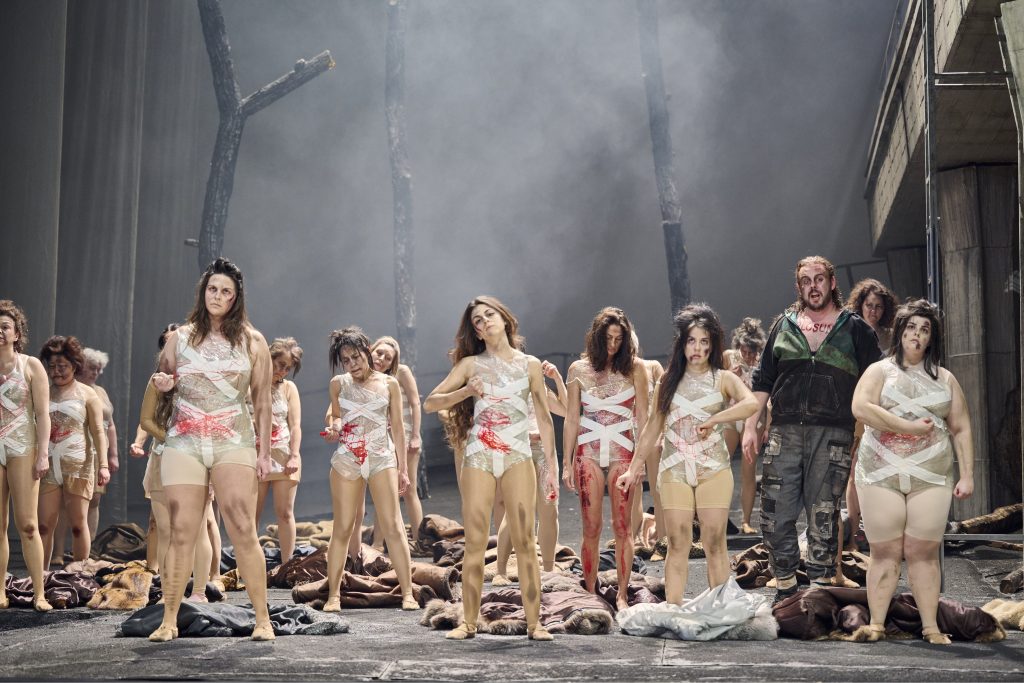
Photo: Martin Sigmund
And Klingsor? Oh yes, he joins in. Goes full tilt with the red marker. Yes, even down there. Shame? Power? A deranged art project? It’s like one big, naked cry for help wrapped in an erotic trance. It sort of reminds me of the whole Wagner–Nietzsche fallout, you know, the one that involved some pretty intense clashes over philosophy and personal habits…
So Parsifal, in a move that feels weirdly Oedipal, first sucks Kundry’s breast and then kisses her (and, well… more). But just as things heat up, he shoves her away and throws the holy spear off that same concrete bridge from Act I.
By Act III, the bridge is even more broken—time has clearly passed. The pregnant Kundry enters the stage. Who’s the father? Good question. She’s been around, but odds are it’s Parsifal. We do know he has a son who ends up as a swan-riding Grail knight—yes, Lohengrin.
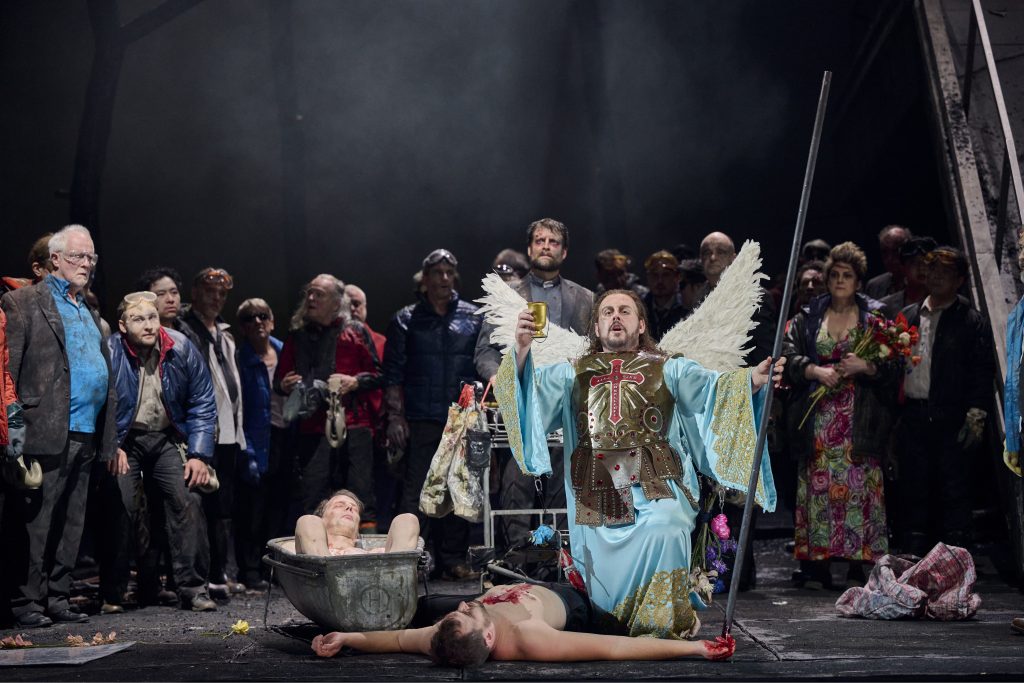
Parsifal gets crowned in a royal blue robe, dangling with decorations like a human Christmas tree. He starts splashing water everywhere like an overenthusiastic priest.
Suddenly, Titurel pops back to life, and Amfortas follows after impaling himself. Resurrection party, anyone?
Christianity isn’t the only religion influencing the scene; traces of Buddhism and Hinduism are also present.
The Soul-Stirring Sounds of Parsifal
Richard Wagner’s music is undeniably grand. But not too grand for Stuttgart. General Music Director Cornelius Meister, who has been at the helm since 2018, knows exactly how to navigate the intricacies of a Wagner score.
Parsifal stands apart from Wagner’s other works, particularly with its long, undulating lines that seem to stretch into infinity. So, how do you keep this sprawling music alive, especially in such a space? Well, with direction, obviously, but how? Meister plays with tempos—some faster than you might expect—and stretches the pauses, building tension.
He doesn’t always go for the big, dramatic crescendos; instead, he chooses his moments with care, creating a sense of anticipation. The orchestra often feels like a vast, enveloping sonic blanket, especially in the interludes, where the sound doesn’t just fill the room but seems to reach into every corner, expanding and breathing as if it’s alive.

This musical landscape is reflected in the performance of the role of Gurnemanz, brought to life by debutant David Steffens. In Act I, his smooth, deep bass voice rises effortlessly above the orchestra, adding weight and authority to his character.
However, just as the Grail Kingdom loses its vitality in Act II with Parsifal’s absence, Steffens’ voice starts to show signs of strain. A message about the start of pollen season before the performance certainly didn’t help matters. By the final act, it’s clear that the weight of the role, combined with the seasonal challenge, has taken its toll. Gurnemanz’s final moments become a struggle, and Steffens, despite his best efforts, is visibly drained, unable to maintain the stamina needed for the conclusion.

Another role debut comes from English mezzo-soprano Rosie Aldridge. Her voice is smooth and conversational, lending a distinctive, spoken quality to the cursed Kundry.
No need for subtitles here; every word is crystal clear. This isn’t by accident. When she shifts into seduction mode, attempting to lure Parsifal, her voice transforms—becoming more sung, more dramatic, as if she’s performing Verdi instead of Wagner. It’s a subtle yet effective shift that highlights her vocal versatility.
Her voice is impressively balanced, with a deep richness that can also soar to higher, lighter notes—nearly impossible to resist. Parsifal certainly seems to be struggling with this temptation. But when he cries out, “Amfortas! Die Wunde!” you get to hear Samuel Sacker’s stunning, soaring side too. His performance really comes into its own in Act II, having warmed up a bit after Act I. It’s as though, just like Parsifal himself, his sound awakens fully. Together with Aldridge’s, they create a sublime listening experience in Act II!
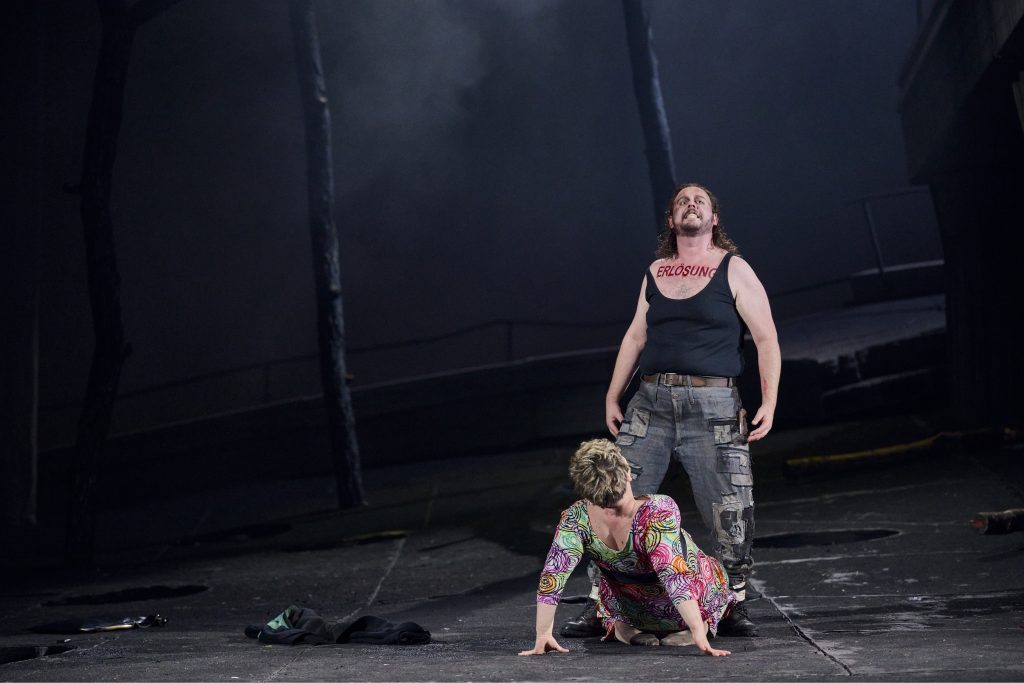
The last time I was in Stuttgart, I heard baritone Paweł Konik‘s debut as Jochanaan in Salome (read the review here), and now he makes his debut as Amfortas. With his bare chest and trousers sitting comfortably halfway up his stomach, he delivers a solid performance. Similarly, Japanese baritone Shigeo Ishino’s portrayal of Klingsor is steady and fitting for the role.
By the final notes of the evening, we return to Kundry, clad in a colorful floral dress and sporting her large belly. With a can in hand (is it tuna?) she digs in with her fingers, gazing lazily into the distance. Life, it seems, continues on, no matter how many gods, curses, and failed redemptions we’ve witnessed.
Fun Fact:
Wagner believed that when religion lost its meaning, art could carry the torch. So he created Parsifal—not just an opera, but a Bühnenweihfestspiel (a sacred festival stage play). Holy drama, Batman!
Trailer:
Cast:
- Conductоr: Cornelius Meister
- Directоr: Calixto Bieito
- Stаge Designer: Susanne Gschwender
- Сostume Designer: Mercè Paloma
- Light Designer: Reinhard Traub
- Dramaturg: Xavier Zuber
- Сhoir: Manuel Pujol
- Amfortas: Paweł Konik
- Gurnemanz: David Steffens
- Parsifal: Samuel Sakker
- Klingsor: Shigeo Ishino
- Kundry: Rosie Aldridge
- Titurel: Peter Lobert
- 1. Gralsritter: Heinz Göhrig
- 2. Gralsritter: Aleksander Myrling
- 1. Knappe: Alma Ruoqi Sun
- 2. Knappe: Catriona Smith
- 3. Knappe: Torsten Hofmann
- 4. Knappe: Sam Harris
- 1.1. Blumenmädchen: Claudia Muschio
- 1.2. Blumenmädchen: Natasha Te Rupe Wilson
- 1.3. Blumenmädchen: Carmen Larios Caparrós
- 2.1. Blumenmädchen: Alma Ruoqi Sun
- 2.2. Blumenmädchen: Lucia Tumminelli
- 2.3. Blumenmädchen: Itzeli del Rosario
- Stimme aus der Höhe: Itzeli del Rosario
Staatsorchester Stuttgart, Staatsopernchor Stuttgart, Kinderchor der Staatsoper Stuttgart

 Blogfløjten