

Bombs are falling, Europe is in chaos, and Richard Strauss? He’s busy composing Die Liebe der Danae. The plan was a grand Salzburg Festival premiere in 1944—fitting, since Strauss helped start the whole thing with Hofmannsthal and Reinhardt. But with the Third Reich going down the drain, the opera went with it, leaving only a public dress rehearsal. Its actual premiere had to wait until 1952—by then, Strauss had already left the stage for good.
Never heard of this opera? Don’t worry, you’re not alone—it barely ever sees the spotlight! But German director Claus Guth has decided it’s time to dust off this hidden Strauss treasure and give it a fresh new look.
A Quick Peek at the Plot
In what might as well be Trump Tower, Pollux, king of Eos (and broker than broke), faces a herd of creditors in black suits, furiously waving yellow folders like stock market traders in freefall. His master plan? Marry off his daughter to a walking pile of cash. Enter Midas, Lydia’s golden boy.

But hold onto your laurel wreaths—this is where things get tricky. Jupiter, king of the gods and serial womanizer, actually wants Danae for himself. Since divine seduction isn’t as easy as it used to be, he strikes a deal with a humble donkey herder—also named Midas. In exchange for borrowing his identity, Jupiter grants him a trick that would make any banker jealous: everything he touches turns to gold.
Beyond the towering windows, the city skyline looms, shrouded in sheets of relentless rain. But as Midas is announced, a dazzling golden jet (maybe a Boeing? Or perhaps a Golding…?) zips past, and suddenly, the rain turns to cascading gold—mirrored by a shimmering orchestral sparkle from the pit.
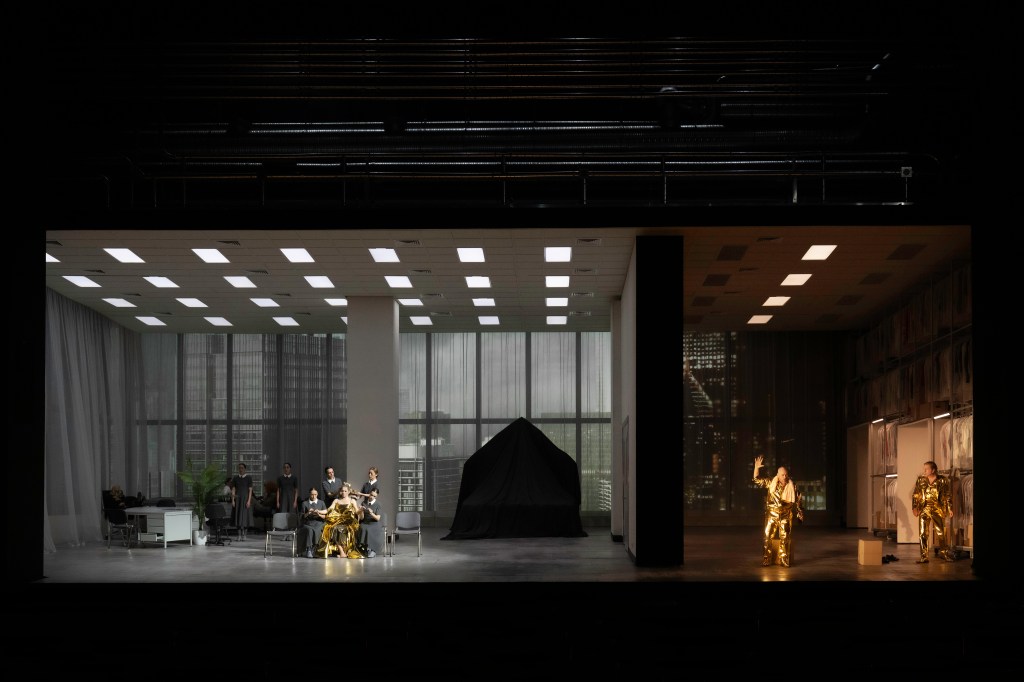
When “Midas” shows up, it’s actually Jupiter in disguise. And when Midas’ so-called messenger Chrystopher (the real Midas, in deep cover) struts in, draped in a burgundy velvet suit and brandishing golden gifts, Danae instantly falls for him. One job, Midas. You literally had one job…
Jupiter, now in a seriously bad mood, drops a wicked curse: the second Midas touches Danae, she turns into solid gold. Well, that was kind of the deal… Midas, in full panic mode, pleads for a second chance. Jupiter, with a dramatic sigh, agrees—on one condition: Danae must choose her own fate. Spoiler alert: she picks Midas, love over luxury.
By Act III, the dream has shattered. Midas and Danae are penniless, Jupiter does one last lap around the mortal world, and then—Tschüssie! Back to Olympus.

Strauss on gold?
The music is very much Strauss – late Romantic, with swelling orchestral sounds, sometimes silky smooth strings, and harmonies that wind like flowing gold through the score. There are sparkling, almost impressionistic colors in the orchestration, but also heavy, Wagnerian passages where the music boils over into big outbursts. At the same time, you can feel Strauss’ characteristic elegance – a lightness in the melodies, a refined play with motifs, and of course, a strong sense of drama.
Vocally, it’s not exactly a walk in the park. The big roles, like Jupiter and Danae, are a bit of a vocal marathon—think Wagner’s heavy hitters, like Wotan, Sieglinde, or even Isolde. And guess what? That’s not the only Wagner connection—there are more parallels than you can shake a conductor’s baton at!

The Two Richards
Jupiter vs. Wotan. Two gods, both with wives at home, yet they can’t resist swooping down into the mortal world for some extra-marital adventures. And, let’s be honest, their affairs are about as subtle as a thunderstorm. In this production, Juno, Jupiter’s long-suffering wife, takes up residence above the stage, watching her husband’s antics with a mix of amusement and disdain. Sometimes she’s sipping from a bottle (I assume it’s champagne?) and peering through a pair of opera glasses, getting a front-row seat to the chaos unfolding below.
In the final act of Die Liebe der Danae, Jupiter goes full undercover, much like Wotan/der Wanderer in Siegfried. In fact, he’s even carrying a stick that looks suspiciously like Wotan’s iconic spear. The parallels keep piling up—Jupiter’s exit is basically a carbon copy of Wotan’s great farewell in Die Walküre. And let’s not forget the themes: gold, power, and love are front and center. Strauss, clearly a Wagner enthusiast, channels his influence both subtly and with all the drama you’d expect, though this is just scratching the surface. And yes, the score is packed with leitmotifs—however, they don’t seem to be used as systematically as in Wagner’s works.
Strauss’ Singing Summit
The vocal demands of Die Liebe der Danae? Oh, they’re a full-on workout. This isn’t a light stroll—it’s a marathon. For many of the singers, it’s a debut into uncharted territory. Enter Christopher Maltman, who steps into the mighty shoes of Jupiter. (By the way, he also made his debut as Hans Sachs in Die Meistersinger in Berlin this December—another mammoth role! More on that here.) It seemed like he was made for this role. His clear voice fills the space with satisfaction, particularly in Act II, where he launches into a lengthy passage leading with “Doch anders ist Danae”—a melody that makes a return in the prelude to Act III. He’s also striking in the finale of Act II, stepping out of the box that serves as the stage. You can feel his frustration as he contemplates that it was the humble herder Midas who was chosen over him—the mighty god himself! The act closes with him almost kneeling on the floor, gazing out toward the audience, as the lights go out.

Tonight, we have a true debutant: Malin Byström, who had to bow out of the premiere (leaving Manuela Uhl to step in, despite not having tackled the role since 2016). But now the Swedish soprano was ready for her moment— and she absolutely took off from the start. With a voice that balanced both fire and finesse, she breezed through Strauss’ vocal obstacle course, where the high notes pop up like pesky speed bumps, and the long phrases stretch out like a never-ending marathon. Sure, there were a couple of moments where her breath had to sprint to catch up, but she crossed that finish line without tripping, her golden Strauss tones gliding all the way to the end.
Another Wagner comparison sneaks its way in with the roles of Merkur and Loge. Both are the trickster tenors, sneaking around the stage like they know something we don’t. In this production, Merkur was brought to life by Ya-Chung Huang, who practically glided across the stage, even in moments when he wasn’t singing. He was like a silent puppeteer, subtly pulling the strings of the story with his presence, leaving just the right traces of influence wherever he went.
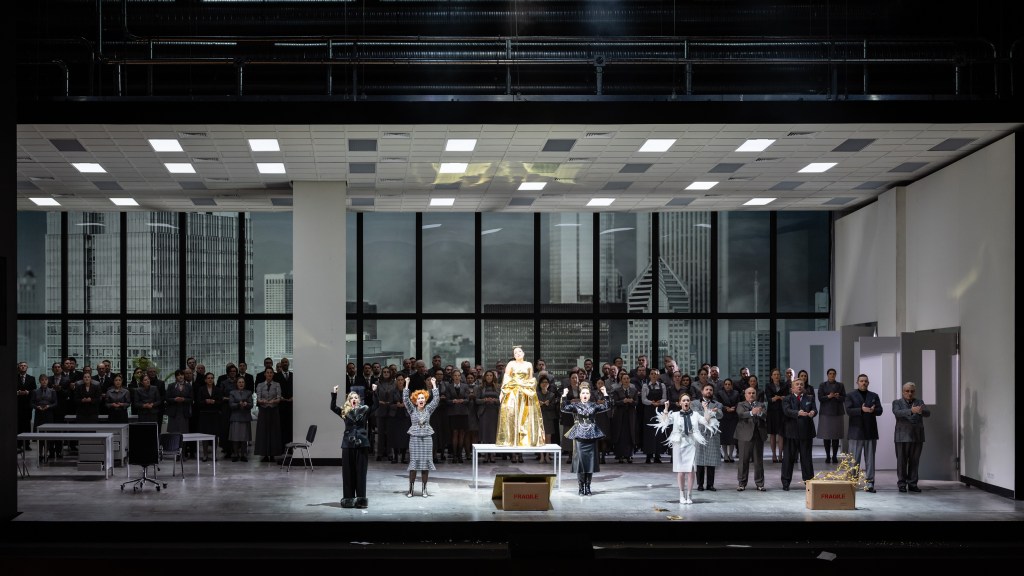
Leda (Avery Amereau). Photo: Geoffroy Schied.
Then we have the four diva dames – Semele (Sarah Dufresne), Europa (Evgeniya Sotnikova), Alkmene (Emily Sierra), and Leda (Avery Amereau) – who are basically a package deal. They’re never alone, always moving as a unit, and almost exclusively singing in tight-knit quartets. And let’s just say, Strauss didn’t exactly make it easy for them. The harmonies twist and turn, and if one of them slips, the whole thing could topple like a house of cards. Luckily, the cards stayed solidly stacked on top of each other.
They also have a bit of a Rhinemaiden vibe – a divine girl gang, part seduction, part mischief, and a touch of chaos. From start to finish, they’re hot on Jupiter’s heels, ready to pounce at the slightest sign of interest. While Wagner’s trio swims through mythological waters, Strauss’ quartet feels more like a synchronized swim team, always teetering on the edge of launching into a dazzling spectacle.
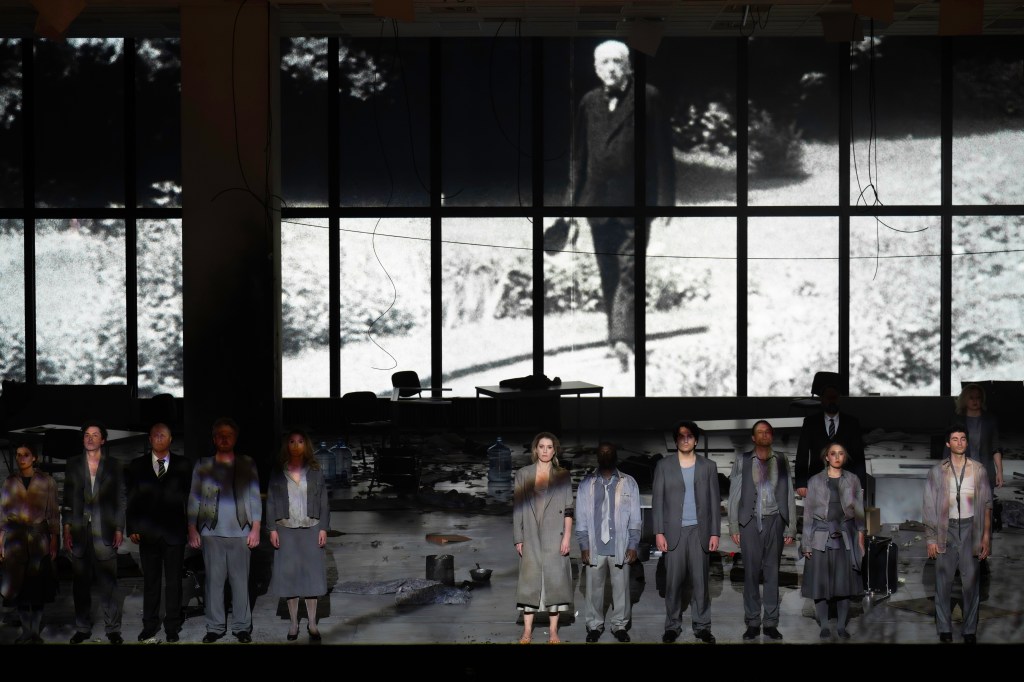
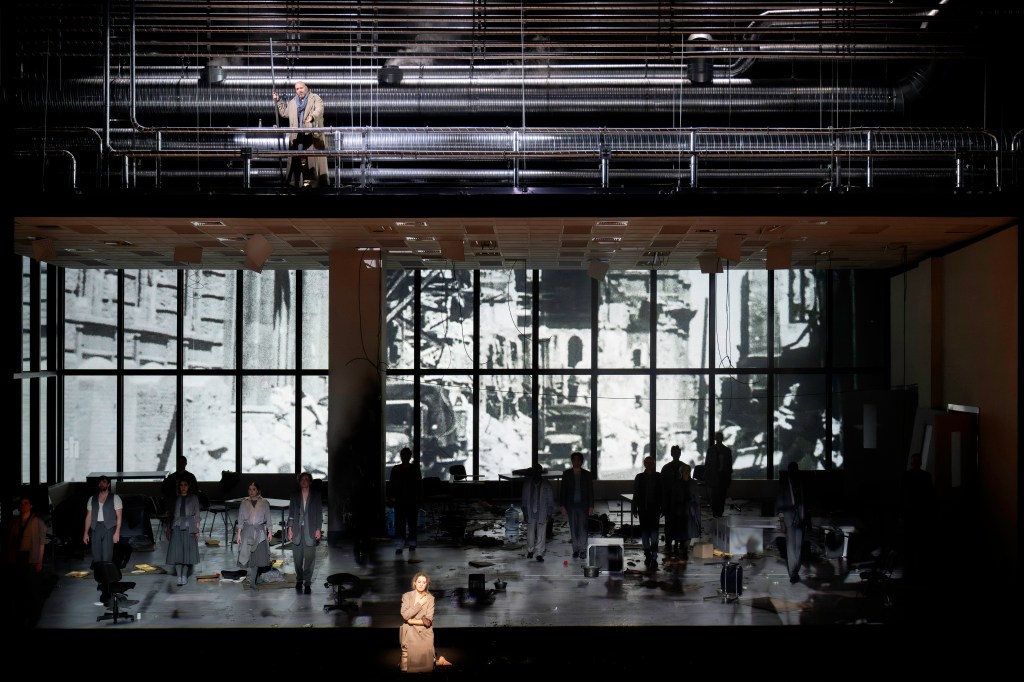
The opera ends with a real punch to the gut. The sleek city skyline is gone, replaced by eerie footage of bombed-out Munich, the opera house in ruins. And then, as if someone switched the channel, there he is: Strauss, strolling peacefully through his garden in Garmisch, looking completely unbothered.
Director Claus Guth puts it bluntly: “The world today isn’t so different from back then. Sometimes you get chills and think: wait a minute—this is exactly how it started last time.”
Fun Fact:
In 1944, Clemens Krauss transposed parts of Jupiter’s role down for Hans Hotter. Strauss had his doubts, but the changes stuck—though a fearless baritone with a solid top can still tackle the original key.
Trailer:
Cast:
- Conductоr: Sebastian Weigle
- Directоr: Claus Guth
- Stаge Designer: Michael Levine
- Сostume Designer: Ursula Kudrna
- Video Designer: Rocafilm
- Light Designer: Alessandro Carletti
- Dramaturg: Yvonne Gebauer and Ariane Bliss
- Сhoir: Christoph Heil
- Jupiter: Christopher Maltman
- Merkur : Ya-Chung Huang
- Pollux: Vincent Wolfsteiner
- Danae: Malin Byström
- Xanthe: Erika Baikoff
- Midas: Andreas Schager
- Vier Könige: Paul Kaufmann, Kevin Conners, Bálint Szabó and Martin Snell
- Semele : Sarah Dufresne
- Europa: Evgeniya Sotnikova
- Alkmene: Emily Sierra
- Leda: Avery Amereau
- Vier Wächter: Vitor Bispo, Bruno Khouri, Yosif Slavov and Daniel Noyola
- Eine Stimme: Louise McClelland
Bayerisches Staatsorchester

 Blogfløjten