

Palestrina? As in the composer? You bet! But hold your horses—it’s not music by Giovanni Pierluigi da Palestrina, but about the man. This so-called “Musical Legend” brings a staggering 39 soloists, a choir, and an orchestra so large it could be a small nation. And now, after 23 years, it’s making a grand return to the stage at the Vienna State Opera. Something I’ve been looking forward to ever since the opera house announced their season around half a year ago.
Herbert Wernicke’s production, which first premiered in 1999, came 50 years after the composer’s passing. While Hans Pfitzner never officially joined the NSDAP (and was cleared during the post-war de-Nazification process), his personal history has been a bit… tricky. Perhaps that’s why this opera hasn’t been a frequent flyer at the opera house?
Maestro Thielemann has mentioned in an introductory chat about the work that it’s one of his favorites—though it might be in a bit of a rivalry with Die Walküre for that top spot!
Let’s Talk About the Work
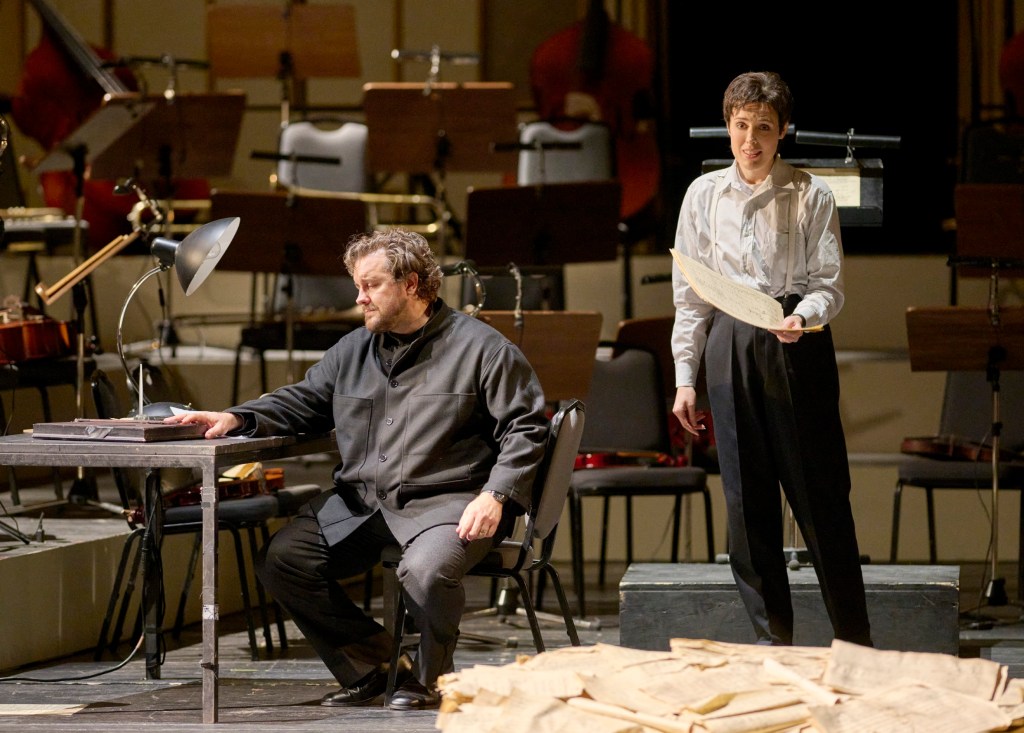
To be honest, the plot isn’t exactly the thrill ride… Sure, the historical backdrop is interesting. We’re in the fateful year of 1563, where the church threatens to ban polyphonic music and stick to Gregorian chants. Meanwhile, the aging composer, struggling after his wife’s death, faces a personal crisis. Cardinal Borromeo tries to convince him to compose a new mass to save music, but Palestrina, feeling uninspired, refuses. He believes his music is outdated and has nothing left to offer.
Before the Council of Trent becomes a battleground of power struggles and debates over music’s role, nine ghostly old masters appear to stir Palestrina’s creativity. With the future of music hanging in the balance, they spark his inspiration. In a last-ditch effort to save both his music and his soul, Palestrina writes a mass that doesn’t just preserve polyphony—it secures his place in music history.
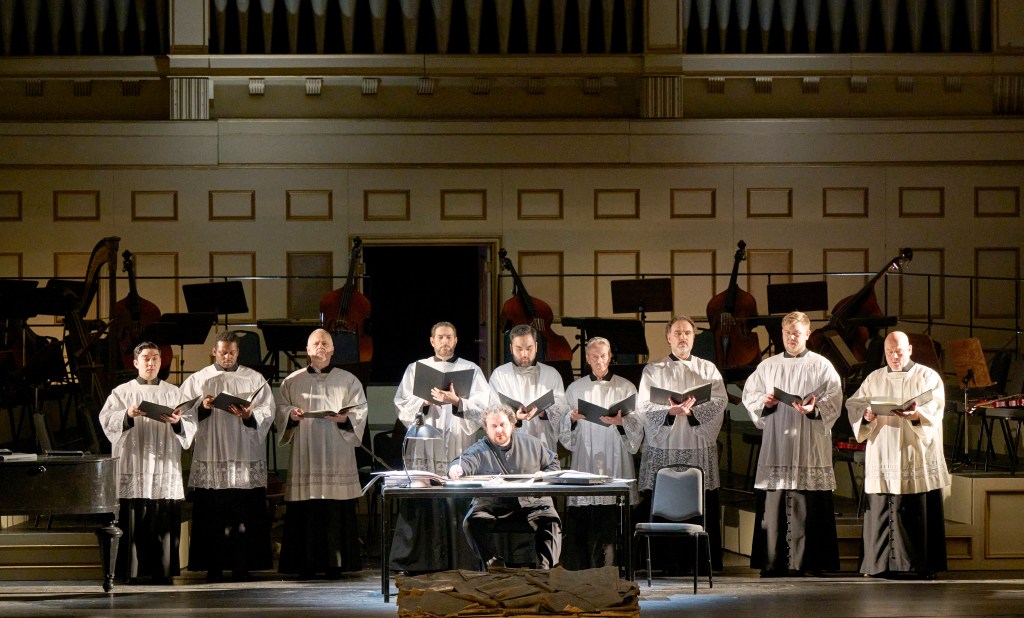
The piece? Missa Papae Marcelli. A mass Palestrina actually composed, although Pfitzner takes a few creative liberties with the story. But the message is crystal clear: Palestrina swoops in to save the day—and the future of music!
Was Pfitzner also the Messiah of Music?
Well, at the dawn of the 20th century, music was becoming a battlefield. Pfitzner believed German music was threaten by atonality, with the Second Viennese School leading the charge. So, in a sense, he may have seen himself as the knight in shining armor, coming to the rescue. In 1917, at the height of a burning Europe, he presented this work under the baton of none other than Bruno Walter.
What’s that sound?
The music in Palestrina offers a bit of everything. There are clear Wagnerian influences, especially in the use of leitmotifs, though they’re not as consistently applied as in Wagner’s works, and the overall orchestration is somewhat thinner. The preludes to both the first and, to a lesser extent, the third act evoke a Parsifal-like atmosphere, driven by lush soundscapes. At the same time, there are hints of Renaissance music woven through the score, though always wrapped in romantic harmonies.
Christian Thielemann really gets into the music, pulling everything together with his usual style. His control over the orchestra and the dramatic punch he brings is a real treat. He has a knack for highlighting the small details, so even though the orchestra plays softly in the first act, nothing ever feels muddy or unclear. The dynamics never feel forced and the balance between the orchestra and singers is spot-on, allowing them to glide through their parts (mostly) without a hitch.
Thielemann throws himself into the drama, giving it everything—even with his injured achilles tendon. Still on crutches after surgery, nothing holds him back from fully immersing himself in the music. By the end of Act 1, he carefully builds a dramatic crescendo, and despite his limp, delivers a thunderous standing forte (literally). Nothing stands between Thielemann and his music. The result? Absolutely spine-tingling.
If I had to nitpick (not that I really do), I’d say the prelude to the second act could have used a bit more punch, especially from the trumpets. Their notes are intentionally unpredictable—think Stravinsky’s Le Sacre du printemps—but I couldn’t help wishing they’d been a bit more in your face, adding that extra dash of drama. But then again, that’s probably just down to personal taste.
An Organ?
At times, the orchestra sounded a bit like a giant organ (maybe Thielemann has been conducting too much Bruckner?), but it actually worked really well with the whole vibe of the performance. Thielemann has mentioned before that conducting wasn’t always his dream—he was very fascinated by the organ. But since it didn’t quite fit with his other musical pursuits, he turned to conducting, thinking that leading a massive orchestra was probably the closest he could get to the full, rich sound of an organ.
“Tristan For Adults“
Palestrina is definitely not a light bite. The opera is semi long, and not every moment brims with excitement—neither in the story nor the composition itself. I had one of those super standing spots at the back of the parquet, and with the performance stretching just over three hours, it turned out to be quite the endurance test. At one point, a lady nearby even fainted—though I suspect it had more to do with something else. As the evening went on, the number of empty seats steadily grew.
It could have been the tourists—just looking for a pleasant evening at the opera, unaware of what they’d signed up for. Which is a shame, because I genuinely thought it improved as it went along. That said, the opera has its highlights but certainly also of moments where it felt less engaging.
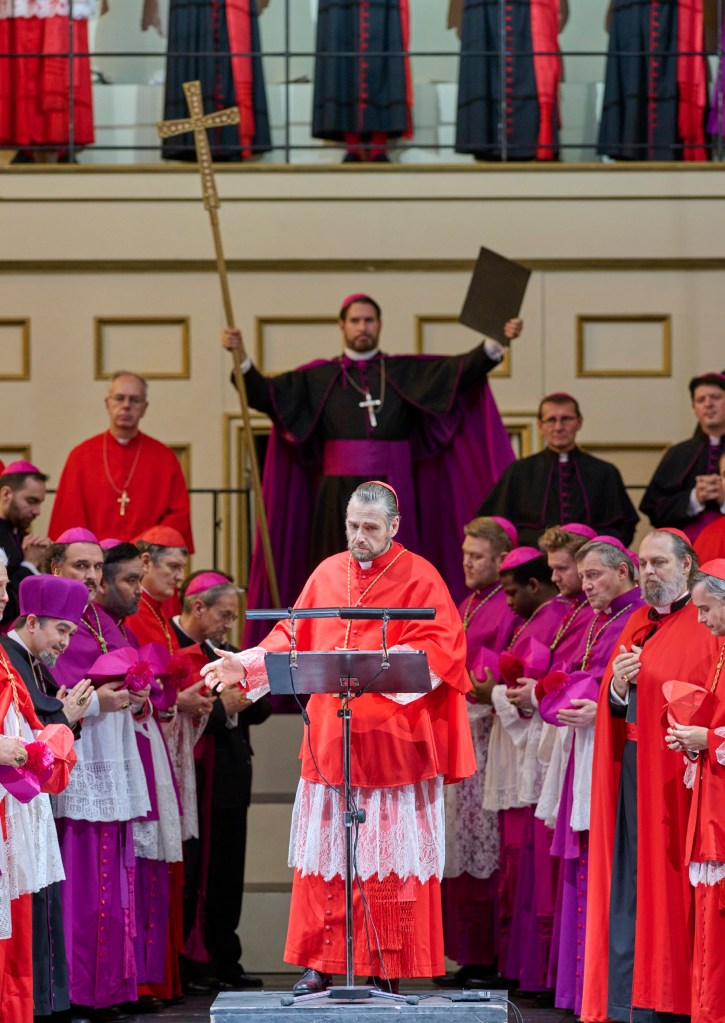
The staging of the ending, though, was absolutely stunning: Palestrina stands on the podium on the stage, in front of chairs arranged as if for an orchestra. In the pit, strings and clarinets play alongside a single, sustained organ note. As the lights dim, the strings fade away, leaving the “real” conductor in the pit as the only figure still illuminated. Slowly, the clarinets fade, to let the organ note gently dissolve into the air, leaving the room in silence… and complete darkness! A brief, reverent pause before the audience begins to clap.
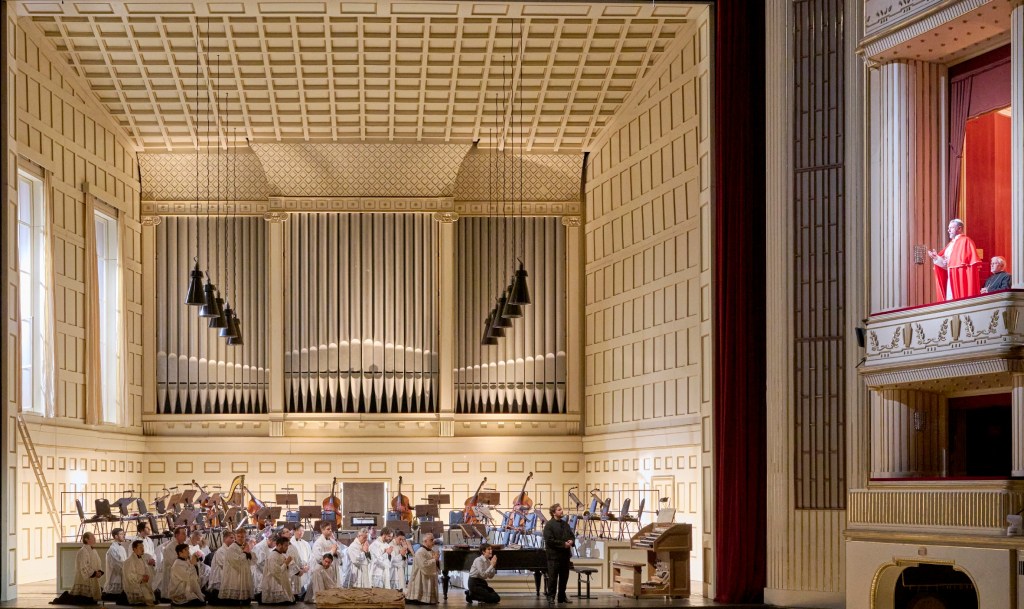
Pope Pius IV, as portrayed by Günther Groissböck, refers to the work as “Tristan [und Isolde] für Erwachsene.” (Tristan for grown-ups) He adds, “Also, Tristan ist auch für Erwachsene, aber für die fortgeschrittenen Erwachsene” (So, Tristan is also for adults, but for advanced adults). The music, however, is something else entirely—on that, we can all agree.
Groissböck sings a (unfortunately far too brief) powerful role. He only steps onto the stage in the third act, appearing for just a few minutes on the first balcony on the right side. But, as expected, he delivers his part with impeccable style and a commanding voice!
Palestrina, a role that actually doesn’t involve as much singing as you might expect, was performed by Michael Spyres (who is also set to sing Walther von Stolzing in the new production of Die Meistersinger in Bayreuth this summer). His stage presence was solid, and his naturally rich, deep tenor timbre made for an enjoyable listening experience.
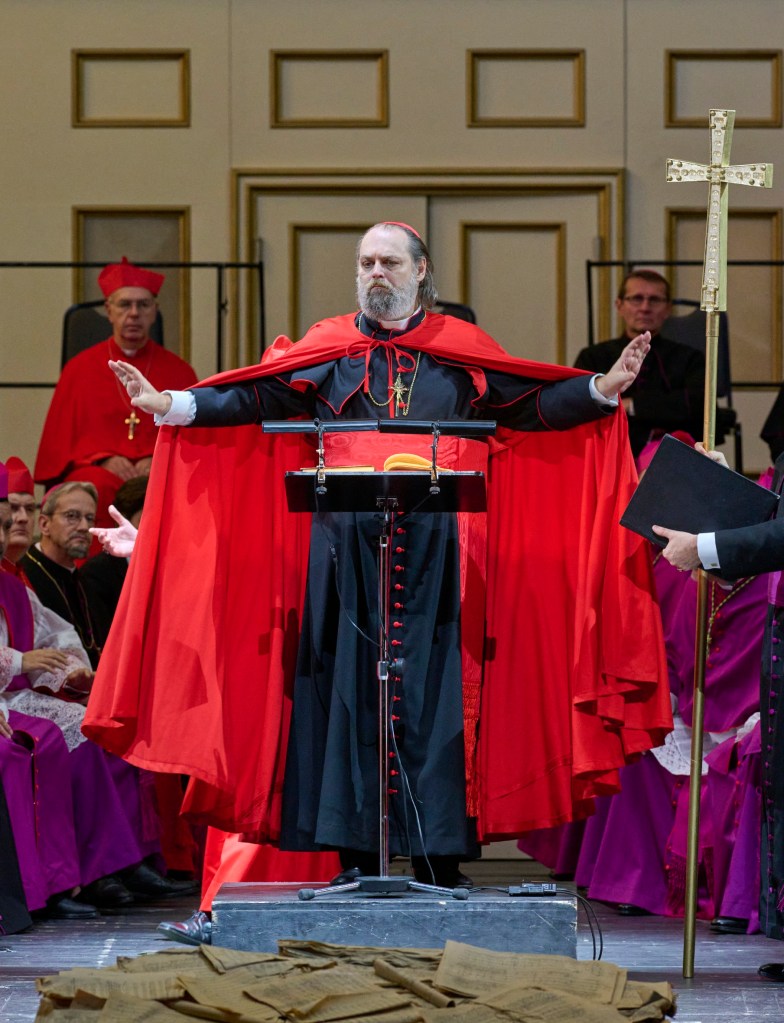
The only character to appear in all three acts is the determined Borromeo, whom Wolfgang Koch portrays with a compelling sense of inner conflict. Koch, a singer who has collaborated with Thielemann quite a lot, brings a voice that fits the character pretty well. His performance effectively captures Borromeo’s steadfastness while subtly reflecting his struggles.
Palestrina’s son, Ighino (Kathrin Zukowski), and his student, Silla (Patricia Nolz), were some of the only characters sung by women—both as trouser roles. They each delivered their parts well, with clear articulation throughout. However, Patricia Nolz’s performance perhaps lacked a bit of depth in certain moments, though not to a degree that detracted significantly from the overall impression.
Michael Nagy (by the way, the upcoming Sixtus Beckmesser in Bayreuth), as Giovanni Morone, commands the stage in the second act. With a timbre somewhat reminiscent of Wolfgang Koch, he demonstrates impressive clarity and delivers a compelling interpretation of the character.
A few last words
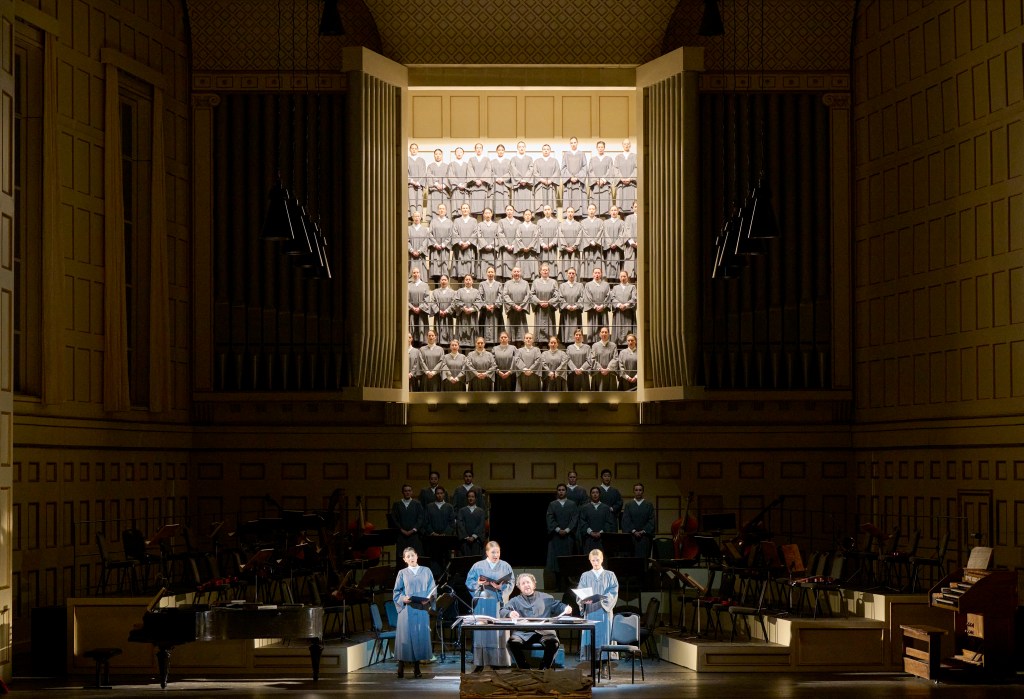
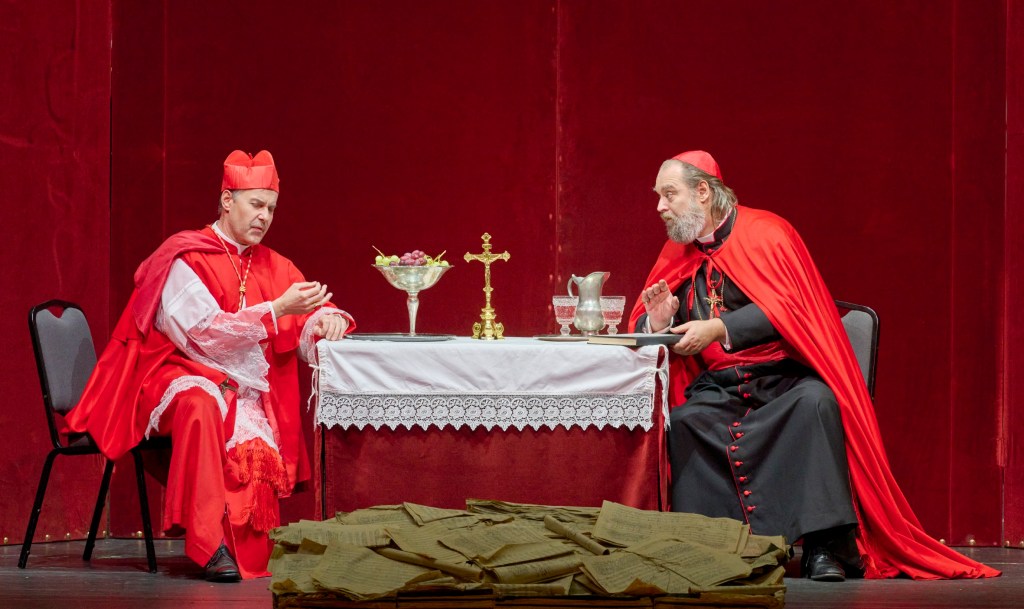
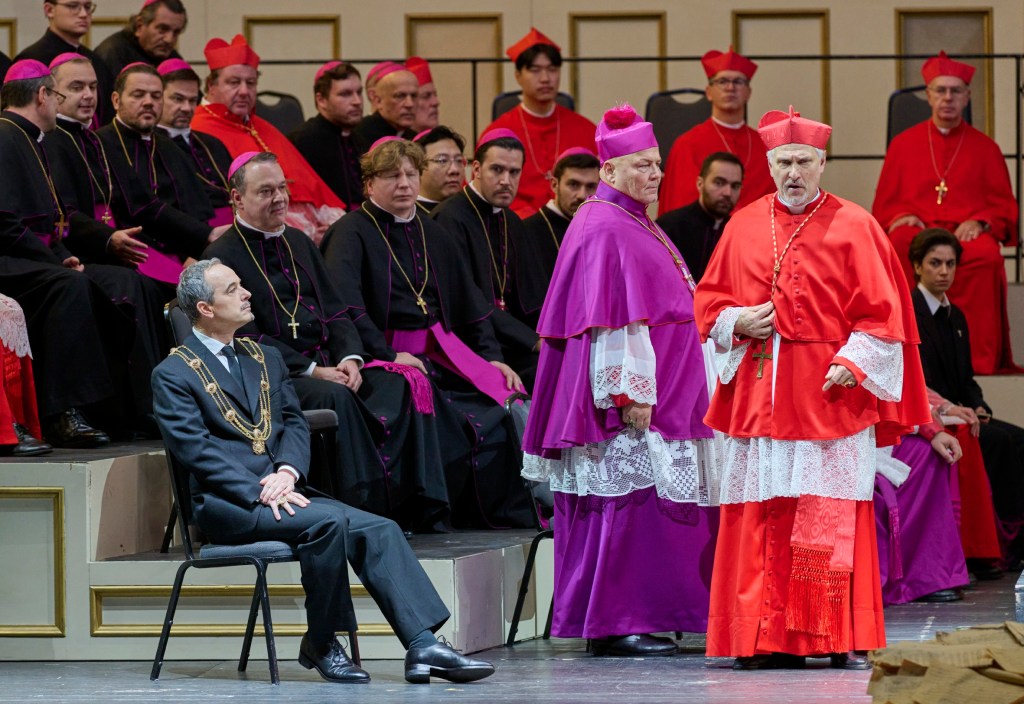
The staging? Surprisingly satisfying. Sure, it didn’t change much throughout the opera, but it was easy on the eyes and never got in the way of the story.
As for Palestrina itself, let’s just say it’s not the kind of opera you casually snack on. It’s dense, demanding, and not exactly bursting with excitement at every turn. For me, Die Walküre will definitely stay higher on the list. But thanks to strong performances and Thielemann’s expert direction, it still turned out to be an experience worth having. Not always thrilling, but occasionally rewarding—like cracking open a tough nut and finding a few sweet kernels inside.
Fun Fact:
The day before Bruno Walter passed away, he wrote in his last letter: “Despite all the dark experiences of today, I am still confident that Palestrina will remain. The work has all the elements of immortality.”
(The enormous) Cast:
- Conductor: Christian Thielemann
- Stage Director: Herbert Wernicke
- Stage, Costume und Light Design: Herbert Wernicke
- Papst Pius IV.: Günther Groissböck
- Giovanni Pierluigi Palestrina: Michael Spyres
- Giovanni Morone: Michael Nagy
- Bernardo Novagerio: Michael Laurenz
- Kardinal Christoph Madruscht: Wolfgang Bankl
- Carlo Borromeo, römischer Kardinal: Wolfgang Koch
- Ighino, sein Sohn: Kathrin Zukowski
- Silla, sein Schüler: Patricia Nolz
- Kardinal von Lothringen: Michael Kraus
- Abdisu, Patriarch von Assyrien: Hiroshi Amako
- Anton Brus von Müglitz, Erzbischof von Prag: Jusung Gabriel Park
- Graf Luna, Orator des Königs von Spanien: Adrian Eröd
- Bischof von Budoja: Matthäus Schmidlechner
- Theophilus, Bischof von Imola: Michael Gniffke
- Avosmediano, Bischof von Cadix: Ivo Stanchev
- Bischof Ercole Severolus, Zeremonienmeister des Konzils: Clemens Unterreiner
- Dandini von Grosseto: Devin Eatmon
- Bischof von Fiesole: Andrew Turner
- Bischof von Feltre: Ilja Kazakov
- Junger Doktor: Teresa Sales Rebordão
- Spanischer Bischof: Marcus Pelz
- 1. Kapellsänger: Clemens Unterreiner
- 2. Kapellsänger: Jusung Gabriel Park
- 3. Kapellsänger: Michael Gniffke
- 4. Kapellsänger: Hiroshi Amako
- 5. Kapellsänger: Ilja Kazakov
- Erscheinung der Lukrezia, Palestrinas verstorbene Frau: Monika Bohinec
- 1. Meister: Hiroshi Amako
- 2. Meister: Andrew Turner
- 3. Meister: Michael Gniffke
- 4. Meister: Clemens Unterreiner
- 5. Meister: Jusung Gabriel Park
- 6. Meister: Marcus Pelz
- 7. Meister: Ivo Stanchev
- 8. Meister: Ilja Kazakov
- 9. Meister: Wolfgang Bankl
- 1. Engelstimme: Ileana Tonca
- 2. Engelstimme: Ilia Staple
- 3. Engelstimme: Jenni Hietala
Orchestra, choir, stage orchestra, extra choir Der Wiener Staatsoper


