
Walking into a six-hour opera, you know you’re in for a night to remember – the only question is how you’ll remember it.
Staatsoper Unter den Linden in Berlin didn’t just make an impression with their production of Die Meistersinger von Nürnberg – it threw a party, and I was lucky enough to be invited. A mix of humor, drama, and musical brilliance. A six-hour rollercoaster I’d happily ride again!
This opera (or music drama, if we’re being proper) isn’t just about one or two dramatic characters – it’s packed with them. And while it’s no easy task to assemble a cast that’s strong across the board, the talent gathered for this production? It might just be as close to satisfaction as you can get.
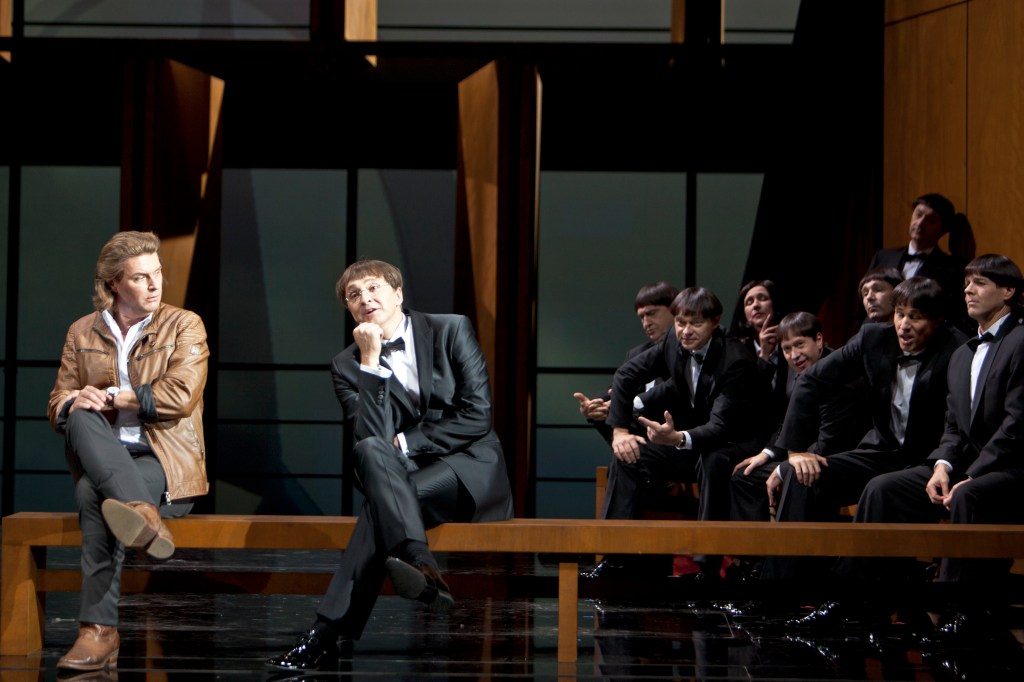
Walking into the hall, we’re met with a stage that looks like a mix between a cozy bar and a church, with wooden walls and rows of benches. Pretty fitting, since the first scene is set in a church.
Just a few minutes before the performance begins, people start wandering onto the stage. Not over-the-top opera characters, but regular folks. Some come alone, others in pairs or small groups, just like us in the audience. They settle in and look out at us, and for a moment, it feels like we could’ve swapped places.

Then the grand, pompous overture kicks in, and even though there’s an f in the score, it felt like Alexander Soddy decided to crank it up a notch. And just like that, we’re off and running!
The opera is definitely one of the longest on the standard repertoire. Still, I can almost imagine Richard Wagner himself thinking, “This one’s just a breeze.” After all, it’s a comedy, right? Now, how funny I actually think it is, is another question, but I will say the music feels a bit lighter than some of Wagner’s other works. And that’s exactly what Soddy brought out so well in his interpretation – his ability to distinguish between the different characters in the music was incredibly clear.

Suspense is definitely something we also could talk a lot about. It’s delivered in big foaming waves of crescendo and diminuendo, as well as the very alive pauses introduced by the orchestra. It made the music even more engaging, AND it actually made perfect sense in relation to the plot. For example, in Act Three, when Walter von Stolzing is composing the text he plans to use to win Eva over, the pauses highlight Stolzing’s moments of reflection. Simple, but incredibly effective!
Breaking the Fourth Wall
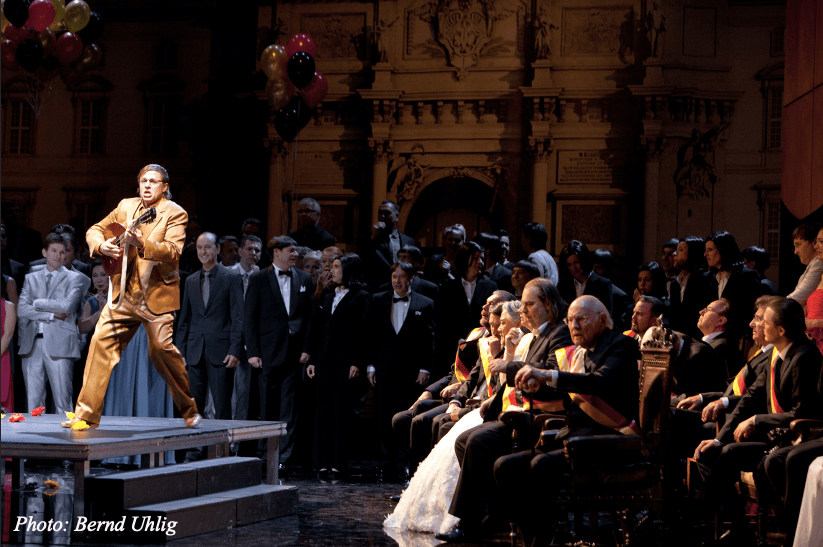
Opera isn’t exactly famous for its down-to-earth storylines, where people fall head over heels at first sight, drop like flies and where higher powers tend to throw in a dramatic twist or two. But I’ve never felt so close to the action as I did tonight. In some cases, quite literally. For example, there was a bridge built from the edge of the stage to the two balconies directly above the orchestra, which the singers used. This brought them right up close to us. On top of that, the Mastersingers also greeted us in the audience in Act Three, before the big singing competition. They came in from each side on the parquet, waving at us, alongside musicians dressed in traditional Bavarian clothes with trumpets on the first balcony and people hanging up balloons. In that moment, we became a direct part of the action, acting as the audience within the story itself.

Regitheater?
I’ve sort of postulated that if you’re looking for a traditional opera production, you might have to head over to the Metropolitan in the U.S. or somewhere along those lines. Of course, that’s not entirely true, but over here in Central Europe, they’re certainly not shy about putting some avant-garde theater on the bill. I wouldn’t say this production (by Andrea Moser) is traditional, but it’s not exactly far off either.

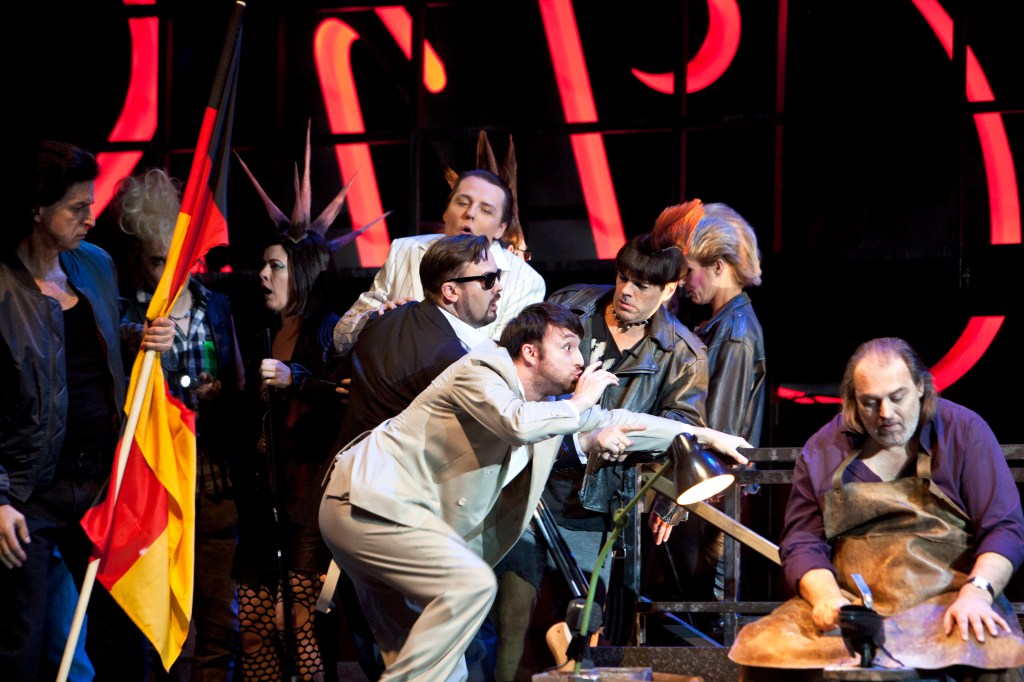
The final scene in Act Two sees a crew of punks and football fans join in, sporting colorful mohawks and outrageous hairstyles that scream ‘rock ‘n roll rebellion.’ The costumes are otherwise pretty low-key, with Beckmesser even rocking a troubadour outfit and lute in hand, as he serenades Eva in Act Two.
It’s an opera with a lot of text to keep track of, and while the plot isn’t exactly the most dramatic, there’s so much to pick up on. The staging did an excellent job of highlighting these nuances, with just the right amount of support for the action and small extra touches. Take, for instance, Sixtus Beckmesser (Martin Gantner) getting so caught up in the moment that he ends up tossing the drink Sachs just poured him! Or the moment when he can’t seem to find the paper (with the text he believes Sachs wrote), even though it’s right in his hand! Then there’s the whole scene where he tries to bring the text to life – it’s so painfully awkward that you almost want to look away as he humiliates himself. The audience couldn’t help but laugh along.

So, Who Were the Voices Behind the Characters?
We had a bit of everything on stage. Klaus Florian Vogt (Walter von Stolzing), who’s almost impossible to overlook if you’re into Wagner, a former star, and a role debut…
There’s a reason Vogt is in such high demand on major stages, which he once again proved with his unique voice. I also enjoyed his imitation of the other Meistersingers in Act Two, when he says “Ein Meistersinger muss es sein,” giving it a fun twist in tone.

From a familiar face to a complete newcomer in the role: Christopher Maltman as the cobbler, Hans Sachs. If I hadn’t known it was his debut in this role, I would never have guessed. He was incredibly convincing, even seemed quite confident. Right from Act One, when he enters in a half-open purple shirt, one hand in his pocket, the other holding a drink. As the evening went on, he became even more at ease in the role, especially his acting in Act Three, which definitely deserves a round of applause! And the audience didn’t hold back, either—when he returned to the stage after the performance, almost the entire hall stood up. You could really see how moved he was. A new Hans Sachs has been born! It’ll be exciting to see what he’ll bring to the Wagner table in the future!
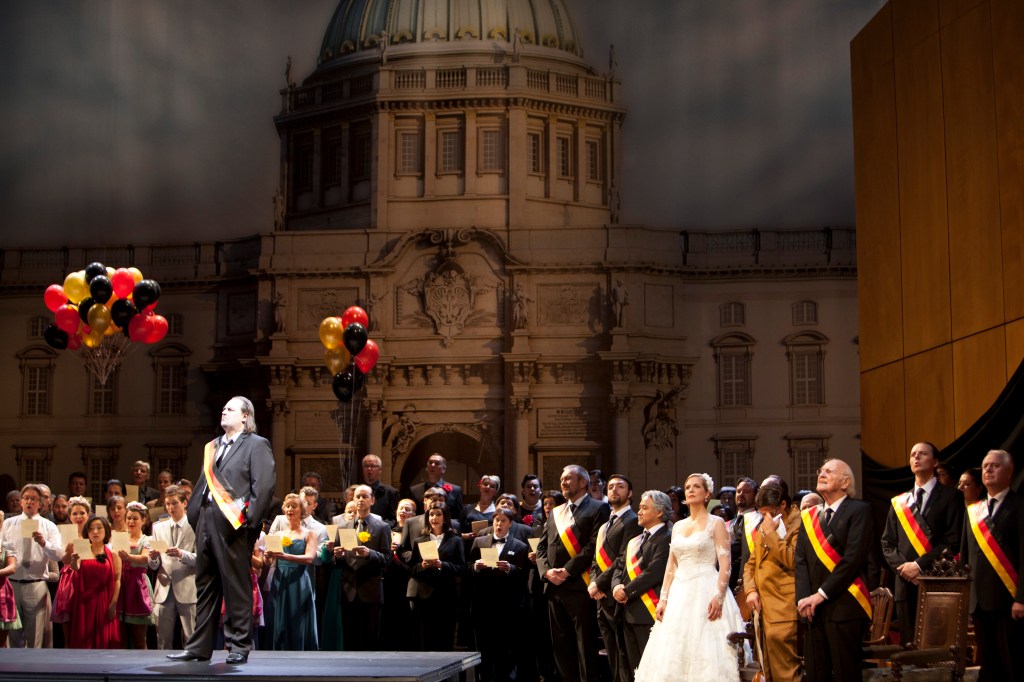
Hans Sachs’ apprentice, David, was sung by the delightful Siyabonga Maqungo, with his fine voice. Eva also received a lovely interpretation from Hanna-Elisabeth Müller. Her father, Veit Pogner, was brought to life by Christof Fischesser, whose clear diction, broad voice, and rich tone made him a pleasure to listen to. Martin Gantner wasn’t bad either!

Finally, I’d like to mention a singer we don’t see much of anymore: Siegfried Jerusalem. At the age of 84! A couple of decades ago, he was undoubtedly one of the greatest tenors bringing Wagner’s roles to life! So, isn’t it a bit odd to have him in the mix now, when his voice isn’t quite what it once was? That was definitely my first thought when I saw his name on the program. But, I was completely wrong! As one of my companions reminded me, he used to be a Meistersinger himself. Suddenly, it made perfect sense to have him there!
I could keep raving about the incredible singers and all the nice little details, but honestly, it’s one of those things you just have to see for yourself!
Fun Fact:
Wagner got the idea for Die Meistersinger von Nürnberg while flipping through Geschichte der deutschen Dichtung (History of German Poetry) at a spa in 1845. Fast forward 23 years, and voilà – the opera was finally ready for the stage!
Trailer:
Cast:
- Conductor: Alexander Soddy
- Director: Andrea Moses
- Stage Designer: Jan Pappelbaum
- Costume Designer: Adriana Braga Peretzki
- Light Designer: Olaf Freese
- Hans Sachs: Christopher Maltman
- Veit Pogner: Christof Fischesser
- Eva: Hanna-Elisabeth Müller
- Walther von Stolzing: Klaus Florian Vogt
- David: Siyabonga Maqungo
- Magdalene: Katharina Kammerloher
- Konrad Nachtigall: Jaka Mihelac
- Sixtur Beckmesser: Martin Gantner
- Fritz Kothner: Jan Martiník
- Balthasar Zorn: Siegfried Jerusalem
- Ulrich Eißlinger: Paul McNamara
- Augustin Moser: Florian Hoffmann
- Hermann Ortel: David Oštrek
- Hans Schwartz: Richard Wiegold
- Hans Foltz: Olaf Bär
- Nachtwächter: Friedrich Hamel
- Kunz Vogelgesang: Tansel Akzeybek
Staatsopernchor
Staatskapelle Berlin
Btw the photos are from the premiere from 2015…


 Blogfløjten