

Stuttgart offered a Salome I couldn’t resist: Kirill Serebrennikov’s modern spin on Richard Strauss’ phenomenal opera. This production pulls the characters out of their historical context. Forget ancient Nazareth. The family now basks in the luxuries of modern Europe, a wealthy clan more fluent in violence than in love.
Videos of terror, cruelty, and breaking news flicker across a screen on the back wall as the audience settles into their seats at Staatsoper Stuttgart. The theater itself is a beauty: brown-paneled walls, silver-toned decorations, and smaller chandeliers arranged in a circle, breaking with the tradition of a grand centerpiece. As surveillance guards pace and the unsettling footage plays in the background, the audience is informed that the original Jochanaan, David Steffens, has fallen ill. Stepping into the spotlight for his debut in the role is Polish baritone Paweł Konik.
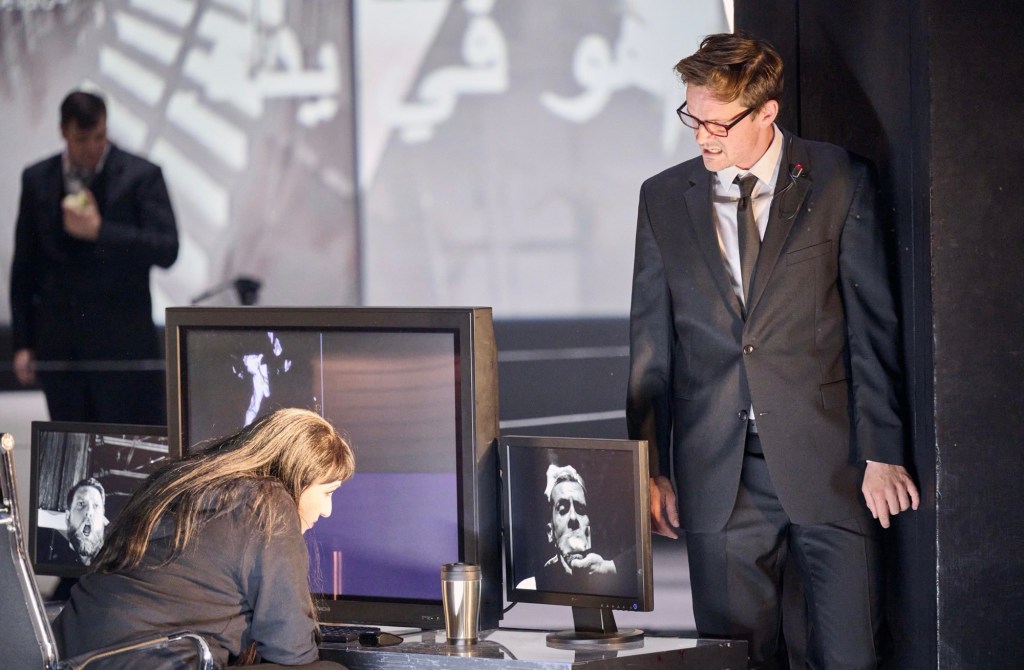
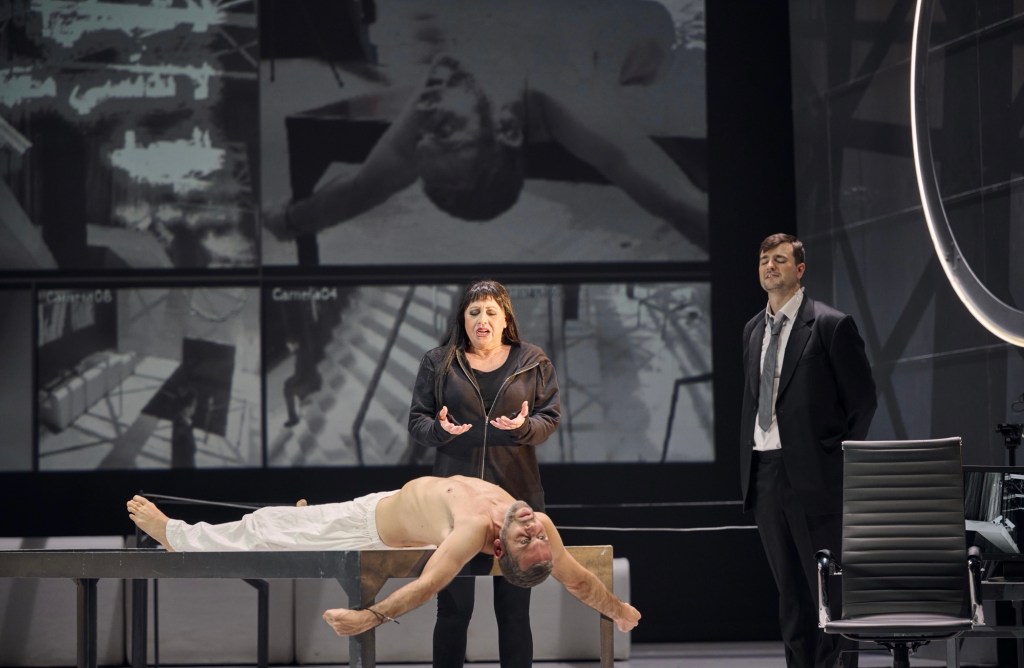
In this production, Salome doesn’t just feature one Jochanaan, but two. One is a shadowy figure, mostly confined to the left side of the stage. His image flickers across the back wall amplified through the cold lens. The family’s entire world is under constant surveillance. No corner is left unmonitored, no detail too small to escape their watchful eyes.
The second Jochanaan, played by Luis Hergón, is a fierce contrast. With raw intensity, he embodies a Muslim terrorist (perhaps a figure from ISIS?) his Arabic cries cutting through the air as he’s violently thrown around the stage by guards in sharp suits. The screen behind him bursts with Arabic text, interspersed with harrowing footage of terror attacks, mass executions, and, oddly enough, a beaming Angela Merkel caught in a moment of football euphoria.
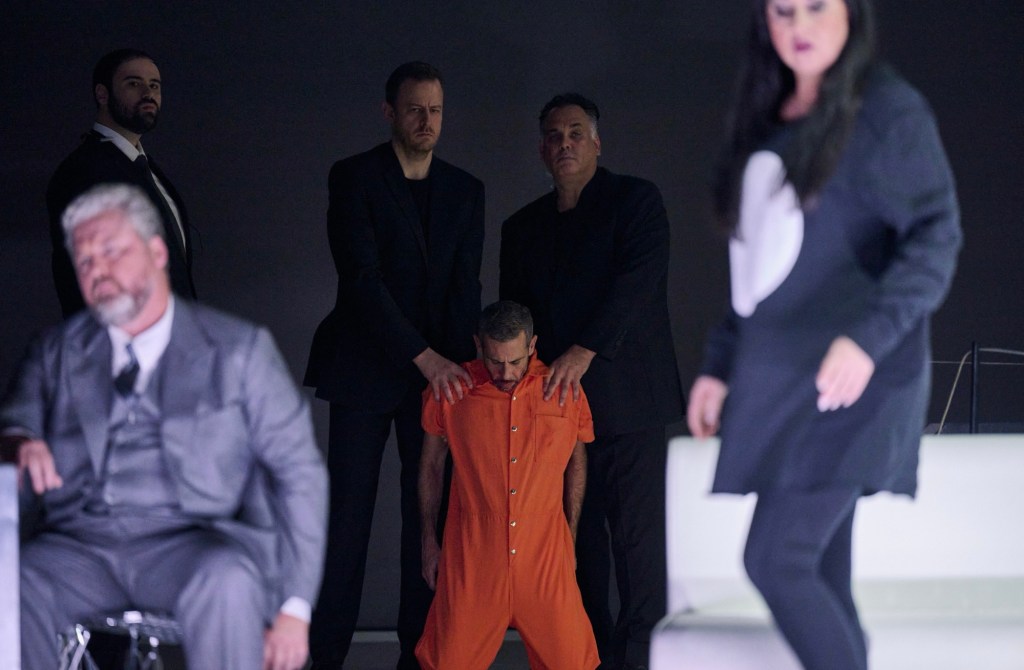
In this production, the security guard, Narraboth, doesn’t take his own life; instead, he’s dramatically shot in the head by one of his subordinates. The impact sends blood and gore splattering across a transparent pane of glass. A striking effect—perhaps one of the most realistically executed moments I’ve ever witnessed in opera.
Salome is dressed in black pants and swims through the scene in a massive hoodie, embodying the restless energy of a teenager. She immerses herself in violent cartoons, one of which shows a figure having their head chopped off, their brain extracted, and then placed next to carved pumpkins. A clear nod to the opera’s chilling finale, perhaps? It’s a sharp commentary on how young people might be affected by what they see, and their ability (or lack thereof) to distinguish between the digital violence they consume online and the harsh reality they navigate in the world around them.
Dance of the Seven Veils
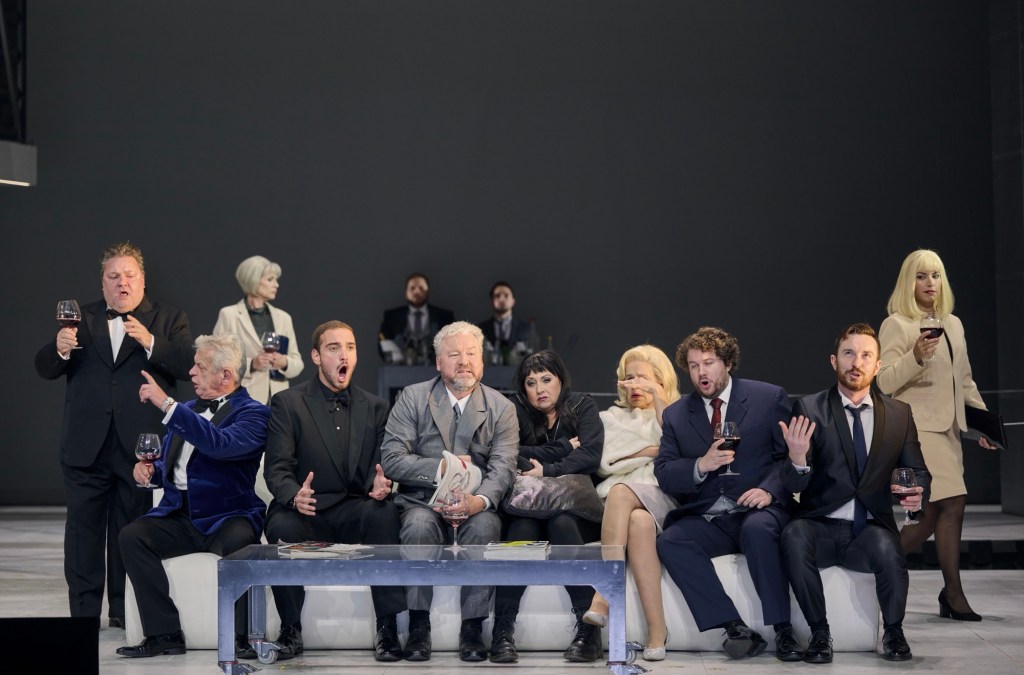
In the famous orchestral interlude, Dance of the Seven Veils, we are thrust back in time. A younger version of Salome takes the stage, sporting in a pink skirt, a Mickey Mouse t-shirt, and tiny wings on her back. Her outfit stays on the whole time, while everyone around her seems to be in a race to shed as much fabric as possible. Her stepfather, Herodes, hands her a large box containing a disturbingly glittering mask, which she eagerly puts on.
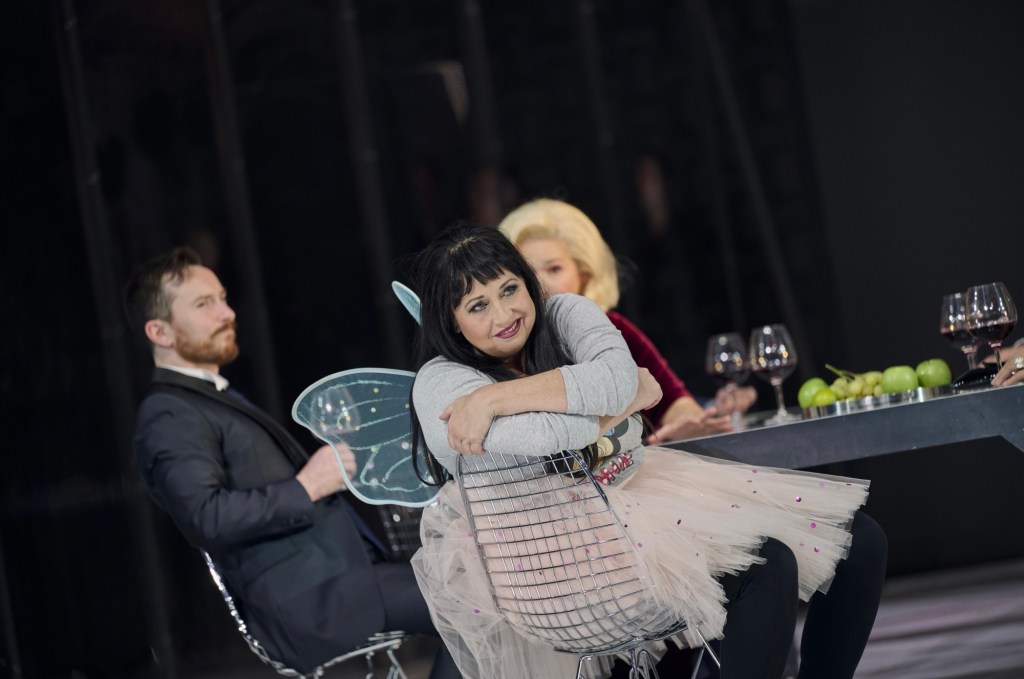
Meanwhile, Herodia openly engages in a threesome with two other men, who after the act, (still in the skimpiest of underwear) join Herodes for a drink. More of their staff then enter the stage wearing as little as possible—except for one who arrives fully covered in a niqab. Herodia reappears, fully clothed, only to be suffocated by Herodes with a pillow, after which Salome runs off the stage.
What does all of this mean? It’s a swirling mix of past, present, and fantasy, where the lines between reality and illusion blur. The young Salome’s forced innocence stands in stark contrast to the more liberated—and ultimately dangerous—freedom of those around her. This disturbing sequence raises questions about control, fantasy, and the role of the body within this twisted family dynamic. Is this scene a reflection of past memories, or are we witnessing the fantasies of Herodes? The ambiguity leaves us questioning what is real and what is imagined in this unsettling world.
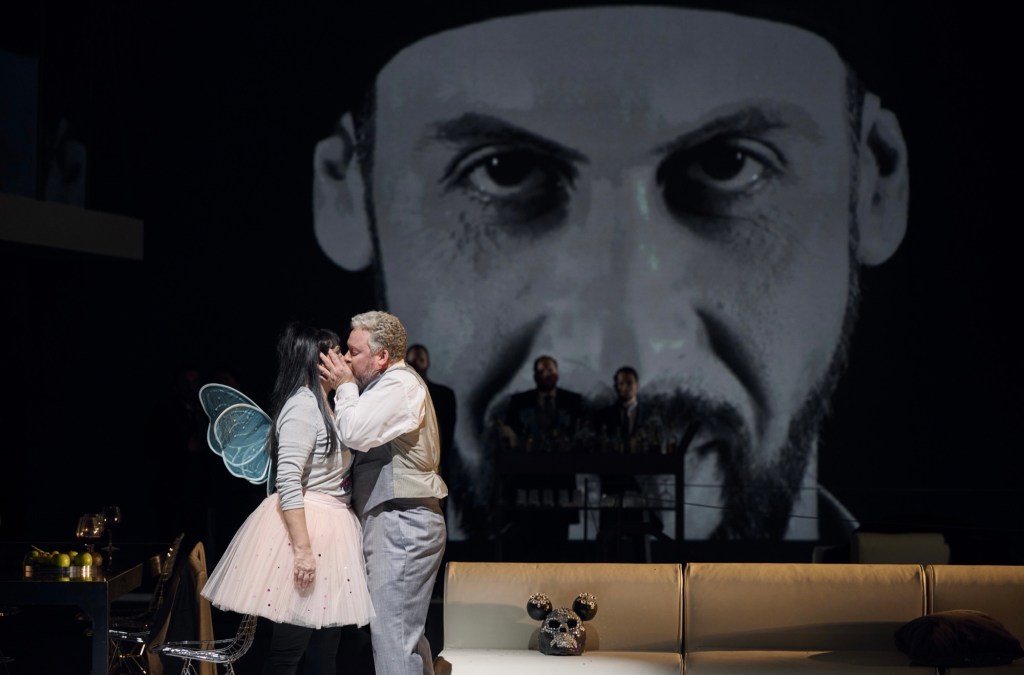
Salome (Simone Schneider) and Herodes (Chad Shelton)… Photo: Martin Sigmund
A Full-on Spectacle
We, the audience, are plunged into a whirlwind of drama, constantly kept on our toes as we try to absorb it all. I’m sure I missed some details—at times, it was hard to know where to look, and I certainly didn’t want to miss anything important! That said, it was a bit of a shame, as the visual frenzy occasionally shifted the focus from the sensational soundscape created by the orchestra, conducted by Czech maestro Tomáš Hanus. Hanus expertly gauged the hall’s sonic potential, selecting subtle shades and highlighting the middle voices and sweeping motifs with precision.
A Great Orchestra
The opera demands a massive orchestra, with four musicians per woodwind section—quite a challenge for the singers, as the sheer volume of sound can easily overpower them. Unfortunately, this wasn’t always successful. Both Salome (Simone Schneider) and Jochanaan (Paweł Konik) occasionally seemed completely drowned out by the orchestra, which was a shame, as both had voices that seems to have a lot to offer. On the other hand, it was never a problem for Herodes, sung by Gerhard Siegel, whose powerful voice pierced through the sound with such force it almost felt like it was drilling into my brain—in the best way possible. He had no trouble at all cutting through the massive orchestra, and the same could be said for Elmar Gilbertsson, who portrayed Narraboth. Sophie Koch, as Herodia, also ensured her voice was unmistakably heard.
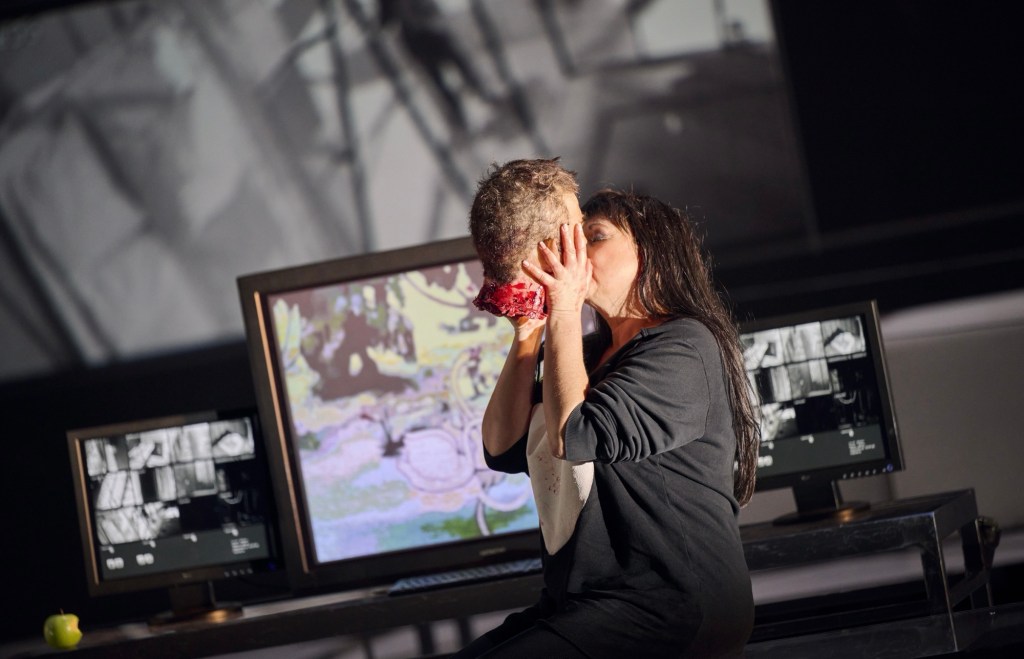
Somehow, I knew what I was getting into with Serebrennikov’s staging. I’ve seen his wild interpretation of Lohengrin, set in a psychiatric hospital, and his Don Carlo production seems to divide opinions in Vienna. I’m also planning to head to the Austrian capital in April to catch his Parsifal. However, tonight’s performance felt like there was just a bit too much going on on stage.
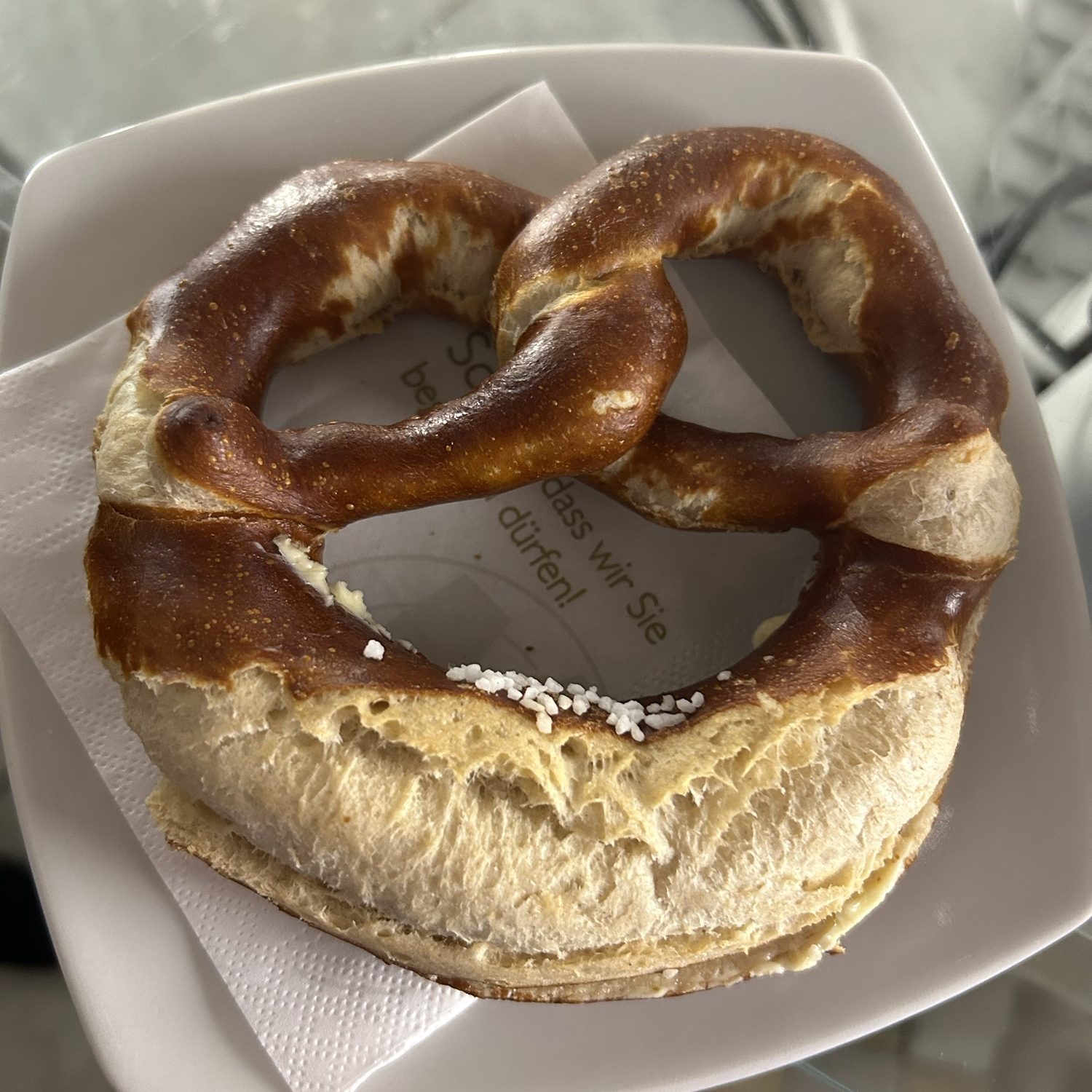
A little note on pretzels:
For those of you new to the blog, I try to sneak in a mini pretzel test whenever I visit different opera houses and concert halls. A sort of unofficial investigator, checking if they’re good for more than just opera and music. So of course, I had to test the pretzels at the Staatsoper Stuttgart, and I’m happy to give them a solid thumbs up. They were neither too dry nor lacking in the right amount of salt. Lovely!
Fun Fact:
It’s said that a young Adolf Hitler (together with Puccini, Alma and Gustav Mahler, Schoenberg, Zemlinsky and Berg among others) might have been in the audience for Salome‘s 1906 performance in Graz, having borrowed money from relatives to make the trip, shortly after witnessing Mahler conduct Tristan und Isolde in Vienna.
Sneak peak of the production:
Cast:
- Conductor: Tomáš Hanus
- Production: Kirill Serebrennikov
- Stage Designer: Pierre Jorde Gonzales
- Costume Designer: Kirill Serebrennikov
- Video: Ilya Shagalov
- Lighting Designer: Reinhard Traub
- Dramaturg: Ann-Christine Mecke
- Herodes: Gerhard Siegel
- Herodias: Sophie Koch
- Salome: Simone Schneider
- Jochanaans Stimme: Paweł Konik
- Jochanaans Körper: Luis Hergón
- Narraboth: Elmar Gilbertsson
- Ein Page: Lana Maletic
- Erster Jude: Torsten Hofmann
- Zweiter Jude: Heinz Göhrig
- Dritter Jude: Sam Harris
- Vierter Jude: Eleazar Rodriguez
- Fünfter Jude: Marcel Brunner
- Erster Nazarener: Michael Nagl
- Zweiter Nazarener: Jacobo Ochoa
- Erster Soldat: Jasper Leever
- Zweiter Soldat: Aleksander Myrling
- Ein Kappadozier: Marius-Sebastian Aron
- Ein Sklave: Elena Salvatori


 Blogfløjten