


“To write a poem after Auschwitz is barbaric,” Theodor W. Adorno once claimed – a stark statement he later revisited. Yet Mieczysław Weinberg’s opera, Passazhierka, also known as The Passagierin or The Passenger, steps straight into this tension, shifting between the bleak shadows of a concentration camp and the gleaming decks of a cruise ship. It’s a story where history’s heavy presence intersects with deeply personal experiences.
Bayerische Staatsoper has revived The Passenger, which first premiered back in March. Like Das Rheingold, which I saw just over two weeks ago, this production is directed by Tobias Kratzer. And once again, it opens in a similar fashion: shrouded in darkness. There’s no grand entrance, only the quiet sound of doors closing as the conductor enters unseen and steps onto the podium. Then, suddenly, we’re plunged into the endless, rolling sea, its waves projected onto a massive white screen.
As the screen rises, it reveals a cruise ship with 15 balconies extending from various cabins, giving the audience a voyeuristic peek into what initially appears to be a serene, picture-perfect scene. The ocean stretches endlessly, as if to suggest that the past is far behind. But lurking just beneath the surface, history waits like a hidden current, ready to drag everything under.
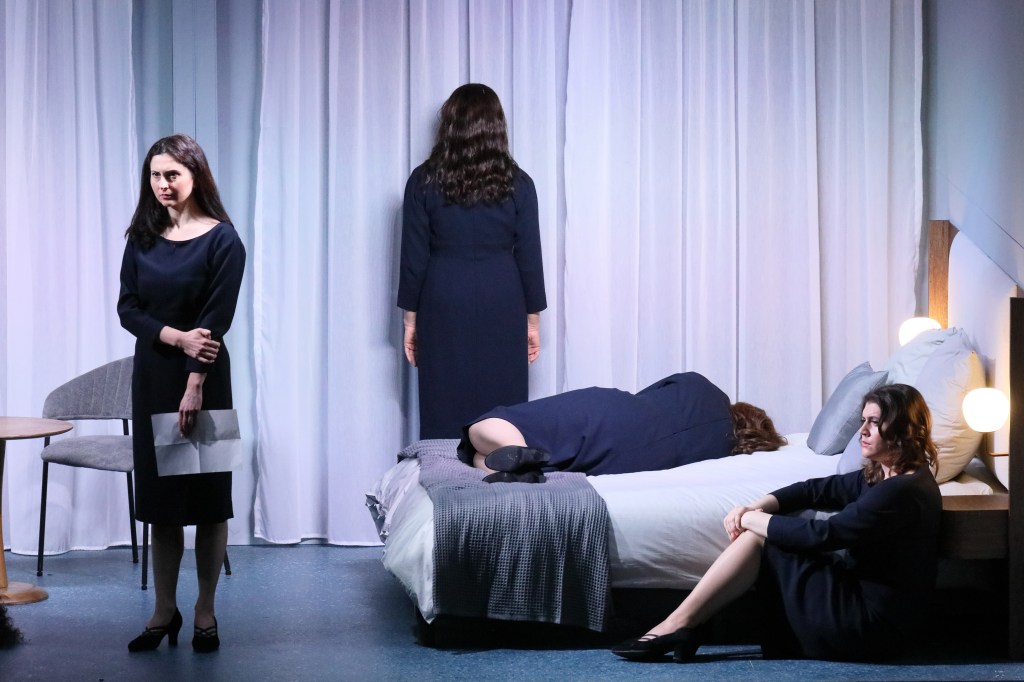
Lisa and her husband are aboard the ship bound for South America (Brazil, to be exact, a destination subtly suggested by the occasional bursts of vibrant, samba-like rhythms in the music). The scene seems idyllic, but Lisa’s past lurks like a shadow she cannot escape. Her carefully constructed present begins to unravel when she spots a face among the passengers: Marta. The sight grips her with a chilling familiarity. Lisa has been hiding a dark truth, one so heavy that even her husband is unaware of it – until now. Haunted by the encounter, she can no longer keep her secret and reveals her former role as an SS guard at Auschwitz.
The opera alternates between Lisa’s haunting memories of the concentration camp and the scenes aboard the ship, contrasting the dark realities of the past with the polished illusion of the present.
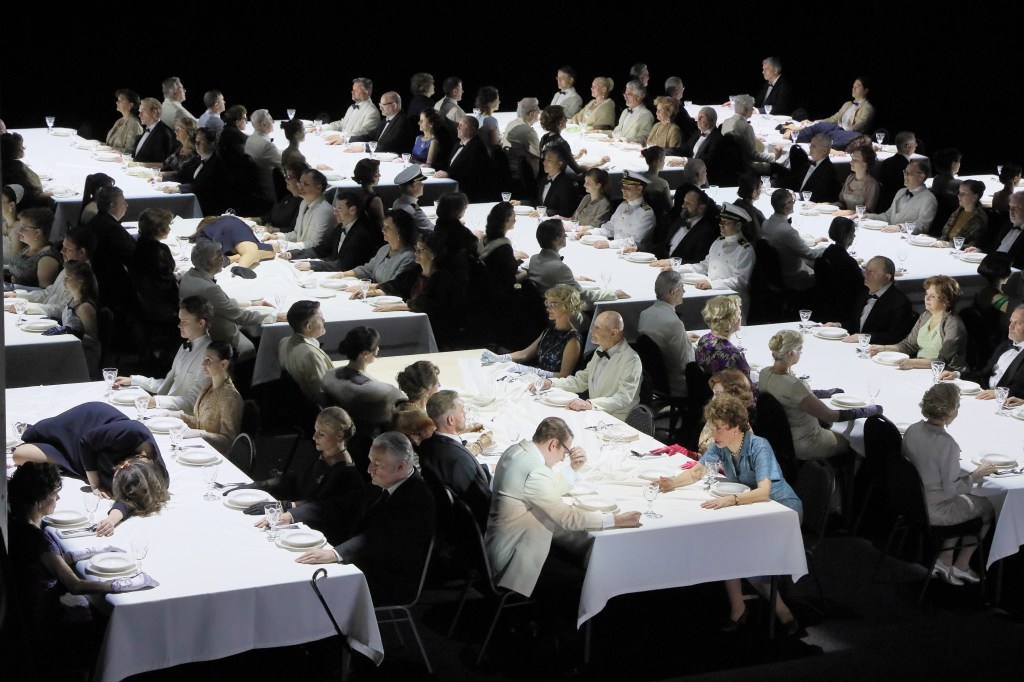
Actually, we never fully step into the concentration camp. In Kratzer’s staging, everything is presented as though it’s unfolding entirely within Lisa’s mind. This approach is certainly intriguing, but it’s also a bit frustrating, especially since the opera clearly specifies such a concrete setting. As a result, some scenes feel slightly out of place – or at least a bit disconnected from the narrative flow.
That said, this approach does succeed in conveying the overwhelming weight of Lisa’s past and its constant presence in her present. She sees it everywhere, and in that sense the blurred lines between memory and reality add an unsettling depth to the story.
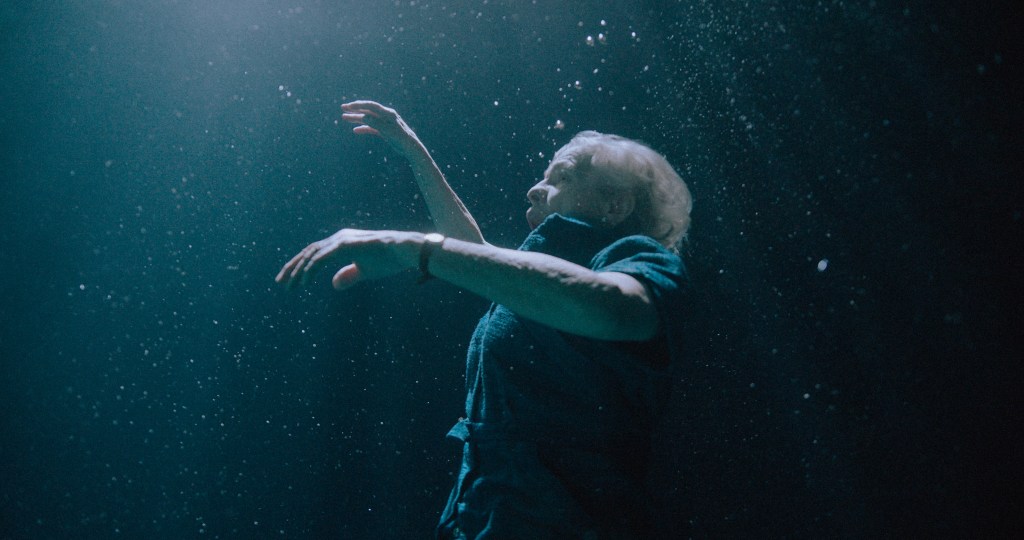
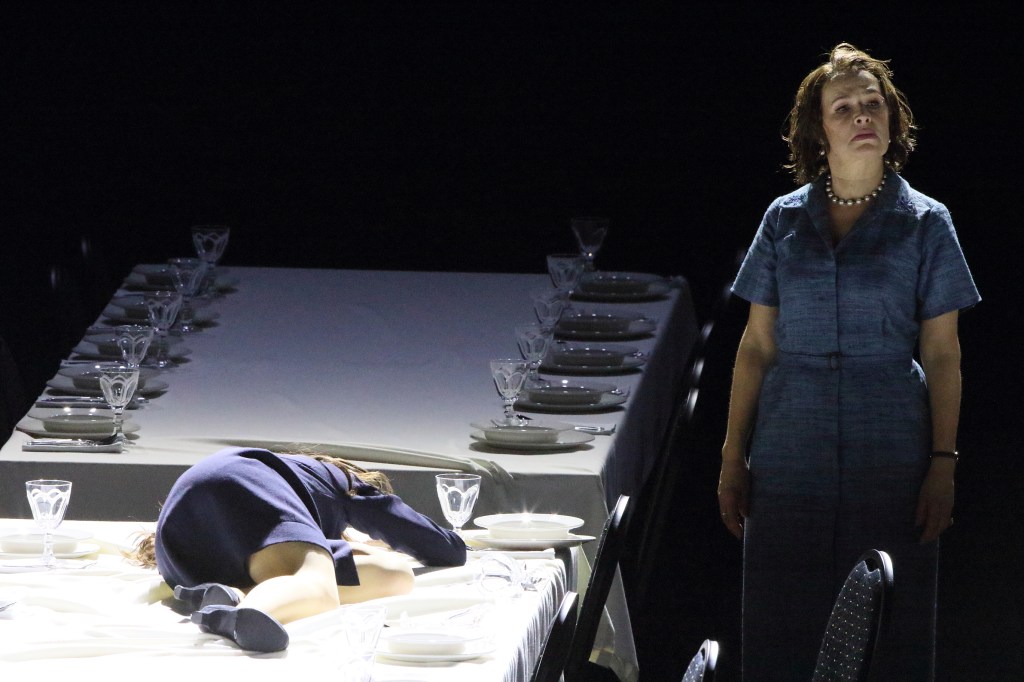
Lisa is portrayed by two distinct figures on stage: the middle-aged woman and the older, disturbed lady, who drifts with an urn in hand, consumed by guilt. As she unravels, she lets her life spill over the railing, tumbling into the deep blue abyss below. And now, the water will drown her as well.
Musically speaking, the piece is strikingly percussive. It begins with the timpani alone, setting a dramatic tone from the outset. Under the baton of Azim Karimov, who has been working as musical assistant to GMD (General Music Director) Vladimir Jurowski since 2023, the performance was both compelling and well-balanced. The orchestra flexed its muscular presence, with the singers matching their intensity – thankfully, never being overpowered.
Among the singers were mezzo-soprano Tanja Ariane Baumgartner as Lisa, and Elena Tsallagova, whose voice seemed to have an endless well of power. Jacques Imbrailo brought his smooth, resonant tones to the stage, while Charles Workman delivered a solid portrayal of Lisa’s husband.
More than just a story
The libretto, penned by Alexander W. Medwedew, is based on the autobiographical novel Pasażerka by Zofia Posmysz. But the story cuts much deeper than you might expect. Weinberg, born in 1919 in Warsaw to a Jewish family, was forced to flee to the Soviet Union when the Nazis invaded. There, he encountered Shostakovich, whose influence is also evident in Weinberg’s compositions – but that’s another story. Tragically, Weinberg fled alone, leaving behind his parents and younger sister, who were deported and killed during the Nazi occupation. Weinberg later said he felt it was his moral duty to write about the war. What stands out to me is how he chose to tell the story through the eyes of a former SS guard, showing that she, too, is haunted by the past. You might have expected him to focus on a prisoner, but instead, he flips the lens, shining a light on a perpetrator who, in her own way, suffers as well.
Weinberg could easily have been swallowed by the dark tides of history, but instead he swam against them. Although he lived under two dictatorships, he never saw himself as a victim. Many of his compositions explore themes of war, and this opera is no exception. It reflects his personal history and the weight of the past. He also quotes the Austrian song ‘Ach, du lieber Augustin’, with the words ‘Alles ist weg’ (Everything is lost), as well as an extended excerpt from Bach’s Chaconne in D minor, which creates a particularly intense moment in the music. I’ve certainly never heard it played with such dramatic color before.
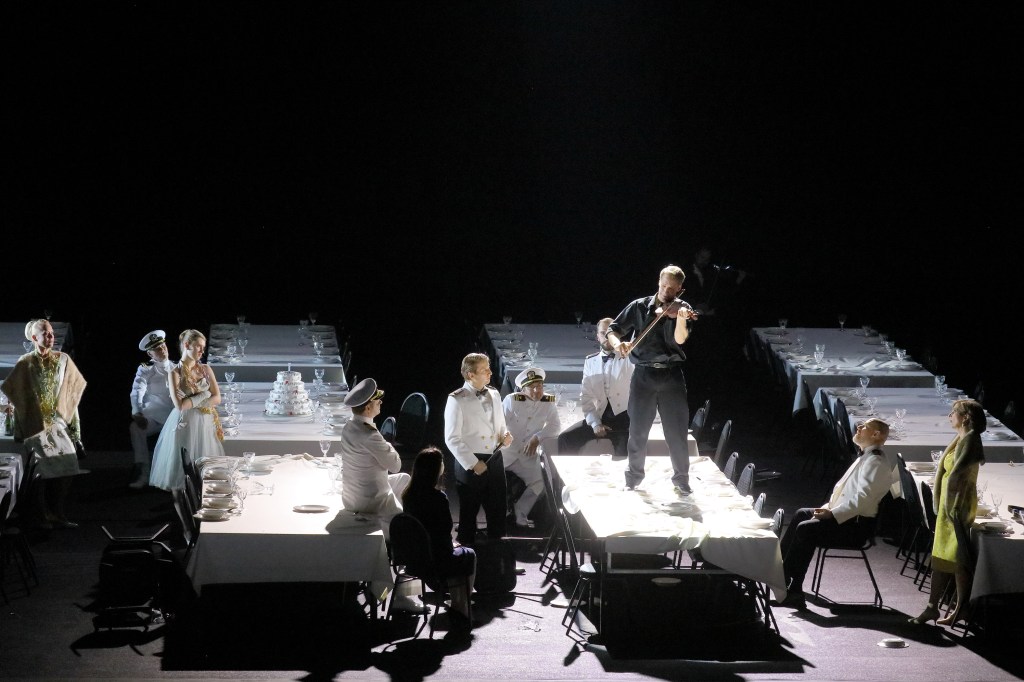
In the end, The Passenger serves as a stark and powerful reflection on history, guilt, and survival. It leaves a lasting impression, reminding us that some histories are too heavy to forget, and some wounds too deep to heal. As I cycled home through the streets of Munich, passing by Hitler’s former office and the buildings erected during his regime, I couldn’t help but reflect on the terrible legacy he left behind, still echoing almost 80 years later.
Fun Fact:
Completed in 1968, The Passenger was banned by Soviet authorities and remained unperformed for decades. It finally had its world premiere in 2010 in Bregenz, fourteen years after Weinberg’s death.
Trailer:
Cast:
- Conductor: Azim Karimow
- Production: Tobias Kratzer
- Stage and Costume Designer: Rainer Sellmaier
- Light Designer: Michael Bauer
- Video Designer: Jonas Dahl and Manuel Braun
- Choir: Christoph Heil
- Dramaturg: Christopher Warmuth
- Lisa: Tanja Ariane Baumgartner
- Alte Lisa: Sibylle Maria Dordel
- Walter: Charles Workman
- Marta: Elena Tsallagova
- Tadeusz: Jacques Imbrailo
- Krystina: Xenia Puskarz Thomas
- Vlasta: Lotte Betts-Dean
- Hannah: Noa Beinart
- Bronka: Larissa Diadkova
- Yvette: Evgeniya Sotnikova
- 1. SS-Mann: Bálint Szabó
- 2. SS-Mann: Roman Chabaranok
- 3. SS-Mann: Gideon Poppe
- Älterer Passagier: Martin Snell
- Oberaufseherin/Kapo: Sophie Wendt
- Steward: Lukhanyo Bele
Bayerisches Staatsorchester
Bayerischer Staatsopernchor

 Blogfløjten