


So, it’s Friday – what better way to spend it than at the opera? I can hardly think of one! Tonight’s pick: L’elisir d’Amore by Gaetano Donizetti at Bayerische Staatsoper.
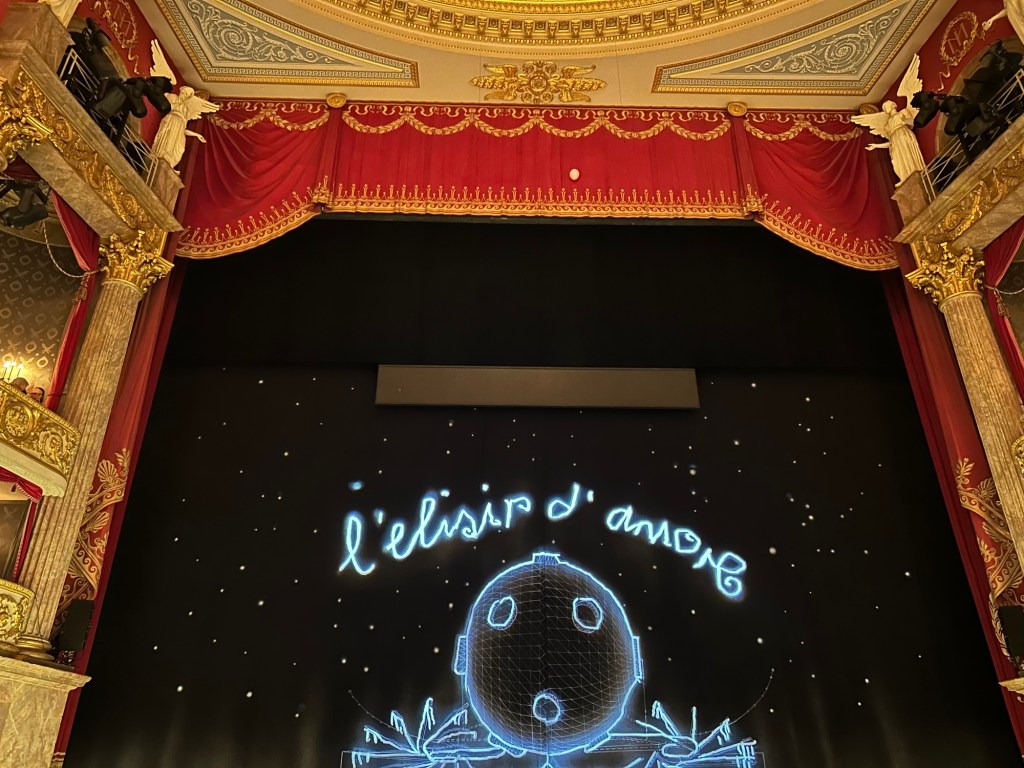
If, against all odds, you walk into the grand opera hall and can’t quite recall what’s on tonight’s program, worry not! The black stage curtain has you covered, thoughtfully adorned with the opera’s title and a glowing illustration of a key prop, both shining against a starry sky. When the lights went down, the design was glowing with a luminous effect.
Right from the very first note, we dive headfirst into this romantic escapade. Few operas can resist the intoxicating charm of love, and L’elisir d’amore is no exception! As the overture begins, a quirky woman steps out from behind the curtain. Clutching two helium balloons, she releases them into the air, watching as they drift slowly upward, gracefully dancing toward the lofty 40-meter-high ceiling.
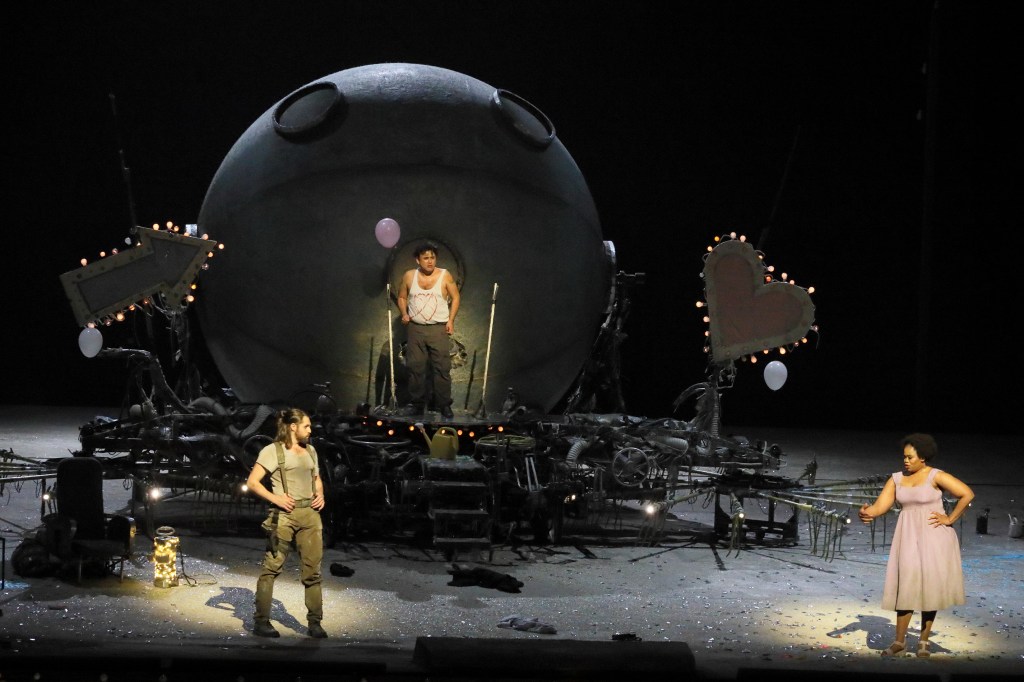
When the curtain finally rises, we’re greeted with a lively scene – perhaps a bustling street or even a beach, complete with colourful parasols dotting the landscape. Here we meet the unfortunate Nemorino, desperately smitten with the beautiful Adina. In a valiant effort to win her heart, he dreams of a love potion to ignite her affections. But how on earth is he supposed to get his hands on such a magical elixir?
Today might be his lucky day. On stage rolls a giant contraption that resembles the moon, dotted with uneven craters, yet somehow it also struts with a hint of basketball swagger. The material seems like something made by bees. At the front of this curious vehicle sits the cunning Dulcamara, decked out in a boiler suit and sporting a string of lights around his neck, ready to peddle his wares. As a doctor, he claims to have just what the people need. Naturally, they fall for his charming words, and he sells his goods by the dozen.
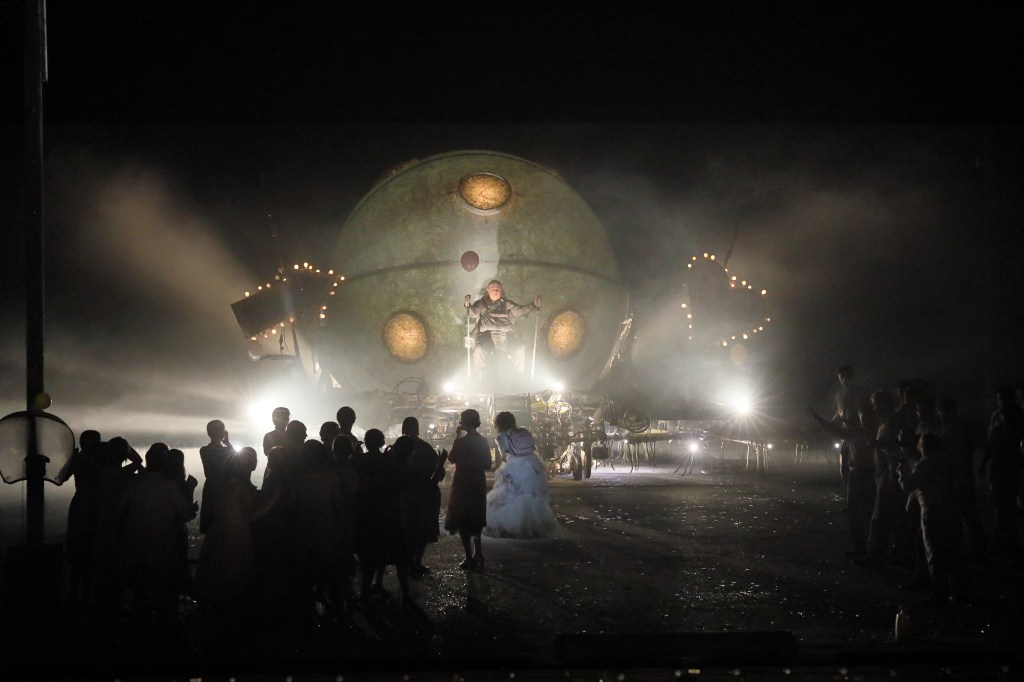
Nemorino, not being any better, decides to buy an elixir of love from Dulcamara – though, in reality, it’s just cheap red wine dressed up with fancy words. Of course, Nemorino is blissfully unaware of this little trick! Dulcamara also adds that the potion will only take effect after 24 hours, giving him plenty of time to vanish into thin air.
But where on earth does Nemorino even get the idea of a love potion you might ask? Our first encounter with Adina reveals her reading the tale of Tristan and Isolde aloud. There’s certainly a love potion involved in that story. Now, let me pause for a moment – when I hear those two names, my mind immediately jumps to the masterpiece by Richard Wagner from 1859. However, we’re actually more than 30 years earlier with L’elisir d’amore. So, no references or leitmotifs from Wagner here, at least not directly written by Donizetti. Yet, from the keys we do get a little improvised moment that resembles Wagner’s famous chromaticism when Isolde’s name is mentioned later.
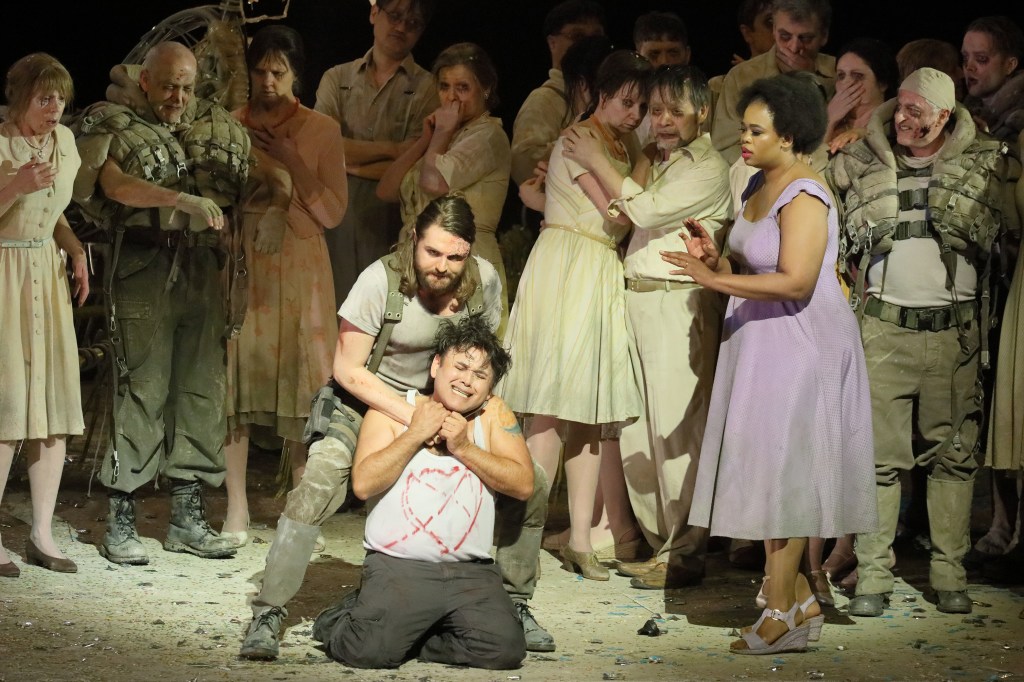
Back to the story. When Nemorino’s rival, Belcore, proposes to Adina, our desperate hero enlists in the army to afford even more elixirs. He’s already spent all his savings on that first potion! But when he unexpectedly inherits money from his wealthy uncle, the village women suddenly look at him with new eyes, which naturally drives Adina green with envy. Eventually, she realizes her true feelings for him.
One could interpret her as someone who just follows the trend – first, Nemorino is unpopular, so she turns him down, but as soon as he becomes popular, she’s all in! However, I doubt that’s the case. It might be more accurate to say that you don’t know what you’ve got until it’s gone. In any case, it all wraps up with the two of them finally getting together. End of story!
The music was so enchanting, it could have coaxed a cat off a windowsill – talk about a purr-fect performance. Or at least worth a meow!
The singers were great! Adina was portrayed by the Armenian soprano Mané Galoyan, whose voice was crystal clear, controlled, and precise. She sang without overdoing it and navigated her phrasing beautifully. Fresh from the Lyric Opera in Chicago, where she dazzled as Gilda in Rigoletto, her next stop is Violetta in La Traviata at the Opéra de Monte-Carlo.
Liparit Avetisyan, also from Armenia, brought Nemorino to life. One thing that struck me about his voice was how incredibly natural it sounded. He didn’t seem to push the boundaries too much; the role clearly suited him very well. After delivering the hit of the opera Una furtiva lagrima, he was met with a lovely round of applause. Speaking of applause, did you know that according to BR-Klassisk, Pavarotti holds the record for the longest applause in opera history? It lasted a whopping 67 minutes and required an astonishing 165 curtain calls for that very aria!
In this staging, Nemorino climbed a lamppost to sing it, while flailing his arms and legs – like he didn’t already have enough to concentrate about!
But thankfully, everything turned out well, thanks to Dulcamara’s magical potion or something like that… He was nicely sung by the Italian Ambrogio Maestri, whose last name sounds like a plural form of “maestro.” However, there was only one conductor down in the pit, and that was Michele Spotti, who added his own little touches here and there.
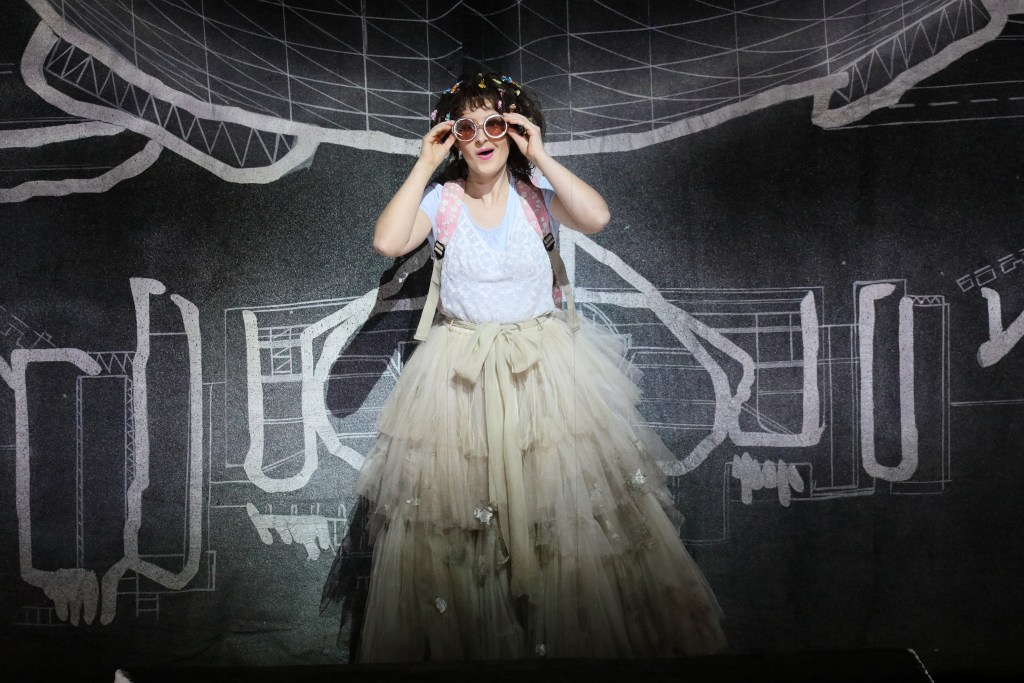
It wasn’t just Nemorino’s unfortunate love that we were treated to this evening. David Bösch‘s production, dating back to 2009, also showcased Giannetta’s deep affection for Nemorino. The young Norwegian soprano Eirin Rognerud added a delightful comedic touch to the evening with her charming voice and amusing portrayal of her slightly awkward character. While the production itself wasn’t overwhelmingly funny, I found myself sitting in a sweet spot surrounded by a few laughers. It was hard not to be in a good mood – laughter really is contagious!
Fun Fact:
With a production time of just over six weeks, L’elisir d’amore quickly became the go-to opera in Italy from 1838 to 1848! Even today, it still ranks high on the list of most performed operas worldwide – talk about an elixir for everlasting popularity!
Cast:
Conductor: Michele Spotti
Director: David Bösch
Stage Designer: Patrick Bannwart
Costume Designer: Falko Herold
Lighting Designer: Michael Bauer
Dramaturg: Rainer Karlitschek
Choir: Franz Obermair
Adina: Mané Galoyan
Nemorino: Liparit Avetisyan
Belcore: Andrzej Filończyk
Dulcamara: Ambrogio Meastri
Giannetta: Eirin Rognerud


