
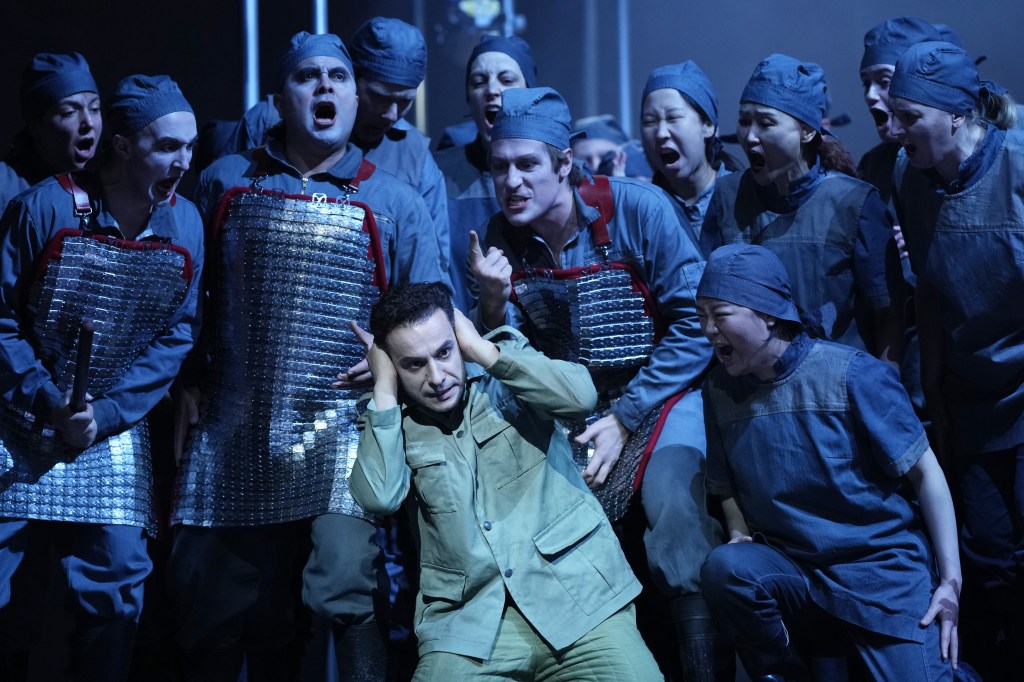

Four notes followed by a chord, like a door being flung open. No warning, no warm-up – just bam.
At the Landestheater Linz – about an hour from Vienna – they didn’t hold back. Especially the percussion, which seemed determined to make those opening bars really land. At first, it felt like opening-night energy – everyone a bit extra awake, a bit extra eager. But as the evening unfolded, it became clear: this wasn’t a moment, it was a mindset.
Fortunately, it was all played with clarity and control, so rather than overwhelming, it came across as confident – just with a noticeable taste for volume.
With Italian Enrico Calesso at the helm, the Bruckner Orchestra Linz proved that Linz doesn’t need to be the biggest city to make an impression. It came across bold and bright – not small at all, but full of might.
They played tightly together, with a sound that didn’t just fill the room – it flooded it. At times, though, the balance tipped from powerful to overpowering, and some of the singers had to fight to stay afloat. At one point, even the chorus was close to being completely carried away by the orchestral current.
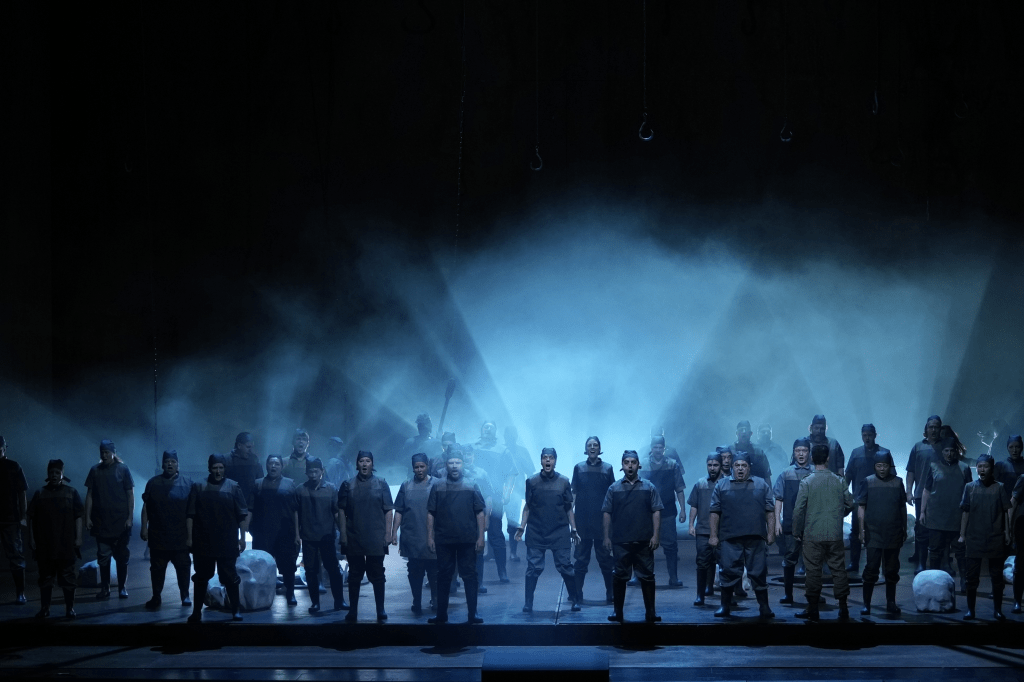
Just Hanging Around
The three ministers, Ping, Pang and Pong, wander around like a slightly unhinged trio of butchers, swinging their oversized cleavers as if it’s all part of a perfectly normal workday. Their costumes don’t exactly argue otherwise. Whatever comic relief they’re supposed to bring is quickly… cut short.
At one point, they slice open a cow hanging from one of the many hooks above the stage – but instead of blood, it’s packed with skulls. The same skulls that lie scattered across the floor, half pretending to be stones. They calmly take them out and start washing them in blood, as if this were just another item on the to-do list. Ritual or routine?
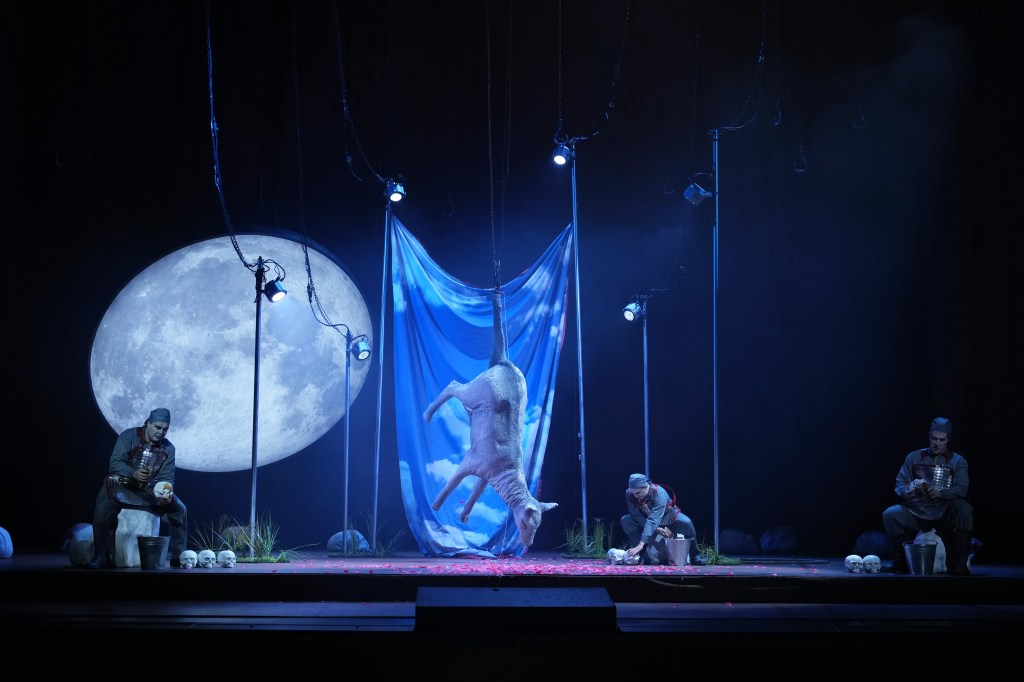
The staging by Jasmina Hadžiahmetović is pretty stripped back and noticeably dark, shifting the focus away from spectacle and onto the atmosphere and the characters. This isn’t a glittery fairy tale – it feels colder, more distant, like a world where things have been running the same way for far too long.
A large moon hangs over the stage the whole time, looming more than glowing – watching everything below. It gives everything a slightly eerie feel… like no one’s getting out of this show.
But on the other side of the moon, there’s light. Whether it’s meant to be the sun or some oversized gong is a bit unclear, but it casts a glow onto the back wall, quietly cutting through all the darkness. Maybe there is, after all, a brighter side?
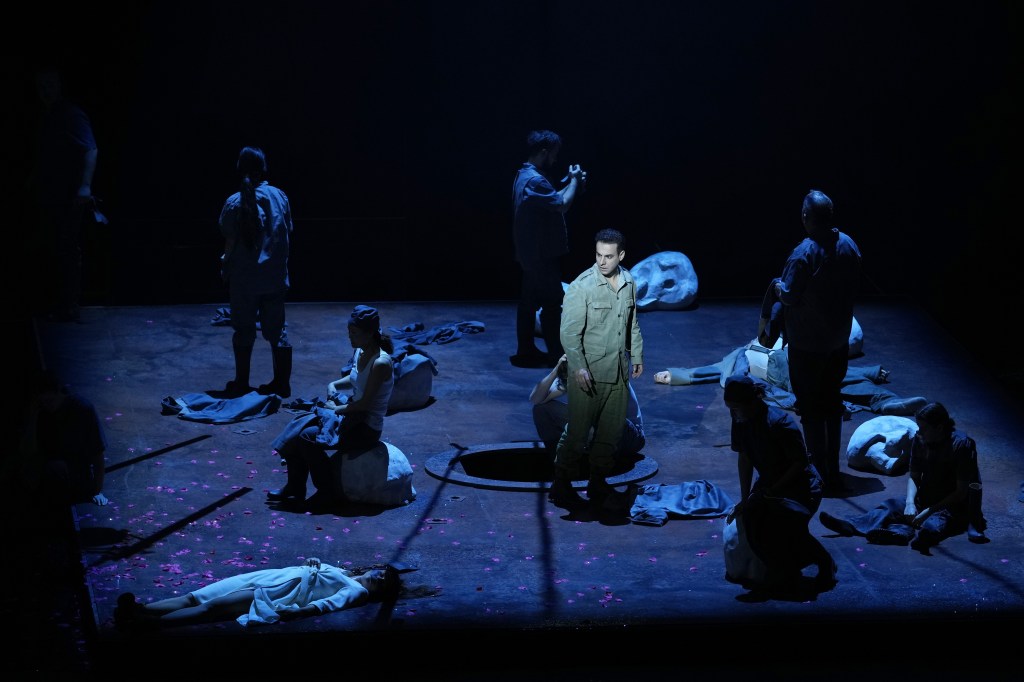
What stands out is how focused everything feels – the gestures, the interactions, the silences. Instead of grand spectacle, it becomes something tighter and more immediate, where the tension lives between the characters rather than in the scale of the scene.
It all fits the story, dark and tight. A princess (Turandot) setting riddles, day and night. Get them wrong, and you lose your head. No second chances – just simply dead.
Then one prince comes and gets them right. Shifts the balance, tilts the fight. The whole thing flips, the tables turn – and now it’s her who feels the burn.
But Caláf gives her a way out. If she can guess his name, she’s free – simple as that. So what’s the problem? Well… apart from the fact that she doesn’t know his name.
The bigger issue, though, is that Giacomo Puccini never got around to finishing the opera, so the ending has been a bit of an open project ever since. Others have stepped in to give it a try, including Italian composer Luciano Berio.
He was born the year after Giacomo Puccini died, in 1925 – and you can hear that.
To be honest, I almost forgot we were getting a different ending. But the moment the duet between Caláf and Turandot begins, there’s no doubt: this is not Puccini anymore. The sound shifts. The orchestration is different, the musical language changes, and the way the instruments are used suddenly stands out. Even the percussion section gets a bit more to do.
Not because Puccini couldn’t write – he very much could. Luciano Berio just writes… differently. And that, of course, makes the ending feel different too.
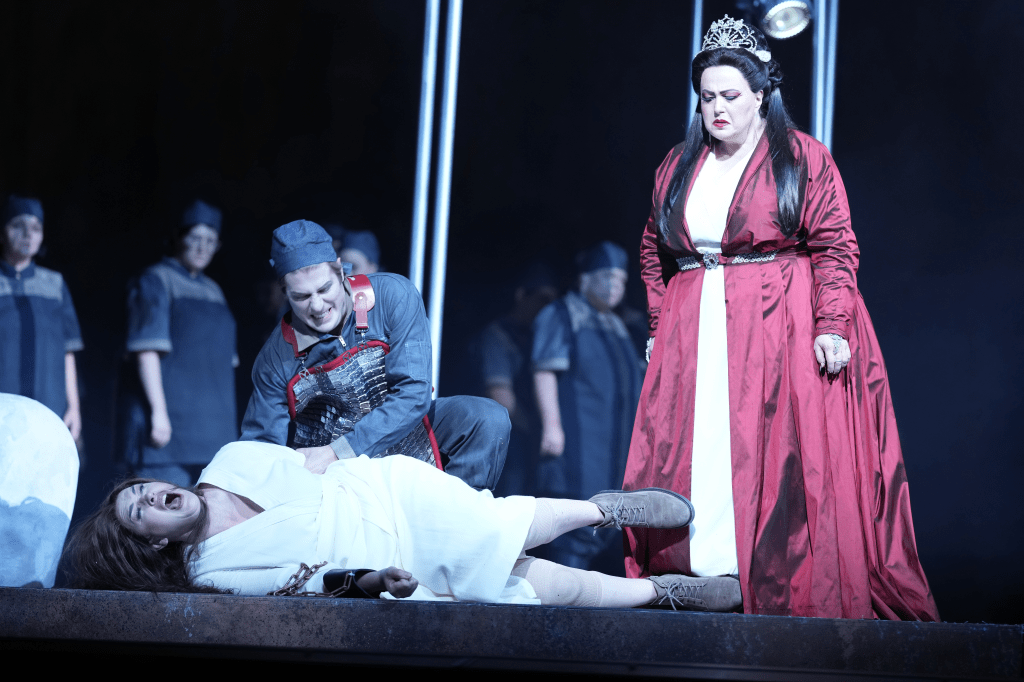
But before we even get there, blood starts pouring from the edge of the stage – Liú’s blood. Sweet, quiet Liú, who takes Turandot’s knife and cuts her own throat rather than give up Caláf’s name.
The French soprano Erica Eloff (Liú) is the vocal highlight of the evening. She sings with conviction and a beautifully controlled vibrato, shaping her phrases with care and clarity. There’s a striking dynamic range in her performance – moments where a single tone grows from something fragile and almost weightless into a sound that feels powerful enough to cut straight through you.
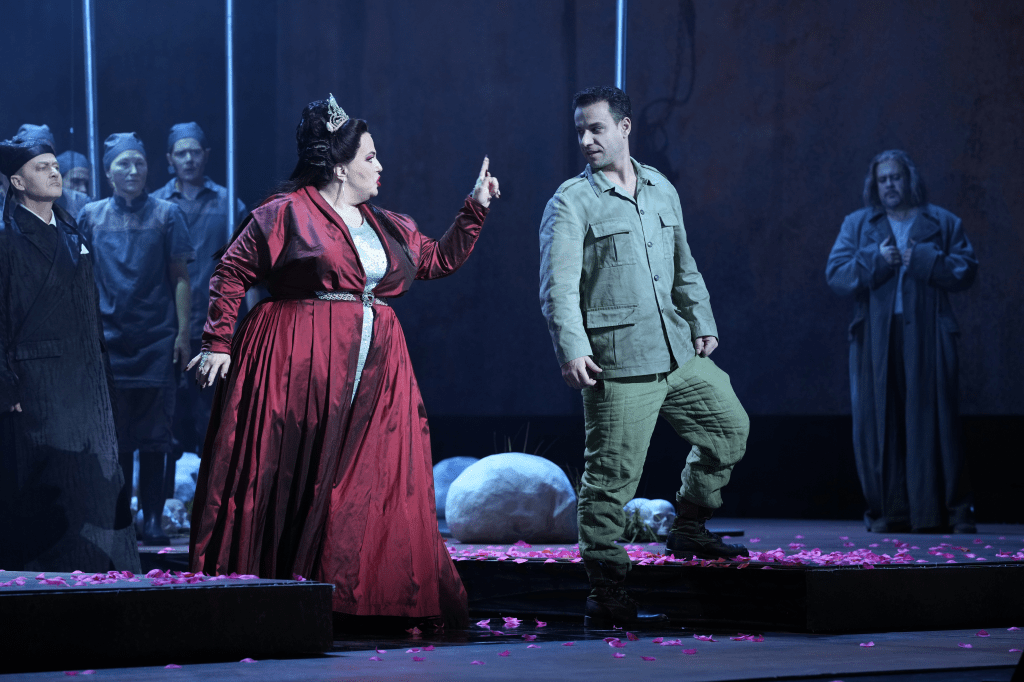
Turandot is sung by the dramatic soprano Elena Batoukova-Kerl. She brings plenty of drama – not just in her voice, but in her interpretation of the role. Then again, everything here is rather dramatic.
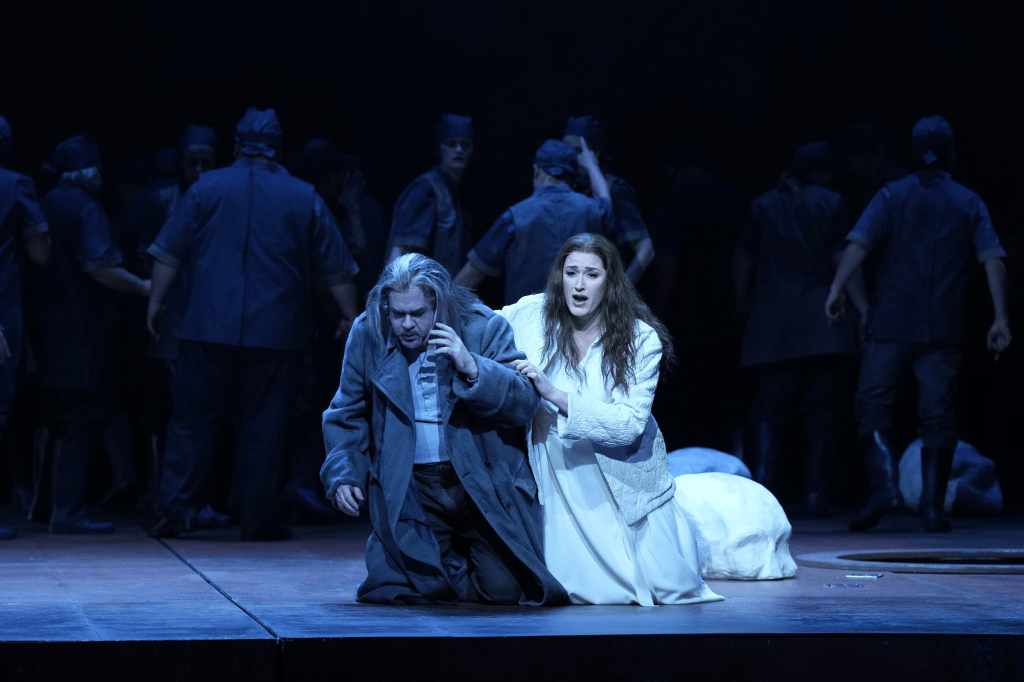
Unfortunately, she’s not the best match for Max Jota, who struggles a bit to keep up. He sings well, yes – but when they perform together, he tends to fade into the background. I also found myself missing a bit more acting and emotional engagement from his side. It’s all well and good to wave your arms, but when you’re close enough, a face can say a lot more.
Luciano Berio ends his version quietly, without the reprise of Nessun dorma in the chorus – as in Franco Alfano’s version. No grand finale – just Turandot walking away, perhaps a little stronger than Puccini had imagined?
Fun Fact!
Giacomo Puccini died of throat cancer before finishing Turandot – so the ending? Still fiercely fought over.
Cast:
- Conductоr: Enrico Calesso
- Directоr: Jasmina Hadžiahmetović
- Stаge Designer: Paul Zoller
- Сostume Designer: Mechthild Feuerstein
- Dramaturg: Christoph Blitt
- Сhoir: Elena Pierini
- Caláf: Max Jota
- Liú: Erica Eloff
- Timur: Dominik Nekel
- Turandot: Elena Batoukova-Kerl
- The Emperor Altoum: Christian Drescher —
- Ping: Alexander York
- Pang: Jonathan Hartzendorf
- Pong: Simon Yong
- The Prince of Persia: Gregorio Changhyun Yun
- Un Mandarino:
Chor des Landestheaters Linz, Extrachor des Landestheaters Linz, Kinderchor des Landestheaters Linz, Statisterie des Landestheaters Linz, Bruckner Orchester Linz
Parsifal, Semperoper 2026
Richard Wagner wrote Parsifal for his very own theatre in Bayreuth. Ideally, that’s where it would have lived happily ever after. It didn’t. Clearly. Because Parsifal isn’t just an ‘opera’, it’s a piece of architecture in sound. Written for that exact acoustic, those stubborn wooden seats, the wide, bowl-shaped hall, the hidden orchestra pit, the…

Der Rosenkavalier, The Royal Danish Opera 2026
Can you translate an opera into another language? A hundred years ago, when Der Rosenkavalier was fifteen years old, the answer was pretty much: of course you can. Translate, tweak, turn. Almost everything was sung in the local language. It wasn’t until the second half of the 20th century that people started getting a bit…
Dialogues des Carmélites, The Royal Danish Opera 2026
If you’re waiting for something to break, Act III is your moment. In Barrie Kosky’s production of Poulenc’s only long opera, it’s not the people – it’s the wall. We’re stuck in the same room. Boxed in by the same walls. First, inside the de la Force family. Then we convert to the Carmelites. Grey…
 Blogfløjten