

Bayerische Staatsoper is almost always packed, but tonight, it feels like they’ve somehow squeezed in a few extra bodies. Maybe it’s the premiere-night jitters taking up all the space? The seats are the same as always, but the atmosphere is denser, the air thick with anticipation.
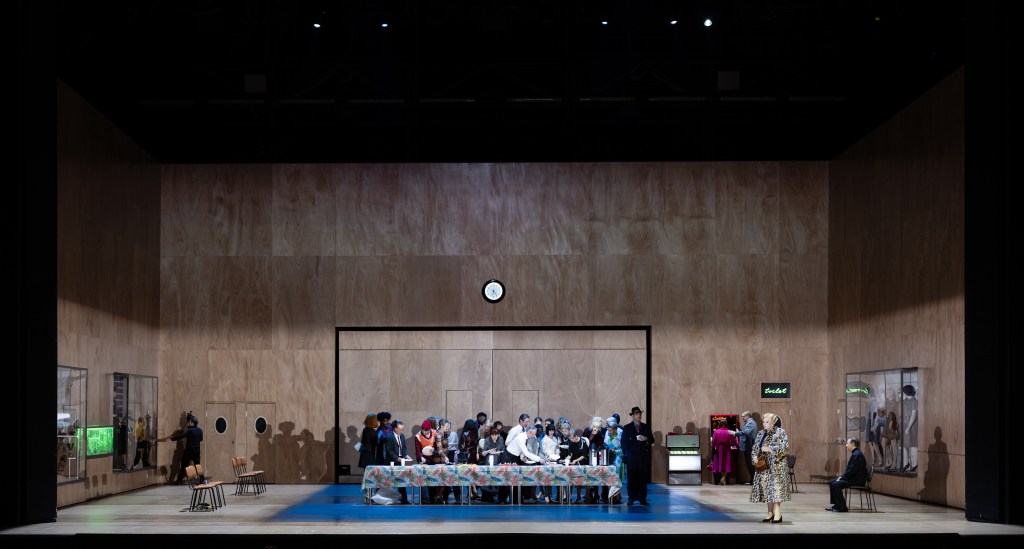
In fact, the performance is already underway as the audience shuffles to their seats. On stage, three pale wooden walls enclose a group of people—some dancing, others gathered around small tables. From my seat in the stalls, I can’t see into the orchestra pit, but conductor Marc Albrecht must have crept in on cat paws, as no applause greets his arrival. The lights simply dim, and then—like ink dissolving in water—the deep strings seep into the hall. A single line, a few bars, a simple stepwise motion in the cello: first up, then down to the minor third—but no, it hesitates, changes its mind, and inches up half a step to the major. A lingering indecision in the music, right from the start.
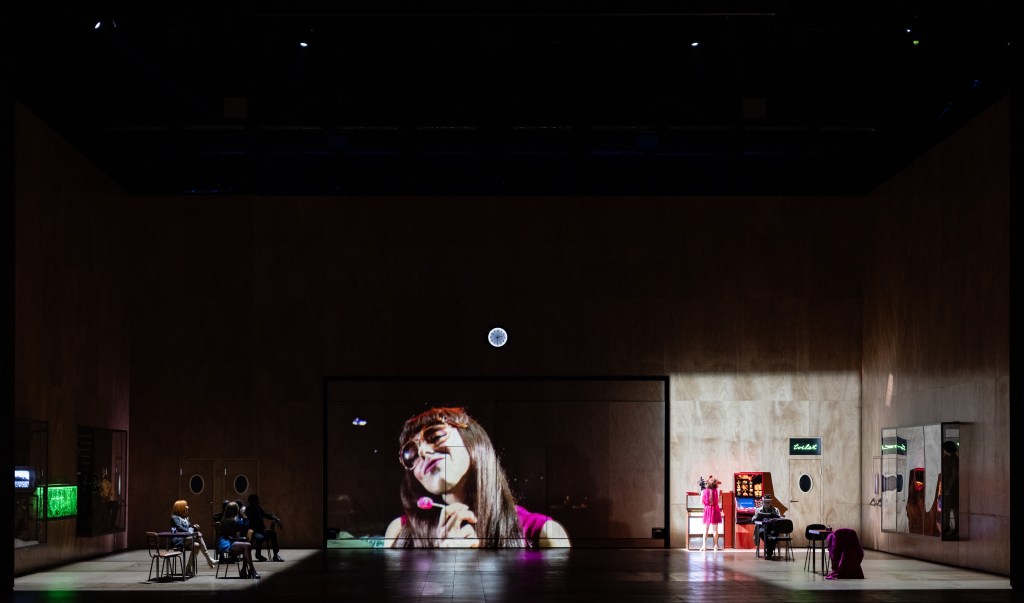
Against the back wall stands a mysterious box. Kata, the evening’s main character, approaches it, a red lollipop in hand, marking the rhythm of the music with sweeping gestures. She faces away from us, but a camera captures her from the front, projecting her enlarged face onto the back wall. An effect that recurs throughout the performance—a relentless 105-minute ride of intensity.
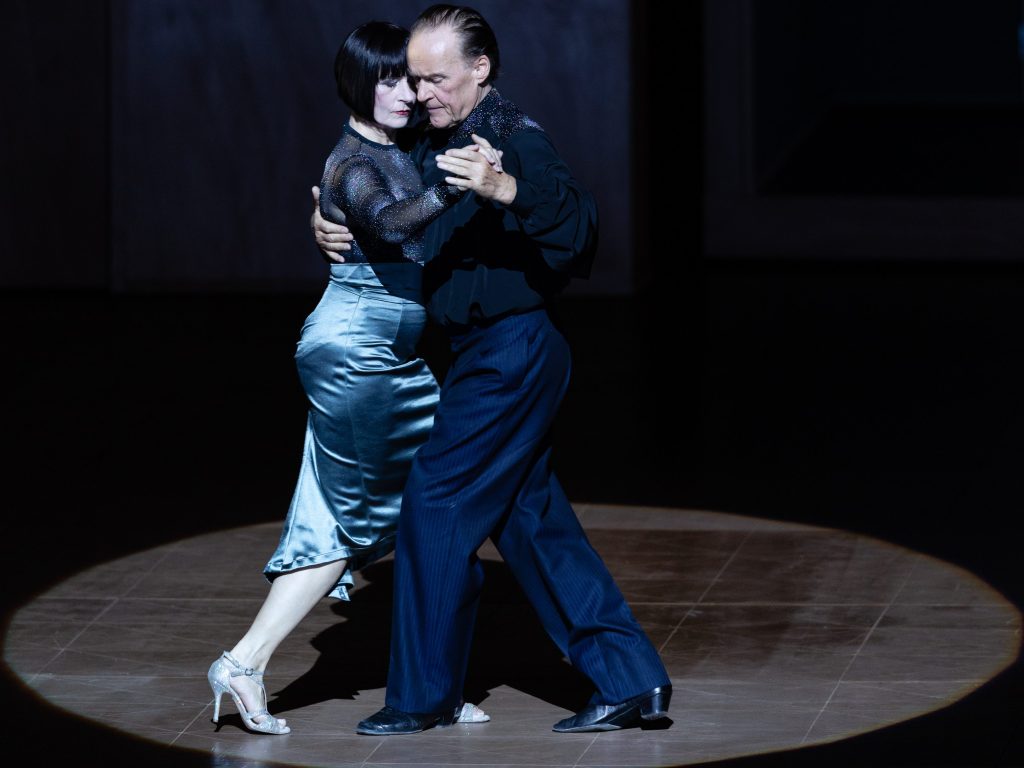
Couples are dancing the tango(?) around her, moving as one, like some synchronized organism. We see this same scene unfold several times throughout the evening, but Kata remains on the outside, living in her own world, not quite fitting in with the rhythm of everything happening around her.
What is going on?
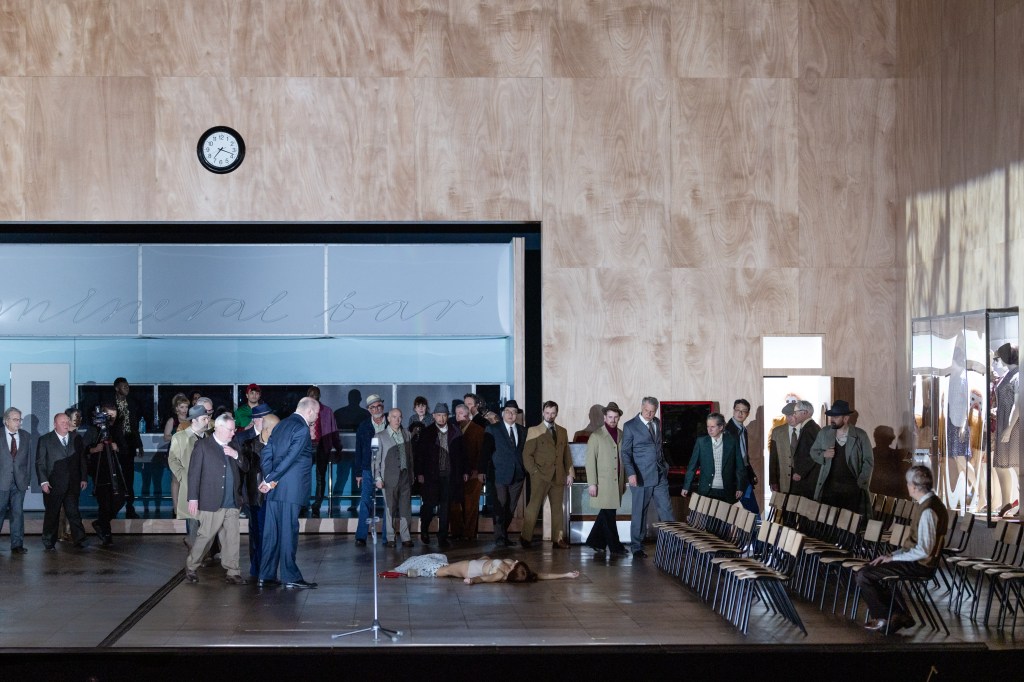
Kata is trapped in a miserable marriage, and as if that weren’t enough, she’s also stuck with a mother-in-law who’s not exactly winning any “Nicest Person of the Year” awards. While Kata’s husband, Tichon, is out of town, she’s lured into a moonlit romance with Boris, who hasn’t hit the jackpot in the family lottery either. But secrets have the lifespan of a fruit fly, and when Tichon returns, the scandal spirals into a spectacular spectacle. Crushed by the weight of it all, Kata tumbles into the river, her body rolling down into the cool embrace of the water—while her mother-in-law simply shrugs and says, “Thanks for the effort.” What a woman…
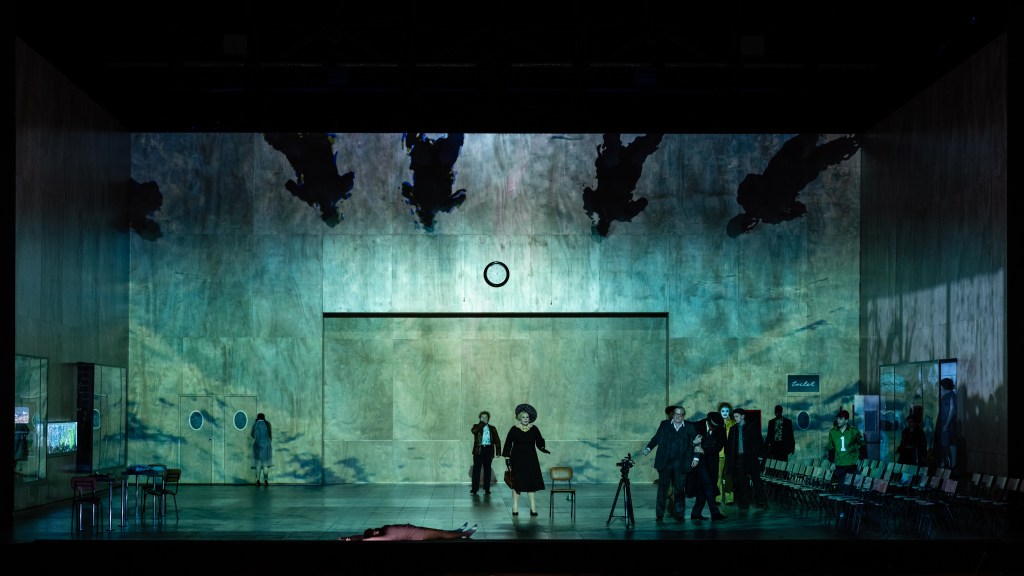
In the first act, the mother-in-law (Kabanicha) watches TV and sees a woman who looks like Kata die in a car accident. The scene unfolds in stark black and white, with the only splash of color being the woman’s red dress—a choice that brings to mind the movie Schindler’s List.
On the left side of the stage, an aquarium sits quietly, its water casting eerie reflections on the opposite wall—like a silent, lurking reminder of the evening’s darker currents. And just to pour a bit more water into the glass of river references, a bar called “Mineral” occasionally makes an appearance too.
Shortly after World War I, Czech composer Leoš Janáček wrote the score, and in 1921, the opera had its premiere at the National Theatre in Brno. The music is tightly intertwined with the action—either serving as a dialogue partner for the singers or reflecting their emotions.
Janáček makes use of major-minor tonality, but throws in a few dissonances here and there, weaving it all together with recurring themes.
Despite an era where grand orchestras were all the rage, Janáček’s orchestration remains spare. Violeta Urmana has a dramatic voice, but there are moments when she has to fight to be heard over the orchestra. She’s never completely drowned out, but she hovers on the edge, balancing on the line between power and fragility.
Her son, Tichon, is portrayed by John Daszak, whose tenor tone fits in well. Recently, I saw these two in Tcherniakov’s staging of Salome in Hamburg, where Urmana played Herodias—yet another crazed mother. Kata’s world, in some ways, feels similar to Salome’s—we’re drawn into her personal universe, shaped by her desires, struggles, and perceptions of the world around her. Both are dominated by complex, intense emotional landscapes, but while Salome is obsessed with a single, dangerous pursuit, Kata’s emotional turmoil is more about her inability to fit into the world she’s trapped in. However, Herod and Tichon? You can’t compare them. They’re like night and day, or maybe more like a hotdog and a salad—just worlds apart!
Boris steps forward in a screaming yellow suit, his hair sticking out in all directions as if he’s just been zapped by an electric shock. The pants flare out at the bottom, and I start wondering if the production is taking place in the ’80s? After a brief absence, he returns wearing a white mask, and from that point on, his face remains hidden. His persona shifts as he dons the mask—he becomes colder, more distant, almost like he’s wearing the mask of societal expectations. What was once an engaging, lively figure turns into an observer, distanced from his own emotions and the world around him. James Ley embodies this transformation, turning Boris from a seemingly vibrant character to someone who retreats behind the mask, reflecting how people sometimes hide their true selves in the face of societal pressures.
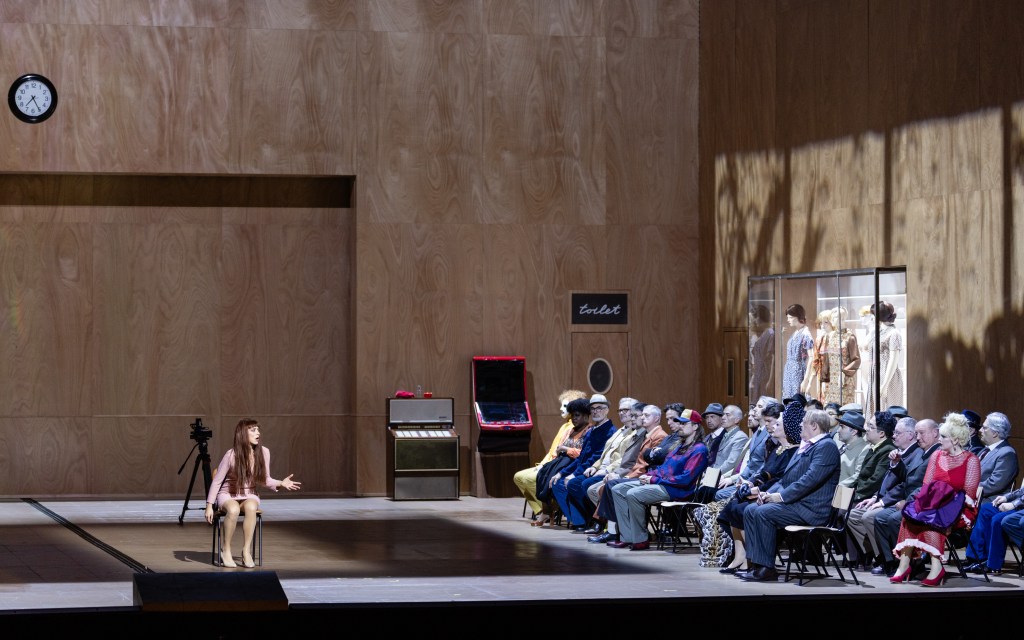
Kata holds up a video diary to the camera, as if documenting her inner turmoil for the world to see. Then, she sits on Boris’ lap—yet, surprise, we still don’t get a glimpse of his face. Meanwhile, the entire back wall turns into a screen showing a green field with yellow flowers. A symbol of hope, you might say? Or maybe it’s just a wishful daydream, something Kata’s desperately grasping for—a peaceful escape from the chaos.
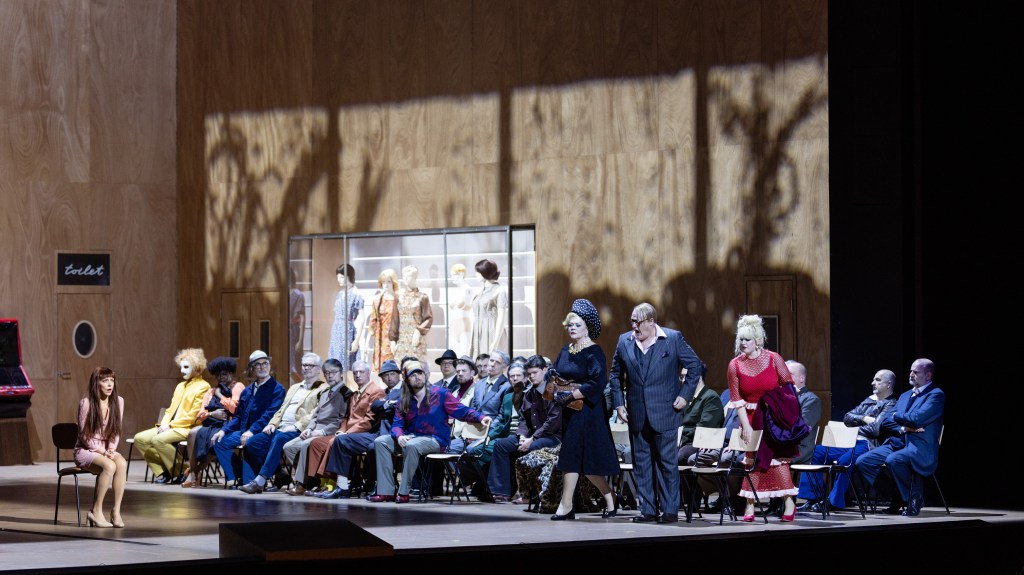
But back to tonight’s Káťa—Corinne Winters. Káťa is a mysterious character, hard to pin down, but Winters creates an intense and moving interpretation of her inner struggle. Her voice is crystal-clear and piercing, almost as pure as a scream of desperation, yet soft enough to express Káťa’s fragility. She manages to make Káťa’s emotional tensions shimmer in the hall, so we feel her longing, her hope—and ultimately, her inevitable downfall.
The evening’s premiere certainly has its high points, but there are moments where it feels a bit uncertain. The music, acting, and staging all have their strengths, yet something feels slightly out of sync. For a production aiming to capture both emotion and spectacle, it’s hard to say it fully hits the mark.
Fun Fact:
Janáček’s opera is unique because the vocal lines are written to closely reflect the rhythms and inflections of the Czech language. He didn’t just compose music; he captured the way people speak, turning their speech patterns into song, which gives the opera an incredibly natural and realistic feel.
Trailer:
Cast:
- Conductоr: Marc Albrecht
- Directоr: Krzysztof Warlikowski
- Stаge and Сostume Designer: Małgorzata Szczęśniak
- Video Designer: Kamil Polak
- Light Designer: Felice Ross
- Dramaturg: Christian Longchamp and Lukas Leipfinger
- Choreography: Claude Bardouil
- Сhoir: Franz Obermair
- Savjol Prokofjevič Dikoj: Milan Siljanov
- Boris Grigorjevič: Pavel Černoch
- Marfa Ignatěvna Kabanová (Kabanicha): Violeta Urmana
- Tichon Ivanyč Kabanov: John Daszak
- Katěrina (Káťa): Corinne Winters
- Váňa Kudrjáš: James Ley
- Varvara: Emily Sierra
- Kuligin: Thomas Mole
- Glaša: Ekaterine Buachidze
- Fekluša: Elene Gvritishvili
- Ein Mann: Samuel Stopford
- Eine Frau (aus dem Volk): Natalie Lewis
Bayerisches Staatsorchester
Bayerischer Staatsopernchor

 Blogfløjten