
Three sharp strikes from the orchestra – and we’re catapulted straight into Richard Strauss’ whirlwind of a fairytale! From the very first moment, the music crackles with energy, unleashing thunderous brass, dramatic strings, and an atmosphere buzzing with something grand and mysterious. Die Frau ohne Schatten isn’t the kind of opera that eases you in gently. It strikes like lightning and pulls us headfirst into a story brimming with drama and moral dilemmas showing Strauss from one of his best sides.
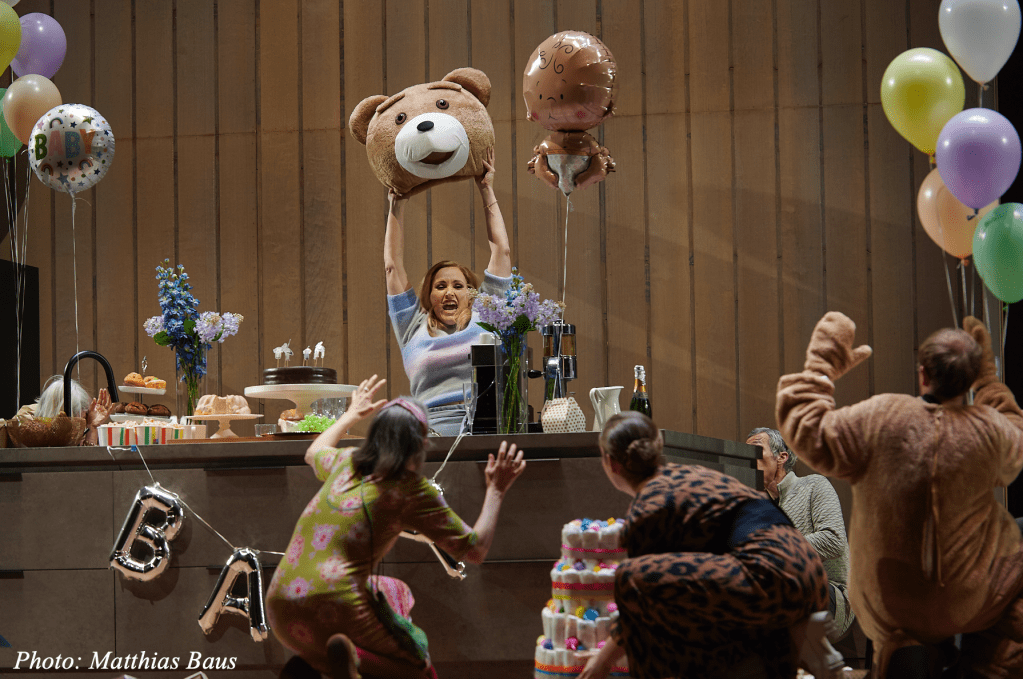
The curtain rises to reveal a living room, as if we’ve just stepped into someone’s cozy home. Enter die Geisterbote—a messenger who, this time, isn’t just delivering an ominous warning (in a killer voice) but also packages from Amazon. And Falke? Forget the mighty, mysterious bird soaring through the shadows—here, it’s a tiny, plush teddy bear.
The woman casts no shadow—suggesting that motherhood is not in her immediate future. A pregnancy test is taken, with fingers crossed that luck is on their side. The battle to expand the family isn’t exactly doing wonders for the relationship. Things aren’t going as smoothly as one might hope for.

Hugo von Hofmannsthal wrote his story amidst the horrors of World War I. Tobias Kratzer’s production pulls it out of the fairytale world and straight into our own. His phenomenal staging flips each situation on its head, making it feel like any other family drama: the longing for children, relationships teetering on the edge, infidelity, temptation, and a conclusion many might fear (and no, it’s not death, like in so many other operas). Kratzer makes it all incredibly relevant and current—no supernatural forces at play, just a sharp look at life’s tough choices.
This is the final opera in Kratzer’s trilogy at Deutsche Oper—the others being Intermezzo and Arabella.
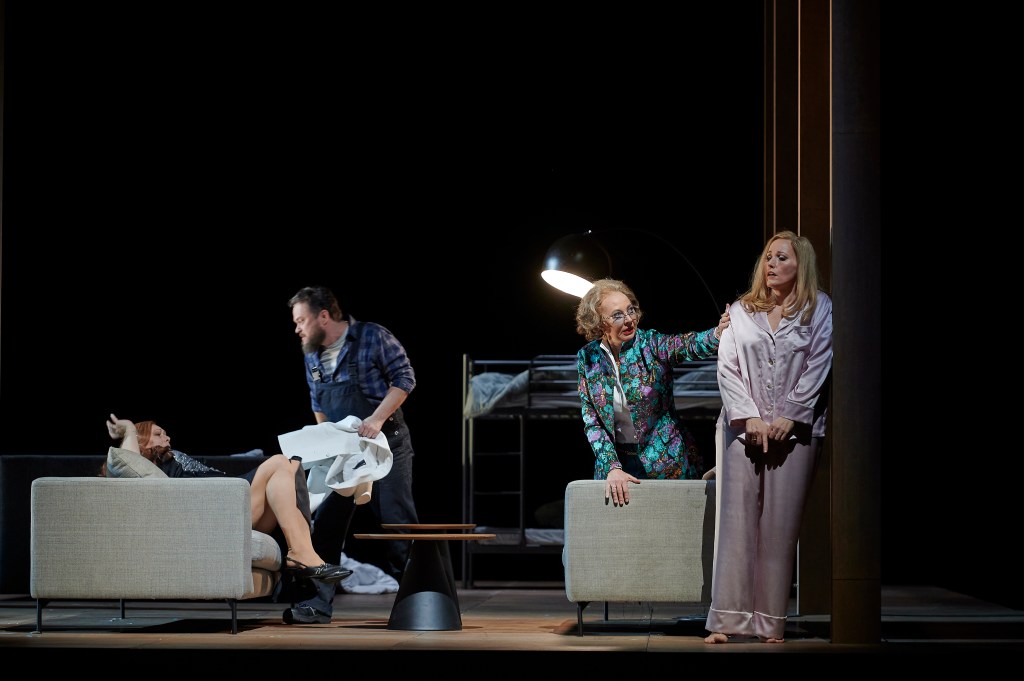
All right, Bach (hehe) to the story. The Empress and her nurse head to the humble home of the poor dyer Barak and his wife, hoping to convince her to sell her shadow in exchange for a lifetime supply of riches. The nurse, almost constantly sporting a new vibrant outfit, is sneaky and has a trick or two up her sleeve—she even tries to tempt Barak’s wife with a (perhaps too) young dude.
The Stagning
The stage is a rotating wooden platform, like a giant spinning (rectangular) disc, with a half wall in the middle. The platform turns throughout the evening, revealing new spaces—each scene offering a fresh peek into the characters’ worlds. We see everything from elegant clothes to work uniforms, and even bright pink pajamas, painting a picture of their contrasting lives. In the first scene, we’re greeted by a sophisticated living room, complete with a big black grand piano that gleams like a showpiece. It’s a world away from Barak and his wife’s humble surroundings.
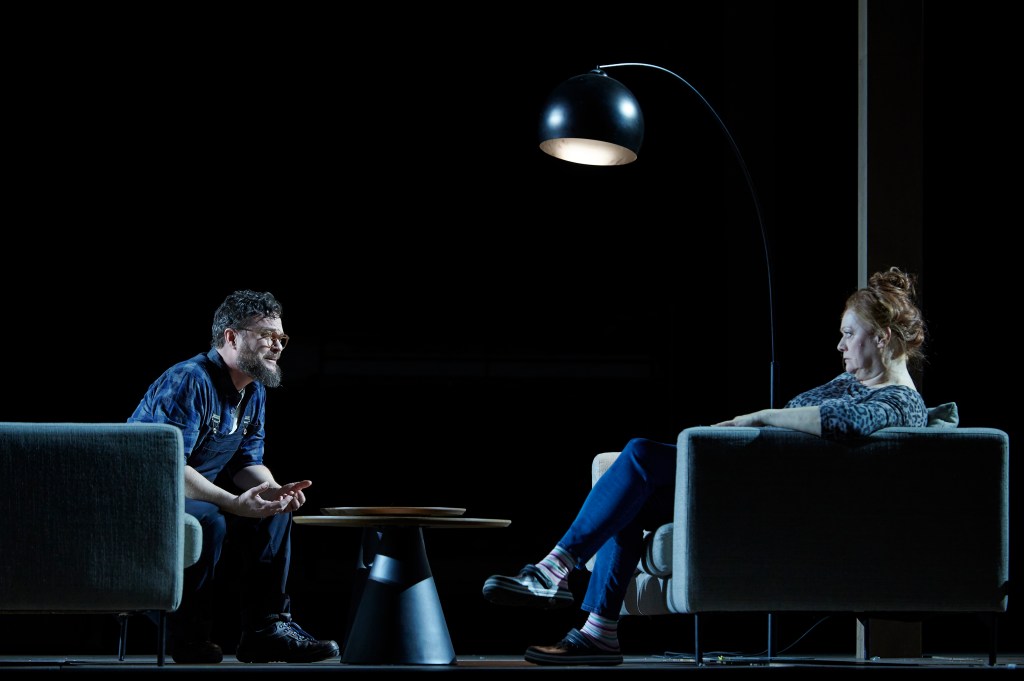
The dryer couple’s room is (as so often) filled with washing machines, while on the other side of the wall, there’s a dining table, a kitchen, a grey sofa, and a tall bunk bed that looks like it was borrowed from one of Berlin’s more budget-friendly hostels—speaking from experience here… Yet, when the visitors arrive, he’s asked to sleep on the sofa—just the beginning of a relationship that leads to a (brilliantly staged) couples therapy session at the start of Act 3 and unfortunately (spoiler alert!) ends with a divorce by the end. His desire to have a child isn’t quite reciprocated by his wife—even though she watches videos from fertility clinics and cell samples…
The Empress also wants a child, but the frustrations of the process push her and the Emperor further apart. The Emperor spends his nights out at parties, surrounding himself with other women. The Empress becomes desperate, and together with her nurse, they visit a children’s clinic, hoping to snatch a child. But the police arrive, and the nurse is taken away.

Even though Strauss and Hofmannsthal thought they were wrapping things up with a big, heartwarming reconciliation, Kratzer has other plans. Sure, the couple (unhappily) divorces, but it doesn’t exactly end in tears. Fast forward a bit, and we find ourselves in a daycare, where Barak happily picks up his little daughter and plops a green frog hat on her head—a perfect little wink to the opera’s cheeky nickname, Frosch (frog). And, just to add a twist, we also spot a same-sex couple picking up their son—because, even if biology isn’t playing nice, there are still plenty of other ways to make a family.

What Do We Hear?
The music is led by Chief Conductor Sir Donald Runnicles, who’s been at the helm since 2009. Strauss’ Die Frau ohne Schatten is one of his more complex scores, and while the music offers a range of colors and nuances, I found myself wishing that Runnicles had dived a little deeper into them. There are certainly some great moments, but at times, it felt like a somewhat flat interpretation. Take, for example, the three initial “hits” at the start—the first few moments of the opera—they’re played exactly the same way. Okay sure, the score says fortissimo, but this could have been the perfect moment to throw in a little dynamic spice.
However, when we reach Act 3, there’s a scene that really hits home. After around three hours of the looming threat of the motif that promises to turn the Emperor to stone, the threat finally becomes a reality. Here, the orchestra gives it everything they’ve got, blasting fff with such intensity that the brass resonates, making the motif reverberate through the walls like thunder.
Then, there’s that wonderfully drawn-out silence in the moment when the Empress declares she will not take the shadow of Barak’s wife. For what feels like eternity, there’s no sound—just an overwhelming, pregnant pause. The score marks it with “Lange Pause,” and Runnicles fully embraces this, stretching the moment to the absolute limit. It creates such a stunning effect. Then, like a slow, creeping wave, the violins begin to emerge, cautiously entering with a soft high f#, gradually building in intensity, followed by three solo violins and the eerie chime of the glass harmonica.
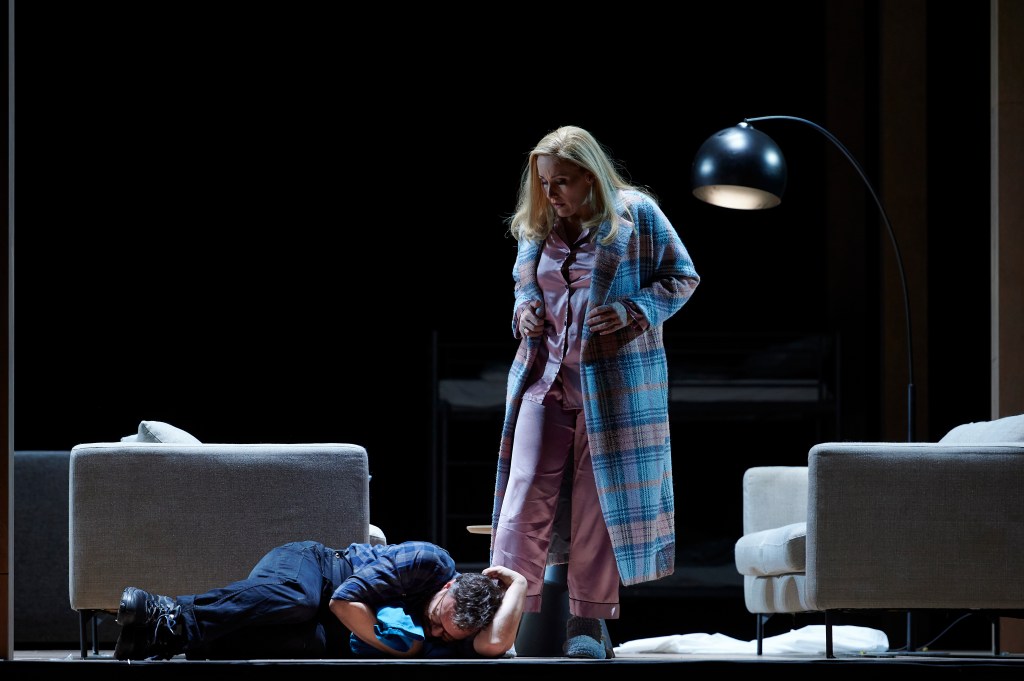
Johan Shanahan (who also sings Klingsor (from Parsifal) in Bayreuth) brought a solid, colorful tone to the role as Barak. His voice worked particularly well during the ‘parterapi-session’ (“Mir anvertraut”), where his emotional range was clear. Lise Lindström, stepping in at the last minute for Catherine Foster, managed to portray Barak’s wife with vocal skill, showing her different sides. Marina Prudenskaya, despite not being in top form, gave a convincing performance as the Nurse. David Butt Philip, playing the Emperor, effectively conveyed the character’s coldness, and his voice made it even better. Daniele Köhler as the Empress was also good, especially in Act 3, where both her acting and singing fit the role well.
I’m always intrigued to see what Tobias Kratzer has up his sleeve, and this evening just kept getting better and better. Everything built toward an ending that, while far from the typical ‘happy’ conclusion, left an unexpected glimmer of hope.
Fun (and pretty random) Fact:
Forget fancy dinners—Richard Strauss was all about the simple joys, like beef with “G’schlader” (yes, the fatty bits), porcini mushrooms with Knödel, and Anni’s vanilla cookies. And let’s not forget his sweet tooth for punch cake and comfort food!
Trailer:
Cast:
- Conductоr: Sir Donal Runnicles
- Directоr: Tobias Kratzer
- Stаge and Сostume Designer: Rainer Sellmaier
- Video Designer: Jonas Dahl, Manuel Braun and Janic Bebi
- Light Designer: Olaf Winter
- Dramaturg: Jörg Königsdorf
- Сhoir: Jeremy Bines
- Der Kaiser: David Butt Philip
- Die Kaiserin: Daniela Köhler
- Die Amme: Marina Prudenskaya
- Barak, der Färber: Jordan Shanahan
- Sein Weib: Lise Lindström
- Der Geisterbote: Patrick Guetti
- Ein Hüter der Schwelle des Tempels: Hye-Young Moon
- erscheinung eines Jünglings: Chance Jonas-O´Toole
- Die Stimme des Falken: Nina solodownikova
- Eine Stimme von oben: Stephanie Wake-Edwatds
- Der Einäugige: Philipp Jekal
- Der Einarmige: Padraich Rowan
- Der Bucklige: thomas Cilluffo
- 1. Dienerin: Hye-Young Moon
- 2. Dienerin: Alexandre oomens
- 3. Dienerin: Arianna Manganello
- Kinderstimmen/Stimmen der Ungeborenen: Hye-Young Moon, Lilit Davtyan, Arianna Manganello, Martina Baroni, Stephanie Wake-Edwards and Alexandra Oomens
- Stimmen der Wächter der Stadt: Stephen Marsh, Kyle Miller and Geon Kim
- Keikobad: Harald Heinz
Kinderchor der Deutschen Oper Berlin
Chor der Deutschen Oper Berlin
Orchester der Deutschen Oper Berlin

 Blogfløjten