

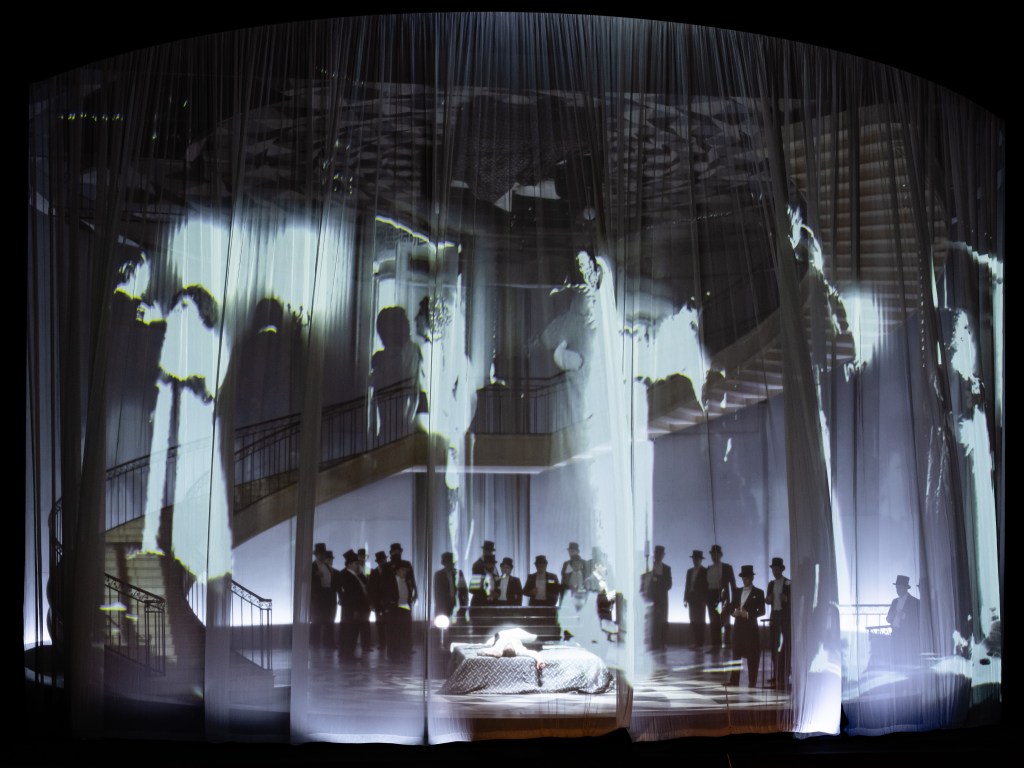
The grand red curtain unfurls with deliberate slowness, just as the first notes of music begin to stir the air. Behind it, a vast, translucent white veil takes shape, shimmering faintly. On this ethereal backdrop, figures in motion are projected, dancing in a dreamlike haze. And there, framed by the glowing veil, sits Riccardo on a majestic queen-size bed.
The music springs to life with three sharp pizzicato plucks from the cellos, each one ringing out like the ticking of a relentless clock, joined by a small upward going motif from the oboe and flute. This playful dance repeats three times before we’re swept into a more expansive melody, leading us into a brief, lively four-part fugue – a musical guest who will return to make several more appearances over the course of the evening.
Running a country isn’t exactly a popularity contest – a fact we’re all too familiar with these days. But hey, it’s always been that way. Let’s hop in a time machine and spin back 233 years to 1792. Take a quick detour to the capital of Köttbullar, and there’s King Gustav III of Sweden, living his best royal life. Or at least he was until March 16th, when a masked ball turned into a rather sharp affair. The king left the party with a not so nice souvenir lodged in his lower back. Thirteen days later, he took his final breath – a stretch of time during which he actually received several apologies from his political opponents.
This very story inspired Verdi to compose the opera Un ballo in maschera – also known as The Masked Ball.
The stage
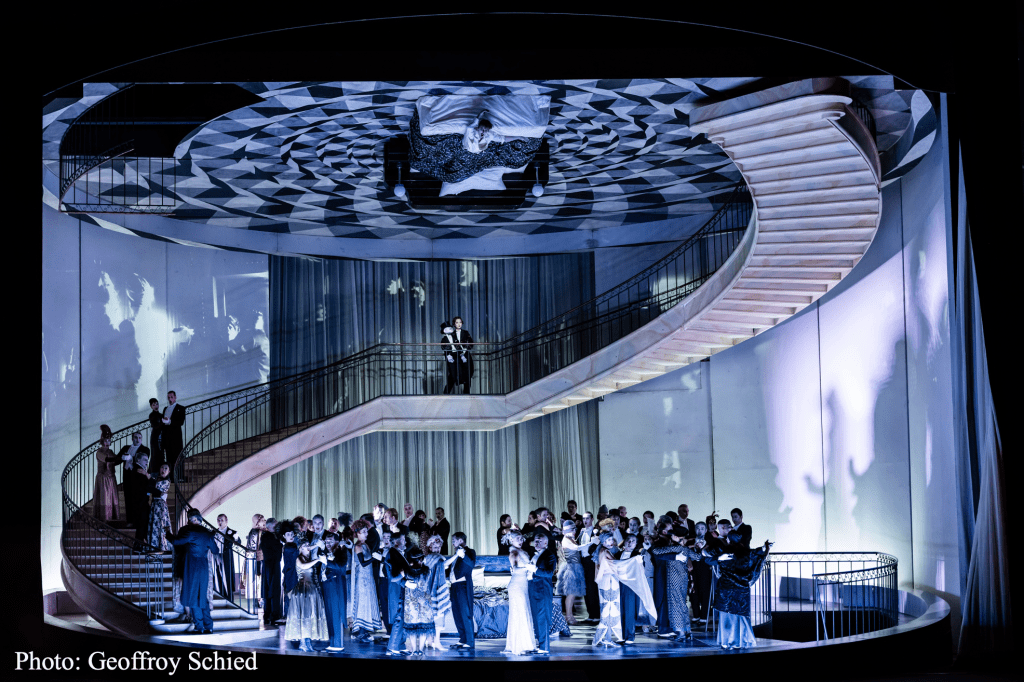
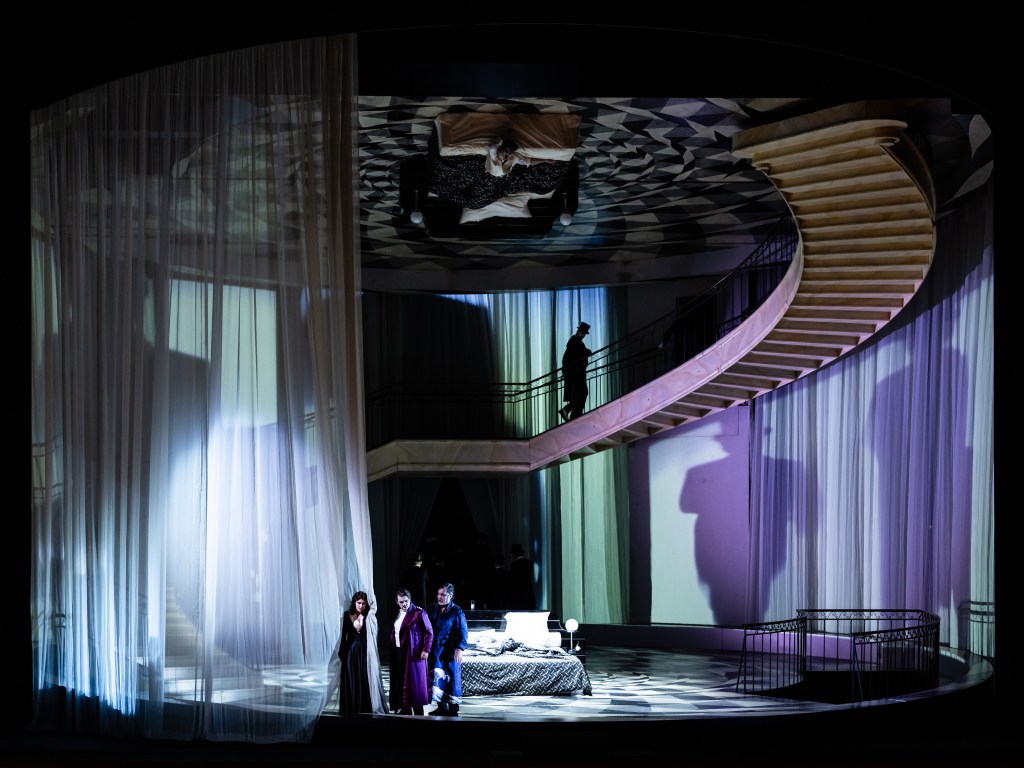
The stage design, created by Heike Scheele, features a grand white staircase spiraling endlessly upward. Above, the ceiling mirrors the floor, so there’s also a bed up there – with someone lying in it. Visually captivating, yes, but the same set remains throughout the evening, which at times feels somewhat disconnected from the unfolding drama. I’m not sure I completely grasp Johannes Erath‘s creative vision here. By Acts 2 and 3, the occupant of the bed is no longer simply sleeping, but rather, a much more lifeless presence. It’s almost as if the bed becomes a glimpse into the future…

The real fortune-teller of the evening, though, is Ulrica, brought to life by Yulia Matochkina. It’s a deeply dramatic role, originally written for a contralto, and she fully steps into it. Before the curtain went up, we were informed that three of the four lead roles were facing issues, which meant stand-ins for both Renato and Riccardo and Matochkina herself wasn’t exactly feeling on top. But honestly, she didn’t need to be – most of her part stayed anchored down in the lower registers either way…
With just 24 hours to acclimate to Munich, Giorgio Berrugi made his debut at the Bayerische Staatsoper – and he pulled it off quite well. At the beginning, the balance between the orchestra and the singers was a bit off, making it harder to catch all the subtleties in the vocal performances. But I think that’s more due to the Italian conductor Andrea Battistoni’s choices in the pit. Sure, it’s a dramatic opera from start to finish, but I kind of wish Battistoni had trusted Verdi’s music a bit more, so he didn’t feel the need to push the drama quite so much for most of the evening. At times, it felt a bit over the top, bordering on ugly – like when the harp seemed to be pulling at its strings just to keep up with Berrugi’s big arm movements.
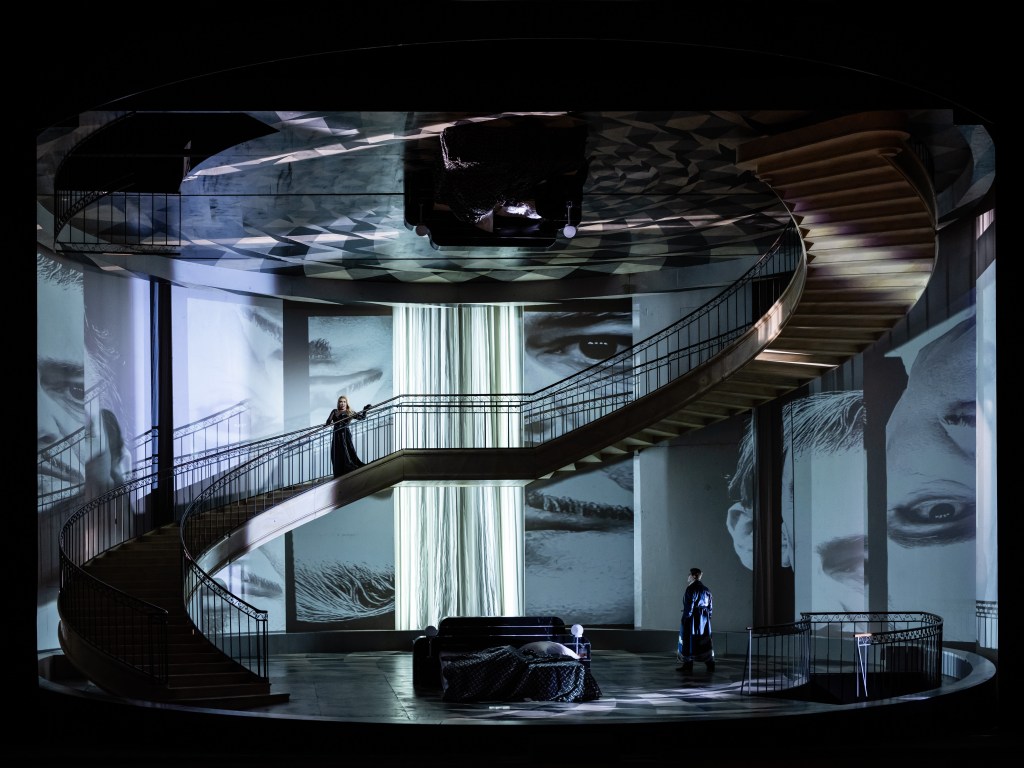
The stage design is just as dramatic, particularly when Ulrica makes her entrance. Three powerful chords from the whole orchestra sets the mood, followed by a more intense mix of sounds from the cello, playing a deep C, the clarinets – with the score calling for C clarinets to hit a low F# – and the viola and violin, who together play a small, striking figure. On stage, everything is focused on Ulrica.
She predicts Riccardo’s death, which is closer than one might think. And it’s actually his right-hand man, Renato, who ends up being the one to kill him. This character is sung by the French baritone Ludovic Tézier, who, at the start of the opera, introduced himself with his very pure voice. Later, we hear a different side of him, a voice that’s had a little extra flavor added to it. There’s a bit more grit, if you will. In the final act, he switches between these two vocal tones, almost making it sound like two different people.
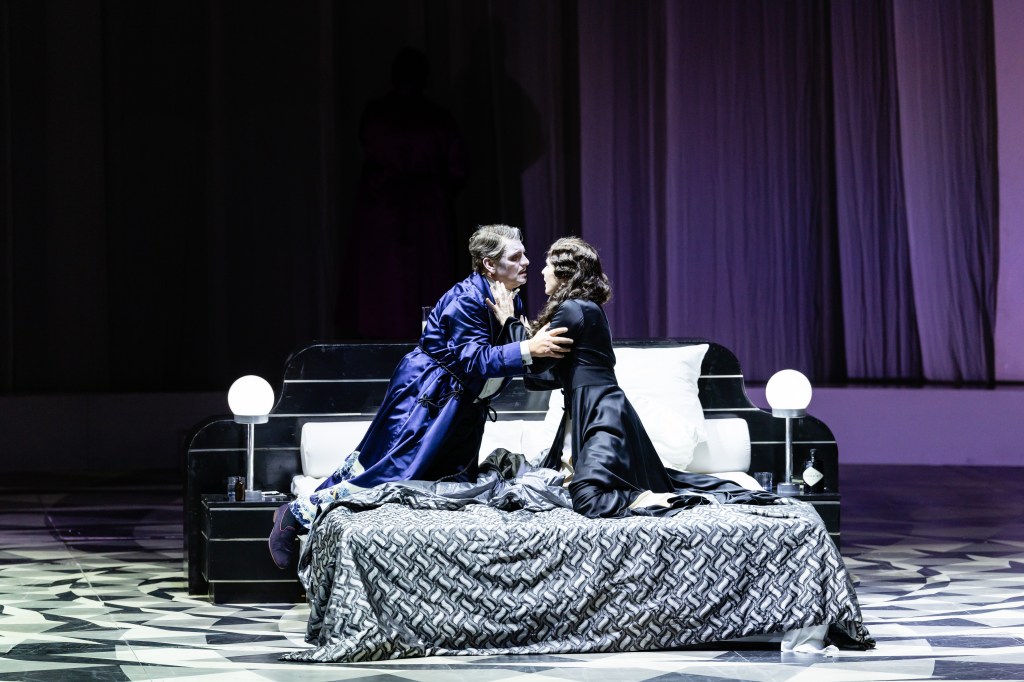
It will never work out
Like most operas, this one is about impossible love. Amelia is married to Renato, but seems to have a bit too soft a spot for Riccardo, who’s also showing some interest in her. Nicole Car made her role debut tonight. At the 2016 premiere, Anja Harteros took on the role, so Car had some pretty big shoes to fill. Thankfully, she did an amazing job! Especially after the intermission, when she had more to sing, Car really let her beautiful voice shine, alongside some convincing acting.
Riccardo’s page, Oscar, is probably the evening’s lighter moment (along with the blind judge who stumbles in and shuffles around the stage a bit lost). Oscar is quite the show(wo)man. Dressed in a black glittery suit, hat, white gloves, and sometimes even with his own spotlight, it almost feels like a magic show is about to kick off. It works, and Seonwoo Lee sings it well.
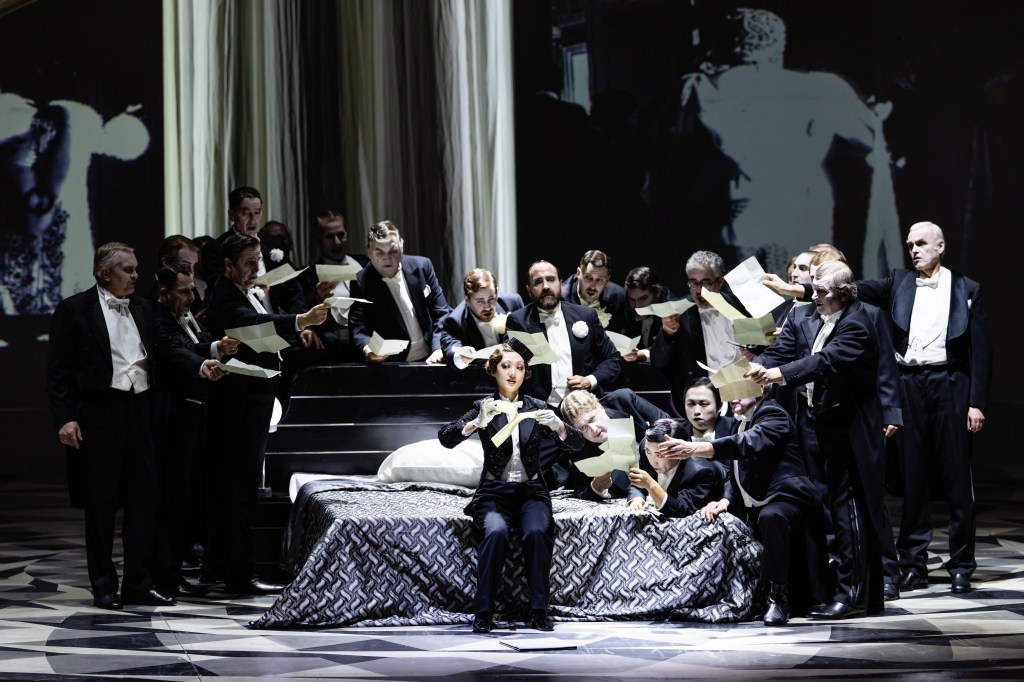
In the final scene, we’re at the masked ball. Well, that’s what they call it anyway. But there aren’t any masks to be found. Just a bunch of quirky hats on everyone’s heads. Maybe calling it a Hat Ball would’ve been a more fitting title?
And then came the moment we’d all been waiting for: the shot at Riccardo. I guess it’s a bit easier to spot him without a mask hiding his face. Even though we all knew it was coming, there were still a few of us in the audience – myself included – who jumped out of our seats when that shot echoed through the air. And just like that, the evening ended with a bang—literally.
Fun Fact!
A Swedish king was assassinated at a masked ball in 1792 – a juicy story Verdi couldn’t resist! But when the censors stepped in, he kept the royal drama, just moved it to 17th-century Boston instead.
Trailer:
Cast:
- Conductоr: Andrea Battistoni
- Directоr: Johannes Erath
- Stаge Designer: Heike Scheele
- Сostume Designer: Gesine Völlm
- Video Designer: Lea Heutelbeck
- Light Designer: Joachim Klein
- Dramaturg: Malte Krasting
- Сhoir: Christoph Heil
- Riccardo: Giorgio Berrugi
- Renato: Ludovic Tézier
- Amelia : Nicole Car
- Ulrica: Yulia Matochkina
- Oscar: Seonwoo Lee
- Silvano: Andrew Hamilton
- Samuel : Bálint Szabó
- Tom: Roman Chabaranok
- Oberster Richter: Tansel Akzeybek
- Diener Amelias: Dafydd Jones
- 1. Violine + BM: So-Young Kim
- 2. Violine + BM: Janis Olsson
- Viola + BM: David Ott
- Violoncello + BM: Dietrich von Kaltenborn
- Kontrabass + BM: Wieland Bachman
Bayerisches Staatsorchester
Bayerischer Staatsopernchor


 Blogfløjten